
Do Electric Baby Nail Files Work? A Practical Safety Guide for Parents

Trimming a baby’s tiny nails can feel surprisingly stressful. Their nails grow fast, their fingers are small, and babies rarely keep their hands still when you need them to. That is why many parents wonder: do electric baby nail files work, and are they actually easier than clippers?
In most cases, they do. Electric baby nail files use a soft rotating filing pad to gradually shorten and smooth the nail instead of cutting it in one motion. This can give parents more control, especially when caring for newborn nails.
However, an electric file is not automatically safer just because it is designed for babies. The pad, speed, pressure, technique, and condition of the baby’s skin all matter. This guide explains how these tools work, their benefits and limitations, how to use one safely, and when another nail-care method may be better.
Quick Answer
Yes, electric baby nail files do work for shortening and smoothing soft infant fingernails and toenails. They remove tiny amounts of nail with a rotating abrasive pad rather than cutting the nail. They can be easier for nervous parents, but correct pad selection, low speed, gentle pressure, and careful supervision are still essential.
How Do Electric Baby Nail Files Work?
An electric baby nail file is essentially a very gentle nail grinder. A small motor spins or moves a soft abrasive attachment against the nail.
Instead of removing a large piece of nail at once, the tool gradually wears away the edge.
Most baby models include several filing pads. The softer pads are normally intended for newborns and younger babies, while firmer pads may be included for toddlers, older children, or adults.
Some models also offer:
- More than one speed
- Clockwise and counterclockwise rotation
- A small LED light
- Different filing grits
- Pressure-sensitive stopping
- Rechargeable or replaceable batteries
- Storage cases for filing heads
The important point is that the abrasive pad does the work slowly. You should never need to press hard against the baby’s nail.
So, Do Electric Baby Nail Files Really Work?
Yes, when the right attachment and technique are used.
A baby’s nails are thinner and softer than adult nails. This makes them relatively easy to shorten with a fine abrasive surface.
The American Academy of Pediatrics notes that a soft emery board can be used for baby nail care, alongside baby clippers or blunt-ended scissors. An electric baby file applies the same basic filing principle but moves the abrasive surface for you.
However, there is an important distinction.
Medical organizations recommend filing as a nail-care method, but that does not mean every electric nail file has been medically proven to be better or safer than a manual emery board.
The usefulness of the tool depends heavily on its design and how carefully you use it.
Why Parents Often Find Electric Nail Files Easier
They Remove Nail Gradually
Baby clippers cut through the nail almost instantly. If your baby’s finger moves at the wrong moment, you have little time to react.
An electric file works more gradually.
That slower action can give you more control when dealing with extremely small nails.
They Smooth Sharp Edges at the Same Time
Babies can develop surprisingly sharp nail corners.
The NHS explains that long baby nails may cause scratching and suggests a fine emery board as one option for filing them down. It also recommends doing nail care when the baby is relaxed or asleep.
Filing can both shorten the nail and round off rough edges.
Some Babies Tolerate Filing Better
A quiet electric file may be less noticeable than repeated clipping.
This does not mean every baby will tolerate it. Some dislike the vibration or having their fingers held.
Trying the tool while your baby is calm can make the process much easier.
Good Lighting Can Improve Control
Some electric baby nail files include an LED near the filing head.
This is not essential, but it can help you see where the nail ends and the fingertip begins.
Good visibility matters more than extra features. Never rely on a built-in light if the room itself is too dark to see clearly.
Electric Baby Nail File vs. Other Baby Nail Tools
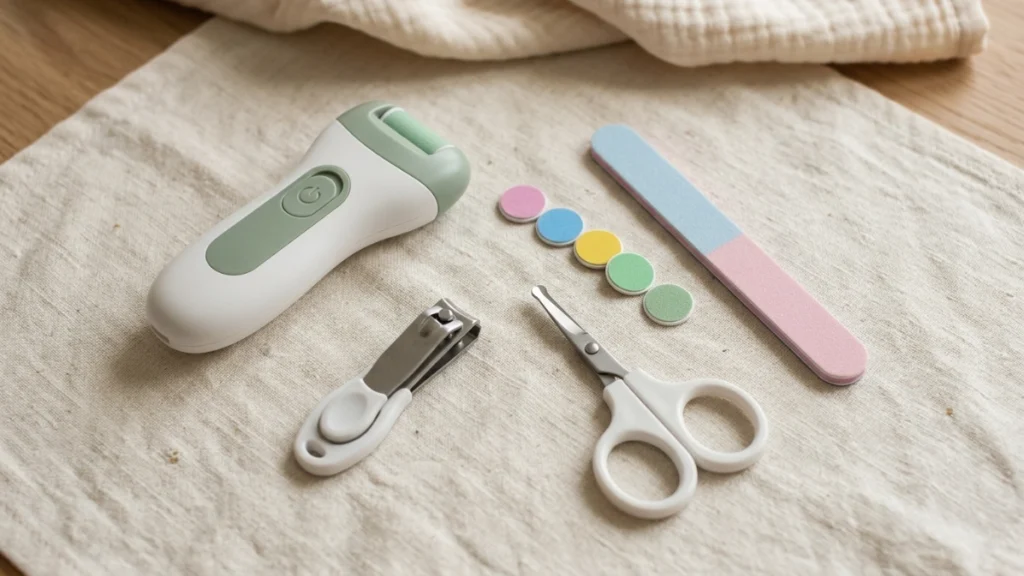
| Tool | How It Works | Main Advantage | Main Limitation | Best For |
|---|---|---|---|---|
| Electric baby nail file | Rotating abrasive pad gradually removes nail | Controlled, gradual filing | Requires batteries/charging and proper pad choice | Parents nervous about clipping |
| Manual emery board | Nail is filed by hand | Simple, inexpensive, no moving parts | Can take longer | Newborns with very soft nails |
| Baby nail clippers | Blades cut the nail | Fast and precise | Can accidentally pinch skin | Parents comfortable with clipping |
| Baby nail scissors | Rounded scissors trim nail | Good visibility and control | Baby movement can make cutting difficult | Older babies or confident caregivers |
There is no single best choice for every family.
If an ordinary emery board works well for you, there is no medical reason to switch simply because electric models exist.
Are Electric Baby Nail Files Safe?
They can be safe when used correctly, but they are not completely risk-free.
The biggest concerns are excessive friction, using an attachment that is too rough, filing the surrounding skin, and continuing while the baby is moving.
Use the Softest Appropriate Attachment
Baby nail files frequently come with several abrasive levels.
A newborn should not normally be filed with the same coarse attachment designed for an adult nail.
Follow the manufacturer’s age recommendations rather than choosing a pad based only on its color.
Start at the Lowest Speed
Higher speed can remove nail more quickly, but faster is not necessarily better.
For a baby’s thin nails, low speed and light contact provide more control.
You can always remove a little more nail. You cannot replace nail that has already been filed too short.
Never Press Hard
The filing head should lightly contact the nail.
If you find yourself pushing the device against the finger, stop.
Hard pressure increases friction and makes it easier to irritate nearby skin.
Keep the Filing Head Moving
Do not hold a rotating abrasive pad on the same spot for an extended period.
Short, controlled touches reduce unnecessary friction.
Stop If Your Baby Starts Moving
Trying to finish “just one more nail” while your baby twists, grabs, or pulls away increases the chance of touching skin.
Put the file down and try again later.
How to Use an Electric Baby Nail File Safely
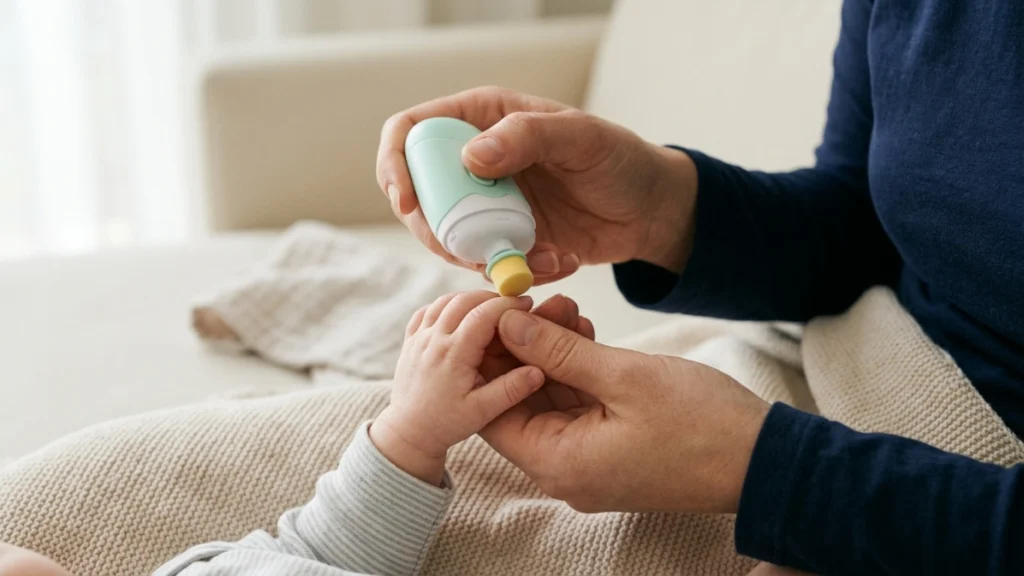
A simple routine can make the process much easier.
- Wash and dry your hands. Make sure the baby’s fingers are clean and easy to see.
- Choose the baby-specific filing pad. Use the softest attachment recommended for your baby’s age.
- Check the attachment. Make sure it is securely fitted and not cracked, dirty, or excessively worn.
- Choose a calm time. Filing while your baby is sleeping or relaxed can reduce sudden movements.
- Support one finger securely. Hold the finger gently without squeezing.
- Start on the lowest suitable speed.
- Touch the pad lightly to the nail edge. Avoid the skin and cuticle.
- Use short passes. Check the nail frequently instead of filing continuously.
- Smooth sharp corners gently.
- Stop once the edge is smooth. Do not try to create an adult-style manicure shape on an infant nail.
Expert Tip:
Test the filing pad against your own fingertip and nail before using it on your baby. This helps you understand the speed, vibration, and roughness, although your baby’s nails and skin are still much more delicate than yours.
What Makes a Good Electric Baby Nail File?
You do not need the model with the most accessories.
For baby nail care, practical safety features matter more.
Appropriate Filing Pads
Look for clearly labeled, age-appropriate attachments.
If you cannot tell which attachment is intended for a newborn or infant, check the manual before using the device.
Low-Speed Control
Multiple speed settings can be useful because the lowest setting gives you more control on very thin nails.
Secure Filing Heads
The attachment should fit firmly onto the device.
Do not use a file if the head feels loose, wobbles excessively, or repeatedly comes off.
Comfortable Grip
You should be able to hold and control the device easily with one hand.
A bulky or slippery file may make precise movements harder.
Easy-to-Find Replacement Pads
Filing pads eventually wear down.
Before paying extra for a premium device, check whether replacement attachments are readily available. A durable motor is not very useful if its proprietary filing heads cannot be replaced.
Cost, Quality, and Durability: What Actually Matters?
Electric nail files usually cost more initially than a basic emery board or baby clipper.
You may also have ongoing costs from:
- Replacement filing pads
- Disposable abrasive discs
- Batteries
- Charging accessories if replacements are needed
Paying more does not automatically make a nail file safer.
Build quality, secure attachments, controllable speed, clearly labeled pads, and reliable instructions are more important than decorative accessories.
Durability also depends on how the device is stored. Keep the file and attachments clean, dry, and protected from impact.
If your model uses replaceable batteries, keep loose batteries well away from children. The U.S. Consumer Product Safety Commission warns that accessible button and coin batteries can cause extremely serious injuries if swallowed and recommends keeping products with these batteries securely closed and inaccessible to children. See the CPSC button and coin battery safety guidance for further safety information.
When an Electric Baby Nail File May Not Work Well
Electric files are helpful tools, but they have limits.
The Nail Is Already Very Long
Slow filing can become frustrating when a nail has grown significantly beyond the fingertip.
Some experienced parents may prefer carefully trimming most of the length first and then smoothing the edge.
Your Baby Hates the Vibration
A quiet motor does not guarantee that your baby will like the sensation.
If filing repeatedly causes distress, a manual emery board or another baby-safe option may be easier.
The Filing Pad Is Worn Out
An old abrasive pad may spin without removing much nail.
Do not compensate by pressing harder.
Replace the attachment instead.
The Nail or Skin Is Injured
Do not run an electric file over:
- Broken skin
- Bleeding areas
- Swollen nail folds
- Cracked or partially detached nails
- Areas with pus or drainage
These problems need healing or medical assessment rather than cosmetic filing.
Common Warning Signs to Watch For
Stop filing if you notice:
- Redness developing around the nail
- Bleeding
- Raw or scraped skin
- Your baby repeatedly pulling the finger away
- Increased sensitivity when the finger is touched
- Swelling around the nail
- Unusual warmth
- Pus or drainage
A minor accidental touch may cause temporary irritation, but persistent redness or swelling deserves more attention.
The American Academy of Dermatology notes that redness and swelling around a nail can indicate infection.
Common Mistakes to Avoid
Even a gentle baby nail file can cause problems when used incorrectly.
- Using an adult attachment on a baby. Adult filing heads may be far too abrasive.
- Starting at maximum speed. Low speed gives you more control.
- Pressing harder when filing feels slow. Replace a worn attachment instead.
- Filing into the skin. Focus only on the nail edge.
- Making nails extremely short. The goal is smooth, manageable nails, not removing every visible edge.
- Filing while your baby is actively squirming. Try again when the baby is calmer.
- Ignoring the manufacturer’s instructions. Attachment colors and age recommendations vary between devices.
- Using damaged equipment. Replace cracked, loose, or badly worn attachments.
- Leaving the file or batteries where a child can reach them. Store the whole kit securely after every use.
- Trying to treat an abnormal nail with a grooming tool. Swelling, drainage, discoloration, or significant nail changes may need professional assessment.
When to See a Nail Technician or Dermatologist
A nail technician is generally not necessary for routine infant nail trimming. Baby nails are better cared for at home by a parent or caregiver using age-appropriate tools.
A nail technician should also never be expected to diagnose or treat an infection or medical nail condition.
For a baby, your pediatrician or other qualified healthcare professional should usually be the first person you contact if something looks wrong.
Seek medical advice if you notice:
- Persistent redness or swelling
- Pus or unusual drainage
- Increasing warmth around the nail
- Significant pain or tenderness
- Bleeding that does not stop normally
- A nail pulling away from the nail bed
- Major discoloration
- Repeated ingrown toenails
- A cut that appears to be getting worse
- Fever together with an inflamed finger or toe
For older children or adults, a dermatologist can evaluate unexplained nail abnormalities. The American Academy of Dermatology’s guidance on nail changes explains several changes that deserve professional assessment.
Do not try to grind away an abnormal-looking nail in the hope that the problem will disappear. Filing changes the nail’s appearance; it does not treat an infection or underlying medical condition.
Are Electric Nail Files Better Than Baby Clippers?
Not necessarily.
Electric files are often more forgiving because they remove nail gradually. That can make them appealing to first-time parents who are uncomfortable putting clipper blades near a baby’s fingertip.
Clippers are much faster once you learn how to use them confidently.
A manual emery board remains another simple choice. In fact, the NHS guidance on cutting a baby’s nails specifically lists a fine emery board as an alternative for parents who prefer filing.
Your best option may change as your child grows.
A gentle electric file may feel ideal during the newborn stage, while clippers may become easier when the nails become thicker.
How Often Should You File a Baby’s Nails?
There is no need to follow a rigid filing schedule.
Check the nails regularly and smooth them when they become long or develop sharp edges.
Fingernails often need attention more frequently than toenails.
The goal is simple: keep the nails short enough that your baby cannot easily scratch themselves while avoiding excessive filing.
If there is very little nail extending beyond the fingertip, you may not need to do anything yet.
FAQs
Do electric baby nail files actually shorten nails?
Yes. The rotating abrasive pad gradually removes material from the nail edge. Because infant nails are thin, a soft baby-specific pad can usually shorten them effectively without cutting.
Can I use an electric nail file on a newborn?
Some electric files include attachments specifically intended for newborn nails. Always check the manufacturer’s minimum-age guidance and use the softest appropriate attachment at low speed. A fine manual emery board is also a simple option for newborns.
Can an electric baby nail file hurt the skin?
Yes, especially if the attachment is too rough, the speed is too high, or the file is held against the skin too long. Use light pressure and keep the filing surface on the nail rather than surrounding skin.
Is an electric nail file safer than clippers for babies?
It may feel easier to control because it removes nail gradually, but no tool is completely risk-free. Clippers, fine emery boards, and properly designed electric files can all be reasonable choices when used carefully.
What grit should I use for a baby’s nails?
Use only the soft attachment recommended by your device’s manufacturer for your baby’s age. Do not assume that attachment colors are universal because different manufacturers may use different systems.
Should I file my baby’s nails while they are sleeping?
That can be a convenient time because the baby may move less. Both the American Academy of Pediatrics and NHS guidance suggest doing nail care when babies are asleep or relaxed. Make sure you still have enough light to see the nail and fingertip clearly.
When should I replace an electric nail file pad?
Replace it when the abrasive surface becomes worn, damaged, dirty, or noticeably less effective. If filing suddenly requires more pressure than usual, the attachment may need replacement rather than additional force.
Conclusion
So, do electric baby nail files work? Yes—when they are designed for babies and used correctly. Their biggest advantage is control. Instead of cutting through the nail instantly, they gradually file the edge, which many parents find less intimidating.
The safest approach is to choose the softest age-appropriate attachment, start slowly, use almost no pressure, keep the file away from surrounding skin, and stop whenever your baby starts moving.
An electric file is useful, but it is not essential. A fine emery board, baby nail clippers, or rounded baby scissors can also work well. Choose the method that gives you the best control and keeps your baby comfortable.
Most importantly, treat unusual redness, swelling, pain, drainage, or damaged nails as a health concern rather than a grooming problem. Use nail tools for routine care—and ask a healthcare professional when something does not look normal.

