
Do Electric Nail Files Work for Babies? A Practical Safety Guide

Trimming a baby’s nails can feel harder than it should. Their nails are tiny, their fingertips are soft, and their hands rarely stay still. Many parents look at clippers and worry about accidentally catching the skin.
So, do electric nail files work for babies? Yes, baby-specific electric nail files can work well for gently shortening and smoothing thin infant nails. They can be easier to control than clippers for some parents. However, they still need careful use. The right attachment, low speed, gentle pressure, and a calm baby all matter.
This guide explains how electric baby nail files work, their benefits and limits, how to use one safely, what features matter, and when a nail problem needs medical attention.
Quick Answer
Yes, electric nail files work for babies when they are designed for infant nails and used gently. A soft, fine filing pad can gradually shorten sharp nails without making a sudden cut. Use the lowest suitable speed, light pressure, and short touches. Stop if the skin becomes red, sore, or irritated.
How Do Electric Nail Files for Babies Work?
A baby electric nail file is quite different from the powerful electric files used for acrylic or gel manicures.
Most baby versions use a small rotating filing pad. The pad gently wears away the free edge of the nail instead of cutting through it in one motion.
This gradual action is the main reason many parents find them easier to control.
A typical baby nail file has:
- A small motor
- Several abrasive filing pads
- Different pad grades for different ages
- Low-speed settings
- A compact filing head
- Battery or rechargeable power
- Sometimes a built-in light
The filing surface should be much gentler than a professional nail drill bit.
Never use a salon-style electric nail drill on a baby. Professional e-files can run at much higher speeds and are made for adult nail services, artificial nails, and trained users.
The American Academy of Pediatrics also suggests that parents can trim or file a baby’s nails when the baby is asleep, which can make the process easier because the baby’s hands move less.
Why Baby Nails Need Regular Care
Baby fingernails can feel surprisingly sharp even though they are thin and flexible.
Long or rough edges may scratch the baby’s:
- Face
- Nose
- Cheeks
- Scalp
- Parent during feeding or cuddling
This does not mean you need to make every nail extremely short. The goal is simply to remove sharp or uneven edges.
The NHS notes that babies may be born with long nails and recommends baby-safe clippers, round-ended scissors, or a fine emery board for filing baby nails. It also suggests trimming while the baby is asleep or relaxed.
An electric baby nail file uses the same basic idea as an emery board, but the abrasive surface moves for you.
Are Electric Nail Files Safe for Babies?
They can be safe when you choose a model intended specifically for babies and use it correctly.
That does not mean an electric file is completely risk-free.
Possible problems include:
- Filing the nail too short
- Touching the surrounding skin repeatedly
- Using too much pressure
- Using an attachment that is too coarse
- Filing at too high a speed
- Continuing after the baby starts moving
- Using damaged or dirty filing pads
A baby’s nail plate and surrounding skin are delicate. You do not need much pressure to shorten the nail.
The file should do the work. Do not push the filing head firmly into the nail.
Can an Electric Nail File Hurt a Baby’s Skin?
Yes, especially if a rough pad is held against the same area for too long.
Some baby files are designed with very gentle attachments, but you should not assume that every electric file is harmless when it touches skin.
Brief accidental contact may cause no problem with a soft attachment, but repeated friction can still irritate delicate skin.
Check the fingertip after each nail. Stop if you see:
- Redness
- Scraped skin
- Bleeding
- Swelling
- Tender-looking areas
- A nail filed extremely close to the skin
Electric Nail File vs Other Baby Nail Tools
There is no single tool that works best for every parent.
| Tool | Control | Speed | Main Benefit | Main Limitation | Ongoing Cost |
|---|---|---|---|---|---|
| Baby electric nail file | High when used gently | Moderate | Gradual filing feels less intimidating | Requires batteries/charging and replacement pads | Replacement pads may be needed |
| Fine emery board | Very high | Slow | Simple and inexpensive | Can take longer | Very low |
| Baby nail clippers | Moderate | Fast | Removes nail quickly | One wrong movement can catch skin | Usually none |
| Round-tip baby scissors | Moderate | Fast | Good visibility around nail edge | Requires steady hands | Usually none |
Which Option Is Best for a Nervous Parent?
If you are worried about using clippers, a baby electric nail file or fine emery board may feel easier because both remove the nail gradually.
Clippers can still be convenient as babies grow and their nails become firmer.
Some parents use both methods. They clip longer nails and then smooth any rough edge with a file.
There is no need to force yourself to use a tool that makes you uncomfortable.
Do Electric Nail Files Work Well on Newborn Nails?
They can, but newborn nails require extra care.
Newborn nails are often very thin and may sit close to the fingertip skin. That makes aggressive filing unnecessary.
Start with the softest attachment recommended by the manufacturer for your baby’s age. Use the lowest practical speed.
A few light passes may be enough.
Do not try to create a perfectly shaped manicure. You only need to smooth the sharp edge.
How to Use an Electric Nail File on a Baby Safely
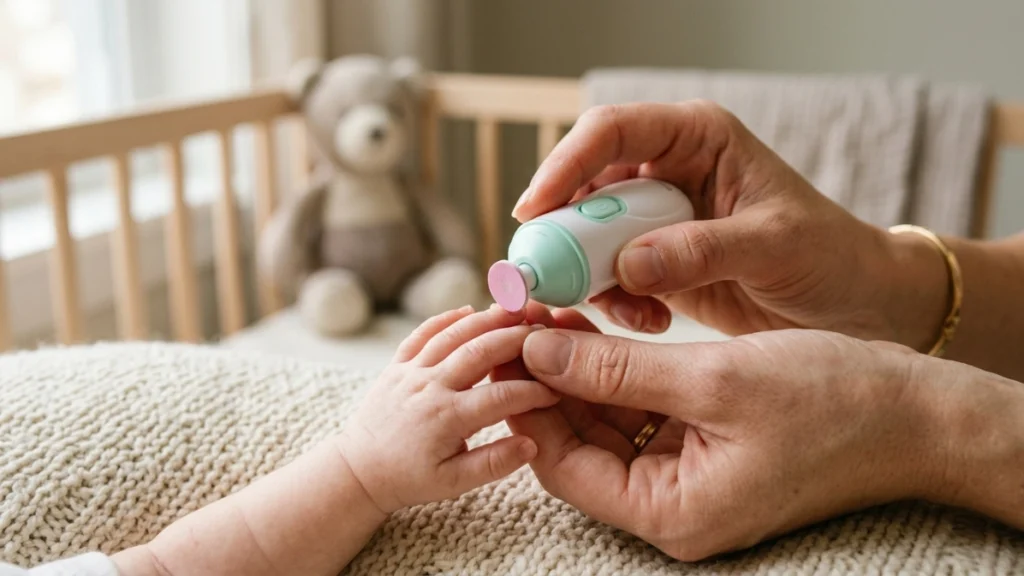
Good technique matters more than speed.
1. Choose a Calm Time
Try filing when your baby is:
- Sleeping
- Relaxed after feeding
- Resting quietly
- Being calmly held by another adult
Avoid filing while your baby is actively kicking, grabbing, or crying.
2. Wash and Dry Your Hands
Make sure your hands and the baby’s fingers are clean and dry.
Dry nails are easier to see and control.
3. Choose the Correct Filing Pad
Baby electric files often include several pads.
Use the one recommended for your baby’s age. Do not automatically choose the roughest disc because it works faster.
Coarser is not better for delicate infant nails.
4. Start at a Low Speed
Use a low setting until you know how quickly the file removes nail.
Higher speed does not necessarily produce a better result.
5. Hold the Finger Securely
Gently support one finger between your fingers.
Keep the fingertip stable without squeezing it.
6. File the Free Edge
Touch only the nail edge that extends beyond the fingertip.
Use short, light passes rather than holding the file in one spot.
7. Check Your Progress Often
Stop every few seconds and look at the nail.
You may need to remove much less than you expect.
8. Stop Once the Sharp Edge Is Gone
You do not need a perfectly symmetrical nail.
If it feels smooth and no longer has a sharp corner, you are finished.
9. Clean the Tool
Remove nail dust and clean reusable components according to the manufacturer’s directions.
Do not soak an electric unit unless its instructions specifically say it is waterproof.
Expert Tip: Test the filing pad against the edge of your own fingernail first. This helps you understand how quickly it removes nail before you use it on your baby.
What Makes a Good Electric Baby Nail File?
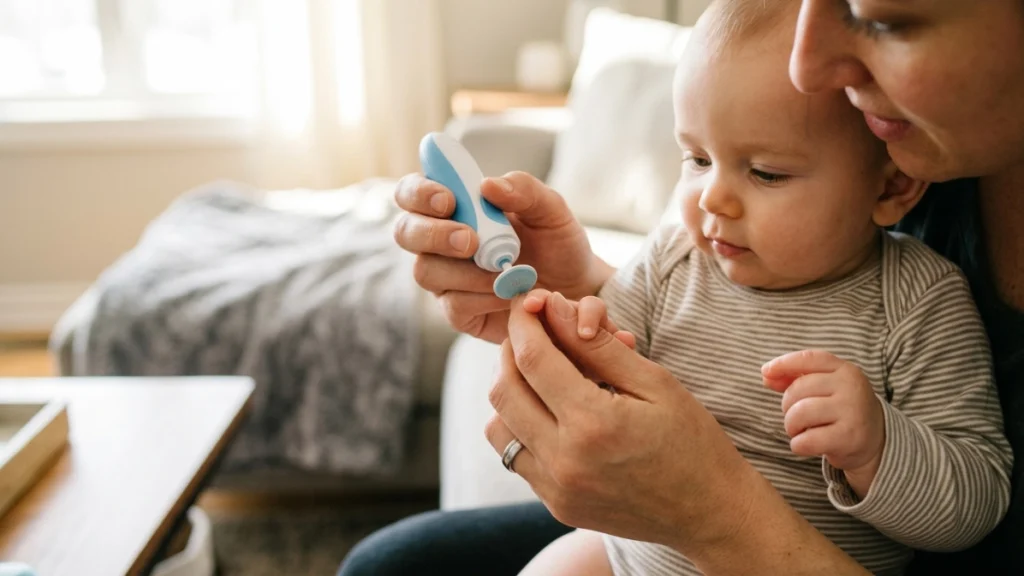
Quality matters more than having lots of accessories.
Gentle Filing Attachments
Look for fine attachments specifically described as suitable for infants.
A very rough surface can remove too much nail too quickly.
Good Speed Control
A low-speed option gives you more time to react.
Multiple speeds can become useful as the child’s nails become thicker with age.
Easy-to-Hold Design
A file should feel stable in your hand.
Poor grip makes precise movements harder.
Easy-to-Find Replacement Pads
Filing discs gradually wear down.
A cheap device may become poor value if compatible replacement pads are difficult or expensive to obtain.
Reliable Construction
Check that attachments fit securely and do not wobble during operation.
A loose filing head makes control more difficult.
Useful Light
A built-in light is optional, but it may help you see the edge of a tiny nail.
Good room lighting is still important.
Cost and Durability: Is an Electric File Worth It?
An electric file usually costs more than a basic emery board or baby nail clipper.
There may also be ongoing costs for:
- Batteries
- Replacement filing discs
- Replacement heads
A rechargeable model may reduce battery use, but battery life and build quality vary.
Before choosing one, consider how long replacement pads are likely to remain available. A durable motor is not very useful if you cannot get the correct gentle attachments later.
For many parents, the main value is not speed. It is confidence and control.
If an inexpensive manual emery board works well for you, an electric version is not essential.
Signs You May Be Filing Too Much
More filing does not mean better nail care.
Stop if:
- The nail becomes very short
- The soft skin under the nail becomes exposed
- The baby pulls the finger away repeatedly
- The surrounding skin becomes red
- You see a scraped area
- Bleeding starts
- The nail edge looks unusually thin or damaged
Do not continue filing a sore nail just to make its shape more even.
Give the area time to recover.
What If You Accidentally Nick or Irritate the Skin?
Stop using the file immediately.
For a small cut, clean the area gently. If there is active bleeding, apply gentle direct pressure with clean gauze or cloth.
The American Academy of Pediatrics advises washing a bleeding fingertip with soap and water and covering it with a soft sterile dressing when appropriate in its guidance on children’s fingertip injuries.
Because babies may put their hands in their mouths, avoid applying nail products, glue, polish, or other cosmetic substances to an injured finger unless a healthcare professional specifically recommends them.
Seek medical advice if bleeding does not stop, the wound looks deep, or you are concerned about the injury.
Common Mistakes to Avoid
Electric nail files are simple tools, but several small mistakes can make them less safe.
- Using an adult nail drill. Salon e-files are not substitutes for baby nail files.
- Choosing a coarse attachment. Start with the gentlest age-appropriate pad.
- Pressing too hard. Light contact is enough.
- Holding the file in one place. Keep the movement brief and controlled.
- Trying to file during active movement. Stop if your baby will not keep the hand reasonably still.
- Filing nails extremely short. Your goal is to remove sharp edges, not remove every visible bit of free nail.
- Ignoring worn filing pads. Replace damaged or badly worn attachments.
- Sharing dirty attachments. Clean the tool as directed.
- Filing irritated or infected-looking skin. Do not use an electric file over injured tissue.
- Expecting the tool to be completely skin-proof. Gentle baby attachments reduce risk but still need careful handling.
When to See a Nail Technician or Dermatologist
A nail technician is generally not the right professional for medical problems affecting a baby’s nails.
Baby nail care should normally be simple grooming at home. If something looks abnormal, contact your pediatrician or another qualified healthcare professional. A dermatologist may be appropriate when recommended, especially for persistent nail or skin problems.
Get medical advice if you notice:
- Increasing redness around a nail
- Swelling
- Warmth
- Pus or drainage
- Persistent bleeding
- Significant tenderness
- A nail lifting away from the nail bed
- Unexplained color changes
- A deep cut
- Repeated inflammation around the same nail
Redness, swelling, warmth, and soreness around a nail can be signs of a nail-fold infection rather than a grooming problem.
Do not try to grind away, cut out, or cosmetically cover a suspicious nail problem on a baby.
Medical evaluation is safer than experimenting with DIY nail treatments.
Electric File or Manual File: How Should You Decide?
Choose the tool that gives you the best control.
An electric baby nail file may make sense if:
- Clippers make you nervous
- Your baby’s nails develop sharp edges often
- You prefer gradual filing
- You can comfortably stabilize each finger
- You are willing to replace filing pads when needed
A manual emery board may be better if:
- You want the simplest option
- You only need occasional smoothing
- You prefer having no motor near the baby’s fingers
- Cost is a priority
Baby clippers may suit you if:
- You are confident using them
- The nails are getting thicker
- You want a faster trim
There is also nothing wrong with switching methods as your child grows.
FAQs
Do electric nail files work for babies better than clippers?
Not necessarily better, but they work differently. Electric files remove nail gradually, while clippers remove a larger piece at once. Parents who worry about accidentally cutting skin may feel more comfortable with a gentle baby electric file.
Can I use an electric nail file on a newborn?
A baby-specific file may be used very gently if its manufacturer says the attachment is suitable for newborns. Newborn nails are extremely thin, so use minimal pressure and remove only the sharp edge.
Can an electric baby nail file cut the skin?
A gentle filing pad is less likely to make a sudden cut than sharp clippers, but it can still irritate or abrade skin if used with too much pressure or held against one spot for too long.
How often should I file my baby’s nails?
There is no fixed schedule for every baby. Check the nails regularly and smooth them when they become long, rough, or sharp enough to cause scratches. Avoid unnecessary filing when the nails are already short and smooth.
Should I file a baby’s nails while they are sleeping?
It can make the job easier. Pediatric guidance suggests trimming or filing while a baby is sleeping or relaxed because there is usually less sudden hand movement.
Can I use my regular electric manicure drill on my baby?
No. Use a tool and attachment specifically intended for baby nail care. Professional manicure drills can be much more powerful and may use abrasive bits intended for adult or artificial nails.
What should I do if the skin around my baby’s nail looks infected?
Stop filing the area and contact your pediatrician or another healthcare professional. Increasing redness, swelling, warmth, tenderness, or pus may indicate infection and should not be treated as a cosmetic nail problem.
Conclusion
So, do electric nail files work for babies? Yes. A baby-specific electric nail file can be a useful way to shorten and smooth tiny nails without making the sudden cutting motion required with clippers.
The biggest advantage is control. You can remove a very small amount of nail at a time. But the tool still needs a careful hand.
Use a gentle age-appropriate attachment, start slowly, apply almost no pressure, stabilize the finger, and stop as soon as the sharp edge is smooth. Never use a professional salon e-file on an infant.
If a manual emery board or baby clipper feels easier for you, that is also a perfectly practical choice. The best nail-care tool is the one you can use gently, safely, and confidently.
Check your baby’s nails regularly, choose a method that gives you good control, and contact a healthcare professional rather than attempting DIY treatment whenever a nail or the surrounding skin looks injured or infected.

