
Do Human Nail Files Work on Dogs? A Safe, Practical Guide

If you already have an emery board or regular nail file in your manicure kit, you may wonder whether you can use it to smooth your dog’s claws instead of buying another grooming tool. So, do human nail files work on dogs?
Yes, they can—but their usefulness depends on your dog’s nail thickness, the type of file, and how much nail needs to be removed. A human nail file can be handy for smoothing a rough edge or shortening thin nails gradually. However, it is usually too slow for thick, overgrown dog nails.
The most important issue isn’t whether the file technically works. It’s whether you can use it without reaching the sensitive quick, irritating the nail, stressing your dog, or creating a hygiene problem.
This guide explains when a human nail file makes sense, which types work best, how to file safely, and when a pet-specific tool or professional is the smarter choice.
Quick Answer
Yes, human nail files can work on dogs, especially for smoothing sharp edges or gradually shortening small, thin nails. A coarse emery board usually works better than a very fine manicure file. However, thick or overgrown dog nails are generally easier to manage with dog nail clippers or a pet nail grinder.
Why a Human Nail File Can Work on a Dog
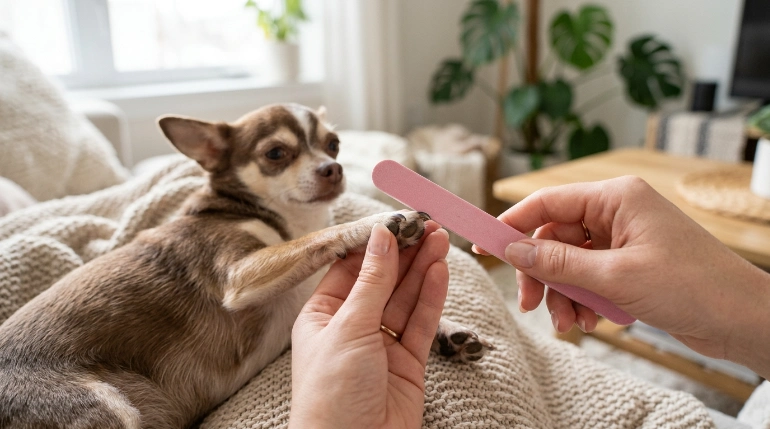
Human fingernails and dog claws are not identical, but both contain hard keratin. That means an abrasive nail file can gradually wear material away from a dog’s nail just as it does from a human nail.
In fact, VCA Animal Hospitals’ dog nail-trimming guidance lists a handheld file or grinder as an alternative to clipping. Filing also creates a smoother edge and may feel less intimidating to dogs that dislike the pressure or snapping sensation of clippers.
The catch is efficiency.
A human nail file is designed for relatively thin human nails. Dog nails—especially on medium and large breeds—can be much harder and thicker.
A human file therefore works best for:
- Smoothing a freshly clipped nail
- Removing a sharp point
- Maintaining already-short nails
- Small dogs with thinner claws
- Dogs that tolerate rubbing better than clipping
- Owners who want very gradual nail removal
It works poorly when you need to remove several millimeters of thick nail from every paw.
Human Nail File vs. Dog Nail Tools
Choosing the right tool makes nail maintenance faster and safer.
| Tool | Best For | Speed | Main Advantage | Main Limitation |
|---|---|---|---|---|
| Human emery board | Thin nails and smoothing | Slow | Cheap and easy to control | Wears out quickly |
| Glass nail file | Light smoothing | Slow | Smooth filing surface | Often too fine for thick claws |
| Metal human file | Small touch-ups | Slow–moderate | Reusable | Can feel harsh and needs cleaning |
| Dog nail file | Routine manual filing | Moderate | Designed for pet claws | Still slower than a grinder |
| Dog nail grinder | Thick nails and regular shortening | Fast | Gradual, controlled removal | Noise, vibration, heat |
| Dog nail clippers | Removing significant length | Fastest | Efficient | Can cut the quick if used incorrectly |
For most dogs, a manual human file is better viewed as a finishing or maintenance tool rather than the fastest primary trimming method.
Which Human Nail Files Work Best on Dogs?
Not every file sitting on your manicure table will perform equally well.
Coarse Emery Boards
A medium-to-coarse emery board is usually the most practical human file for dog nails.
The rough abrasive surface can remove more material than the ultra-fine side of a polishing file. Because emery boards are inexpensive, you can also dedicate one exclusively to your dog and discard it when worn.
Avoid extremely aggressive filing pressure. A coarser surface should do the work without force.
Glass Nail Files
Glass files are excellent for controlled human manicures, but they can be frustratingly slow on a dog’s thick claws.
They may work for a small dog or for polishing a rough tip after clipping. For a large dog, you could spend a long time filing a single nail.
Glass also requires careful handling so it does not crack or break if dropped.
Metal Nail Files
A metal file can remove material more effectively than some fine manicure files, but it isn’t automatically the best pet tool.
Its hard surface may feel uncomfortable if dragged aggressively across a nail. It also needs thorough cleaning before and after use.
Never move a file back and forth across surrounding skin or paw pads. Only the hard nail should contact the abrasive surface.
Buffing Blocks
A beauty buffing block is generally too soft and fine to shorten a dog’s nails effectively.
It might smooth a tiny rough spot, but it is not a substitute for a real nail file, clipper, or grinder.
The Biggest Safety Issue: Your Dog’s Quick
The main danger with any nail-shortening method is reaching the quick.
The quick is the living tissue inside the nail containing blood vessels and nerves. Cutting or filing into it can cause pain and bleeding.
On pale or transparent nails, the quick may appear pink inside the nail. Dark nails make it much more difficult to see.
The Humane Society’s at-home dog grooming guidance recommends trimming only a little at a time on dark nails and stopping as you approach signs of the quick.
Filing may feel safer because you’re removing tiny amounts rather than making one large cut. But a file can still reach the quick if you keep going.
Slow does not mean risk-free.
How to Use a Human Nail File on a Dog Safely
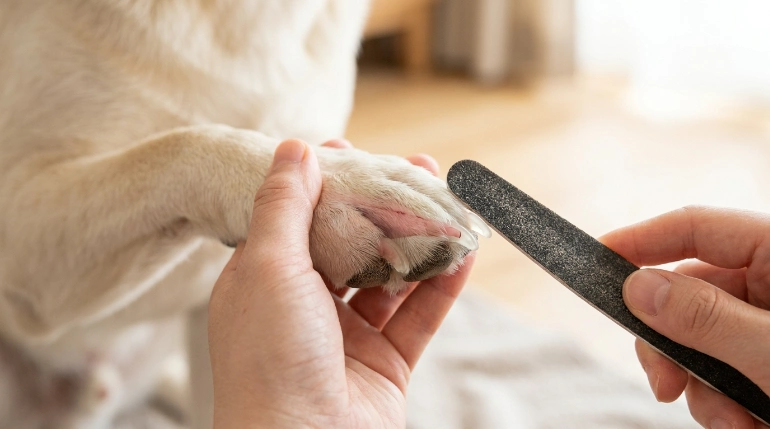
If your dog’s nails need only minor maintenance and your dog is comfortable having her paws handled, manual filing can be straightforward.
1. Choose a Clean File
Use a fresh or thoroughly clean medium/coarse file.
Ideally, dedicate the file to your dog rather than moving the same tool between your manicure kit and your pet’s paws.
2. Get Your Dog Comfortable First
Don’t immediately grab a paw and start filing.
Touch and gently hold your dog’s paws during relaxed moments. Reward calm behavior with praise or a small treat.
VCA’s guidance for reducing nail-trimming stress recommends breaking the process into small steps, keeping sessions short, and progressing only while the dog remains comfortable.
Let your dog sniff the file before you begin.
3. Inspect the Nails
Look for:
- Cracks
- Splits
- Bleeding
- Swelling
- Redness around the nail
- An unusually shaped claw
- Nails curling toward the paw pad
If you notice an injury or abnormal nail, don’t simply file over the problem.
4. Hold One Toe Gently
Support the paw without squeezing tightly.
Separate one toe enough that you can clearly see the nail and surrounding fur.
Your dog should be relaxed enough that you are not fighting sudden pulling or twisting movements.
5. File the Tip Gradually
Work primarily on the pointed end of the nail.
Use controlled strokes and remove only a small amount at a time. Stop frequently to inspect your progress.
The American Kennel Club’s nail-grinding guidance similarly recommends removing only a small portion of nail at a time rather than aggressively shortening it in one pass.
6. Round Off Sharp Edges
Once the length is acceptable, gently smooth any rough corners.
This is one situation where a regular human nail file can be especially useful.
7. Stop Before Your Dog Gets Frustrated
You don’t need to complete all four paws in one session.
For a nervous dog, doing one or two nails and ending positively can be much better than forcing a full manicure.
Expert Tip: Keep the first few filing sessions extremely short. Your goal isn’t perfectly shortened nails—it’s teaching your dog that having a paw touched and filed predicts something pleasant.
How Much Can You Safely File Off?
There isn’t one safe number for every dog because nail length and quick length vary.
Instead of trying to remove a predetermined amount, work in very small increments.
This is especially important with black nails, where the quick isn’t visible from the outside.
According to VCA’s puppy nail guidance, removing small amounts progressively can reduce the chance of significantly injuring the quick.
If you’re uncertain, stop early.
A slightly longer nail is better than a painful nail injury.
Signs Your Dog’s Nails Need Attention
You don’t need to wait until claws look dramatically overgrown.
The ASPCA’s dog grooming guidance advises that nails generally need attention when they begin touching the ground, clicking, or getting snagged.
Other signs can include:
- Sharp tips scratching you easily
- Nails catching on blankets or carpet
- Obvious downward curling
- Awkward paw placement
- Reluctance to walk normally
- A dewclaw becoming excessively long
Some active dogs naturally wear their nails down on hard surfaces, while less active dogs may require more frequent maintenance.
Check the nails rather than relying entirely on a fixed calendar.
Can Filing Replace Dog Nail Clippers?
Sometimes—but not always.
If your dog’s nails are already at a healthy length and you file them frequently, manual filing might maintain them without much clipping.
However, if the nails are substantially overgrown, a human nail file can become impractical.
Imagine trying to shorten a thick acrylic nail using only the fine finishing side of an emery board. It eventually works, but the process is unnecessarily slow.
A useful routine may be:
- Use dog clippers to remove excess length when appropriate.
- Use a file to smooth the sharp edges.
- Maintain the nails regularly so they don’t become severely overgrown again.
Owners uncomfortable with clippers may prefer a pet nail grinder because it removes nail progressively.
Human Nail File vs. Dog Nail Grinder
A grinder is essentially the powered version of filing.
For thick dog nails, it can remove material much faster than an ordinary emery board.
A grinder may be a better choice when:
- Your dog has large, thick nails.
- Several nails need substantial shortening.
- Manual filing takes too long.
- Your dog dislikes the snap of clippers.
- You regularly maintain multiple dogs.
But grinders have their own disadvantages.
They create noise and vibration, which some dogs dislike. Friction can also generate heat, and long fur can potentially get near rotating components.
A manual file is quieter, generates less dramatic vibration, and gives you very slow control.
The best tool is the one that allows you to work safely while keeping your dog reasonably calm.
What About Very Overgrown Dog Nails?
This is where a simple human nail file becomes less useful.
When nails remain long for an extended period, the quick may extend farther down the nail. Trying to restore a very short nail length in one session can therefore cause bleeding and pain.
Don’t aggressively file or clip an overgrown nail simply because it looks too long.
Gradual maintenance may be necessary.
For severely overgrown, curled, painful, damaged, or embedded nails, contact a veterinarian or qualified professional groomer rather than attempting a major DIY correction.
Hygiene: Should You Share Your Own Nail File With Your Dog?
It’s better not to.
Dog paws contact floors, soil, sidewalks, grass, and many other surfaces. Reusing the same porous emery board on yourself introduces an unnecessary hygiene concern.
Instead:
- Keep separate files for people and pets.
- Label your dog’s file.
- Replace disposable emery boards regularly.
- Clean reusable metal tools after use.
- Follow the manufacturer’s instructions for disinfecting reusable tools.
- Wash your hands after handling paws and nail debris.
Professional dog-grooming standards also emphasize cleaning and disinfecting grooming tools between animals, reinforcing why tool hygiene matters.
A disposable emery board is inexpensive. There is little reason to put it back in your manicure kit afterward.
What Does Dog Nail Care Cost?
DIY manual filing is one of the least expensive options.
Typical costs vary by tool quality, location, dog size, and professional service, but the general comparison looks like this:
| Option | Relative Cost | Best Use |
|---|---|---|
| Human emery board | Very low | Occasional smoothing |
| Pet manual file | Low | Regular manual maintenance |
| Dog nail clippers | Low | Routine shortening |
| Electric nail grinder | Moderate | Frequent filing or thick nails |
| Groomer nail trim | Recurring service cost | Owners wanting professional handling |
| Veterinary nail trim | Usually higher | Difficult dogs or medical concerns |
Don’t choose solely by price.
A $2 file is not a bargain if filing takes so long that your dog becomes anxious or you cannot safely shorten thick nails.
Dogs That May Not Be Good Candidates for DIY Filing
Manual filing is not automatically suitable for every pet.
Be cautious if your dog:
- Snaps or bites when paws are touched
- Panics during restraint
- Has very painful feet
- Has an injured nail
- Has bleeding around a claw
- Has significant swelling
- Has a nail growing into the paw
- Suddenly starts limping
- Has extremely overgrown nails
- Has a medical condition affecting the paws or nails
A frightened dog’s sudden movement can turn a simple grooming session into an injury risk for both of you.
Professional help is sometimes the kinder option.
Common Mistakes to Avoid
Even though filing feels simple, a few mistakes can make the experience uncomfortable or unsafe.
- Using the same file on yourself and your dog. Keep pet grooming tools separate for better hygiene.
- Trying to remove too much nail at once. File gradually and inspect frequently.
- Assuming filing can’t reach the quick. It can if you continue removing nail.
- Using an ultra-fine buffer on thick nails. It may take so long that your dog loses patience.
- Holding the paw too tightly. Firm restraint can increase fear and struggling.
- Continuing when your dog is panicking. Stop and try a shorter, calmer session later.
- Filing damaged or bleeding nails. An injured claw may require veterinary evaluation.
- Ignoring dewclaws. They may not contact the ground and therefore don’t wear down naturally.
- Forcing every nail to be finished at once. Several tiny positive sessions can be safer than one stressful marathon.
- Filing surrounding paw skin. Keep the abrasive surface on the hard nail only.
When to See a Nail Technician or Dermatologist
For your dog’s nails, a human nail technician or dermatologist is not the appropriate professional. A veterinarian or experienced professional dog groomer is the better choice.
Contact a veterinarian if your dog has persistent bleeding, swelling, redness, discharge, obvious pain, limping, a torn nail, an embedded nail, or another abnormal change around the paw.
A professional groomer can be useful when the nails are healthy but you aren’t comfortable shortening them yourself.
For your own nails and skin, a licensed nail technician can help with routine cosmetic nail care, while persistent pain, inflammation, infection-like symptoms, or unusual nail changes are better evaluated by a qualified healthcare professional such as a dermatologist.
DIY beauty tools have limits—whether they’re being used on you or your pet.
FAQs
Can I use a regular emery board on my dog?
Yes. A regular emery board can smooth a dog’s nail or gradually shorten thin claws. Choose a medium or coarse surface and use gentle, controlled strokes. Keep the file exclusively for your dog.
Can I file my dog’s nails instead of clipping them?
You may be able to, particularly if you maintain the nails frequently. Manual filing becomes slow when nails are thick or significantly overgrown, so clippers or a pet grinder may be more practical.
Does filing dog nails hurt?
Filing the hard outer nail should not hurt when done correctly. However, filing into the quick can be painful and may cause bleeding. Pressure, restraint, or an existing nail injury can also make the process uncomfortable.
Can I use a glass nail file on my dog?
A glass file may work for smoothing or for small dogs with relatively thin nails, but many glass manicure files are too fine to shorten thick dog claws efficiently.
Is a dog nail grinder safer than a human nail file?
Neither tool is completely risk-free. A grinder is faster but can create heat, vibration, and noise. A manual file is slower and easier to control but can still reach the quick if too much nail is removed.
How do I know when to stop filing my dog’s nails?
Stop once you have removed the sharp tip or reached an appropriate length, and always stop before approaching the quick. With dark nails, take off very small amounts and inspect the end frequently. If you’re uncertain, leave the nail slightly longer.
What should I do if my dog’s nail starts bleeding?
Stop filing immediately. Minor quick injuries may be controlled with styptic powder and gentle pressure. If bleeding doesn’t stop promptly, the nail is badly torn, or your dog appears very painful, contact a veterinarian.
Conclusion
So, do human nail files work on dogs? Yes—but they’re best for small adjustments, smoothing, and maintaining nails that are already reasonably short.
A coarse emery board can be an inexpensive, quiet option for a small dog or a pet that dislikes clippers. For thick or overgrown nails, dog clippers or a pet nail grinder are usually faster and more practical.
Whatever tool you choose, focus on the same priorities: remove only small amounts, protect the quick, keep tools clean, watch your dog’s body language, and never force a stressful grooming session.
If your dog’s nails are painful, damaged, severely overgrown, bleeding, or difficult for you to handle confidently, skip the DIY experiment and ask a veterinarian or experienced groomer for help. Safe nail care matters more than finishing every paw yourself.

