
Do I Need a Baby Nail File? A Safe, Simple Guide

If you have ever looked at your baby’s tiny fingernails and wondered, “Do I need a baby nail file?”, you are not alone.
Baby nails can grow surprisingly fast. They can also develop sharp little edges that may scratch your baby’s face. At the same time, using scissors or clippers on tiny moving fingers can feel stressful.
A baby nail file can make nail care easier because it lets you smooth sharp edges slowly instead of making one quick cut. But you do not always need a special file, and the right choice depends on your baby’s age, nails, movement, and your comfort level.
Here is how to decide what you actually need and how to care for baby nails safely.
Quick Answer
Yes, a baby nail file can be useful, especially if you are nervous about using clippers on tiny nails. A fine, gentle file can smooth sharp edges with less risk of accidentally cutting skin. However, you do not need an expensive electric file. A fine emery board may also work well.
The American Academy of Dermatology recommends using a nail file or emery board to keep a baby’s nails rounded rather than jagged.
Why Baby Nails Need Regular Care
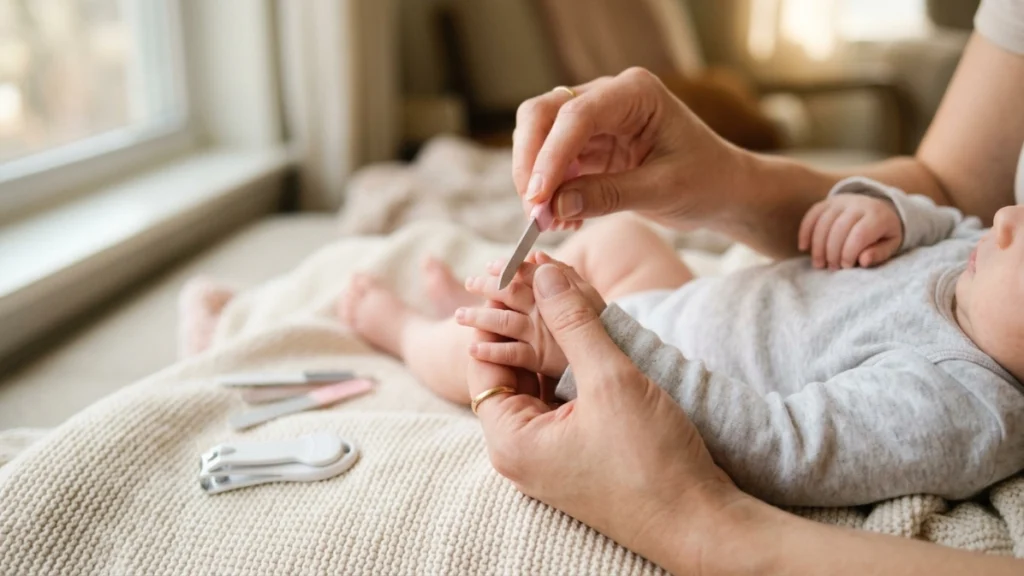
Baby fingernails are small, thin, and sometimes surprisingly sharp.
A baby may move their hands across their face while sleeping, feeding, or stretching. If a nail develops a sharp corner, it can leave a small scratch.
That does not mean you need to keep the nails extremely short.
The main goal is simple:
- Remove sharp or jagged edges.
- Keep the nail comfortably short.
- Avoid cutting nearby skin.
- Avoid irritating the nail bed.
- Keep tools clean.
According to the American Academy of Dermatology’s baby nail-care guidance, parents can file or trim nails when they become sharp and should aim for a smooth, rounded edge.
Do I Need a Baby Nail File Instead of Clippers?
Not necessarily.
A nail file, baby nail clippers, and round-ended baby scissors can all have a place in baby nail care.
The best tool is usually the one you can control comfortably while your baby remains calm.
A file may be the better starting choice if:
- Your baby moves suddenly.
- You are nervous about clippers.
- Only one or two nail edges are sharp.
- Your baby’s nails are very soft.
- You want to smooth the nail after trimming.
- You accidentally leave a rough corner after clipping.
The NHS also lists a fine emery board as an option for baby nail care and notes that baby clippers or small round-ended safety scissors can be used as alternatives.
Baby Nail File vs. Clippers vs. Scissors
Each option has benefits and limits.
| Tool | Best For | Main Benefit | Limitation |
|---|---|---|---|
| Fine baby nail file | Sharp edges and short nails | Slow and easy to control | Can take longer |
| Emery board | Gentle manual filing | Simple and inexpensive | Wears out |
| Baby nail clippers | Longer nails | Fast trimming | Requires careful positioning |
| Round-ended baby scissors | Controlled trimming | Easy to see the cutting area | Baby must remain still |
| Electric baby nail file | Frequent filing | Can make filing quicker | Costs more and requires careful pressure |
You do not need to buy every option.
For many families, one gentle file plus a pair of baby clippers is more than enough.
What Type of Baby Nail File Should You Use?
Choose something gentle.
Baby nails are not the same as thick adult nails. A very coarse adult file can remove more nail than you intended.
Fine Emery Board
A fine emery board is one of the simplest choices.
It works well when you only need to smooth:
- A sharp corner
- A small rough edge
- A slightly uneven nail
The NHS baby-care guidance specifically mentions using a fine emery board as an alternative to cutting baby nails.
Manual Baby Nail File
A baby-specific manual file usually has a gentle filing surface and an easy-to-hold shape.
It may give you better control than a full-size adult file.
This is particularly useful during the newborn stage when there is very little nail extending past the fingertip.
Electric Baby Nail File
Electric baby nail files use rotating or moving filing pads.
They can be convenient, but they are not essential.
The biggest benefit is speed. The biggest limitation is that the moving surface can remove nail quickly if you hold it against one area for too long.
If you use one:
- Start with the gentlest pad.
- Use low speed when possible.
- Apply very light pressure.
- Keep the tool moving.
- Stop if the finger becomes warm or irritated.
- Follow the manufacturer’s instructions.
A manual file gives you more direct control and is perfectly adequate for many babies.
How to File Your Baby’s Nails Safely
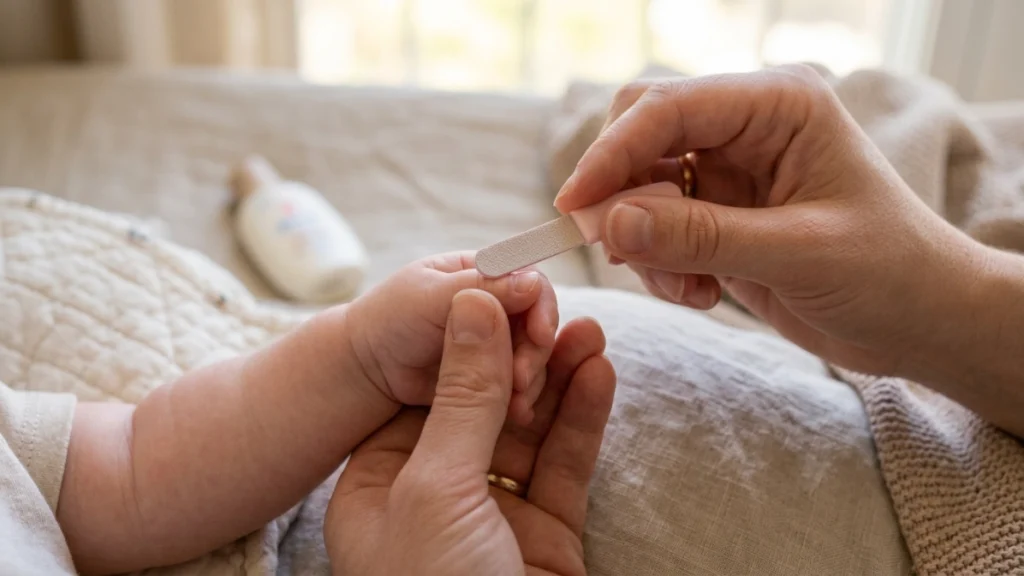
You do not need a complicated routine.
1. Pick a Calm Time
Trying to file the nails of a kicking, grabbing baby makes the job harder.
A good time may be when your baby is:
- Sleeping
- Feeding
- Relaxed
- Being held calmly by another adult
The NHS recommends trimming baby’s nails while the baby is asleep or relaxed because less movement makes nail care easier.
2. Use Good Lighting
Tiny nails can blend into the skin.
Sit somewhere bright so you can clearly see:
- The free edge of the nail
- The fingertip
- The surrounding skin
Do not file by feel alone.
3. Support the Finger
Hold one finger gently but securely.
Keep the fingertip stable without squeezing.
This helps prevent a sudden movement from pushing the file onto the surrounding skin.
4. File the Sharp Edge Gently
Place the file against the free edge of the nail.
Use small, controlled strokes.
You are trying to smooth the nail, not dramatically shorten it.
Avoid aggressive sawing.
For older children’s nail care, the American Academy of Dermatology recommends smoothing rough edges with a file and moving it consistently rather than filing aggressively back and forth.
5. Check With Your Fingertip
Run your clean finger gently across the finished edge.
If you still feel a sharp corner, file it a little more.
Stop when the edge feels smooth.
6. Clean or Replace the File
Disposable emery boards should be replaced when they become worn, dirty, bent, or rough.
Reusable tools should be cleaned according to their manufacturer’s instructions.
Do not share nail tools between people without proper cleaning.
How Often Should You File Baby Nails?
There is no need to follow a strict schedule.
Check them regularly and file when you notice a sharp edge.
Some babies may need nail care more often than others.
Instead of thinking, “It has been a certain number of days, so I must file them,” look at the nails themselves.
Ask:
- Are they getting long?
- Is there a sharp corner?
- Is my baby scratching their face?
- Is a nail catching on clothing?
If the answer is no, you probably do not need to do anything yet.
Should You File or Cut a Newborn’s Nails?
For a very young baby, filing can feel easier because you can work slowly.
You do not have to position a cutting blade close to the skin.
However, filing is not automatically better in every situation.
If the nails have grown significantly beyond the fingertip, trimming may be quicker. You can then use a fine file to smooth any remaining rough edges.
The safest approach is often the method you can perform with the most control.
Are Electric Baby Nail Files Worth It?
They can be convenient, but they are optional.
A basic manual file performs the essential job: smoothing the nail.
An electric model may make sense if:
- You strongly dislike using clippers.
- Your baby’s nails need frequent smoothing.
- You find manual filing tiring.
- You want several interchangeable filing pads.
The tradeoff is cost and complexity.
A manual emery board is usually the least expensive approach. An electric file costs more and may also require replacement pads, batteries, or charging.
Do not assume that a more expensive tool is automatically safer.
Technique and gentle pressure matter more than having a motorized file.
Expert Tip: File only what needs smoothing. Trying to make every nail perfectly even can lead to unnecessary filing and irritated fingertips.
Can a Baby Nail File Hurt the Skin?
Yes, if it is used too aggressively.
Even a gentle nail file is abrasive.
If it repeatedly rubs against the skin beside the nail, you may notice:
- Redness
- Tenderness
- Scraped skin
- Minor bleeding
- Fussiness when the finger is touched
Stop immediately if you reach the skin.
If you are using an electric file, never hold the moving pad against one spot for an extended period.
Hygiene Matters More Than You May Think
Baby nail tools touch areas where small scratches can occur.
Keep them clean.
Avoid using a dirty file that has:
- Makeup residue
- Nail dust from another person
- Dirt
- Moisture damage
- A worn or damaged surface
Do not use the same disposable emery board for your own manicure and then your baby’s nails.
Cuticles also deserve protection. They form a protective barrier around the nail. The American Academy of Dermatology’s manicure safety advice advises against cutting or aggressively pushing back cuticles because damaging them can increase infection risk.
There is no reason to push back or trim a baby’s cuticles during routine nail care.
What If You Accidentally File Too Much?
First, stop filing.
If the nail itself simply looks shorter than planned but the skin is intact, leave it alone and allow it to grow.
If you have irritated the skin:
- Stop using the tool.
- Keep the area clean.
- Avoid additional filing or clipping.
- Watch for increasing redness, swelling, drainage, or tenderness.
Do not try to “fix” an over-filed nail by filing the other nails equally short.
Baby nail care is about comfort and safety, not creating a perfect manicure.
Common Mistakes to Avoid
Baby nail filing is simple, but a few mistakes can make it uncomfortable.
- Using a coarse adult file. A rough grit may remove too much from a thin baby nail.
- Filing while your baby is moving. Wait until the baby is calm.
- Pressing too hard. Gentle contact is enough.
- Filing the surrounding skin. Keep your attention on the nail’s free edge.
- Trying to make every nail identical. Smooth is more important than perfectly shaped.
- Using dirty tools. Keep reusable tools clean and replace worn disposable files.
- Cutting or pushing back the cuticles. Leave them alone.
- Ignoring redness or swelling. Persistent changes deserve professional attention.
- Using an electric file on high speed immediately. Begin with the gentlest appropriate setting.
- Continuing after your baby becomes distressed. Finish the remaining nails later.
When to See a Nail Technician or Dermatologist
For routine baby nail care, you normally do not need a nail technician.
A salon manicure is unnecessary for an infant.
If the issue appears medical rather than cosmetic, a pediatrician or dermatologist is more appropriate.
Contact a healthcare professional if you notice concerns such as:
- Persistent swelling
- Increasing redness
- Pus or unusual drainage
- Bleeding that does not settle
- Significant tenderness
- Skin that looks infected
- A nail repeatedly growing into the surrounding skin
- Major changes in nail color or shape
- An injured nail that is lifting or badly damaged
The American Academy of Dermatology notes that significant changes in nail color, texture, or shape can sometimes deserve evaluation by a dermatologist.
For an older child or adult, a licensed nail technician can help with normal cosmetic filing and shaping. A nail technician should not be used as a substitute for medical care when infection, injury, or disease is suspected.
Baby Nail Care at Home vs. Professional Help
Most routine baby nail maintenance belongs at home.
| Situation | Best Next Step |
| One sharp nail edge | Gently file at home |
| Nails slightly too long | File or use baby nail clippers |
| Baby moves too much | Try again while calm or asleep |
| Mild rough edge after clipping | Smooth with a fine file |
| Significant redness or swelling | Contact a healthcare professional |
| Drainage or suspected infection | Seek medical advice |
| Cosmetic shaping only | No professional service is usually needed for a baby |
The important distinction is between normal nail maintenance and a possible nail or skin problem.
FAQs
Do newborns need a special nail file?
Not always. A fine emery board can work well. A baby-specific file may simply be easier to hold and gentle enough for tiny nails.
Is filing safer than clipping baby nails?
Filing may feel easier because you can shorten or smooth the nail gradually. Clippers are also an accepted option when used carefully. The best choice depends on your control and your baby’s movement.
Can I use my normal nail file on my baby?
Avoid very coarse adult files. Baby nails are thin, so a fine, gentle file is a better choice.
Can I file my baby’s nails every day?
You generally only need to file when nails have become long or sharp. Unnecessary filing can irritate the nail or nearby skin.
Do I need an electric baby nail file?
No. An electric baby nail file is optional. A simple manual file or fine emery board can do the same basic job.
What should I do if my baby moves while I am filing?
Stop and try again later. Filing while your baby is asleep, feeding, or relaxed can make the process much easier.
Should I file a baby’s toenails too?
You can gently smooth sharp toenail edges when needed. Avoid aggressively rounding or digging into the sides of the toenail. Keeping toenails from being cut too short or down the sides helps reduce problems around the nail edge.
Final Thoughts: Do I Need a Baby Nail File?
So, do I need a baby nail file?
You do not absolutely need a special baby-branded file, but having a gentle nail file can make baby nail care much less stressful.
A fine emery board or baby nail file is especially helpful when the nails are already short but have sharp corners. Clippers may be quicker when the nails become longer.
Whichever tool you choose, focus on the basics: good light, a calm baby, gentle pressure, clean tools, and smooth—not excessively short—nails.
If a nail or the surrounding skin becomes swollen, very red, painful, injured, or appears infected, stop treating it as a simple grooming issue and contact an appropriate healthcare professional.
Choose the method you feel you can control safely. Your baby’s nails do not need to look perfect. They simply need to be clean, comfortable, and free of sharp edges.

