
Do I Need to Bring a Baby Nail File to the Hospital? A New Parent’s Guide

If you are packing your hospital bag, you may be wondering, “Do I need to bring a baby nail file to the hospital?” It is a sensible question. Newborn nails can be soft, thin, and surprisingly sharp.
The good news is that a baby nail file is not usually a must-have hospital item. Standard hospital-bag checklists focus more on clothes, diapers, blankets, feeding needs, and a safe way to take your baby home. The NHS hospital bag checklist does not list a nail file among its essential baby items.
Still, a small, fine baby nail file can be convenient. Some babies are born with long or jagged nails and may accidentally scratch their faces. In this guide, I’ll explain whether to pack one, what type is safest, how to use it, and when a nail problem needs professional attention.
Quick Answer
No, you generally do not need to bring a baby nail file to the hospital. It is an optional item rather than a hospital-bag essential. However, packing a small, fine emery board can be useful if your newborn has sharp or rough nails that could scratch their face.
Why Newborn Nails May Need Attention
Newborn fingernails are different from adult nails. They tend to be thin, flexible, and soft. At the same time, their edges can feel surprisingly sharp.
Babies also have very little control over their hands during the newborn stage. Their hands often move toward their faces, so sharp nails can cause small scratches. MedlinePlus notes that newborn nails can injure the baby’s skin when they are jagged or too long and recommends keeping them clean and appropriately trimmed.
This does not mean you need to start cutting every nail immediately after birth. Look at your baby’s nails first.
If they are smooth and short, there may be nothing to do.
If one edge feels rough or pointed, gentle filing may be enough.
Is a Baby Nail File an Essential Hospital Bag Item?
For most parents, no.
Your hospital bag has limited space, and certain items deserve priority. Clothes, diapers, wipes or cotton wool, a blanket, feeding supplies when needed, and an appropriate car seat are much more important.
A baby nail file falls into the nice-to-have category.
| Item | Hospital Bag Priority | Why |
|---|---|---|
| Diapers | Essential | Needed for regular diaper changes |
| Baby clothes | Essential | Needed during the stay and for going home |
| Blanket | High | Helps keep your baby comfortable |
| Car seat | Essential when travelling by car | Needed for safe transportation |
| Baby nail file | Optional | Useful for smoothing sharp nails |
| Baby nail clippers | Usually optional | May not be needed during a short stay |
| Electric baby nail file | Optional | Convenient but adds extra equipment |
Hospital requirements and what the maternity unit provides can vary. Check your own hospital’s maternity packing list instead of assuming it will supply a particular baby-care tool.
Why You Might Still Want to Pack a Baby Nail File
Although it is optional, there are good reasons to put one in your toiletry or baby-care bag.
Your Baby Could Be Born With Sharp Nails
Some newborns have nails that extend beyond the fingertip at birth. Others have uneven or jagged edges.
Stanford Medicine notes that newborn nails are often jagged or sharp and that babies can scratch their own faces because they naturally bring their hands upward.
A file lets you smooth only the troublesome edge without taking much length off the nail.
Filing Can Feel Less Intimidating Than Cutting
Using tiny scissors or clippers on a newborn can make a first-time parent nervous.
A fine file gives you more control because you can work slowly. There is no sudden clipping motion.
The NHS guidance on caring for a newborn’s nails specifically says that parents can use a fine emery board to file a baby’s nails. It also recommends working when the baby is asleep or relaxed.
A Manual File Takes Almost No Space
A basic emery board is thin and lightweight. You can keep one in a clean pouch without making your hospital bag noticeably heavier.
That makes it an easy optional extra if you prefer being prepared.
What Type of Baby Nail File Should You Bring?
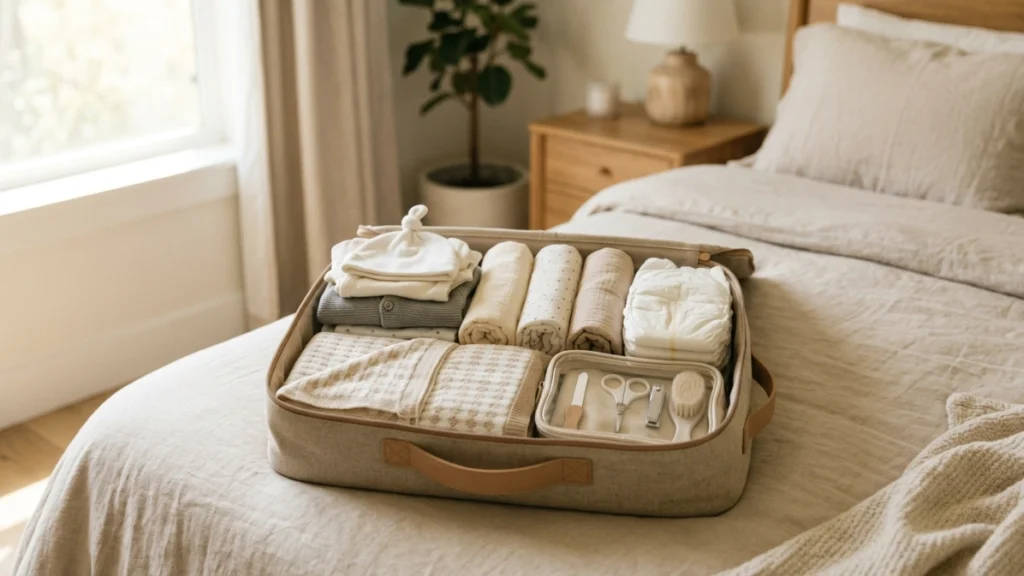
Not every nail file is suitable for a newborn.
The safest practical choice is usually a small, fine, gentle file intended for babies.
Fine Emery Board
A fine emery board is simple and inexpensive.
It works well for:
- Smoothing one sharp corner
- Removing a rough edge
- Shortening a very soft nail gradually
- Parents who are nervous about clippers
The American Academy of Pediatrics’ HealthyChildren guidance recommends an emery board for smoothing sharp or rough nail edges.
Electric Baby Nail File
Electric baby nail trimmers use rotating filing pads instead of cutting blades.
They can be useful at home, but you do not need one simply because you are going to the hospital.
If you use an electric model, follow its instructions closely. Use only the newborn-appropriate attachment and the gentlest suitable setting.
A manual file is usually easier to pack and does not require batteries or charging.
Adult Nail Files
Avoid using a very coarse adult file on delicate newborn nails.
Newborn nails require little pressure. A coarse surface can remove more nail than you intended and may irritate the nearby skin.
Metal Nail Files
A metal file is durable, but durability is not the main goal for newborn care.
For a baby’s soft nails, a gentle filing surface and easy control matter more than having a file that lasts for years.
Cost, Quality, and Durability: What Actually Matters?
You do not need an expensive nail-care system for a newborn.
Basic baby emery boards are usually simple products. If you already have a clean, fine baby file, there is little reason to purchase a complicated tool just for your hospital stay.
When comparing options, prioritize:
- Fine filing texture
- Rounded or smooth edges
- Small, easy-to-control size
- A clean storage case or pouch
- Newborn suitability
- No loose or damaged abrasive material
An electric file may last longer than disposable emery boards, but it also costs more and needs appropriate attachments.
For a hospital bag, simplicity usually wins.
How to File a Newborn’s Nails Safely
You do not have to file your baby’s nails simply because you brought the tool.
Only use it when there is a rough or sharp edge that needs attention.
1. Wait Until Your Baby Is Calm
Choose a time when your baby is sleeping, feeding peacefully, or deeply relaxed.
Both NHS and American Academy of Pediatrics guidance suggest dealing with nails while a baby is asleep or relaxed because there is less movement.
2. Make Sure You Have Good Light
Never work on tiny nails in a dark hospital room.
Move somewhere with enough light to clearly distinguish the nail from the surrounding skin.
3. Hold the Finger Gently
Support one finger at a time.
Do not squeeze it tightly. You simply want enough control to keep the fingertip steady.
4. File the Sharp Edge Slowly
Use gentle, controlled movements.
You are trying to smooth the rough edge, not dramatically shorten the nail.
Stop frequently and feel the edge with your fingertip.
5. Stop Once the Nail Feels Smooth
More filing is not better.
Once the sharp point is gone, leave the nail alone.
Never file aggressively toward the skin or continue until the nail becomes extremely short.
6. Keep the File Clean
Keep the file in a clean, dry pouch.
Do not share your baby’s nail file with adults or use a file that has previously been used on an infected or damaged nail.
Expert Tip
Expert Tip: If only one tiny corner of your newborn’s nail feels sharp, smooth that spot rather than filing the whole nail. Newborn nails are thin, so a little work can make a big difference.
Filing vs Clippers for a Newborn
Both methods can have a place in baby nail care.
| Feature | Baby Nail File | Baby Nail Clippers |
|---|---|---|
| Control | Very gradual | Removes nail instantly |
| Best for | Rough and sharp edges | Nails that are clearly too long |
| Learning curve | Usually simple | Requires careful positioning |
| Risk of nicking skin | Lower when used gently | Possible if baby moves suddenly |
| Speed | Slower | Faster |
| Hospital necessity | Optional | Optional |
MedlinePlus advises that newborn nails can be carefully trimmed with small blunt-tipped scissors and smoothed with an emery board. The best option therefore depends on the nail and your confidence level rather than one tool always being superior.
What If You Forget the Nail File?
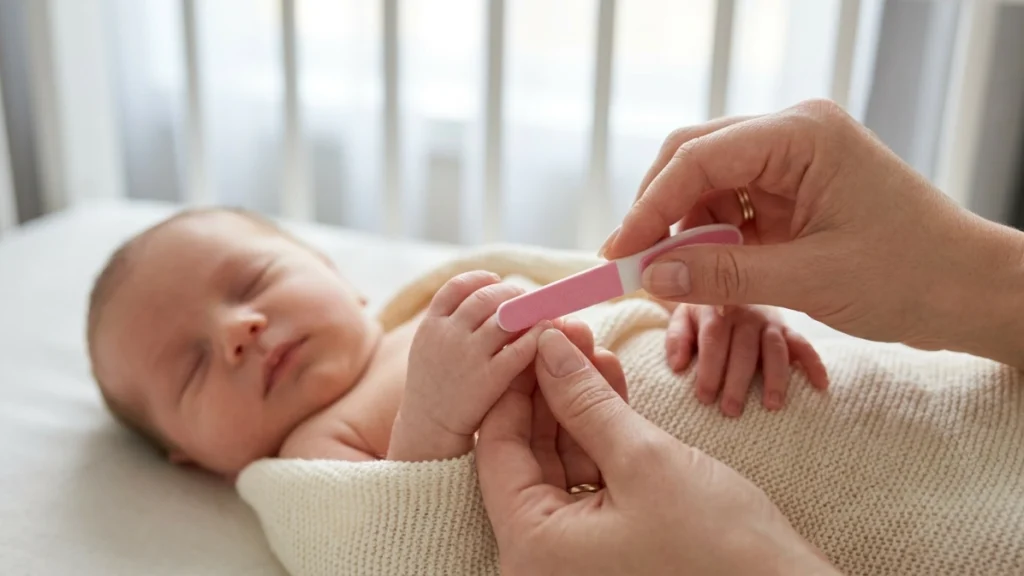
Do not worry.
Forgetting a nail file should not send someone home to retrieve it.
If your baby’s nails are not causing a problem, simply wait until you return home.
If a nail seems particularly sharp during your hospital stay, ask your nurse or maternity-care professional what they recommend. Hospital policies and available supplies vary, so do not assume staff will trim the nails or provide a grooming tool.
Your medical team can also show you how to handle a nail safely if you feel unsure.
Can Scratch Mittens Replace Nail Filing?
Scratch mittens are sometimes included on hospital packing lists, including the NHS checklist.
They can temporarily cover sharp nails, but they do not actually smooth them.
The American Academy of Pediatrics notes that good nail trimming may reduce the need for mittens and that some hospitals discourage routine mitten use.
Follow the advice given by your maternity or pediatric team, especially during your baby’s first days.
What If I Accidentally File or Cut Too Far?
First, stay calm and look closely at the fingertip.
A tiny superficial injury can happen because newborn fingers are extremely small. If there is bleeding, stop nail care immediately and follow the instructions given by your baby’s healthcare team.
Do not keep filing an injured nail.
Ask a nurse, pediatrician, or other qualified healthcare professional to assess the area if:
- Bleeding does not stop as expected
- The cut looks deep
- The nail is partly torn away
- The fingertip becomes increasingly red or swollen
- Pus or drainage appears
- Your baby seems unusually uncomfortable
Redness, drainage, and worsening swelling can be warning signs of infection rather than a simple rough nail. HealthyChildren also identifies increasing redness or pus among signs that a cut may be infected.
Common Mistakes to Avoid
Baby nails look simple to manage, but a few common mistakes make the job harder.
- Using a coarse adult nail file. Newborn nails are very thin, so use a gentle filing surface.
- Filing while the baby is moving. Wait until your baby is calm or asleep.
- Trying to make every nail perfectly shaped. Your goal is safety, not a manicure.
- Applying too much pressure. Light contact is usually enough.
- Filing too close to the skin. Stop once the sharp edge is smooth.
- Using dirty grooming tools. Keep the baby’s file clean and stored separately.
- Sharing nail tools. Give your baby dedicated grooming items.
- Ignoring redness or swelling. A nail problem that looks inflamed deserves medical attention.
- Using adult salon techniques on a newborn. Newborn nail care should remain basic and gentle.
Should a Nail Salon or Nail Technician Handle Baby Nails?
Generally, routine newborn nail care does not require a nail salon.
A newborn does not need cosmetic shaping, buffing, polish, cuticle work, or other manicure services.
For normal nails, parents can usually provide simple care at home after learning the correct method.
For a nail that appears injured, infected, badly ingrown, unusually shaped, or otherwise concerning, medical advice is more appropriate than salon treatment.
When to See a Nail Technician or Dermatologist
For an adult, a nail technician may help with cosmetic nail maintenance. For a newborn, a nail technician should not be your first choice for a suspected nail problem.
Start with your baby’s pediatrician or other healthcare professional.
They may recommend additional assessment or refer your baby to a dermatologist when necessary.
Seek medical advice if you notice:
- Increasing redness around a nail
- Significant swelling
- Pus or unusual drainage
- Persistent bleeding
- A deeply torn nail
- Skin that appears increasingly painful or inflamed
- A nail separating significantly from the nail bed
- Nail changes that concern you or do not improve
A newborn’s fingers are tiny and delicate. When something looks abnormal rather than simply sharp, professional medical assessment is the safer choice.
A Simple Hospital Bag Decision Checklist
Still unsure whether to pack the file?
Use this quick test.
Bring one if:
- You already own a clean baby nail file
- It is small and easy to pack
- You would feel more comfortable having it available
- You prefer filing instead of immediately using clippers
Leave it at home if:
- Your hospital bag is already crowded
- You do not own a newborn-appropriate file
- You plan to handle nail care after you return home
- Packing it is causing unnecessary stress
There is no prize for fitting every possible baby-care product into your maternity bag.
Focus on essentials first.
FAQs
Do hospitals provide baby nail files?
Some facilities may have supplies or offer advice, but you should not assume your hospital provides baby nail files. Hospital practices vary. Check directly with your maternity unit if this matters to you.
Can I file my newborn’s nails on the first day?
If a nail has a sharp edge that is scratching your baby’s skin, gentle filing with a fine emery board can be an option. NHS, MedlinePlus, and American Academy of Pediatrics guidance all recognize filing as a method of caring for newborn nails.
Is filing safer than clipping newborn nails?
Filing provides gradual control and can feel easier for nervous parents. Clippers are faster when nails become long, but they require careful positioning. Whichever method you use, work gently while your baby is calm.
Can I use my own nail file on my newborn?
A fine, clean file may work, but a baby-specific fine emery board is easier to control. Avoid coarse files, rough surfaces, and tools previously used on unhealthy or infected nails.
Do newborn babies really scratch themselves?
Yes. Newborns naturally move their hands toward their faces before they have good control of their movements. Sharp or jagged nails can therefore leave facial scratches.
Should I bring baby nail clippers to the hospital too?
You can, but they are not usually a high-priority hospital-bag item. A fine file may be enough for a rough edge during a short hospital stay. Keep clippers at home unless you specifically want them available.
How often will I need to care for my baby’s nails?
Newborn fingernails can grow quickly. MedlinePlus notes that fingernails may need trimming about once a week, while toenails generally require less frequent attention. Check the nails regularly instead of following a rigid schedule.
Conclusion
So, do I need to bring a baby nail file to the hospital? Usually, no. It is an optional convenience rather than an essential hospital-bag item.
If you have room, a clean, fine baby emery board is easy to pack and may be useful if your newborn arrives with a sharp or jagged nail. Use it gently, work only when your baby is calm, and stop once the rough edge is smooth.
Prioritize genuine hospital essentials first. Once your baby arrives, look at their nails before deciding whether anything needs to be done.
And if a nail looks injured, swollen, infected, or otherwise unusual, skip the DIY grooming and ask your baby’s healthcare professional for guidance.

