
Do You Need Dehydrator and Primer for Nails?

Quick Answer
You don’t always need both nail dehydrator and primer. A dehydrator removes temporary oil and moisture from the nail surface, while primer helps certain gels, acrylics, extensions, or adhesives bond more securely. Your product system’s instructions should come first, especially because some nail primers contain stronger ingredients than others.
When do you need each one?
- Dehydrator: Helpful when natural nails are oily or when your enhancement system recommends an extra oil-removal step.
- Primer: Useful when your gel, acrylic, extension, or bonding system specifically needs an adhesion promoter.
- Both products: Often used together for enhancement services where maximum adhesion is important.
- Neither product: Some modern systems are designed to bond after basic nail prep without separate dehydrator or primer.
- Correct order: Prep and clean the nail first, apply dehydrator, then primer if your system calls for it.
Best rule to remember
- Don’t add more prep chemicals just because you assume more products mean better retention. Match your prep to the system you’re using.
If you’ve wondered, “Do you need dehydrator and primer?”, the confusing part is that the two bottles often appear together in nail kits. That makes them look interchangeable or equally necessary.
They’re not. I think of them as two separate tools doing two different jobs before gel, acrylic, Gel-X, dip, or another enhancement is applied.
In this guide, I’ll explain what each product does, when using both makes sense, and when you can safely simplify your prep routine.
In This Guide
- What do nail dehydrator and primer actually do?
- Do you need dehydrator and primer together?
- When should you use a nail dehydrator?
- When do you actually need nail primer?
- What is the correct order for dehydrator and primer?
- Do different nail systems need different prep?
- Why are my nails still lifting after dehydrator and primer?
- Are nail dehydrator and primer safe to use?
- Frequently asked questions
- Bottom line
What Do Nail Dehydrator and Primer Actually Do?
A nail dehydrator temporarily removes surface oil and moisture before product application. A nail primer prepares that surface for stronger bonding with a compatible enhancement system.
That difference matters because removing oil and improving adhesion are related jobs, but they’re not the same job.
What does nail dehydrator do?
A nail dehydrator is part of the prep stage. You normally apply a thin layer after shaping, light surface preparation, and cleaning away nail dust.
It evaporates quickly and leaves the natural nail looking dry or slightly chalky. No lamp is usually needed unless your specific product says otherwise.
The main reasons people use dehydrator are:
- Removing temporary surface oils before product application
- Reducing moisture that may interfere with adhesion
- Creating a cleaner surface before primer or a bonding product
- Helping prep naturally oily nail plates
Dehydrator isn’t glue. It doesn’t create the same bonding layer that a primer or bonder can create.
What does nail primer do?
Primer is an adhesion-promoting prep product. Its purpose is to help the next compatible nail product hold onto the prepared natural nail.
Primers aren’t all identical. Acid-free primers, acid primers, bonders, and system-specific prep products can behave differently.
- Acid-free primer: Common in many modern gel and enhancement systems.
- Acid primer: A stronger professional prep option used with some enhancement systems.
- Bonder: Often creates a sticky or bonding layer, depending on the formula.
- System primer: Made specifically to work with products from the same nail system.
That’s why I wouldn’t treat every bottle labeled “primer” as interchangeable.
Section Takeaway: Dehydrator primarily removes surface oil and moisture. Primer primarily promotes adhesion between the prepared nail and a compatible product.
Do You Need Dehydrator and Primer Together?
Sometimes, but not always. Using dehydrator followed by primer is common for enhancement systems where strong retention matters, but some systems require only one product.
Others may not require either as a separate step.
When using both makes sense
I would consider both when the product manufacturer’s instructions specifically recommend both steps. They’re also commonly paired when oily nails have a history of premature lifting.
A typical two-product approach looks like this:
- Prepare the natural nail.
- Remove nail dust and contamination.
- Apply a thin coat of dehydrator.
- Let it air-dry completely.
- Apply the recommended primer.
- Continue with the base, acrylic, gel, or extension system.
The dehydrator tackles the surface condition first. The primer then prepares that cleaned surface for adhesion.
When you may not need both
Some gel polish, soft-gel tip, builder gel, dip, and press-on systems have their own prep requirements. Adding an unrelated primer can sometimes create compatibility problems rather than solve them.
- Your system may already contain a bonding base.
- Your primer may include prep properties of its own.
- The manufacturer may specify cleanser only.
- Some press-on adhesives are designed for clean, dry nails without primer.
- Regular nail polish usually doesn’t need an enhancement primer.
More prep isn’t automatically better. The correct combination matters more than the number of bottles you use.
When Should You Use a Nail Dehydrator?

A dehydrator is most useful when surface oil or moisture could interfere with adhesion. It’s particularly common before gel extensions, acrylics, builder products, or other longer-wear systems.
It can also help when someone’s nails become oily again quickly after cleansing.
Signs dehydrator may be useful
- Your enhancement system specifically requires it.
- Lifting happens despite otherwise careful prep.
- The natural nail looks oily again shortly after cleaning.
- You need a consistent dry surface before primer.
- You’re applying an enhancement designed around a multi-step prep system.
Don’t confuse dehydration with aggressive filing. You shouldn’t need to thin the natural nail plate just to make a dehydrator work.
Can alcohol replace a nail dehydrator?
High-concentration isopropyl alcohol is sometimes used as a nail cleanser because it can remove oils and evaporate quickly. That doesn’t automatically make it chemically identical to a branded dehydrator.
Some dehydrators contain different solvent blends. Follow the instructions for the nail system you’re using instead of assuming every prep liquid is interchangeable.
Before applying any prep product, keep the nail surface free from hand cream, cuticle oil, food oils, and unnecessary touching.
When Do You Actually Need Nail Primer?
You need primer when the nail system you’re applying calls for it or when a compatible primer is being used to solve an adhesion problem. Primer shouldn’t be added blindly to every manicure.
This is especially important because primer formulas can differ significantly.
Primer is commonly used with enhancements
You may encounter primer when working with acrylic, hard gel, builder gel, soft-gel extensions, or other artificial nail systems. The exact requirement depends on the chemistry of the products.
Many brands design their dehydrator, primer, base, gel, and top products as one system. Mixing prep chemicals from several brands may work, but compatibility shouldn’t be assumed.
Acid-free primer versus acid primer
Acid-free primers are popular because they’re designed to promote adhesion without relying on methacrylic acid. They still need careful application and should stay off surrounding skin.
The FDA notes that methacrylic acid has been used in nail primers to improve artificial-nail adhesion. Primers containing it can require additional safety precautions.
You can review the FDA’s guidance on nail care products and nail-primer ingredients before choosing or using unfamiliar formulas.
For home use, I wouldn’t move to a stronger primer simply because one manicure lifted. Technique and compatibility should be checked first.
What Is the Correct Order for Dehydrator and Primer?
Dehydrator normally comes before primer. Think of the sequence as prepare, clean, dehydrate, prime, then apply the enhancement system.
Always change that sequence if your product manufacturer gives different instructions.
A practical nail-prep order
- Wash and dry your hands: Start with clean hands and fully dry nails.
- Shape the nail: File the free edge to the desired shape.
- Manage the cuticle area gently: Remove only non-living tissue that could interfere with product placement.
- Prepare the surface: Lightly remove shine only when your nail system requires it.
- Remove dust: Keep the nail surface clean and untouched.
- Apply dehydrator: Use a thin amount and let it evaporate.
- Apply primer: Use only the amount recommended by the manufacturer.
- Apply the nail system: Continue with the designated base, gel, acrylic, adhesive, or extension product.
A common mistake is applying cuticle oil immediately before dehydrator. That gives the prep product more oil to remove and can undermine the clean surface you just created.
I prefer saving cuticle oil for the end of the service, after the enhancement or polish has been completed.
Do Different Nail Systems Need Different Prep?
Yes. There isn’t one universal dehydrator-and-primer rule for every manicure.
The table below gives a practical starting point, but your manufacturer’s instructions remain the deciding factor.
| Nail System | Dehydrator | Primer | What Matters Most |
|---|---|---|---|
| Regular polish | Usually optional | Usually unnecessary | Clean, oil-free nails and suitable base coat |
| Gel polish | System-dependent | System-dependent | Correct base coat, prep, and curing |
| Builder gel | Often used | May be recommended | Compatibility with the builder system |
| Soft-gel/Gel-X style tips | Common | Common in some systems | Tip preparation, fit, adhesive, and curing |
| Acrylic | Common | Common | Correct primer type and monomer system |
| Dip powder | Varies | Varies | Follow the liquids supplied with the dip system |
| Press-on nails | Can be helpful | Often unnecessary | Clean surface, correct sizing, and compatible adhesive |
For example, I wouldn’t automatically put acrylic primer under ordinary press-on glue. Unless the adhesive manufacturer recommends that combination, it adds a chemical step without a clear reason.
Likewise, regular polish doesn’t normally need an acrylic-style primer. A suitable base coat does a different job and is usually the more relevant product.
Section Takeaway: Match dehydrator and primer to your nail system. Product compatibility matters more than following one universal prep routine.
Why Are My Nails Still Lifting After Dehydrator and Primer?
Dehydrator and primer can’t compensate for every prep or application problem. If lifting continues, look at the whole service rather than adding another coat of primer.
These are the first issues I would check.
Too much primer
Primer should usually be applied sparingly. Flooding the nail with product doesn’t necessarily create a stronger bond.
Follow the amount and drying instructions printed on your specific product.
Product touched the skin
Gel, acrylic, adhesive, or base product sitting on the surrounding skin can contribute to poor application and unwanted exposure. Leave a controlled margin around the skin instead of flooding the cuticle area.
You touched the prepared nail
Once the nail has been cleaned and prepared, repeatedly touching it can transfer oils back onto the surface. Handle the finger from the sides where possible.
Cuticle or non-living tissue remains on the nail plate
Product bonded to tissue instead of the nail can lift as that tissue separates. Careful preparation around the cuticle area matters.
Aggressive cuticle cutting isn’t the answer, though. The American Academy of Dermatology recommends protecting the cuticle because it helps guard the nail root against infection.
Your layers are too thick
Thick gel layers may not behave like properly applied thin layers. With light-cured products, correct lamp compatibility and curing time are also essential.
The products may not be compatible
A dehydrator from one brand, primer from another, base from a third, and gel from a fourth may create unpredictable results. Using a coordinated system can remove one variable while you’re troubleshooting.
Section Takeaway: Persistent lifting isn’t automatically a sign that you need more primer. Check contamination, skin contact, prep, layer thickness, curing, and product compatibility first.
Are Nail Dehydrator and Primer Safe to Use?
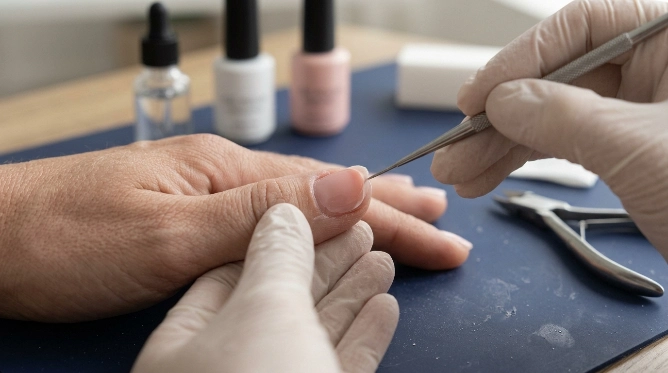
They can be used safely when they’re suitable for the service and used according to their labels. Avoid treating prep chemicals as harmless simply because the amounts are small.
The FDA advises consumers to read nail-product directions and warnings carefully. Good ventilation also matters when using nail products that release vapors.
Keep primer and dehydrator off your skin
Apply them to the nail plate, not the cuticle or surrounding skin. Repeated exposure to certain nail chemicals may contribute to irritation or allergic reactions.
Stop using a product if you develop burning, swelling, persistent redness, blistering, or another significant reaction.
Don’t apply aggressive prep to damaged skin
Avoid getting prep chemicals into cuts, torn cuticles, or irritated skin. Damaged skin can make chemical exposure more uncomfortable and potentially more problematic.
The OSHA nail-salon chemical safety guidance also stresses reading product labels, following manufacturer instructions, limiting unnecessary exposure, and keeping products away from skin and eyes.
Ventilation still matters
Strong odors aren’t a reliable measurement of danger, but they shouldn’t be ignored either. Keep the room well ventilated and close product bottles promptly after use.
Pay attention to your natural nails
Don’t cover a painful, swollen, unusually discolored, or obviously infected-looking nail just to complete a set. Cosmetic prep isn’t treatment for an underlying nail problem.
The American Academy of Dermatology’s manicure and pedicure guidance recommends paying attention to nail changes and using careful manicure practices.
Health note: Persistent pain, swelling, drainage, unusual discoloration, or a worsening reaction should be evaluated by a qualified healthcare professional or dermatologist.
Frequently Asked Questions
Can I use nail dehydrator without primer?
Yes. You can use dehydrator without primer when your nail system allows it. A dehydrator can remove surface oils before gel, adhesive, or another product, while primer is only needed when your particular system calls for an adhesion-promoting step.
Can I use primer without dehydrator?
Sometimes. Some systems allow primer after their recommended cleansing and prep routine without a separate dehydrator.
Check the instructions for both the primer and the enhancement product instead of assuming dehydrator is mandatory.
Is dehydrator the same thing as primer?
No. Dehydrator primarily removes temporary surface oil and moisture, while primer helps compatible nail products bond to the prepared nail.
Because they solve different problems, one isn’t automatically a replacement for the other.
Do I need dehydrator and primer for gel nails?
Not every gel system requires both. Some gel-polish or builder-gel systems recommend dehydrator and primer, while others use their own cleanser, bonder, or base product.
Follow the manufacturer instructions for the exact gel system you’re using.
Do I need dehydrator and primer for press-on nails?
A dehydrator can be useful for removing surface oil before press-on adhesive, but a separate nail primer isn’t always necessary. Use primer only when the press-on or adhesive manufacturer recommends it.
Do dehydrator and primer need a UV or LED lamp?
Many traditional dehydrators and primers air-dry and don’t require curing. Some bonding products marketed alongside primers may have different instructions, so always read the label before putting your hand into a lamp.
What happens if I use too much nail primer?
More primer doesn’t automatically produce better adhesion. Excess product can interfere with a controlled prep routine and increases unnecessary chemical exposure.
Use a thin amount according to the manufacturer’s directions.
Do You Need Dehydrator and Primer? The Bottom Line
So, do you need dehydrator and primer? You need them when your nail system, nail condition, and prep routine justify them—not simply because the products are commonly sold together.
A dehydrator removes temporary oil and moisture. Primer provides an adhesion-promoting step for compatible nail systems.
For acrylics, builder systems, and many extensions, using both may be part of a reliable prep routine. For regular polish, some gel systems, and many press-ons, one or both steps may be unnecessary.
My favorite rule is simple: use the fewest prep products needed to follow your system correctly. Don’t turn a basic adhesion problem into an overloaded chemical routine.
Start with clean nails, careful preparation, thin applications, and products designed to work together. Then adjust only when there’s a clear reason.

