
Do You Tip at a Nail Salon? A Practical Guide to Nail Salon Tipping Etiquette

If you’re wondering do you tip nail salon staff, the short answer is yes, in the U.S. it’s generally customary to tip for nail services. A tip is usually expected for the person who performed the service, whether that’s a nail technician, manicurist, or pedicurist. In most cases, 15% to 20% of the service cost is the standard range, which lines up with guidance from industry and consumer sources such as NerdWallet’s nail salon tipping guide and V Beauty Pure’s etiquette article.
That said, tipping at a nail salon is not one-size-fits-all. The right amount can change based on the service, the complexity of the work, whether the tech is the salon owner, and whether a gratuity is already included. If you want a fast rule: tip around 20% for a standard appointment, adjust up for detailed or time-intensive work, and check the bill before adding anything extra.
Do You Tip at a Nail Salon?
In most U.S. nail salons, tipping is part of normal service etiquette. It’s not usually built into the listed price, so if your manicure or pedicure was performed by a technician, leaving a gratuity is the common expectation rather than an unusual bonus.
The reason this feels confusing is that nail salons sit somewhere between retail and personal service. You’re not just buying a product; you’re paying for someone’s time, skill, and attention. That’s why tipping norms in nail care are closer to other service-based beauty appointments than to a store checkout.
A useful way to think about it:
- If someone performed a hands-on service for you, tipping is usually expected.
- If the price already includes a service charge or gratuity, you may not need to tip again.
- If you’re at a very casual or self-serve setup, ask before assuming the same rule applies.
There is some regional and salon-to-salon variation, so it’s better to follow the pricing and tipping norm of the specific business than to apply one universal rule.
For a broader overview of what to expect before your appointment, you may also find Nail Prime’s guide on whether you tip at a nail salon helpful.
How Much to Tip for Common Nail Services
The simplest starting point is 15% to 20% of the service price. That range is widely used for nail salon tipping, and it gives you a fair baseline without overthinking every appointment.
Here’s a practical table you can use when you’re deciding quickly:
| Service | Common tip range | Example on a $40 service | Example on a $60 service |
|---|---|---|---|
| Basic manicure | 15%–20% | $6–$8 | $9–$12 |
| Pedicure | 15%–20% | $6–$8 | $9–$12 |
| Gel manicure | 15%–20% | $6–$8 | $9–$12 |
| Acrylic set | 15%–20% or more if complex | $6–$8 | $9–$12 |
| Nail art or detailed design | 20%+ if especially involved | $8+ | $12+ |
A few practical notes help make this table more useful:
Basic manicures
For a routine manicure, 15% is usually the lower end of normal, and 20% is the more comfortable default if the service was pleasant and efficient. On a $40 manicure, that means about $6 to $8.
Pedicures
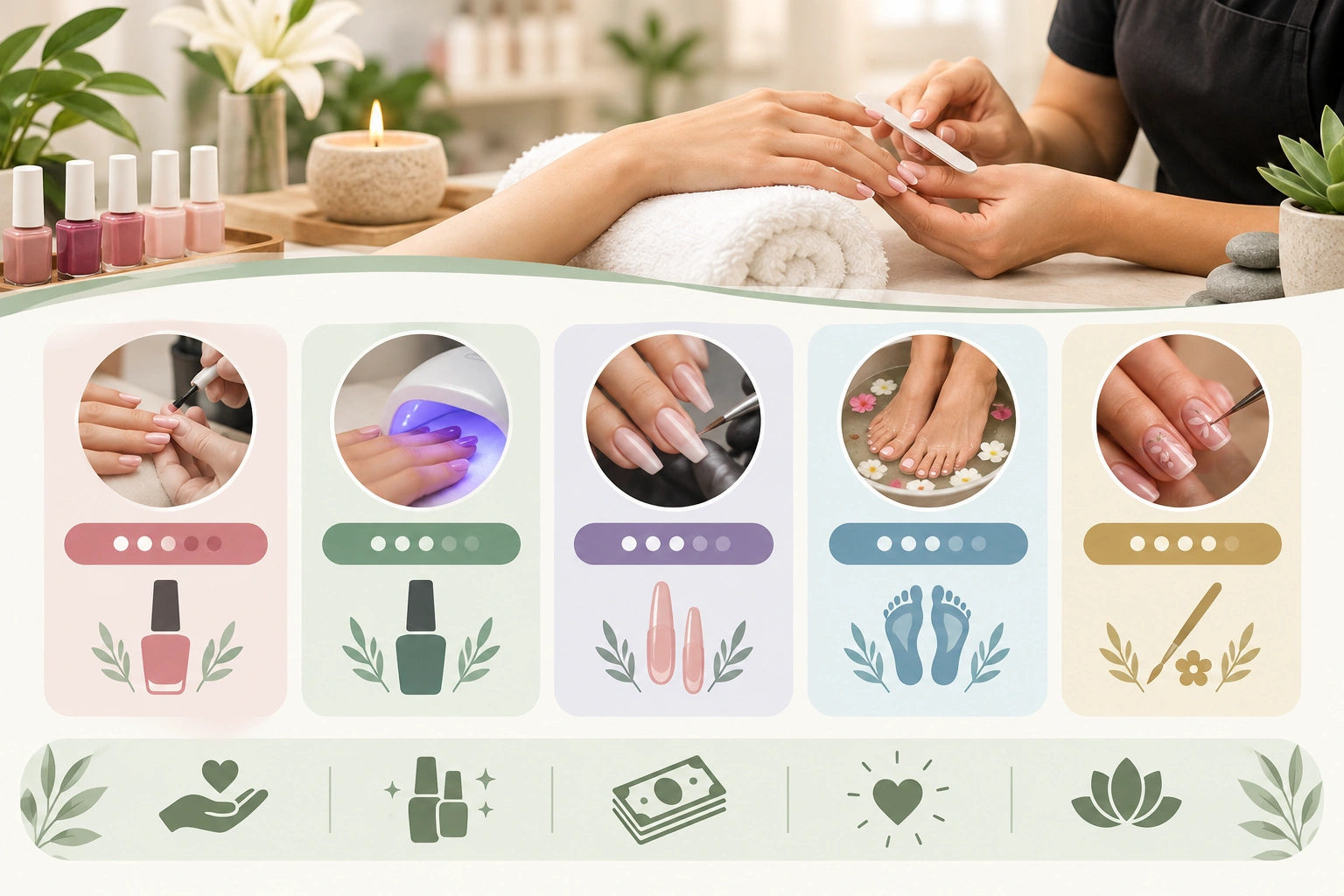
Pedicures often involve more time and physical effort, so many clients lean toward the higher end of the range. On a $60 pedicure, a tip around $9 to $12 fits the standard range.
Gel nails and acrylics
These services often take longer and require more precision than a basic polish change. If the appointment involved shaping, layering, curing, or careful finishing, tipping toward 20% is a reasonable choice.
Nail art
This is where the work can become highly individualized. A simple accent nail is one thing; a full set with intricate hand-painted detail is another. If the design clearly took extra skill or time, a higher tip is a fair way to acknowledge that effort.
If you’re looking for very low or very high price examples, the same percentage rule still applies: on a $25 service, 15% is about $4 and 20% is about $5; on a $100 service, 15% is $15 and 20% is $20.
Nail Prime also has related guides on what to tip at a nail salon and how much to tip at a nail salon if you want more examples by service type.
Should You Tip on the Base Price or the Total Bill?
In most cases, tip on the service price before tax, not the final total after tax and add-ons. That’s the cleanest and most common approach because the gratuity is meant to reflect the cost of the service itself, not government taxes.
Here’s the practical rule I recommend clients use:
- Use the base service price when calculating a standard tip.
- Do not double-tip on taxes unless the salon explicitly asks for it that way.
- If the bill includes multiple services, tip each service thoughtfully or use the service total as a whole.
Example: if your manicure is $40 and your pedicure is $60, you can either tip each service separately or calculate a tip on the combined $100 service total. What matters most is that you’re not accidentally tipping on a gratuity already included or on unrelated charges like retail products.
If you buy polish, cuticle oil, or another product at checkout, that retail purchase usually should not be part of the service tip.
Do You Tip the Salon Owner, Employee, or Independent Nail Tech?
This is one of the most common gray areas, and it’s worth getting right.
If the tech is an employee
Tip them the normal way. This is the most straightforward situation.
If the tech is the salon owner
A lot of clients assume owners should not be tipped, but many etiquette guides say you should still tip the person who performed the service, even if that person owns the salon. A published salon etiquette article from Erica’s ATA says to tip the person who did the work, including an owner. That’s a useful rule when the owner is hands-on and performing the service themselves.
In practice, though, owner tipping can vary more than people expect. Some salon owners set their own prices high enough that clients tip less often or tip a smaller amount, while others still follow standard service etiquette and expect a normal gratuity. If you’re unsure, look for a posted policy, check the booking notes, or ask the front desk what’s customary there.
If the tech is an independent contractor or booth renter
Tipping is still common, but the setup can feel different because the technician may set their own prices and keep more of the service revenue. In that case, many clients still tip, but some choose a smaller tip if the prices are already higher than a traditional salon. If the booth renter works like a standard service provider, a normal percentage is still a safe default; if their pricing is clearly premium, a modest tip or extra cash for especially good work may be more in line with the salon’s norms.
If the tech works from home
Home-based nail services often follow the same courtesy rules as salon services, but the expectation can vary more by local culture and pricing structure. If the service fee already feels premium, a tip may be appreciated, but the amount can depend on whether the home-based tech is essentially operating as a solo business owner or pricing the service like a traditional salon appointment. When in doubt, ask ahead of time whether gratuity is expected or already built into the price.
A simple decision rule: if the person spent time and skill on your service, tipping is usually appropriate unless the pricing model clearly says otherwise.
When a Service Charge or Gratuity Is Already Included
Before you leave an extra tip, check the receipt or booking confirmation for words like:
- gratuity
- service charge
- automatic tip
- appreciation fee
- included tip
Those charges are not always the same thing. A mandatory service charge is a separate line item the salon adds to the bill, while an included gratuity or auto-gratuity may already be the tip. Depending on the salon’s policy, a service charge may be kept by the business, shared among staff, or passed through in part to the technician, so it’s worth asking if the receipt doesn’t make that clear. If the bill already adds a gratuity, you usually do not need to tip again unless you want to leave something extra for exceptional service.
This is where many people overpay by accident. A quick glance at the bill can prevent that. If the receipt is unclear, ask politely at the front desk: “Is gratuity already included, and does it go to the technician?”
That one question saves awkwardness and protects you from tipping twice.
Cash Tip vs. Card Tip: What’s Better?
Cash is often preferred because it’s immediate and simple. The technician gets it right away, and there’s no waiting for payment processing or payroll distribution. That said, card tipping is still perfectly acceptable if cash isn’t available.
Here’s the trade-off:
- Cash tip: easiest for the tech to receive directly; best if you want to be certain it goes straight to the person who did the work.
- Card tip: more convenient if you don’t carry cash; good for a smooth checkout, though the payout process may vary by salon.
If you only have a card, don’t skip the tip just because you’re short on cash. Use the card terminal if the salon offers it, or ask whether you can add the gratuity to your payment.
A polite phrase works well: “Can I add the tip to my card, or would you prefer cash?”
For general consumer guidance on service tipping norms, NerdWallet’s overview is a helpful reference.
How to Adjust the Tip for Poor, Average, or Exceptional Service
Not every appointment deserves the same amount, and it’s reasonable to adjust based on service quality.
If the service was average
Stay in the standard range: 15% to 20%. Average doesn’t mean bad; it just means the appointment met expectations.
If the service was exceptional
Go higher. This is especially appropriate when the tech took extra time, fixed a problem graciously, or gave you careful attention without rushing.
If the service was poor
You have some room to reduce the tip, but it helps to be fair and specific. If the issue was a small annoyance, a smaller tip is more appropriate than no tip at all. If the service was rushed, careless, or clearly below standard, a tip of around 10% is a common lower-end response; if the result was genuinely unacceptable, you may choose not to tip and instead speak to the manager or front desk about the problem.
A practical way to judge this:
– One minor issue: reduce the tip slightly.
– Several issues, but still usable result: tip at the low end.
– Clearly unacceptable service: consider speaking to the manager instead of relying only on the tip.
Tipping should reflect the service you received, not punish ordinary human imperfection.
When to Tip Extra for Complex or Time-Intensive Work
Some services deserve more than the standard percentage because they require more skill, time, or attention.
This often applies to:
– detailed nail art
– acrylic sets
– repairs or reshaping
– specialty pedicures
– long appointments with multiple steps
The logic is simple: if the work took more precision or creative labor than a standard service, a standard tip may feel light. A higher tip is a practical way to show appreciation for the extra effort.
For example, if your appointment involved custom artwork across several nails, a flat 15% may technically be fine, but 20% or a little more is often more in line with the work involved.
Regional and Situational Differences to Keep in Mind
Tipping culture is not identical everywhere. In some regions, people tip more generously; in others, salon pricing may already be structured differently. Spa settings, luxury salons, and home-based appointments can all shift expectations too.
A few useful adjustments:
- Higher-end salons: prices may be higher, but tipping is still usually expected.
- Small independent studios: the owner may set prices to reflect more of the service value.
- Travel or international settings: don’t assume U.S. tipping rules apply.
When in doubt, watch the salon’s payment system, ask quietly, or follow local custom rather than forcing a universal rule.
Quick Rules for Tipping at a Nail Salon
If you want the shortest possible answer, use this checklist:
- Tip in most U.S. nail salons.
- Use 15% to 20% as your default range.
- Tip on the service price, not the retail items.
- Check whether gratuity is already included.
- Tip the person who did the work, including an owner if they performed the service.
- Cash is convenient, but card tipping is fine.
- Go higher for detailed nail art or time-intensive services.
- Adjust down only when the service quality truly warrants it.
If you keep those rules in mind, you can walk into almost any nail appointment with confidence.
When to See a Nail Technician or Dermatologist
If your question is about salon etiquette, a nail technician can usually help explain pricing, service charges, and how tipping works at that specific salon. If you have a nail or skin concern that affects whether you should book a service at all, it’s better to speak with a dermatologist before your appointment.
For general nail-care information from a medical source, the American Academy of Dermatology is a reliable place to start.

