
Do You Wipe Off Nail Dehydrator? The Right Way to Use It

Quick Answer
Usually, no—you do not wipe off a standard brush-on nail dehydrator. Apply a thin coat and let it air-dry or evaporate completely before moving to primer, base coat, gel, acrylic, or another compatible product. Always check your bottle’s directions, because some wipe-style or dual-purpose prep products work differently. For broader product-safety guidance, see the FDA’s nail care product guidance.
What to do after applying dehydrator
- Apply it thinly: Cover the natural nail without flooding the surrounding skin.
- Let it evaporate: Most brush-on formulas are designed to flash off on their own.
- Do not touch: Fingers can put oil and moisture back onto the prepared nail.
- Follow with primer: If your nail system calls for primer, dehydrator normally comes first.
- Check the label: A cleanser/dehydrator designed for use with a lint-free wipe may have different instructions.
The simplest rule
- Never automatically wipe a dehydrator off just because the nail still looks wet for a few seconds—let the formula work according to its directions.
If you’ve ever applied nail prep and immediately wondered, “Do I wipe this off now?”, you’re not alone. Dehydrators look simple, but confusing them with nail cleansers can undo careful prep.
I treat dehydrator as a short transition step between cleaning the natural nail and applying the bonding products. The important part is knowing whether you have a traditional brush-on dehydrator or a product specifically designed to be used with a wipe.
In This Guide
- Do you wipe off nail dehydrator after applying it?
- Why is nail dehydrator usually left to air-dry?
- What is the correct nail prep order?
- When should you wipe off a nail dehydrator?
- Nail dehydrator vs cleanser vs primer
- What happens if you wipe dehydrator off too soon?
- How long should nail dehydrator dry?
- How do you use nail dehydrator safely?
- Frequently asked questions
Do You Wipe Off Nail Dehydrator After Applying It?
Most standard brush-on nail dehydrators should not be wiped off. You apply a light layer, allow the solvent to evaporate, and continue your nail service once the surface is dry.
A nail dehydrator is a preparation liquid used to temporarily reduce oil and moisture on or near the natural nail surface. That cleaner, drier surface can help the next compatible product make better contact with the nail.
What should the nail look like afterward?
After a typical dehydrator flashes off, the natural nail often looks matte, dry, or slightly chalkier than before. It should not have a thick visible coating sitting on top.
You also shouldn’t touch the nail to test whether it’s dry. Your fingertip can transfer natural oils straight back to the surface.
- Wet and glossy: Give the product more time to evaporate.
- Dry and matte: You can usually continue to the next step.
- Sticky: Check the label, because you may be using a primer or bonding product instead.
- Pooling around skin: You probably applied too much product.
Why the manufacturer’s directions come first
“Nail dehydrator” is used on labels for several types of prep products. A bottle with a brush may work differently from a liquid meant to saturate a lint-free wipe.
That is why I wouldn’t use “never wipe it” as an absolute rule. The safer rule is: do not wipe a standard air-dry dehydrator unless its directions tell you to.
Why Is Nail Dehydrator Usually Left to Air-Dry?
Nail dehydrators usually contain fast-evaporating solvents. Leaving the product on the nail gives those ingredients time to spread over the surface and then flash off.
Wiping immediately can shorten that contact time. It may also transfer lint, oil, moisture, or residue back onto a nail you just prepared.
The dehydrating effect is temporary
The nail does not stay dehydrated permanently. Normal moisture begins returning after the prep product evaporates, so the next application step should follow without a long delay.
This is one reason I prep with everything ready beside me. Once the nail is clean and dehydrated, I don’t want to stop and search for primer, base coat, or adhesive.
- Finish shaping and gentle surface preparation first.
- Remove filing dust and contamination.
- Apply the dehydrator.
- Let it flash off completely.
- Continue promptly with the nail system’s next step.
Don’t blow on the nail to speed things up. Your breath introduces moisture, and touching the nail creates the same contamination problem.
What Is the Correct Nail Prep Order?
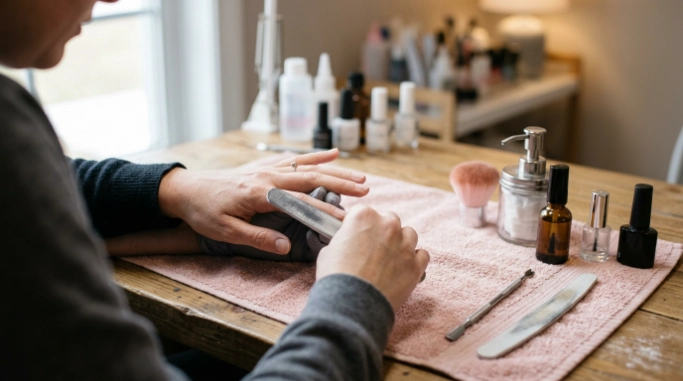
For many gel, acrylic, builder-gel, and extension systems, dehydrator comes after physical preparation and cleaning but before primer. Your product system may simplify or change these steps, so its instructions still control.
Here is the general sequence I use as a reference:
- Prepare the nail: Shape the free edge and perform appropriate cuticle-area prep without cutting living skin.
- Remove surface shine if required: Use only the amount of buffing recommended for your system.
- Remove dust: Brush or wipe away filing dust so it cannot become trapped beneath the product.
- Clean the nail: Use the cleanser recommended by your system and allow the surface to dry.
- Apply dehydrator: Use one thin, controlled layer on the natural nail.
- Let it air-dry: Wait until the visible wetness has evaporated.
- Apply primer if required: Use acid-free or acid primer only according to the system’s instructions.
- Apply your base or enhancement: Continue with gel, acrylic, dip, builder gel, adhesive, or another compatible product.
Does dehydrator go before primer?
Yes, in systems that use both products, dehydrator normally goes before primer. Dehydrator prepares the natural nail surface, while primer is intended to support bonding between that surface and the enhancement system.
Putting dehydrator over primer can interfere with the primer layer. It also prevents the dehydrator from contacting the natural nail the way it was designed to.
Does dehydrator need a UV or LED lamp?
Standard nail dehydrator does not normally need lamp curing. It evaporates in the air because of its solvent-based formulation.
If your product specifically says to cure it, follow that label. A product requiring a lamp may be a bonder, base, or hybrid prep product rather than a traditional dehydrator.
When Should You Wipe Off a Nail Dehydrator?
Wiping is appropriate when the manufacturer’s instructions specifically describe a wipe-on or cleansing process. Some professional prep liquids combine cleansing and dehydrating functions and are applied using a saturated lint-free pad.
Those products shouldn’t be treated exactly like a polish-style dehydrator. Their application method is part of how they remove dust, oil, and residue from the nail.
Three situations where wiping may be correct
- Wipe-on prep liquid: The directions tell you to saturate a lint-free wipe and clean the natural nail.
- Dual-purpose cleanser/dehydrator: The same formula is designed for both preparation and a separate cleansing task.
- Brand-specific system: The manufacturer explicitly tells you to wipe, scrub, or cleanse with its prep solution.
This is the exception that causes so much confusion online. Two bottles may both say “dehydrator” while giving completely different application instructions.
Before your first use, read both the bottle and the brand’s directions. That small check is more reliable than copying another person’s routine with a different product.
Nail Dehydrator vs Cleanser vs Primer: What Is the Difference?
Dehydrator, cleanser, and primer all appear during nail prep, but they are not automatically interchangeable. Understanding the job of each one makes the “wipe or don’t wipe” question much easier.
| Product | Main Job | Typical Application | Wipe Off? | Usual Next Step |
|---|---|---|---|---|
| Brush-on dehydrator | Temporarily reduces surface oil and moisture | One thin coat | Usually no; let it evaporate | Primer or base product |
| Wipe-on prep/dehydrator | Cleans and dehydrates during wiping | Lint-free wipe saturated with product | Wiping is part of application | Primer or enhancement |
| Nail cleanser | Removes dust, oil, or specified residue | Usually used with a lint-free wipe | Usually yes | Prep or product application |
| Nail primer | Promotes adhesion in compatible systems | Very thin controlled coat | Normally no | Base, gel, acrylic, or enhancement |
Is rubbing alcohol the same as nail dehydrator?
Not necessarily. Isopropyl alcohol can clean and degrease the nail, and some commercial nail-prep formulas contain it, but dedicated dehydrators can use different solvent blends.
If your system specifically recommends alcohol for preparation, use it as directed. Don’t assume every professional dehydrator can be replaced one-for-one without checking compatibility.
Is acetone the same as dehydrator?
Acetone also removes oil and evaporates quickly, but that doesn’t make every dehydrator identical to acetone. Commercial prep products can be formulated for a particular gel, acrylic, dip, or extension system.
Mixing unrelated products can make troubleshooting difficult. When retention matters, following one compatible system is usually easier than improvising each preparation step.
What Happens If You Wipe Nail Dehydrator Off Too Soon?
Wiping an air-dry dehydrator immediately may reduce the benefit of that preparation step. You can also accidentally put moisture, lint, or skin oil back onto the nail.
That does not mean one mistaken wipe guarantees lifting. Retention depends on the entire preparation and application process.
Common prep mistakes that can contribute to lifting
- Touching prepared nails: Fingertips can transfer oil back onto the nail plate.
- Using too much dehydrator: Flooding the nail does not necessarily improve preparation.
- Applying over filing dust: Dust can remain trapped beneath later layers.
- Reversing the order: Dehydrator normally belongs before primer, not after it.
- Waiting too long: The dehydrating effect is temporary, so continue once the nail is ready.
- Flooding the skin: Prep products should stay on the nail plate unless their instructions say otherwise.
If one or two nails keep lifting in the same location, inspect the whole routine rather than applying more and more dehydrator. Cuticle residue, product touching skin, incomplete curing, poor tip fit, or incompatible products may be more important.
How Long Should Nail Dehydrator Dry Before Primer or Gel?
Wait until the dehydrator has fully evaporated and the nail no longer looks visibly wet. Many fast-solvent formulas flash off within seconds, while some products may take closer to 30–60 seconds.
The label is more useful than a universal stopwatch. Temperature, amount applied, formula, and ventilation can all change how quickly a product evaporates.
How can you tell it is ready without touching it?
- The visible wet shine has disappeared.
- The nail looks dry or matte.
- No liquid is pooled near the sidewalls or cuticle area.
- The product has finished visibly evaporating.
- You have followed any stated waiting time on the bottle.
Use visual cues instead of touching the nail with a finger. That protects the prepared surface from contamination.
Should you apply two coats of dehydrator?
One thin application is enough for many products. A second coat should only be used when the brand recommends it or when your professional system specifically calls for it.
More product is not automatically better. Excessive prep can also contribute to dry surrounding skin, so controlled application matters.
How Do You Use Nail Dehydrator Safely?
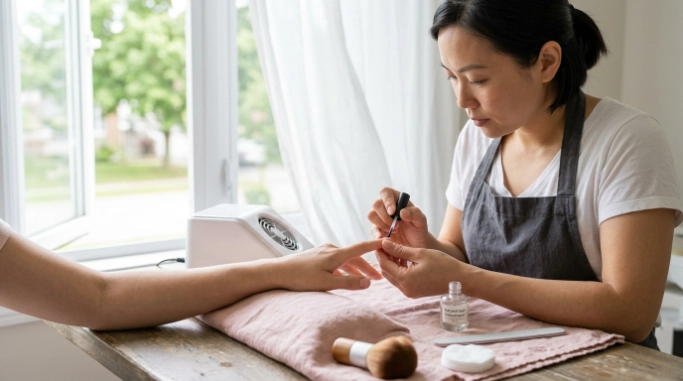
Nail dehydrators are chemical cosmetic products, so use only the amount you need and follow the bottle’s warnings. Keep the product off broken or irritated skin and avoid the eyes.
The OSHA guidance on nail-salon chemical hazards also emphasizes ventilation, product labels, safety data sheets, and limiting unnecessary skin exposure when working with salon chemicals.
Use good ventilation
Many nail prep products contain volatile solvents that evaporate quickly. Work where fresh air or suitable ventilation can reduce the buildup of vapors.
Close the bottle promptly after application. This limits both evaporation and accidental spills.
Keep prep products on healthy nail surfaces
Avoid flooding the surrounding skin, especially if it is cracked, cut, sore, or irritated. Stop using a product if it causes burning, swelling, a rash, or another concerning reaction.
For broader manicure and nail-health advice, the American Academy of Dermatology’s manicure and pedicure guidance is a useful reference.
Health note: Persistent redness, swelling, pain, drainage, nail separation, or an ongoing rash is not simply a prep problem. Stop cosmetic nail applications and ask a dermatologist or healthcare professional for advice.
Don’t over-file just to improve adhesion
Good adhesion does not require aggressively thinning the natural nail. Remove only the amount of surface shine recommended for the nail system you’re using.
If lifting keeps happening despite correct application, review product compatibility and technique before filing harder. Over-preparation can create a new problem instead of solving the original one.
Frequently Asked Questions About Wiping Nail Dehydrator
Do you wipe nail dehydrator off before primer?
Usually, no. Let a standard brush-on dehydrator evaporate completely, then apply primer if your nail system requires it. Only wipe the product when its own directions describe a wipe-on application method.
Do you wipe nail dehydrator off before gel polish?
Normally, you let the dehydrator air-dry before applying the next gel-prep step. Depending on the system, that may be primer, bonder, or base coat rather than color gel directly.
Can you put primer on while dehydrator is still wet?
It’s better to wait until a conventional dehydrator has flashed off fully. Applying primer over visibly wet dehydrator can dilute or disturb the preparation process and makes it harder to follow the system as intended.
Why does my nail turn white after dehydrator?
A temporary dry, pale, or chalky appearance can happen as oils and moisture are removed and the solvent evaporates. If the skin becomes painful, burns, stays unusually white, or becomes irritated, rinse as appropriate and stop using the product.
Can I touch my nails after using dehydrator?
Avoid touching them. Natural oil and moisture from your fingers can contaminate the prepared nail surface, which defeats part of the reason you used a dehydrator.
Can I use nail dehydrator without primer?
Sometimes, because not every polish or enhancement system requires a separate primer. Follow the instructions for the base coat, gel, acrylic, dip, adhesive, or extension system you’re applying rather than adding primer automatically.
What if my dehydrator says to use a lint-free wipe?
Follow those instructions. Some prep products dehydrate while you actively wipe the nail, which is different from a traditional brush-on formula designed to evaporate after application.
Final Takeaway: Should You Wipe Off Nail Dehydrator?
For a traditional brush-on nail dehydrator, the answer is usually no. Apply a thin layer, let it evaporate completely, avoid touching the prepared nail, and continue with the next step in your system.
The exception is a dehydrating cleanser or wipe-style prep product whose directions specifically tell you to use a lint-free pad. In that case, wiping is part of the correct application rather than a mistake.
- Read the bottle before your first application.
- Keep the dehydrator on the natural nail rather than surrounding skin.
- Let air-dry formulas evaporate instead of rubbing them off.
- Use dehydrator before primer when your system requires both.
- Continue with the next step promptly once the nail is dry.
As of 2026, that simple distinction is still the easiest way to avoid confusion: air-dry a standard brush-on dehydrator; wipe only when the product specifically tells you to wipe.

