
What Is a Good Toenail Care Routine? A Simple At-Home Guide

Toenail care can seem simple until you deal with a rough edge, thick nail, painful corner, discoloration, or a pedicure that leaves your toes feeling sore. The good news is that most healthy toenails do not need a complicated beauty routine.
So, what is a good toenail care routine? For most people, it means keeping the feet clean and dry, trimming toenails correctly, gently filing sharp edges, protecting the cuticles, moisturizing dry skin, keeping tools clean, and checking regularly for changes that may need professional attention.
A consistent routine does more than make your toes look polished. It can help prevent accidental nail damage and make it easier to notice possible ingrown nails, infections, or other changes early.
Quick Answer
A good toenail care routine includes washing and thoroughly drying your feet, trimming nails straight across, smoothing sharp edges with a clean nail file, leaving cuticles intact, moisturizing dry skin, disinfecting personal tools, wearing comfortable shoes, and checking your toenails regularly for pain, swelling, discoloration, thickening, or other unusual changes.
What Should a Basic Toenail Care Routine Include?
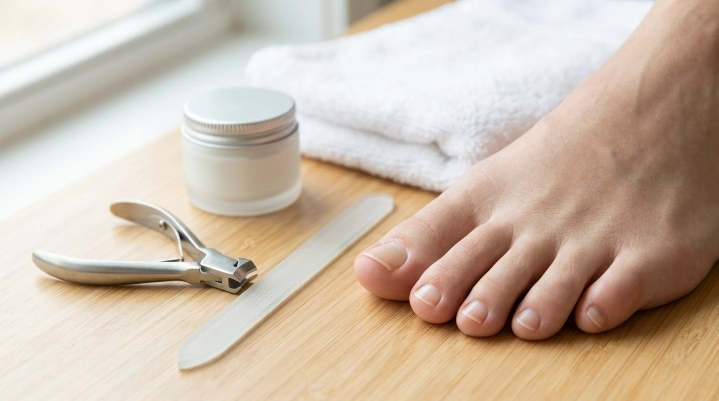
You do not need to give yourself a full pedicure every week. A better approach is to separate toenail care into simple everyday habits and occasional maintenance.
Your basic routine should include:
- Keeping your feet clean.
- Drying your feet and toes thoroughly.
- Checking nails and surrounding skin for changes.
- Trimming toenails when they become long.
- Filing rough or sharp edges.
- Avoiding aggressive cuticle cutting.
- Moisturizing dry skin around the nails.
- Cleaning your nail tools after use.
- Wearing shoes that do not constantly press against the toenails.
According to the American Academy of Dermatology’s healthy nail tips, regularly trimming toenails and protecting nails from unnecessary trauma can help keep them healthy. The organization also recommends professional evaluation when nails become painful, swollen, or noticeably changed.
Step-by-Step Toenail Care Routine
1. Wash Your Feet and Toenails
Start with clean feet. Your normal shower or bath is usually enough for everyday cleaning.
Gently wash around the toenails and between your toes instead of aggressively scraping underneath the nail plate.
There is usually no reason to dig deeply beneath a healthy toenail. Sharp objects can injure the sensitive skin underneath and create an opening where bacteria or fungi could potentially enter.
After washing, dry your feet thoroughly, including around and between your toes.
2. Check Your Nails Before You Trim
Take a few seconds to look at each toenail.
You are checking for changes such as:
- New redness.
- Swelling.
- Tenderness.
- Drainage or pus.
- A nail lifting away from the nail bed.
- Unusual thickening.
- Crumbling.
- Significant yellow, white, brown, green, or black discoloration.
- A nail corner growing painfully into the surrounding skin.
This quick inspection matters because simply clipping away a suspicious area does not necessarily address its cause.
For example, the American Academy of Dermatology notes that nail fungus can cause toenails to become thickened, discolored, lifted, or crumbly.
3. Trim Toenails Straight Across
One of the most important parts of a good toenail care routine is proper trimming.
Use a clean toenail clipper or nail nipper that feels comfortable in your hand. Make several controlled cuts rather than trying to remove a thick nail in one dramatic clip.
Cut the nail mostly straight across instead of deeply rounding the corners.
The American Academy of Dermatology recommends cutting toenails straight across, while Mayo Clinic similarly advises straight-across trimming to help reduce ingrown toenail problems.
Do not cut the nail extremely short. Ideally, you want enough nail remaining to protect the end of the toe without leaving a long edge that catches on socks or shoes.
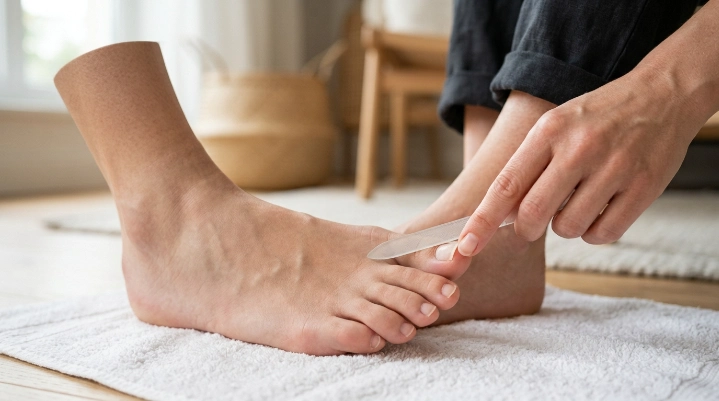
4. Smooth Sharp Edges With a Nail File
After clipping, check each nail for rough corners or jagged edges.
A nail file can gently smooth these areas so they are less likely to catch on fabric.
For natural toenails, common choices include:
- Glass files: Smooth, washable, and reusable when handled carefully.
- Emery boards: Affordable and easy to replace.
- Metal files: Durable but potentially aggressive if too much pressure is used.
- Fine-grit files: Useful when you only need gentle finishing.
For routine maintenance, use light pressure. You are trying to refine the edge rather than aggressively thin the entire nail.
The AAD’s general nail-care guidance recommends filing nails in one direction rather than repeatedly sawing back and forth.
Expert Tip: Clip toenails to establish the basic shape, then use a fine file only to remove small rough spots. Trying to create the entire shape by aggressively filing can make maintenance unnecessarily slow and may irritate sensitive nails.
5. Leave Healthy Cuticles Alone
The cuticle is the thin area of tissue that helps seal the space between the nail and surrounding skin.
It may be tempting to trim every bit of visible cuticle during a home pedicure, but aggressive cutting is unnecessary for routine toenail care.
The American Academy of Dermatology’s manicure and pedicure safety guidance recommends avoiding cutting or forcefully pushing back cuticles because disrupting this protective area can increase infection risk.
If the skin around your toenails looks dry, gentle moisturizing is usually a better beauty-care approach than repeatedly cutting it.
6. Moisturize Dry Skin Around the Nails
After your feet are clean and dry, apply a small amount of moisturizer to dry areas of your feet and around the nails.
This is particularly useful if the skin around your toes tends to become rough or flaky.
Massage the product gently rather than pushing underneath the nail or aggressively manipulating the cuticle.
If a product causes burning, itching, significant redness, or a rash, stop using it. Beauty products can contain fragrances or other ingredients that do not agree with every person’s skin.
7. Clean Your Nail Tools
A good toenail routine also includes taking care of your tools.
Do not repeatedly put dirty clippers, nippers, or reusable files back into your manicure kit.
If you have a suspected fungal infection, be especially cautious about using the same tools on other nails. The AAD explains that contaminated grooming tools can contribute to the spread of nail fungus.
Follow the cleaning or disinfection instructions recommended for your specific tool and material. Disposable files should be replaced when they become dirty, damaged, or difficult to clean.
And avoid casually sharing personal toenail tools with family members or friends.
Which Tools Do You Need?
A basic routine does not require an expensive professional pedicure kit.
| Tool | Main Purpose | Cost Level | Best For | Safety Consideration |
|---|---|---|---|---|
| Toenail clipper | Shortening normal nails | Low | Routine maintenance | Avoid cutting extremely short |
| Nail nipper | Cutting thicker nails | Low to moderate | Thick or firm toenails | Very sharp; use controlled cuts |
| Glass nail file | Smoothing edges | Low to moderate | Reusable gentle filing | Can break if dropped |
| Emery board | Smoothing and shaping | Low | Simple home care | Replace when worn or dirty |
| Fine-grit file | Finishing rough edges | Low | Sensitive or natural nails | Avoid excessive filing |
| Moisturizer | Softening dry surrounding skin | Low to moderate | Dry feet and nail folds | Stop if irritation develops |
You can usually build a simple home-care kit without buying salon-grade equipment.
Quality and control matter more than owning many tools. A comfortable, sharp clipper and a suitable file are more useful than a large kit filled with tools you do not know how to use safely.
What If Your Toenails Are Thick?
Thick toenails can be harder to trim safely.
If the thickness is mild and you already know the nail is otherwise healthy, softening it before trimming may make the process easier. Mayo Clinic’s guidance on trimming thickened toenails recommends soaking thickened toenails in warm water for about 5 to 10 minutes, drying them, and using an appropriate nail nipper carefully.
However, do not assume every thick nail simply needs stronger clippers.
Thickening can have multiple causes, including previous trauma and nail disease. Fungal infections, for example, can cause thickening and discoloration.
If the change is new, unexplained, painful, or difficult to manage, professional evaluation is safer than repeatedly grinding or cutting the nail thinner yourself.
How Often Should You Trim and File Your Toenails?
There is no perfect schedule for everyone.
Toenail growth rates vary, so trim based on the actual length rather than forcing yourself to follow a strict weekly calendar.
A practical routine might look like this:
Daily or during normal bathing
- Wash your feet.
- Dry them thoroughly.
- Notice obvious redness, pain, or skin changes.
Every few days
- Check for rough edges.
- Apply moisturizer when skin feels dry.
- Make sure shoes are not constantly pressing against a tender nail.
When the nails become noticeably long
- Trim straight across.
- Smooth rough edges with a file.
- Clean your tools afterward.
The goal is steady maintenance, not excessive grooming.
Toenail Hygiene Between Pedicures
Beautiful toenails are easier to maintain when your everyday habits support nail health.
Try to:
- Change out of damp socks.
- Let shoes dry properly between wears.
- Wear footwear that gives your toes adequate room.
- Keep your personal nail tools clean.
- Avoid picking at the skin around your nails.
- Wear protective footwear in communal showers or pool areas.
The AAD recommends protective footwear in pools and public showers as one measure for reducing exposure to fungi that can infect toenails.
If you regularly get salon pedicures, cleanliness matters there too. Look for a salon that follows appropriate sanitation practices, and do not be afraid to ask how reusable instruments are cleaned.
DIY Toenail Care vs. a Professional Pedicure
Home maintenance works well for many healthy nails.
A salon can be useful when you want polish, shaping, cosmetic care, or simply do not want to do the work yourself.
However, a nail technician should not be treated as a substitute for medical diagnosis.
If you have a painful, infected-looking, severely damaged, or dramatically changed toenail, covering it with polish or filing away the visible problem may make it harder to understand what is happening.
A dermatologist, podiatrist, or other qualified healthcare professional is more appropriate for medical nail concerns.
When to See a Nail Technician or Dermatologist
A nail technician may be helpful when your nails appear healthy but you want cosmetic shaping, polish application, maintenance, or a professional-looking pedicure.
Consider a dermatologist or other healthcare professional when you notice:
- Persistent or increasing pain.
- Significant redness or swelling.
- Pus or drainage.
- A nail lifting away from the nail bed.
- Unexplained dark or unusual discoloration.
- Persistent thickening or crumbling.
- Repeatedly ingrown toenails.
- Changes affecting several nails.
- A suspected fungal infection that is not improving.
- A nail problem you cannot identify confidently.
The NHS notes that fungal nail infections can require medical treatment when pharmacy treatment has not worked, while the AAD advises seeing a dermatologist when nail changes are accompanied by swelling or pain.
Seek professional guidance sooner if you have diabetes, reduced sensation in your feet, poor circulation, or another condition that makes foot injuries harder to notice or heal. Mayo Clinic specifically advises extra caution with nail trimming when diabetes, poor circulation, or reduced foot sensation is present.
Common Mistakes to Avoid
Even a well-intentioned home pedicure can cause problems when you become too aggressive.
Avoid these common mistakes:
- Cutting toenails extremely short. This can leave tender skin exposed and make nail corners harder to manage.
- Digging deeply into nail corners. Trying to carve out a painful corner yourself can irritate the surrounding tissue.
- Rounding the sides excessively. A straighter trim is generally preferred for toenails.
- Using excessive pressure when filing. More pressure does not automatically produce healthier nails.
- Cutting healthy cuticles. They serve a protective role around the nail.
- Sharing unclean nail tools. Personal grooming tools can potentially transfer infectious organisms.
- Ignoring persistent discoloration or thickening. Cosmetic changes can sometimes reflect an underlying nail condition.
- Covering a suspicious nail immediately with polish. If something looks significantly different, inspect it instead of simply hiding it.
- Performing aggressive DIY treatment on painful nails. Pain, swelling, or drainage deserves more caution than an ordinary cosmetic issue.
- Assuming salon care replaces medical care. Nail technicians are valuable beauty professionals, but medical nail conditions require the appropriate healthcare provider.
FAQs
What is the best routine for healthy toenails?
Keep your feet clean and dry, trim toenails straight across when necessary, gently file rough edges, moisturize dry surrounding skin, protect the cuticles, clean your tools, and regularly check for unusual changes.
Should I cut or file my toenails?
For most people, clipping is the quickest way to shorten toenails, while filing works well for smoothing rough or sharp edges afterward. You can also use a file between trims when only a small amount of shaping is needed.
Should toenails be cut straight or curved?
Toenails are generally best trimmed straight across rather than deeply rounded at the sides. This helps avoid creating very short corners that can contribute to irritation or ingrown nails.
Is it better to cut toenails before or after a shower?
Normal healthy toenails can often be trimmed whenever they are clean and easy to control. Very thick nails may be easier to cut after a brief warm-water soak, followed by thoroughly drying the feet before trimming.
How can I make my toenails look cleaner naturally?
Regular washing, careful trimming, smoothing rough edges, moisturizing dry surrounding skin, and keeping your tools clean can make toenails look more groomed without polish. Avoid aggressively scraping underneath the nails.
Should I cut my toenail cuticles?
Routine cutting is generally unnecessary. Cuticles help protect the area where the nail meets the skin. Aggressive cutting or forceful pushing can injure the surrounding tissue and increase infection risk.
When should I stop doing DIY toenail care?
Stop and seek professional guidance when you have significant pain, swelling, pus, persistent discoloration, unexplained thickening, severe nail damage, repeated ingrown nails, or another change that you cannot confidently identify.
Conclusion
So, what is a good toenail care routine? It is a simple combination of cleanliness, careful trimming, gentle filing, skin care, tool hygiene, and regular observation.
You do not need aggressive filing, deep cuticle cutting, complicated pedicure tools, or constant trimming to keep healthy toenails looking neat.
Focus on consistency instead. Keep your feet clean and dry, trim nails straight across when they need shortening, smooth rough edges carefully, protect the surrounding skin, and pay attention when something changes.
Most importantly, know where DIY care should end. Pain, swelling, drainage, persistent discoloration, significant thickening, or unexplained nail changes should not simply be filed or polished away.
Build a gentle routine you can maintain, keep your tools clean, and give your toenails the same thoughtful care you give the rest of your beauty routine.

