
How Does Nail Dehydrator Work? A Complete Nail Prep Guide

Quick Answer
A nail dehydrator works by temporarily removing surface oils, moisture, and residue from the natural nail plate before gel, acrylic, dip, or other nail products are applied. Its fast-evaporating solvents leave the surface cleaner and drier, which can help the next product make better contact with the nail; the FDA’s nail product guidance also stresses following each product’s label and safety directions.
How the process works
- Removes surface oil: Solvents help dissolve oily residue that can interfere with product contact.
- Reduces moisture: The formula temporarily dries the outer nail surface rather than permanently drying the entire nail.
- Evaporates quickly: Most dehydrators flash off within seconds and do not need a curing lamp.
- Improves the foundation: A clean, dry nail gives primer, base coat, acrylic, or adhesive a better surface to contact.
- Doesn’t replace primer: Dehydrator cleans and dries, while a primer or bonding product performs a different adhesion job when the system requires one.
Best-use tip
- Apply a thin coat to the natural nail only, let it air-dry, and continue with the next step recommended by your nail system.
If you’ve ever finished a manicure only to see lifting around the cuticle or sidewalls, nail prep is one of the first places worth checking. A dehydrator looks like a small step, but understanding what it does makes the whole application process easier to troubleshoot.
In this 2026 guide, I’ll explain how nail dehydrator works, what happens on the nail surface, how it differs from primer, and when it makes sense to use one.
In This Guide
- What is a nail dehydrator?
- How does nail dehydrator work?
- What happens to your nail after dehydrator?
- How do you use nail dehydrator correctly?
- Nail dehydrator vs primer vs cleanser
- Do you need nail dehydrator for every manicure?
- Common mistakes and safety tips
- Frequently asked questions
- Final takeaway
What Is a Nail Dehydrator?
A nail dehydrator is a nail-preparation liquid designed to temporarily remove surface moisture, natural oils, and light residue from the natural nail plate. It is normally used before an enhancement, adhesive, primer, or base product.
Think of it as surface preparation rather than glue. The dehydrator helps create a cleaner working surface, but it does not physically attach the gel or acrylic by itself.
What is the nail plate?
The nail plate is the hard keratin structure that we usually call the fingernail. Its surface may carry small amounts of oil, water, lotion, dust, or residue even when the nail looks clean.
Those contaminants matter because nail coatings need close contact with the nail surface. A barrier between the two can make reliable adhesion more difficult.
What is usually inside nail dehydrator?
Formulas vary by brand, so the ingredient label matters. Many dehydrators use fast-evaporating solvents such as isopropyl alcohol, acetone, ethyl acetate, or similar solvent systems.
- Alcohol-type solvents: Help clean and evaporate quickly.
- Acetone: Can remove oily residue and moisture from the surface.
- Acetate solvents: Common fast-evaporating ingredients in some professional nail-prep formulas.
- Brand-specific ingredients: Some systems add other ingredients to control drying, application, or compatibility.
A dehydrator’s exact formula should guide how you use it. Don’t assume that every bottle labeled “nail prep” behaves exactly the same way.
How Does Nail Dehydrator Work?
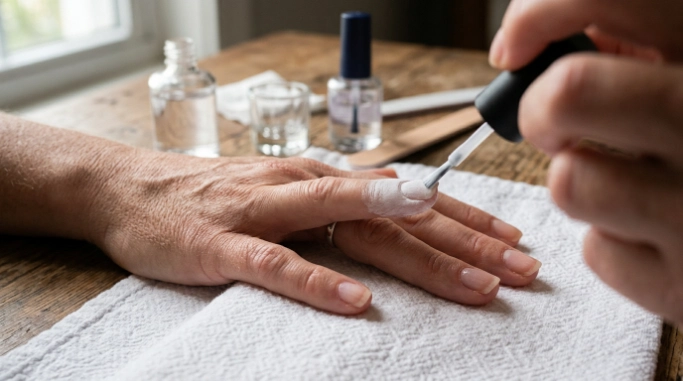
Nail dehydrator works through a simple combination of solvent action and evaporation. The liquid loosens or picks up surface oils and moisture, then its volatile ingredients evaporate rapidly.
The result is a temporarily cleaner, drier surface. That improves the conditions for whatever compatible bonding or coating product comes next.
Step 1: The liquid spreads across the nail
A thin application wets the nail plate and reaches small surface irregularities. You don’t need to flood the nail for this to happen.
More product isn’t automatically better. A controlled layer usually gives you enough coverage without sending liquid into the sidewalls or cuticle area.
Step 2: Solvents interact with surface residue
The solvent system helps loosen oils and some residue on the nail. That matters because oily contamination can reduce direct contact between the nail and your next product.
I like to think of it like preparing a surface before applying tape. The tape performs the bonding, but cleaning the surface first gives it a better starting point.
Step 3: Moisture and solvent evaporate
Most dehydrators contain ingredients chosen partly because they evaporate fast. As the product flashes off, the nail often starts looking less shiny and more matte.
Drying usually takes only seconds, although there is no universal number for every formula. Follow the drying directions printed on your specific bottle.
Step 4: The next product gets a cleaner surface
Once dry, the nail is ready for the next step in the manufacturer’s system. That might be primer, bonder, base gel, acrylic product, tip adhesive, or another prep layer.
This is why dehydrator can help with retention without being an adhesive itself. It improves the condition of the surface instead of forming the main bond.
Does nail dehydrator change your nails permanently?
No. A standard dehydrator is intended to create a temporary surface effect, not permanently remove the nail’s natural moisture.
Normal exposure to water and natural oils returns over time. That’s also why touching a freshly prepared nail with your fingers can undo part of your careful prep.
Section Takeaway: Nail dehydrator works mainly by cleaning, degreasing, and temporarily drying the nail surface. It prepares the foundation; it doesn’t replace the bonding chemistry of every primer or nail system.
What Happens to Your Nail After Dehydrator?
After dehydrator evaporates, the most obvious change is usually visual. A properly prepared natural nail often looks matte, clean, and less oily than it did before application.
You shouldn’t expect the nail to become dramatically rough. Surface roughness comes mainly from filing or buffing, not from a standard dehydrator.
Why does the nail sometimes look chalky?
A light matte or pale appearance can happen as surface oils and moisture are removed. That appearance often disappears later as the nail takes on product or natural moisture returns.
A chalky look should not be used as an excuse to repeatedly soak the nail in dehydrator. Use the amount the product manufacturer recommends.
Does dehydrator open the nail pores?
You may see descriptions saying dehydrator “opens the pores” of the nail. That’s an oversimplified way to describe surface preparation.
The nail plate is made of compact layers of keratin cells, not skin-like pores that open and close. A better description is that dehydrator temporarily reduces surface contamination so products can make better contact.
How Do You Use Nail Dehydrator Correctly?
Use nail dehydrator after basic nail preparation and before the bonding steps specified by your product system. Exact instructions vary, so your product label always wins over a generic routine.
- Clean your hands and nails. Remove old product when appropriate and make sure the nail area is clean.
- Manage the cuticle area gently. Keep dead surface tissue away from the nail plate without aggressively cutting healthy skin.
- Shape the free edge. File the nail to the desired shape before applying liquid prep.
- Buff only if your system requires it. Use gentle pressure and avoid thinning the natural nail unnecessarily.
- Remove filing dust. Use a clean nail brush or the cleansing method recommended by your system.
- Apply one thin coat of dehydrator. Cover the natural nail plate while avoiding surrounding skin.
- Let it air-dry. Many formulas flash off within roughly 10–30 seconds, but use the manufacturer’s stated timing.
- Continue with primer or base product. Don’t touch the prepared nail before the next step.
Should nail dehydrator go on before or after primer?
In systems that use both products, dehydrator generally comes before primer. The dehydrator prepares the nail surface, while the primer performs the next adhesion-related function.
Some brands combine several prep functions or use different terminology. Mixing instructions from unrelated systems can produce unpredictable results.
Do you cure nail dehydrator under a lamp?
Most traditional nail dehydrators are designed to air-dry and don’t need UV or LED curing. They evaporate because of their solvent formulation.
If a specific product tells you to cure it, follow that label. Don’t add lamp exposure simply because your later gel layers require curing.
Section Takeaway: Keep dehydrator application thin, let it dry fully, avoid touching the prepared nail, and follow the sequence recommended by the gel, acrylic, dip, or extension system you’re using.
Nail Dehydrator vs Primer vs Cleanser: What’s the Difference?
A dehydrator, primer, and nail cleanser can all appear in the same manicure, but they are not automatically interchangeable. Each addresses a different part of preparation.
| Product | Main job | Typical timing | What it leaves behind |
|---|---|---|---|
| Nail cleanser | Removes dust, residue, or surface contamination | During prep or where the system directs | Ideally a clean surface |
| Nail dehydrator | Temporarily removes surface oil and moisture | After physical prep, before primer or bonding layers | Dry, matte surface after evaporation |
| Primer | Promotes adhesion between natural nail and enhancement system | Usually after dehydrator | Depends on primer chemistry; some remain slightly tacky |
Is nail primer stronger than dehydrator?
“Stronger” isn’t the most useful comparison because the products do different jobs. A dehydrator removes interfering surface material, while primer helps create conditions for adhesion.
The FDA notes that some professional nail primers can contain methacrylic acid, which carries specific handling concerns. That makes reading product directions especially important.
Can you use dehydrator without primer?
Sometimes, depending on the nail system. Certain base gels, press-on adhesives, or enhancement products may specify dehydrator without a separate primer.
Other systems are designed around both products. The safest approach is to follow the manufacturer’s sequence rather than assuming a universal recipe.
Do You Need Nail Dehydrator for Every Manicure?
No. Nail dehydrator can be useful for many enhancement services, but it is not automatically required for every person, every polish, or every system.
It tends to matter most when reliable adhesion is important or when surface oil has contributed to lifting.
Gel polish
A compatible dehydrator can help prepare natural nails before gel base coat. Some gel brands include a dedicated prep liquid, while others give different instructions.
Acrylic nails
Acrylic systems commonly use detailed preparation because retention depends heavily on clean product contact. Dehydrator is often followed by a compatible primer or bonding product.
Gel extensions and soft-gel tips
Dehydrator may be part of the prep sequence for Gel-X-style or other soft-gel extension systems. Tip fit, surface preparation, adhesive placement, and proper curing remain important too.
Dip powder
Some dip systems include their own prep liquids. Use the dehydrator only when it fits that manufacturer’s sequence rather than adding extra chemicals automatically.
Press-on nails
Removing surface oil before press-on adhesive can improve contact. Depending on the adhesive instructions, alcohol prep or a dedicated dehydrator may be recommended.
Regular nail polish
Traditional polish doesn’t always require a separate dehydrator. Clean, dry nails and a compatible base coat may be enough for many routines.
What Nail Dehydrator Mistakes Should You Avoid?
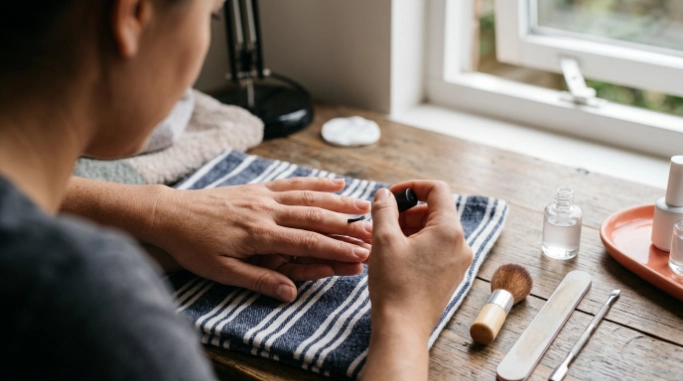
The biggest mistakes usually involve overusing product, getting it on skin, touching the prepared nail, or treating dehydration as a substitute for the rest of nail prep. A dehydrator works best as one controlled step.
- Flooding the nail: A heavy coat can run onto the surrounding skin without improving preparation.
- Touching after prep: Fingertips can transfer oil back onto the freshly dehydrated nail.
- Skipping dust removal: Dehydrator isn’t meant to make heavy filing dust disappear.
- Over-buffing first: Aggressive filing can thin the nail plate and is not necessary just because you plan to dehydrate afterward.
- Mixing random systems: Primer, base gel, adhesive, and dehydrator should be chemically compatible.
- Ignoring ventilation: Nail products can release solvent vapors, so use them in a well-ventilated area.
- Using product on irritated skin: Avoid broken, inflamed, or painful surrounding skin.
For broader manicure safety, the American Academy of Dermatology’s manicure and pedicure guidance recommends gentle nail care and avoiding practices that unnecessarily damage the nail or surrounding skin.
Professional nail technicians can also review OSHA’s nail salon safety guidance for information about ventilation, product labels, safety data sheets, and chemical exposure.
Health note: Stop using a nail product if you develop significant burning, swelling, persistent redness, blistering, or another concerning reaction. A dermatologist or healthcare professional can evaluate symptoms that continue or worsen.
Can too much nail dehydrator damage nails?
Repeated exposure to strong solvents can contribute to dryness, especially when combined with frequent filing, acetone removal, and repeated enhancement services. More dehydrator does not equal better adhesion.
Use the minimum amount directed by the manufacturer. If your natural nails are already thin, peeling, sore, or damaged, focus on resolving that problem before covering them again.
Frequently Asked Questions
How long does nail dehydrator take to dry?
Most nail dehydrators air-dry within seconds because their formulas contain volatile solvents. Around 10–30 seconds is common for many products, but always use your product’s instructions instead of relying on one universal drying time.
Does nail dehydrator make gel nails last longer?
It can support better retention by removing oil and surface moisture that may interfere with adhesion. However, longevity also depends on cuticle-area prep, product compatibility, correct curing, nail condition, application technique, and daily wear.
Can I use acetone instead of nail dehydrator?
Acetone can remove oil and moisture from the nail surface, but it is not automatically identical to a purpose-made dehydrator. A dedicated product may use a different solvent blend designed to work with a specific nail system.
Can rubbing alcohol replace nail dehydrator?
Isopropyl alcohol can help clean and degrease natural nails, and some dehydrators contain it. However, concentration, added ingredients, and system compatibility vary, so alcohol should not automatically replace a manufacturer-required prep product.
Do you use nail dehydrator before base coat?
Usually yes when the nail system calls for dehydrator. The common order is physical nail prep, dust removal, dehydrator, primer if required, and then the compatible base or enhancement product.
Why do my nails still lift after using dehydrator?
Lifting can have several causes, including product touching skin, invisible cuticle on the nail plate, poor tip fit, incorrect curing, incompatible products, excessive nail flexibility, or application errors. Dehydrator can improve surface prep, but it cannot correct every retention problem.
Can nail dehydrator touch the skin?
It’s better to keep dehydrator on the nail plate and away from surrounding skin. Solvent-based nail products can irritate sensitive or damaged skin, so use a controlled amount and follow the bottle’s warnings.
Final Takeaway: What Does Nail Dehydrator Actually Do?
The simplest answer to how does nail dehydrator work? is that it temporarily removes surface oils, moisture, and residue so your nail products start on a cleaner, drier surface. Its fast-evaporating solvents do the prep work and then disappear.
It doesn’t replace careful cuticle-area prep, correct application, proper curing, or a primer when your nail system requires one. I treat it as one link in the adhesion chain, not as a cure for every lifting problem.
If lifting keeps happening, look at the entire routine instead of adding more dehydrator. Better prep usually comes from using the right amount of each compatible product in the right order

