
How Long to Sit Under a Nail Dryer at the Salon: The Practical Guide

If you want the shortest useful answer: it depends on the service.
- Regular nail polish: usually air-dries, not lamp-cures. In a salon, you may be told to sit for 15 to 20 minutes for a single quick coat to set, but full drying can still take longer.
- Gel polish: typically needs a few minutes under a UV or LED lamp for each coat, following the brand’s instructions.
- Top coat: may need its own cure time, especially with gel systems.
- Dip powder: usually does not air-dry in the same way as regular polish. Most dip systems use a liquid activator and then a gel top coat that cures under a lamp, though some salon steps may be allowed to air-set between layers.
- Pedicures: often need the same technical drying or curing time, but the practical wait can feel longer because toes are easier to bump on shoes.
Quick answer by service
– Regular polish: sit until it is no longer denting easily; about 15–20 minutes for a light coat, longer for multiple coats.
– Gel polish: expect about 30–60 seconds per layer under LED or about 1–2 minutes per layer under UV, but always follow the product brand if the salon gives a specific time.
– Gel top coat: usually cures on the same schedule as the rest of the gel system, though some brands call for a slightly longer finish cure.
– Dip powder: there is usually no lamp time for the powder itself, but the gel top coat at the end often does need lamp curing.
If you only remember one rule, make it this: ask what product was used, then follow that product’s cure or dry time instead of guessing.
For regular polish, salon advice varies because the formula, coat thickness, and airflow all matter. Some sources suggest a fast single coat may be ready in 15 to 20 minutes, while Londontown notes nail polish can take 30 minutes to an hour to dry completely without assistance, and a fan may cut that to about 10 to 20 minutes depending on the formula and fan speed. If you want a deeper look at regular polish wear time, see how long regular nail polish lasts.
Drying vs. Curing: Why the Timing Depends on the Product
The biggest source of confusion is that drying and curing are not the same thing.
- Regular nail polish dries by evaporation. The solvents leave the polish, and the coating gradually hardens in air.
- Gel polish cures under a lamp. The lamp activates the product so it hardens in a controlled way.
- A top coat may behave differently depending on whether it’s regular or gel-based.
- Dip powder usually sits somewhere in between: the powder layers are built up with resin and activator, then many systems finish with a gel top coat that cures under a lamp.
That difference matters because a client can leave the salon thinking, “My nails feel dry,” when the surface is only dry enough to lightly touch. The deeper layers may still dent if you press, grab a bag, or put on tight shoes too soon.
A simple way to think about it:
- Regular polish: you’re waiting for it to dry
- Gel polish: you’re waiting for it to cure
- Dip powder: the powder layers are usually set with activator, then the final top coat may be cured
- “Feels dry” is not the same as “safe to use normally”
If your salon uses gel, a helpful companion guide is how long gel nail polish takes to dry.
Typical Salon Drying and Curing Times by Product Type
Here is the most practical way to match the service to the timing.
| Product / Step | What happens | Typical salon time | What to watch for |
|---|---|---|---|
| Regular polish, one light coat | Air-dries | About 15–20 minutes for a quick single coat; longer for full hardness | Easy to dent if coats are thick |
| Regular polish, multiple coats | Air-dries | Often 30 minutes to an hour or more for complete drying | Surface may look fine before the layers are truly set |
| Gel base coat | Cures under lamp | Usually about 30–60 seconds under LED or 1–2 minutes under UV, depending on the brand | Follow the salon’s system, not a universal timer |
| Gel color coat | Cures under lamp | Usually about 30–60 seconds under LED or 1–2 minutes under UV, depending on the brand | Thick coats may need more time |
| Gel top coat | Cures under lamp | Usually about 30–60 seconds under LED or 1–2 minutes under UV, depending on the brand | A sticky layer can be normal with some systems |
| Dip powder base / activator steps | Sets without a lamp for the powder layers | Varies by brand and technique | Often feels dry before the final top coat |
| Dip powder top coat | Usually gel-based finish | Often 30–60 seconds under LED or 1–2 minutes under UV, depending on the brand | Ask whether the salon uses a gel top coat |
A few practical notes:
- Thin coats dry or cure more reliably than thick coats.
- Multiple coats take longer than one coat.
- Darker or more opaque regular polishes often need more patience because people tend to apply them more heavily.
- Gel systems are brand-specific. The instruction sheet or bottle is more useful than any generic timer.
- Dip powder is also system-specific. Some salons use different activators, sealers, or top coats, so the final cure time can vary.
If you’re sitting in the salon and nobody tells you the product type, ask one direct question: “Is this regular polish, gel, or dip powder, and how long should I stay under the lamp?” That one question prevents most smudges.
UV Lamp vs. LED Lamp: What Changes and How Long Each Usually Takes
Salons may use a UV nail lamp, an LED nail lamp, or a lamp that’s designed to handle both types of gel systems.
In practice:
- LED lamps usually cure faster
- UV lamps often need longer exposure
- The correct time still depends on the gel brand and the product step
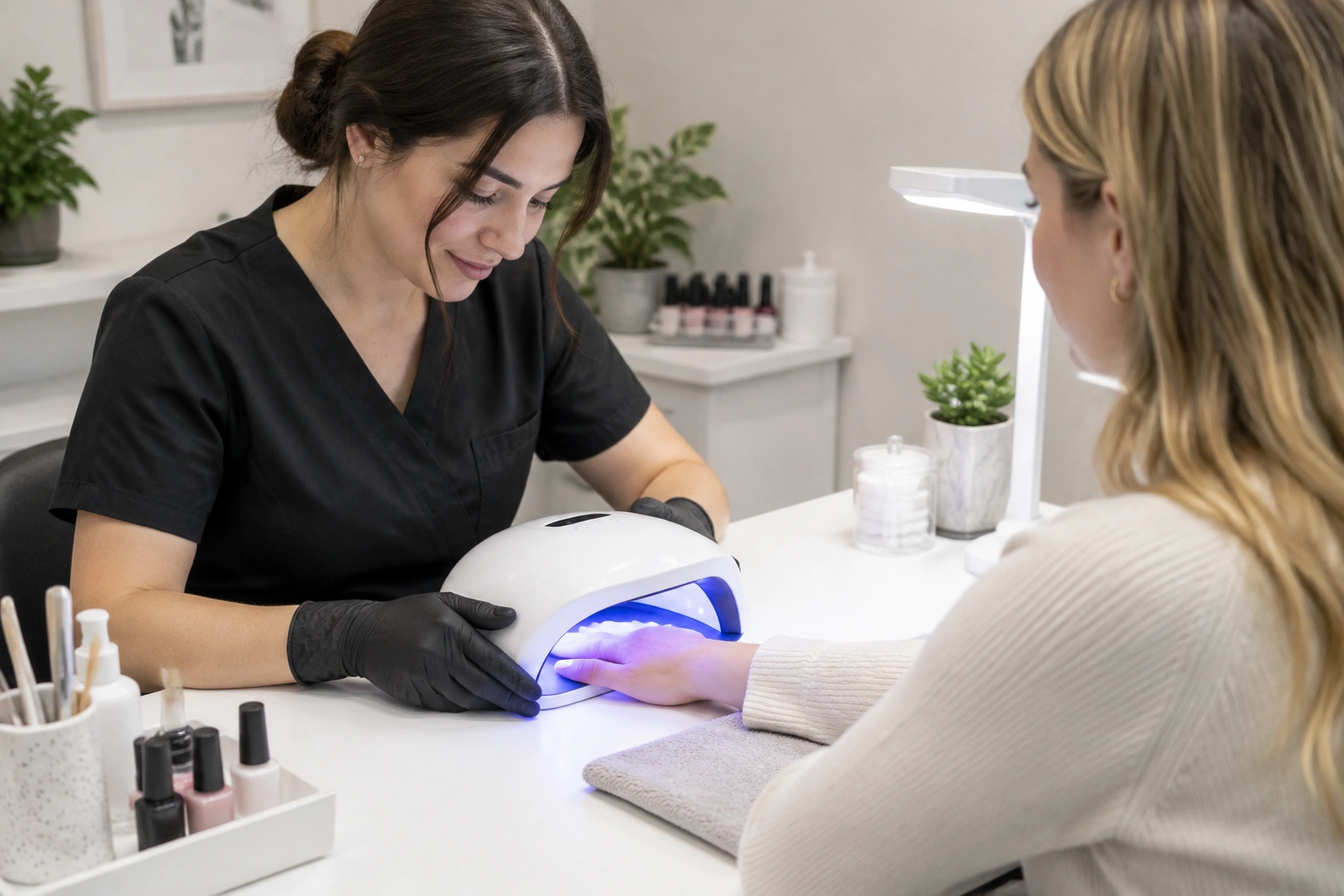
A practical rule of thumb for many salon gel systems is:
- LED: about 30–60 seconds per coat
- UV: about 1–2 minutes per coat
Some brands may call for longer, especially for thicker layers, builder gels, or certain top coats. That’s why the bottle or product sheet matters more than a generic salon timer.
If you’re not sure what you got, use this quick identification guide:
- Regular polish: no lamp needed; it dries in air
- Gel polish: the manicure goes under a lamp after each coat
- Dip powder: the powder itself is usually built with powder + activator, but the finish often includes a lamp-cured top coat
- Top coat alone: if the salon says “one more minute under the lamp,” it’s probably part of a gel system
Here’s the decision rule I use when teaching clients:
- Identify the product: regular polish, gel polish, or dip powder.
- Identify the lamp: UV or LED.
- Follow the brand time if available.
- If the technician gives a specific time, use that over guesswork.
If you’re curious about lamp safety and general exposure guidance, the FDA’s cosmetics and nail product information is a useful place to start, especially for understanding that salon products and devices should be used as directed.
What Can Make Nails Need More or Less Time Under the Dryer
Several salon variables change the timing more than people realize.
Coat thickness
This is the biggest one. A thin coat cures or dries more evenly. A thick coat can look smoother at first, but it traps more product underneath and is more likely to stay soft in the center.
Trade-off:
– Thin coats = faster, safer drying/cure
– Thick coats = more coverage in one pass, but more risk of wrinkling or under-curing
Brand instructions
Different gel systems are not interchangeable. One brand may need a short LED cycle, while another needs a longer UV cycle. The same is true for some top coats and builder-style products.
Nail color and opacity
Very sheer polish usually behaves differently from a dense, opaque formula. With regular polish, heavier pigmentation often tempts people to apply thicker coats, which slows drying.
Manicure vs. pedicure
Toenails are not magically faster just because they are on your feet. The product still needs the same chemical or air-drying time. The difference is practical: toes get bumped by shoes more easily, so the aftercare window matters more.
Lamp strength and salon technique
A salon’s lamp and the technician’s application technique can affect results, but product instructions still come first. A technician who applies thin, even coats will usually get a cleaner finish than one who rushes.
For clients who want the broader salon context, what a full set at a nail salon includes can help clarify where drying or curing fits into the appointment flow.
How to Tell If Nails Are Fully Dry or Properly Cured
The safest answer is: don’t trust appearance alone.
What you can safely check
- Look for shine and evenness
- Gently hover a finger near the surface without pressing
- Ask the technician to confirm whether the product is dry, cured, or still needs a final step
- For gel, ask whether the tacky layer is supposed to stay on until cleanup
What you should not do
- Do not press a thumbnail into the polish to “test” it
- Do not rub the surface with your other hand
- Do not tap hard against a counter or bag to see if it feels set
- Do not put on tight shoes to test a fresh pedicure
Signs regular polish is still too soft
- It dents when you lightly tap it
- It feels cool, tacky, or rubbery
- A fingerprint marks the surface
- The polish wrinkles when you touch something
Signs gel may be under-cured
- It still feels unusually soft after the lamp
- The surface looks uneven or wrinkled
- The tacky layer seems heavier than normal for that system
- The technician says it needs another cycle
Signs the service is ready
- The surface no longer dents easily
- The finish looks even and smooth
- The technician confirms the product has cured or set
- You can carefully move your hands without fear of immediate smudging
One important detail: some gel systems leave a tacky layer on purpose. That does not automatically mean the polish is under-cured. It may simply need a cleanser or the next step in the salon’s process. If you’re unsure, ask before touching it.
Common Mistakes That Cause Smudging, Wrinkling, or Under-Cured Nails
Most ruined fresh manicures come from a few predictable habits.
Leaving too early
If you leave the dryer because the surface “looks dry,” you may still be within the danger zone. This is especially true for regular polish with multiple coats.
Touching nails to test them
Pressing a thumbnail into another nail is one of the fastest ways to create a dent you can’t fix.
Putting on shoes too soon after a pedicure
Even when toenails seem set, tight shoes can leave marks. Open-toe footwear is the safer choice if you’re leaving the salon right away.
Letting coats get too thick
This is the hidden mistake that causes many “it should have been dry by now” complaints. Thick layers need more time than most clients expect.
Not speaking up about heat or discomfort
If a lamp feels hot, burning, or unusually uncomfortable, tell the technician immediately. That is not something to push through.
What to Do If Your Nails Still Feel Sticky, Soft, or Warm After the Dryer
Use this simple decision tree.
If you have regular polish
- Stay longer if the technician recommends it.
- Avoid bags, car doors, and phone screens for a little while longer.
- If the polish is still soft, assume it is not ready.
- If it has been only a few minutes and the polish is thick, more time is normal.
If you have gel polish
- Ask whether the lamp was UV or LED.
- Ask whether the product needs another full cycle.
- Check whether the tacky layer is normal for that system.
- If it is soft or wrinkled, do not leave yet if you can avoid it.
If you have dip powder
- Ask whether the powder layers are finished and whether the top coat has fully cured.
- If the powder feels set but the surface is tacky, the salon may still be on the final top-coat step.
- If the finish is soft, sticky, or denting, it likely needs more time or another coat step.
If you’re not sure what was applied
This is the moment to ask directly:
“Was this regular polish, gel, or dip powder, and is it fully set?”
A good technician will answer clearly. If they need to check the product instructions, that is a better sign than a vague “it should be fine.”
Manicure vs. Pedicure: Does Drying Time or Aftercare Change?
The product timing is usually similar, but the risk of damage after the service is different.
Manicures
Hands are more active, so the challenge is accidental contact:
– opening a purse
– reaching for keys
– typing too soon
– grabbing a cup with a fresh thumbnail
Pedicures
Feet are less active, but they face different problems:
– shoes can compress the polish
– socks can rub the surface
– toes can bump each other when walking
That is why pedicure timing is not just about the lamp or dryer. It is also about the first 30 minutes after you leave. If you can, wear roomy shoes or sandals after a fresh pedi.
For readers who want to compare polish wear and maintenance across services, our guide to regular nail polish longevity is a useful next step.
When Can You Leave the Salon? Quick Checklist
Use this before you head out.
Regular polish
- The surface no longer dents easily
- You can move your hands without brushing the nails against anything
- You have a plan to avoid heavy contact for the next hour or so
- For pedicures, you have open-toe or roomy shoes if possible
Gel polish
- The technician confirms the final coat has cured
- Any tacky layer is understood as part of the system, not a mistake
- Your nails are not warm, soft, or wrinkled
- You can leave without immediately gripping bags, keys, or shoe straps against the nails
Pedicures
- Toes are fully set or cured
- Your shoes will not squeeze the toes
- You can avoid socks or tight footwear for a bit, if possible
- You are not rushing into a long walk or workout right away
If any of those boxes are not checked, it’s worth staying a little longer.
Safety Notes for Salon Nail Lamps
Salon nail lamps are generally used as directed by the technician and product brand, but a few common-sense precautions matter.
- Follow the recommended cure time. More is not automatically better.
- Speak up if the lamp feels hot or painful.
- Don’t assume every gel system works with every lamp.
- If you have questions about UV exposure, ask the salon what lamp they use and how long the service is designed to cure.
For broader health guidance on skin and sun-related exposure, the American Academy of Dermatology offers general skin-care information that can help you think about protection and caution without turning a manicure into a medical project.
When to See a Nail Technician or Dermatologist
See a nail technician if:
– you’re unsure what product was applied
– the polish is still soft after the expected time
– the gel seems sticky in a way that doesn’t match the salon’s usual process
– you need help figuring out whether another lamp cycle is appropriate
See a dermatologist if:
– you have a skin reaction around the nails
– the area becomes painful, swollen, or persistently irritated
– you notice a change that seems more like a skin issue than a polish problem
That distinction matters. A curing problem is usually a salon-application issue. A skin reaction is a separate concern and deserves proper attention.
The Bottom Line
If you’re wondering how long to sit under a nail dryer at the salon, the honest answer is: long enough for the product you actually received.
- Regular polish usually needs air-drying time, often 15–20 minutes for a quick single coat and longer for full hardness.
- Gel polish usually cures in about 30–60 seconds per coat under LED or 1–2 minutes per coat under UV, but the brand’s directions still win.
- Dip powder usually does not need the powder layers lamp-cured, but the final gel top coat often does.
- Thick coats, multiple layers, and pedicures usually need more caution, not less.
When in doubt, ask the technician before you leave. That one conversation is often the difference between a polished finish and a smudged one.

