
How Much to Tip at a Nail Salon: A Practical Guide for Manicures, Pedicures, and More

If you want the short answer, tip 15% to 20% at a nail salon. That range is the common standard for manicure and pedicure services, and 20% is a solid default when you’re happy with the result. If the service was simple and the price was low, a few dollars may still land in that range. If the appointment was detailed, long, or included specialty work, lean toward the higher end.
A useful rule: tip on the service total, not the product shelf price or add-ons you didn’t receive. If you’re unsure, 18% is a comfortable middle ground.
Quick Answer: How Much to Tip at a Nail Salon
Here’s the fast version:
- Basic manicure: 15% to 20%
- Pedicure: 15% to 20%
- Combo manicure and pedicure: 15% to 20% on the total, or split fairly if different technicians helped
- Gel, acrylic, dip powder, or nail art: usually still 15% to 20%, with the higher end making more sense for detailed work
If you want a single number and don’t want to overthink it, 20% is the safest tip when the service met your expectations. For a broader consumer reference, NerdWallet’s nail salon tipping guide also places customary tipping in that range.
The Standard Nail Salon Tip: 15%, 18%, or 20%?
Think of these percentages as three different comfort zones:
15%
Use 15% when the service was straightforward, the price was already high for your budget, or the appointment was fine but not exceptional. This is still within the normal range for nail services.
18%
Use 18% when you want to tip generously without jumping all the way to 20%. It’s a practical middle choice for a good manicure or pedicure when everything went smoothly.
20%
Use 20% when the technician did excellent work, spent extra time on shaping or cleanup, or gave you a polished result that feels worth rewarding. That matches what many regular clients use as their default. You can see that framing in DaySmart Salon’s tipping guidance.
A simple decision rule:
– Fine service: 15%
– Good service: 18%
– Excellent service: 20%
That keeps the choice fair without turning checkout into a math problem.
How to Calculate a Nail Salon Tip
The easiest method is to multiply the bill by the percentage you want.
Quick math shortcuts
- 15% = bill × 0.15
- 18% = bill × 0.18
- 20% = bill × 0.20
Examples:
– $30 manicure at 20% = $6
– $45 pedicure at 18% = $8.10
– $70 gel manicure at 20% = $14
If you prefer a fast mental shortcut, you can:
– figure 10% first,
– then add half of that for 15%,
– or double the 10% amount for 20%.
Pre-tax or post-tax?
The simplest default is to tip on the pre-tax service total. If you round up a little, that’s perfectly acceptable too. The key is consistency: choose one method and use it every time so you’re not second-guessing yourself at the register.
For example, if your manicure is $38 before tax:
– 15% = $5.70
– 18% = $6.84
– 20% = $7.60
Rounding to $6, $7, or $8 is normal and easy.
How Much to Tip for a Manicure vs. Pedicure
A manicure and a pedicure usually follow the same tipping range, but the service length and effort can change what feels appropriate.
Basic manicure
For a basic manicure, 15% to 20% is standard. If the appointment was quick and simple, a flat tip that lands in that range is perfectly reasonable.
Pedicure
Pedicures often take longer and can involve more detailed foot and leg work, so many clients tip at the higher end when the service is thorough. The percentage range stays the same, but the dollar amount may be higher because the bill is often higher.
Combo manicure and pedicure
If one technician handled both, tip once on the full bill. If two different technicians each performed separate services, tip each person based on the share of work they handled. A salon guide from vbeautypure notes that when you receive multiple services, tipping separately for each service is common practice.
A practical example
If your manicure is $25 and your pedicure is $40:
– total = $65
– 15% = $9.75
– 20% = $13.00
If one technician did both, a single tip of $10 to $13 works well. If two technicians split the work, you may want to divide that tip between them in a way that reflects each person’s contribution.
How Much to Tip for Gel, Acrylic, Dip Powder, Spa Services, and Nail Art
Specialty services usually justify the same percentage range, but the complexity matters.
Gel nails
Gel manicures often take more time than a basic polish service because of prep, application, and curing. A tip in the 15% to 20% range still fits well, with 20% making sense if the finish is clean and precise.
Acrylic nails and dip powder
Acrylics and dip powder usually involve more technical skill and more steps. The tip doesn’t have to follow a separate formula, but many clients lean toward the higher end when the work is detailed or the appointment ran long.
Spa manicures and spa pedicures
Spa versions often include more massage, exfoliation, or extra care. If the service felt more involved than a standard manicure or pedicure, 18% to 20% is a reasonable choice.
Nail art
Detailed nail art can take much longer than a standard color application. When the design is intricate, a tip at the higher end is a fair way to recognize the extra time and precision.
A helpful rule: the more customized the work, the more likely 20% feels appropriate.
For broader nail-care context, if you’re also learning what service level to book, our guide on what is a full set at a nail salon can help you understand the difference between basic and more involved appointments.
When to Tip More, Less, or the Same
Use the same percentage when the service was normal and the result matched expectations. Adjust only when something clearly shifts the experience.
Tip more when:
- the technician fixed a problem without making it awkward
- the appointment took extra time because of detailed shaping or nail art
- the result looked especially clean and polished
- you felt well cared for and unrushed
Tip less when:
- the service was rushed
- the result was noticeably uneven or incomplete
- you had to ask for multiple corrections
- the experience was poor enough that you would not want to return
Keep the tip the same when:
- the service was ordinary and acceptable
- the salon was busy but the technician still did the job well
- the result was fine, even if not memorable
The goal is not to punish small imperfections. It’s to match the tip to the actual service experience.
What to Do If the Service Was Poor
If something went wrong, handle it in two steps: address the issue politely first, then decide on the tip.
For example:
1. Tell the technician what needs correction while you’re still there.
2. If the issue is fixed well, you can still tip normally.
3. If the result remains poor, it is reasonable to tip less.
What matters most is staying calm and specific. Instead of saying, “This is bad,” try:
– “Could you even out this side?”
– “This one looks thicker than the others.”
– “I’d like the shape adjusted before I leave.”
If the service was truly unsatisfactory, a smaller tip is not rude. Tipping is customary, but it is still tied to the quality of the experience. StyleSeat’s nail salon tipping guide also notes that tipping is not mandatory, which reflects how most people treat it: expected, but still connected to service quality.
Cash Tip vs. Credit Card Tip
Both are acceptable, but they’re not always equally convenient.
Cash tip
Cash is the simplest option when you want the technician to receive it directly and immediately. It also avoids any confusion about whether the tip was processed correctly.
Credit card tip
Card tipping is convenient if you don’t carry cash. Many salons allow it, and it’s perfectly normal to add the tip during checkout. The only drawback is that card tips may be processed later, depending on the salon’s system.
A practical tip from consumer guidance: if you prefer cash, bring it with you so you’re not hunting for an ATM after your appointment. That advice appears in NerdWallet’s nail salon tipping article, and it’s genuinely useful.
If you’re deciding between cash and card, choose the one that makes it easiest to leave the amount you intended. The best tip is the one you can give smoothly and confidently.
How to Tip When More Than One Technician Helps
When multiple people help, don’t assume one tip will be shared fairly.
If one person did the full service
Leave one tip at checkout.
If two technicians split the appointment
Tip each technician separately if you can. That is especially helpful when one person prepped, another painted, and a third handled nail art or finishing.
If the salon uses a team approach
Ask at checkout how they prefer tips to be handled. A simple question works:
– “Would you like me to tip each person separately?”
That keeps things clear and avoids accidentally overlooking someone who contributed to the service.
Should You Tip the Salon Owner?
Yes, if the salon owner performed your service, it is generally still appropriate to tip them.
A simple rule:
– Owner did the work: tip as you would any nail technician
– Owner only oversaw the salon: no tip needed for that
If the salon has a different policy, follow the salon’s lead. Otherwise, use the same 15% to 20% guideline.
Simple Tip Examples for Common Nail Salon Bills
Here’s a quick reference you can use at checkout.
| Bill | 15% Tip | 18% Tip | 20% Tip |
|---|---|---|---|
| $25 | $3.75 | $4.50 | $5.00 |
| $30 | $4.50 | $5.40 | $6.00 |
| $40 | $6.00 | $7.20 | $8.00 |
| $45 | $6.75 | $8.10 | $9.00 |
| $50 | $7.50 | $9.00 | $10.00 |
| $60 | $9.00 | $10.80 | $12.00 |
| $70 | $10.50 | $12.60 | $14.00 |
| $100 | $15.00 | $18.00 | $20.00 |
A few real-world examples:
– $30 basic manicure → tip about $5 to $6
– $45 pedicure → tip about $8 to $9
– $70 gel manicure with nail art → tip about $12 to $14
– $100 manicure-pedicure combo → tip about $18 to $20, or split if different technicians helped
Frequently Asked Questions About Nail Salon Tipping
Is 15% or 20% better at a nail salon?
Both are normal. Use 15% for a standard, acceptable service and 20% when the work was excellent or more detailed.
Do I tip on the total before or after tax?
Most people tip on the pre-tax service total. If you round a little up, that’s fine too.
Can I tip with a credit card?
Yes. Card tipping is common and acceptable, though cash is sometimes simpler for the technician.
Should I tip more for gel, acrylic, or nail art?
Usually not because of the service name alone. Tip more when the work takes extra time, skill, or attention.
What if two technicians worked on my nails?
Tip each person if they each provided a separate service, or ask the front desk how they prefer tips to be split.
Is it okay not to tip if the service was bad?
If the service was genuinely poor and the problem was not corrected, a smaller tip is reasonable. Try to address the issue politely before you leave.
Do I tip the salon owner?
If the owner performed the service, yes, tipping is still appropriate.
What if I only got a quick polish change?
For very small services like a polish change or a quick cleanup, a flat $3 to $5 tip is usually an acceptable way to keep things simple, especially if the bill is low.
Does location matter?
Yes. At higher-end salons or in higher-cost areas, tipping toward 20% is a good rule of thumb. If prices are already steep, 15% to 18% is still reasonable and often feels more practical.
Final Takeaway
If you want one rule to remember, use this: tip 15% to 20% at a nail salon, with 20% as the easy default for good service. Adjust up for detailed work, multiple technicians, or an especially polished result. Adjust down only when the service was clearly poor and you’ve already given the salon a fair chance to correct it.
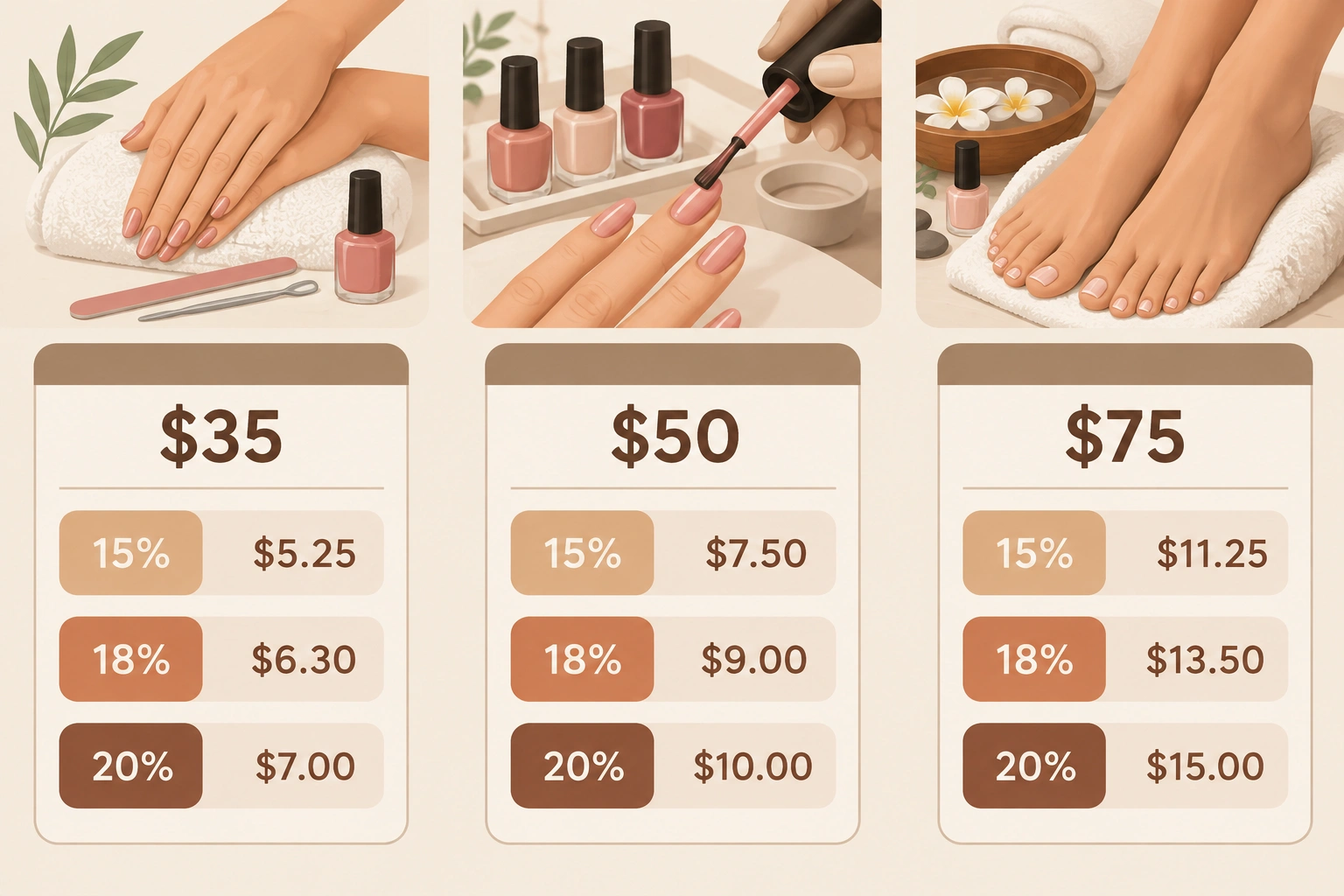
That keeps your tip fair, simple, and easy to calculate—exactly what checkout should feel like.

