
How Often Should You Check Your Toenails? A Simple Care Guide

Your toenails are easy to ignore until one becomes painful, thick, discolored, cracked, or difficult to trim. But taking a few seconds to look at them regularly can help you notice small changes before they turn into bigger problems.
So, how often should you check your toenails? For most healthy adults, a careful check about once a week is a practical routine. You may want to look more often if you frequently wear tight shoes, exercise heavily, get pedicures, have recurring ingrown nails, or notice an existing nail change.
This guide explains what to look for, how to check your toenails safely, which tools can help, and when a change deserves professional attention.
Quick Answer
For most people, checking your toenails once a week is enough to notice changes in color, thickness, shape, texture, or the surrounding skin. Check them sooner if you have pain, redness, swelling, injury, or nail lifting. People with diabetes or reduced foot sensation may need to inspect their feet and toenails every day.
Why Checking Your Toenails Regularly Matters

Toenails grow slowly, so changes can be easy to miss. You might not notice a slightly yellow area, a cracked corner, or pressure from a shoe until the problem has progressed.
A simple inspection lets you catch issues such as:
- A nail beginning to grow into the skin
- Cracks or splits
- Thickening
- Yellow, white, brown, or dark discoloration
- Lifting from the nail bed
- Redness or swelling around the nail
- Cuts or blisters near the toes
- Rough edges that can snag socks
- Changes after a pedicure or injury
Regular checks are not about diagnosing yourself. They are about knowing what your nails normally look like so unusual changes are easier to recognize.
The American Academy of Dermatology’s guidance on nail changes recommends professional evaluation for concerning changes such as nail lifting, swelling, pain, or significant changes in appearance.
How Often Should You Check Your Toenails?
There is no single schedule that fits everyone. Your ideal routine depends on your nail health, footwear, activity level, and medical risk factors.
Once a Week: A Good Routine for Most People
If your toenails are generally healthy, checking them once every week is reasonable.
A weekly check works well because it fits naturally into routines such as:
- Trimming or filing your nails
- Applying moisturizer
- Removing nail polish
- Taking care of your feet after a shower
- Doing an at-home pedicure
You do not have to perform an elaborate inspection. A minute or two is usually enough.
Look at all ten nails under good lighting, then check the surrounding skin.
Check More Often If Something Is Changing
If one toenail has recently been injured, cracked, or irritated, look at it every few days to see whether it is improving.
More frequent checks can also make sense if you:
- Run or walk long distances
- Wear work boots or tight footwear
- Dance or participate in sports
- Frequently get pedicures
- Have had ingrown toenails before
- Recently changed shoes
- Have a nail that is already thick or damaged
Repeated pressure inside shoes can affect toenails gradually. If one toe repeatedly rubs against the front or side of your shoe, noticing the problem early gives you a chance to adjust your footwear before the nail becomes more irritated.
Daily Checks May Be Important for Some People
People with diabetes may need a much more frequent foot-care routine. The CDC’s diabetes foot-care guidance recommends checking the feet every day for cuts, sores, redness, swelling, blisters, and changes involving the skin or nails. Reduced sensation can make an injury harder to notice without looking.
If you have diabetes, neuropathy, poor circulation, or another condition affecting your feet, follow the schedule recommended by your healthcare professional rather than relying only on a general weekly routine.
What Should Healthy Toenails Normally Look Like?
Knowing your normal appearance is more useful than trying to make every toenail look perfectly smooth.
Generally, a healthy toenail should be firmly attached and should not cause pain. Some variation in thickness, ridges, or appearance can be normal, especially with age.
During your weekly check, compare each nail with how it looked previously.
Ask yourself:
- Has the color changed?
- Is the nail thicker than before?
- Is part of it lifting?
- Has the shape changed?
- Is there new cracking or crumbling?
- Is the surrounding skin irritated?
- Does pressing around the nail hurt?
A sudden or progressive change matters more than a feature that has looked the same for years.
Warning Signs to Look for During a Toenail Check
Discoloration
Pay attention to new yellow, white, brown, greenish, or dark areas.
Discoloration does not automatically mean you have an infection. Polish staining, trauma, repeated shoe pressure, and other nail conditions can also alter nail color.
However, fungal nail infections commonly cause color changes along with thickening, brittleness, buildup, or nail lifting. The American Academy of Dermatology’s nail-fungus symptom guide describes discoloration, crumbling, thickening, and separation from the nail bed as common signs worth noticing.
Thickening
Toenails can gradually become thicker with age, repeated injury, pressure from footwear, certain skin conditions, or fungal infection.
Mayo Clinic notes that aging, trauma, tight shoes, psoriasis, and fungal infection are among the possible causes of thickened toenails.
Do not aggressively file down a suddenly thickened or painful nail just to make it look thinner. You could damage the nail or surrounding skin without addressing the cause.
Lifting
Look for a white or hollow-looking area where the nail appears to be separating from the skin beneath it.
Avoid digging underneath a lifted nail with a metal tool or sharp object. This can cause more separation or create an opening for germs.
Redness and Swelling
Healthy skin around your toenails should not suddenly become swollen, hot, very tender, or increasingly red.
These changes can occur with:
- Ingrown toenails
- Injury
- Skin irritation
- Infection
If the area is becoming increasingly painful, draining fluid, or spreading in redness, home cosmetic care is no longer the priority.
Cracks, Splits, and Rough Edges
A small rough edge is often easy to smooth with an appropriate nail file.
A deep split is different. Filing aggressively around it can extend the damage.
If a crack reaches into the attached portion of the nail or causes bleeding or pain, avoid trying to reshape it aggressively at home.
Dark Streaks or Unexplained Pigment Changes
Some nail pigmentation can be harmless, but a new or changing dark streak should not automatically be treated as a cosmetic problem.
A dermatologist should evaluate concerning or unexplained nail color changes, particularly when they persist or change over time.
A Simple Weekly Toenail Check Routine
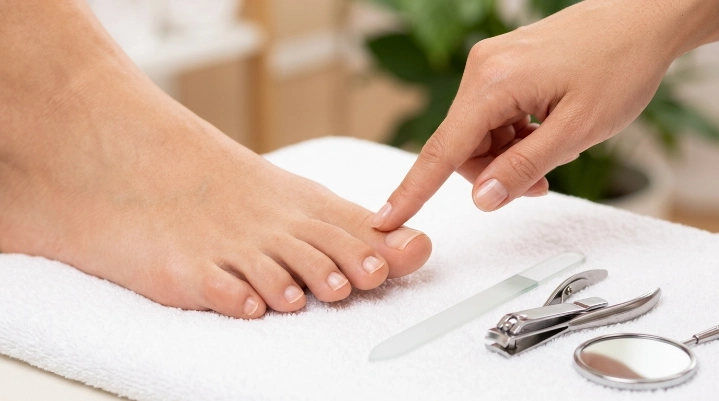
You can complete a useful toenail check in just a few minutes.
1. Remove Polish When Necessary
If you regularly wear opaque polish, occasionally remove it so you can see the actual nail plate.
You do not necessarily need polish-free nails every week, but continually covering the nail can make gradual color or texture changes harder to notice.
2. Use Good Lighting
Sit somewhere bright and comfortable.
If necessary, use a mirror to see the smaller toes clearly.
3. Look at Each Nail
Compare:
- Color
- Thickness
- Shape
- Surface texture
- Attachment to the nail bed
- Free edge
Look for anything that appears different from your last check.
4. Inspect the Skin Around the Nail
Look along both sides and around the base of every toenail.
Check for:
- Redness
- Swelling
- Cuts
- Peeling
- Bleeding
- Tender spots
- Signs of pressure from shoes
5. Smooth Minor Rough Edges
If the nail is otherwise healthy and simply has a rough free edge, gently smooth it with an appropriate nail file.
Do not use filing as a treatment for unexplained thickening, lifting, pain, or discoloration.
6. Note Changes
You do not need a detailed journal. If something catches your attention, however, taking a clear photo can make it easier to see whether it is actually changing over the next few weeks.
Toenail Tools: What You Actually Need
You do not need an expensive pedicure kit for routine toenail care.
| Tool | Best Use | Typical Cost | Safety Consideration |
|---|---|---|---|
| Toenail clipper | Reducing nail length | $5–$20 | Use sharp, clean blades |
| Fine/medium nail file | Smoothing rough edges | $2–$15 | Avoid aggressive filing |
| Glass nail file | Gentle edge smoothing | $8–$25 | Clean between uses |
| Disposable emery board | Occasional shaping | $1–$10 | Replace when worn or contaminated |
| Small mirror | Viewing difficult angles | $3–$15 | Helpful if mobility is limited |
| Nail brush | Gentle external cleaning | $3–$10 | Avoid forceful scrubbing |
Prices vary by brand and material, but basic toenail care does not require professional-grade tools.
Choosing a Nail File for Toenails
Toenails are often thicker than fingernails, but that does not mean the roughest file available is always best.
For normal natural toenails, a medium or fine file is usually easier to control. Glass files can also work well for smoothing edges.
Very coarse files remove material quickly, which increases the chance of taking off more nail than you intended.
If a nail is extremely thick, painful, distorted, or difficult to cut, professional help may be safer than repeatedly grinding it down.
Expert Tip: Use your nail file mainly for smoothing the free edge after trimming. If you find yourself filing deeply into the sides of a toenail or thinning the entire nail surface to manage pain or thickness, stop and figure out why the nail is changing first.
How to Trim and File Toenails Safely
Good technique matters because aggressive shaping around the corners can irritate the skin.
The American Academy of Dermatology’s nail-trimming instructions recommend trimming toenails straight across and smoothing rough edges with a nail file.
A simple routine is:
- Start with clean tools.
- Trim the toenail mostly straight across.
- Do not cut deeply into the corners.
- Leave enough nail to protect the end of the toe.
- Smooth sharp edges gently with a file.
- Stop if filing causes pain or sensitivity.
The goal is a comfortable, smooth edge—not an extremely short or deeply rounded toenail.
Tool Hygiene Matters More Than You May Think
Toenail tools come into contact with nail debris and surrounding skin, so keeping them clean should be part of your routine.
Do not casually share:
- Clippers
- Nail files
- Cuticle tools
- Pedicure blades
Disposable emery boards are difficult to thoroughly sanitize and are usually better treated as personal items.
Reusable tools should be cleaned according to their material and manufacturer instructions and dried fully before storage.
The AAD also recommends regular disinfection of nail-trimming tools.
If you notice signs of possible fungal infection, be especially cautious about using the same uncleaned tools on other nails because fungal infections can spread.
Nail Polish, Gel, and Pedicures: When Should You Check?
If your toenails are almost always covered with polish, gel, wraps, or another opaque product, build occasional bare-nail checks into your routine.
When product comes off, look at the nail before immediately applying another color.
Check for:
- Unexpected discoloration
- White rough patches
- Surface damage
- Separation
- Tenderness
- Unusual thinning
- Redness around the nail
After a professional pedicure, mild awareness of freshly trimmed nails may occur, but significant pain, bleeding, burning, swelling, or worsening redness should not simply be covered with another product.
DIY Care vs. Professional Care
Routine trimming and gentle filing are reasonable DIY tasks for healthy nails.
Professional care becomes more useful when the problem is beyond ordinary grooming.
| Situation | DIY Care May Be Reasonable | Professional Evaluation Is Better |
|---|---|---|
| Slightly rough nail edge | Yes | Usually unnecessary |
| Routine length reduction | Yes | Optional |
| Mild cosmetic shaping | Yes | Optional |
| Very thick toenail | Sometimes | Often safer |
| Persistent discoloration | No diagnosis at home | Yes |
| Nail lifting | Avoid aggressive filing | Yes |
| Significant pain | No | Yes |
| Redness or swelling | Avoid cosmetic treatment | Yes |
| Repeated ingrown nail | Limited DIY care | Yes |
| Drainage or suspected infection | No | Prompt evaluation |
A nail technician can help with cosmetic grooming, shaping, and routine pedicure care. A nail technician cannot diagnose or medically treat an infection or disease.
For unexplained nail changes, a dermatologist, podiatrist, or other qualified healthcare professional is the more appropriate choice.
Common Mistakes to Avoid
- Ignoring your toenails for months. Small changes are harder to track when you rarely look at them.
- Cutting toenails extremely short. This can make the surrounding skin more vulnerable to irritation.
- Digging into the corners. Deep corner cutting may contribute to ingrown nail problems.
- Aggressively filing thick nails. Thickness can have multiple causes and should not automatically be treated as cosmetic buildup.
- Using dirty tools. Clippers and files can carry debris and microorganisms between uses.
- Sharing nail tools. Personal nail tools are safer than communal ones.
- Covering a suspicious change with polish. Polish can make it harder to monitor progression.
- Picking beneath a lifting nail. This can worsen separation and damage sensitive tissue.
- Continuing a pedicure when something hurts. Pain is a reason to stop, not push through.
- Trying to diagnose every color change yourself. Different conditions can look similar.
When to See a Nail Technician or Dermatologist
A nail technician is appropriate when your toenails are healthy but you want help with routine shaping, polishing, or cosmetic maintenance.
Choose a dermatologist, podiatrist, or other healthcare professional when you notice changes that may go beyond ordinary grooming.
Consider professional medical evaluation for:
- Persistent or worsening discoloration
- A nail becoming significantly thicker
- Nail lifting
- Recurrent ingrown toenails
- Pain or throbbing
- Swelling or increasing redness
- Drainage or pus
- Bleeding without an obvious minor cause
- A new or changing dark streak
- A nail that repeatedly cracks or crumbles
- Changes that do not improve
If you have diabetes, reduced circulation, numbness, or difficulty seeing or reaching your feet, ask your healthcare professional how you should handle toenail trimming and foot checks. The CDC specifically advises people with diabetes to seek professional help with toenail care when they cannot safely see or reach their feet.
FAQs
How often should you check your toenails?
For most healthy adults, a careful toenail check about once a week is a practical routine. Look sooner if you notice pain, irritation, injury, or another new change.
Should I check my toenails every day?
Most healthy people do not need a detailed daily inspection. However, people with diabetes or certain conditions affecting foot sensation or circulation may be advised to inspect their feet every day.
How often should I trim my toenails?
Trim them when they become long enough to catch, press against your shoes, or become uncomfortable. Toenails grow more slowly than fingernails, so the schedule varies from person to person.
Is it okay to file toenails every week?
Gentle edge smoothing is generally reasonable when needed. Avoid repeatedly thinning the entire surface or aggressively filing the sides of the nail.
What toenail color changes should I watch for?
Look for new yellow, white, brown, greenish, or dark changes, especially if accompanied by thickening, crumbling, pain, buildup, or lifting.
Can I tell if I have toenail fungus just by looking?
Not reliably. Fungus can cause characteristic changes, but other nail problems can look similar. A dermatologist may need to examine or test the nail to confirm the cause.
Should I remove nail polish to check my toenails?
Yes, periodically. If your toenails stay covered continuously, removing the polish occasionally lets you inspect the natural nail plate for changes that would otherwise be hidden.
Conclusion
So, how often should you check your toenails? For most people, once a week is a simple and realistic goal. It takes only a few minutes and helps you notice changes in color, thickness, shape, texture, and the surrounding skin.
Keep your routine gentle: trim straight across, smooth rough edges with a clean nail file, avoid digging beneath nails, and do not aggressively file away unexplained changes.
Most importantly, know the limits of DIY nail care. A slightly rough edge may need nothing more than a file, while persistent discoloration, thickening, lifting, swelling, or pain deserves closer attention.
Make your toenail check part of your regular beauty and self-care routine. A quick look today can make it much easier to recognize when something changes tomorrow.

