
How to Care for Children’s Nails Safely at Home: A Parent’s Practical Guide

Children’s nails need regular attention for a simple reason: short, smooth nails are less likely to scratch skin, snag on clothes, or collect debris. The goal is not to make nails look “perfect.” It’s to keep them clean, comfortable, and safe.
For babies, toddlers, and older children, the routine changes a little. Babies often need the gentlest tools and the most careful handling. Toddlers usually need a calmer setup and a steadier hold. School-age children may be ready to help, but they still need supervision for sharp tools and trimming around the edges.
A few rules apply at every age: use clean tools, trim only when you can see well, avoid cutting cuticles, and stop if the child is moving too much. If a nail looks red, swollen, painful, or infected, home care is no longer the right answer.
Choose the Safest Nail-Care Tools for Your Child’s Age
The best tool is the one that gives you control without taking off too much nail. That usually means choosing between baby nail clippers, rounded-tip scissors, and an emery board.
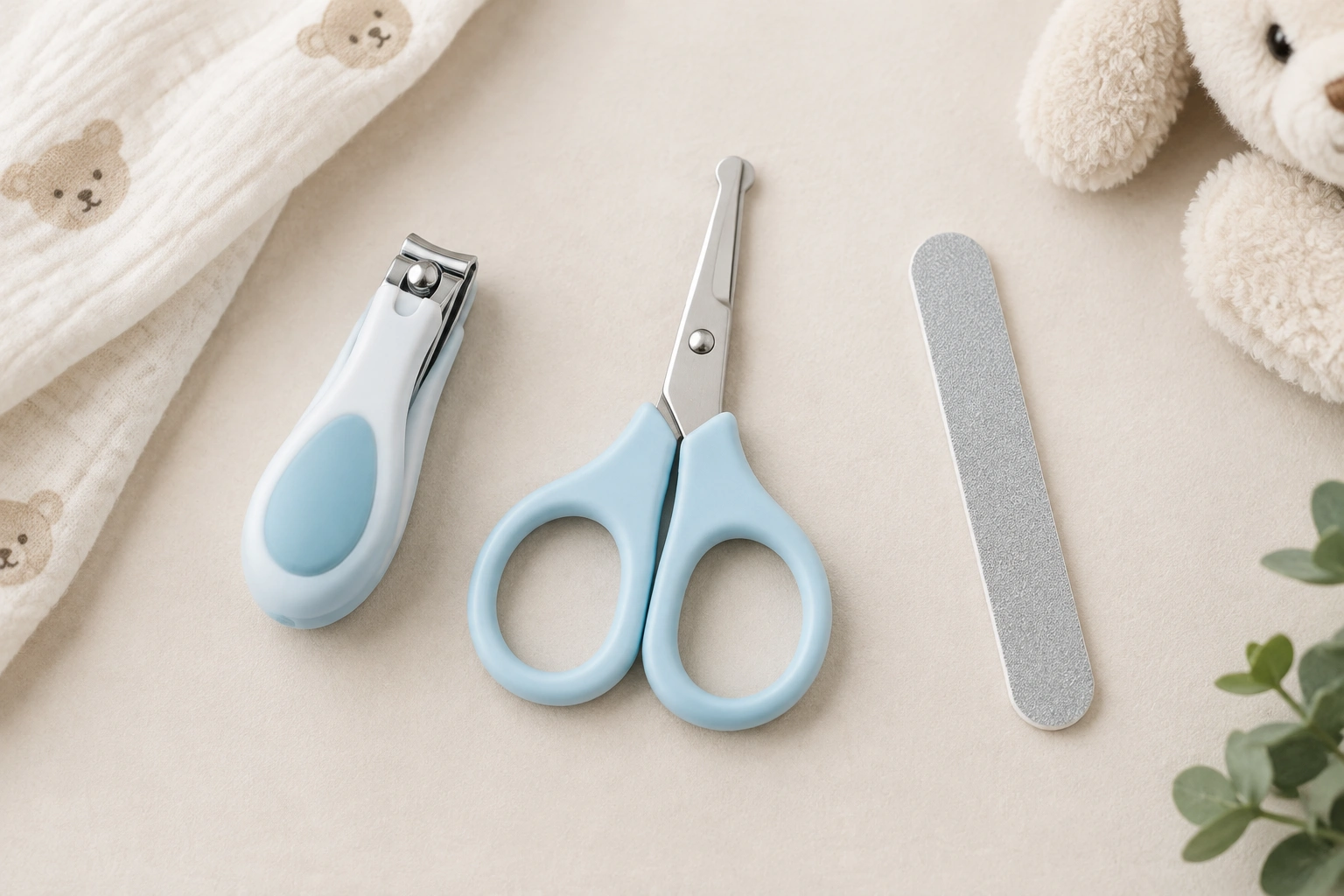
| Tool | Best for | Strengths | Trade-off |
|---|---|---|---|
| Baby nail clippers | Infants and small nails | Fast, compact, easy to use on tiny nails | Can nick skin if the child jerks suddenly |
| Rounded-tip scissors | Babies, toddlers, and caregivers who want more visual control | Easier to see where the blade is going | Slower than clippers and needs a steady hand |
| Emery board | Smoothing sharp edges after trimming or for very small shape corrections | Gentle and useful for finishing touches | Too slow for major trimming |
If you’re deciding between clipping and filing, think about the job at hand. Clipping removes length quickly. Filing is better for smoothing a rough corner after clipping, or for very tiny nails that don’t need much removal. In practice, many parents use both: clip first, then lightly file.
Clean tools matter too. Wipe clippers or scissors after use and keep them dry so they stay in good condition. Dull tools can crush the nail instead of cutting it cleanly, which makes edges rougher.
How Often to Trim Fingernails and Toenails
There isn’t one universal schedule that fits every child, because nail growth and activity levels vary. A practical starting point is:
- Babies: check nails about once a week and trim as needed; some babies need attention more often if they scratch easily.
- Toddlers: check nails weekly to every 2 weeks.
- School-age children: check nails every 1 to 2 weeks, or sooner if they get sharp or start snagging.
The practical rule is simple: trim when nails start to extend past the fingertip or when they become sharp enough to scratch.
Fingernails usually need attention more often than toenails. Hands are used constantly, so fingernails tend to grow out faster and catch on things sooner. Toenails can often go longer between trims, but they should still stay neat and not press into the skin.
A useful decision rule: if you can hear a nail clicking on a surface or feel it snagging on fabric, it’s probably time to trim. If the nail is already short and smooth, filing may be enough.
The trade-off is worth keeping in mind. Very short nails may seem safer for scratching, but cutting too close increases the chance of nicking the skin. Aim for short and smooth, not clipped down to the quick.
Age-by-Age Nail Care Checklist
A simple age-based routine can make nail care easier to remember:
Babies
– Trim when nails feel sharp or about once a week.
– Use baby clippers or rounded-tip scissors.
– Try after a bath or while the baby is sleepy.
– Leave a tiny white edge and smooth sharp corners.
Toddlers
– Check nails weekly and trim every 1 to 2 weeks as needed.
– Use a calm, well-lit setup.
– Keep the child seated securely on your lap or against your body.
– Trim small amounts at a time and pause if they squirm.
School-age children
– Check nails every 1 to 2 weeks.
– Let the child help by holding still or showing you the hand or foot.
– Teach them not to bite, pick, or chew the nails.
– Keep supervision in place for clippers, scissors, and filing.
The Safest Way to Trim a Baby’s Nails
Babies have tiny nails and delicate skin, so the safest method is slow and deliberate. Many caregivers find it easier to trim after a bath, when nails are softer, or while the baby is sleeping and less likely to jerk suddenly. The American Academy of Dermatology notes that nails are softer after a bath or shower, which can make trimming easier.
Here’s a calm, practical method:
- Wash your hands and make sure the clippers or scissors are clean.
- Hold the baby’s hand firmly but gently so the finger does not twist.
- Trim small amounts at a time, following the natural shape of the nail.
- Leave a tiny bit of white edge instead of cutting flush with the skin.
- Check for any sharp corner and smooth it lightly with an emery board if needed.
Do not cut the cuticle. Cuticles protect the nail root, and the AAD advises leaving them alone. Also avoid trying to dig under the nail to “clean it out” before trimming. That usually creates more risk than benefit.
If the baby keeps waking or jerking, stop and try again later.
How to Trim Toddlers’ and Older Children’s Nails
Toddlers are often the hardest age group because they want to help, but they also move without warning. The safest setup is one that reduces surprises.
Good lighting helps more than people realize. Sit near a bright window or use a lamp that shines directly on the hand. Keep the child in a stable position, such as seated on your lap or resting against your body. For some children, trimming while they are drowsy works better than trying to do it during playtime.
A simple routine helps:
- Explain what you’re doing in one sentence.
- Trim one hand or one foot at a time.
- Pause after each nail if the child is squirmy.
- Finish with a quick check for rough edges.
Older children can often hold their own hand steady while you trim. That’s useful, but supervision still matters. School-age children may be ready to learn the process, yet they should not handle sharp tools alone until they can do it safely.
If your child is anxious, let them choose whether to sit on a bed, a couch, or a parent’s lap. The best position is the one that keeps the hand still.
Fingernails vs. Toenails: What Should Be Different?
Fingernails and toenails are not trimmed the same way. Fingernails can be slightly rounded at the corners after clipping. Toenails should be cut straight across to help lower the risk of an ingrown nail.
That difference matters because toenails are more likely to press into the surrounding skin if the corners are cut too deeply. With fingernails, a little rounding helps reduce sharp edges that can scratch the face or arms.
A practical comparison:
- Fingernails: cut almost straight across, then soften the corners lightly.
- Toenails: cut straight across and avoid rounding the sides too much.
For toenails, resist the urge to make the edge look “pretty” by curving it inward. A neat straight edge is usually the safer choice. If a toenail is thick, curved, or already growing into the skin, stop home trimming and ask a pediatrician or dermatologist for guidance.
How to File Sharp Edges After Trimming
Filing is the finishing step that keeps a fresh trim from becoming scratchy. It is especially helpful for babies and toddlers, whose nails can feel surprisingly sharp even after clipping.
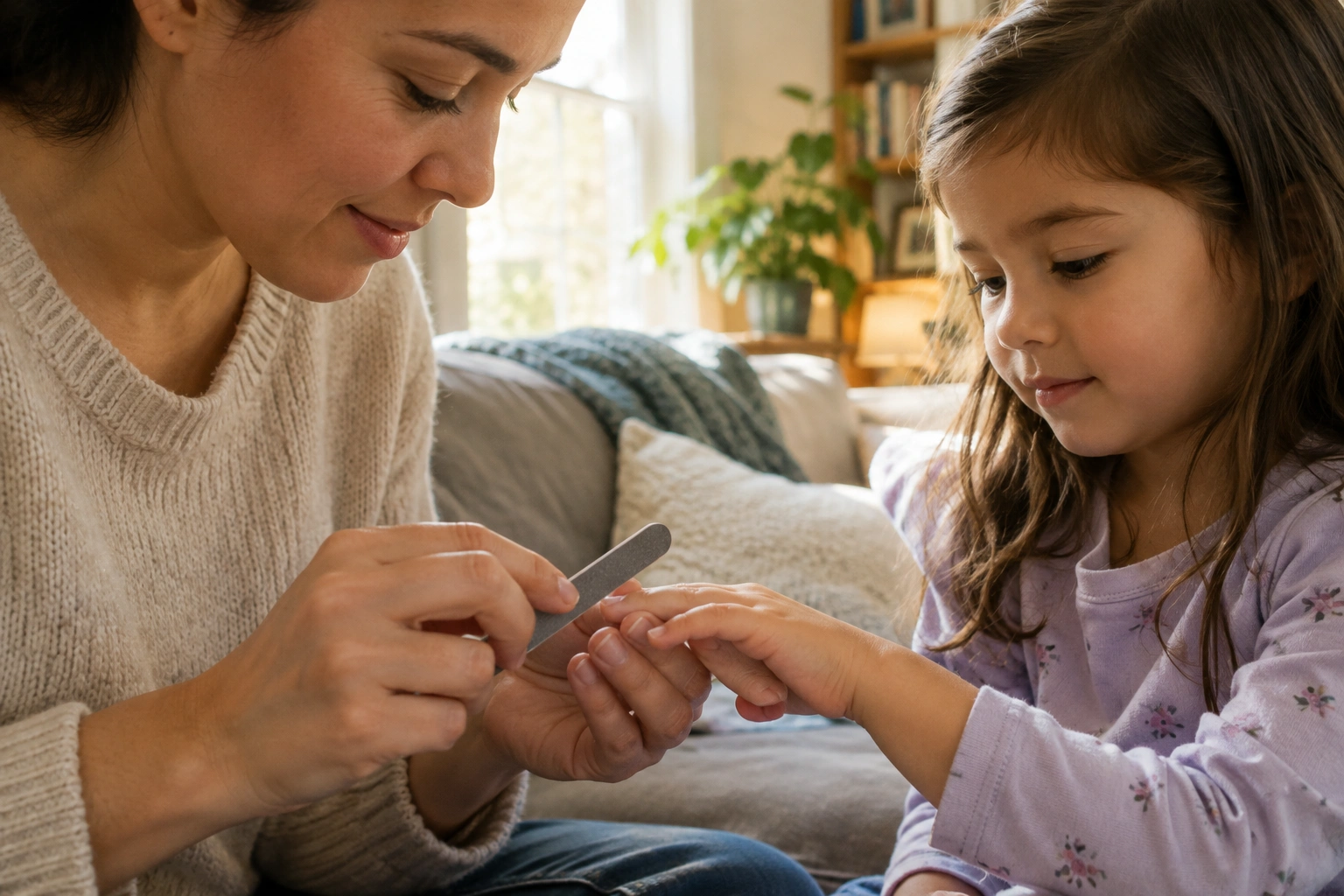
Use a clean emery board and move it in one direction along the edge rather than sawing back and forth aggressively. The goal is to soften the corners, not thin the nail down.
Filing is most useful when:
- a clipped edge feels rough,
- a corner catches on clothing,
- you want to reduce scratching risk without cutting more length,
- the child’s nails are too small for more clipping.
Do not overfile. Too much filing can leave the nail thin and weak. A few gentle passes are usually enough.
How to Clean Under Children’s Nails Without Causing Damage
Children’s nails do need cleaning, but gentle cleaning is the right approach. Soap, water, and a soft touch usually do the job.
After handwashing, use a soft washcloth or a soft nail brush to remove visible dirt. If you see debris under the nail, clean only what comes away easily. Don’t dig with a pointed tool, toothpick, or sharp object. That can injure the skin and create a path for infection.
Dry the hands well afterward. The AAD notes that nails that stay wet for a while can develop a nail infection. That’s one reason drying matters as much as washing.
If your child likes to play outdoors, check nails after messy activities such as sandbox play, gardening, or finger painting. A quick wash is safer than trying to scrape out every trace of dirt.
How to Prevent Scratches, Hangnails, and Ingrown Nails
Most nail problems in children are easier to prevent than to fix. The most effective habits are also the simplest: keep nails short, smooth, clean, and dry.
Short nails reduce scratching and make it harder for dirt to hide beneath the edge. Smooth nails are less likely to snag and turn into a hangnail. Dry nails are less likely to stay damp long enough to encourage infection.
A few practical habits help:
- Trim before nails become sharp enough to scratch.
- File after clipping to remove tiny snags.
- Dry hands and feet thoroughly after washing.
- Keep toenails straight across to reduce ingrown nail risk.
- Watch for children who bite or pick at nails, since that can lead to infection.
If your child bites or picks at nails, start with the simplest fix: keep nails short enough that there is less to chew on, smooth rough edges with a file, and use a calm reminder rather than punishment. For older children, a habit tracker or reward chart may help. If the skin around the nail is broken, red, or tender, pause home trimming on that area and watch for infection.
Moisturizing can also help if nails or surrounding skin are dry. KidsHealth notes that a little hand lotion or moisturizer can be used on nails and cuticles regularly. Use a small amount and keep it simple; the goal is to reduce dryness, not create a thick coating.
What to Do If You Accidentally Nick the Skin
A small nick can happen even when you’re careful. If it does, stay calm. Most minor cuts stop with gentle pressure.
Here’s what to do:
- Press a clean cloth or gauze lightly on the spot.
- Hold pressure until the bleeding slows or stops.
- Clean the area with mild soap and water.
- Dry it gently.
- Watch the area over the next day or two for redness, swelling, or increasing pain.
If the nick is tiny and stops bleeding quickly, that is usually manageable at home. If bleeding won’t stop, the cut looks deep, or the child seems very uncomfortable, contact a healthcare professional.
When Home Care Is Enough, and When to Call a Pediatrician
Some minor nail issues can be watched at home for a short time, while others need medical advice.
Home care is usually enough for:
– a small hangnail without swelling,
– mild dryness around the nail,
– a tiny nick that stops bleeding quickly,
– a rough edge that improves after trimming and filing.
Call a pediatrician if you notice:
– redness that spreads around the nail,
– swelling or warmth,
– pus or drainage,
– increasing pain,
– a nail that seems to be growing into the skin,
– a nail that turns thick, discolored, or crumbly in a way that doesn’t improve.
If the skin around the nail is tender and swollen, trimming it more at home can make things worse. A worsening ingrown nail should also be evaluated by a pediatrician or dermatologist.
Nail problems such as peeling, splitting, or brittleness can also come from injury, infection, or poor nutrition, according to Nationwide Children’s. If the change is persistent or affects several nails, it’s worth asking a clinician.
Common Nail-Care Mistakes to Avoid
The most avoidable mistakes are the ones that seem harmless in the moment.

Don’t cut nails too short. That increases the chance of nicking the skin and can make fingertips sore. Don’t cut or push back the cuticles; they protect the nail root. Don’t use dull tools, because they tear instead of cutting cleanly. And don’t try to trim a moving child’s nails in a hurry.
Another common mistake is treating fingernails and toenails the same way. Fingernails can be slightly rounded; toenails should stay straighter. Mixing up those methods can raise the chance of an ingrown nail.
If your child hates nail trims, it helps to make the process predictable. Use the same chair, the same tool, and the same short routine each time. Familiarity often reduces resistance more than force ever will.
When to See a Pediatrician or Dermatologist
For everyday trimming, most families can manage nail care at home. But if a child has repeated ingrown nails, a nail that is painful to touch, ongoing discoloration, or signs of infection, professional advice is the safer route.
If you’re unsure whether a nail issue is cosmetic or medical, choose the medical evaluation first. That’s especially true when pain, swelling, or drainage is involved. A pediatrician is often the best first call, and a dermatologist may be helpful for ongoing or unusual nail problems.
FAQ
How often should I cut my child’s nails?
Many families find that fingernails need trimming about weekly to every 2 weeks, while toenails often need less frequent attention. Check sooner if nails are sharp or snagging.
Is it better to cut or file children’s nails?
Both can help. Clipping removes length faster, while filing is useful for smoothing sharp edges after trimming or for very small nails.
What if my child bites their nails?
Keep nails short, smooth rough edges, and use calm reminders. If the skin becomes red, swollen, or painful, contact a pediatrician.
Can I trim nails after a bath?
Yes. Nails can be softer after a bath, which may make trimming easier.
When should I call the doctor about a nail problem?
Call a pediatrician if you see spreading redness, swelling, warmth, pus, increasing pain, or a nail that seems to be growing into the skin.
Quick Takeaway for Busy Parents
Healthy children’s nail care comes down to a few steady habits: trim when nails get sharp, use clean tools, keep cuticles untouched, smooth rough edges, and watch for signs of infection or ingrown nails. If you build the routine around safety instead of speed, nail care becomes much easier for you and much more comfortable for your child.

