
How to Choose Nail Polish Without Feeling Overwhelmed

Choosing nail polish gets much easier when you stop thinking about it as one big decision. You are really making four small choices: the color, the finish, the formula, and how much wear you need from it. Once you look at polish that way, the whole process feels a lot less confusing.
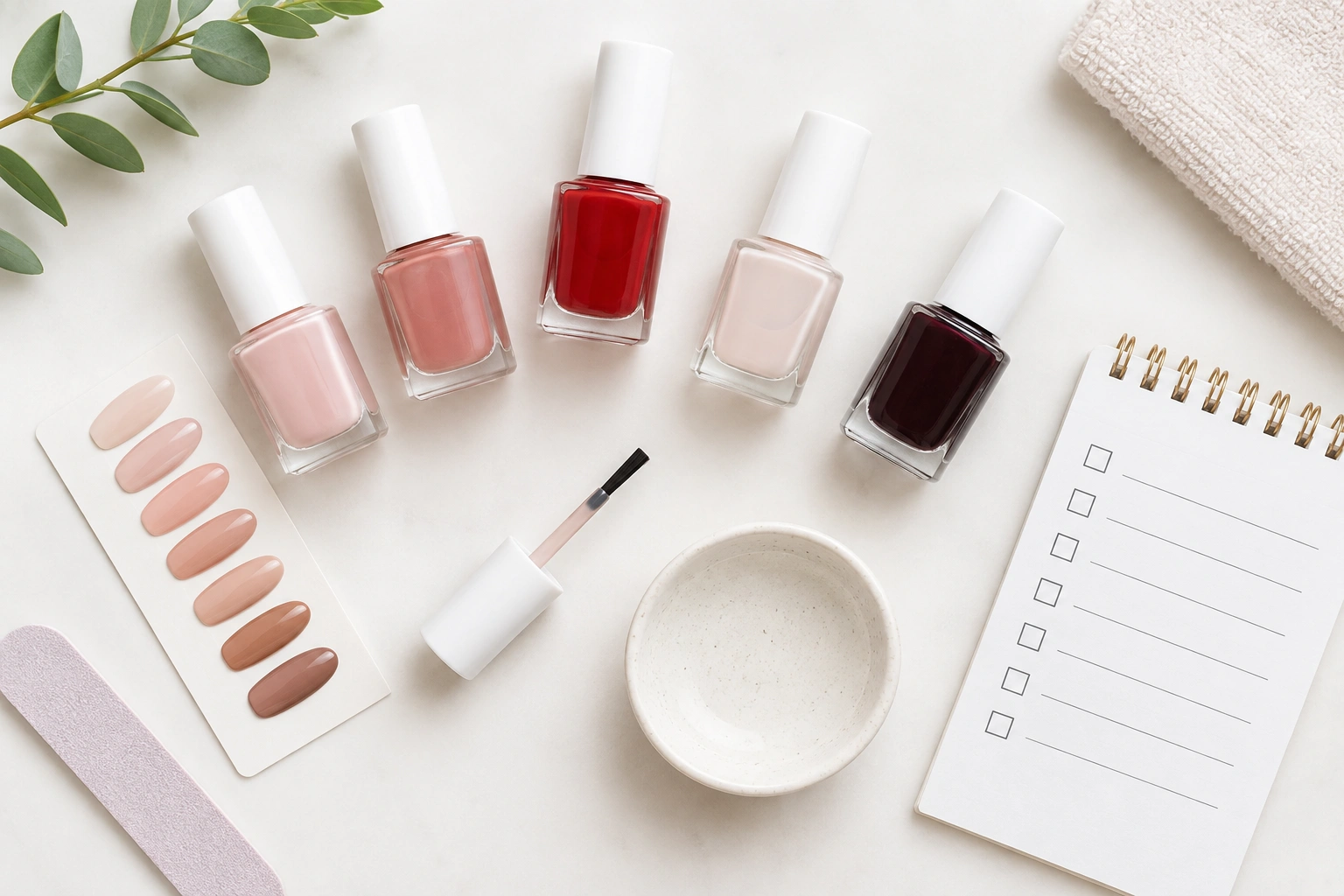
If you are new to polish, keep your first pick simple. A shade you like, a finish you understand, and a formula that fits your routine will usually give you a better experience than chasing the “perfect” bottle. That is the approach I use with beginners all the time as a licensed nail technician: practical first, pretty second, and no stress either way.

How to Choose Nail Polish: The Simple Beginner Framework
A simple way to narrow your options is to choose in this order:
- Your goal — everyday wear, a special event, or practice
- Your color — what looks good on your skin tone and style
- Your finish — cream, shimmer, glitter, or matte
- Your formula — regular, gel, or quick-dry
- Your wear needs — easy removal, longer wear, or faster drying
If you want a faster beginner shortcut, use this decision tree:
- If you want office-safe or everyday wear: choose a sheer, nude, pink, or mauve in a cream finish
- If you want a first-time at-home manicure: choose a regular polish with a medium-opacity cream formula
- If you want low-maintenance wear: choose a chip-resistant or long-wear formula and pair it with base coat and top coat
- If you want a special event look: choose a deeper opaque shade, shimmer, or glitter
- If you want fast drying: choose a quick-dry formula in a shade you already know you like
- If you want easy removal: choose regular polish over gel or glitter
- If you are on a budget: choose a simple cream formula in a versatile color you will actually wear often
That order matters because it keeps you from buying a polish just because the bottle looks nice. A bold red may be perfect for a party, but a sheer nude might be easier if you are still learning how to paint your dominant hand. A quick-dry polish can save time, but a standard cream polish may be easier to control if you are still building steady brush strokes.
essie’s color-finder style guidance is a useful example of thinking beyond the shade family and considering the polish type, base coat, top coat, and nail care products. You can see that approach in essie’s color finder.
Start With Your Goal: Everyday Wear, Special Events, or Easy Practice
Before you compare shades, ask what you want the polish to do for you.
Everyday wear
For daily use, choose something that feels easy to match with your clothes and routine. Soft pinks, nudes, mauves, and classic reds are common starting points because they work in many settings. If you want a polished look without much fuss, a cream finish in a medium-opacity formula is usually the simplest place to begin.
Special events
If you want your nails to stand out, look at richer colors, shimmer, glitter, or a deeper opaque shade. Special-event polish can be more dramatic because you do not need it to blend into your everyday wardrobe. This is the time to pick a finish that feels fun, even if it is not the most practical for regular wear.
Easy practice
If you are still learning, forgiving shades help. Sheer pinks, nude tones, and softer creams are often easier because small mistakes are less obvious. You can still get a neat result without needing perfection on the first try.
Choose a Color That Looks Good on You
Color choice is where most beginners get stuck. The easiest way to simplify it is to think about skin tone, undertone, nail length, and personal style.
Skin tone and undertone
Skin tone gives you the overall lightness or depth of your complexion. Undertone is the subtle cast underneath it, usually warm, cool, or neutral. You do not need to overcomplicate this. If gold jewelry tends to flatter you, warm shades may feel natural. If silver jewelry looks better, cooler shades may be easier to wear. Neutral undertones can usually wear a wider range.
General style guidance can help when you are stuck:
- Fair skin: soft pinks, light nudes, lavender, peach, baby blue, and other lighter shades often look gentle and balanced. Very dark shades can look more striking against fair skin, which may be exactly what you want.
- Medium skin: rose, mauve, coral, berry, and warm nude shades usually feel flattering and easy to wear.
- Deep skin: rich jewel tones, warm reds, chocolate browns, and bold bright shades can look especially vivid.
As a general style suggestion rather than a rule, warm shades often look especially balanced on medium to deep skin tones. If you are choosing between a few bottles in-store or online, that can help you narrow the field without treating it as a hard rule.
Nail length and shape
Nail length changes how a color reads. Short nails often look neat in lighter shades, sheers, and medium creams because the color does not overwhelm the nail. Longer nails can carry deeper shades and stronger contrast more easily. If your nails are very short, a sheer nude can make them look clean and tidy; if they are longer, a deep berry or navy can look elegant and balanced.
Personal style
This part matters more than people think. If you wear mostly soft, neutral clothing, a muted pink, beige nude, or taupe may feel natural. If your style is bold, you may enjoy a bright red, cobalt, or black polish even if it is not the most “universal” choice. The best polish is the one you will actually want to wear.
Pick the Finish: Cream, Shimmer, Glitter, or Matte
The finish changes how the color looks on the nail, even when the shade is the same.

| Finish | What it looks like | Best for beginners? | Main trade-off |
|---|---|---|---|
| Cream | Smooth, solid color with a glossy look | Yes | Can show streaks if the formula is thin |
| Shimmer | Soft sparkle or sheen | Yes | The shine can make brush marks more noticeable in some formulas |
| Glitter | Visible sparkly particles | Sometimes | Harder to remove and can feel less smooth |
| Matte | Flat, non-shiny finish | Sometimes | Can show imperfections more easily and may need extra care |
Cream finish
Cream polish is usually the easiest finish for beginners. It gives a clean, classic look and works well in nearly every color family. If you want one polish that feels straightforward, this is often the safest bet.
Shimmer finish
Shimmer adds dimension without going full sparkle. It can make a simple shade feel more polished and can soften the look of minor application mistakes. If you want something a little more interesting than cream, shimmer is a nice middle ground.
Glitter finish
Glitter is fun and eye-catching, but it is not the easiest choice for a first manicure. It can apply unevenly, and removal usually takes more effort. I like glitter for accents, short-term wear, or when you want a festive look and do not mind extra removal time.
Matte finish
Matte polish creates a modern, velvety look. It can be very striking, but it is less forgiving than glossy cream polish because smudges and uneven application can stand out more. If you want matte, choose a shade with good coverage so the finish looks intentional.
Understand Nail Polish Formulas: Regular, Gel, and Quick-Dry
Formula affects how the polish behaves on the nail. For beginners, this matters just as much as color.
| Formula | Main advantage | Main drawback | Best for |
|---|---|---|---|
| Regular polish | Easy to find and usually easy to remove | Longer drying time | Beginners, practice, flexible wear |
| Gel polish | Longer wear and a glossy finish | Needs curing and more involved removal | People who want durability and are comfortable with the process |
| Quick-dry polish | Faster to set | May trade off some application time or finish feel | Busy routines and impatient painters |
Regular polish
Regular polish is the simplest place to begin. It gives you time to correct mistakes before it sets, and removal is usually more straightforward than with gel. If you are still learning brush control, regular polish is often the most forgiving option.
Gel polish
Gel polish is popular for longer wear and a glossy finish, but it is less beginner-friendly because it requires a curing step and more careful removal. If you want to avoid frequent chip touch-ups and are comfortable with the extra steps, gel may fit your routine. If not, regular polish is usually easier to live with.
Quick-dry polish
Quick-dry polish is useful when you need your nails ready fast. The trade-off is that faster setting can give you less time to smooth out the application. If you are careful and want convenience, it can be a smart choice. If you are still slow and deliberate with your brush, standard polish may be easier.
L’Oréal Paris explains that dip manicures use a base coat and powder, repeated until opaque, and finish with clear powder and sealant; unlike gel, dip does not require an LED light. That is useful context if you are comparing long-wear options, but dip is usually more of an advanced choice than a first beginner polish. You can find that overview in L’Oréal Paris’s nail polish guide.
Drugstore Polish vs Premium Polish
Price does not always tell you how a polish will perform, but there are a few common differences to keep in mind.
| Factor | Drugstore polish | Premium polish |
|---|---|---|
| Brush quality | Can be perfectly usable, but may vary more from bottle to bottle | Often more consistent and easier to control |
| Opacity | May need more coats depending on the shade | More likely to feel even and opaque in fewer coats, though not always |
| Formula consistency | Can be a little thinner or thicker between shades | Often more consistent across the line |
| Value | Usually better if you want to try many colors for less | Better if you want a formula you enjoy enough to repurchase |
For beginners, drugstore polish is often a smart starting point because it lets you experiment without much risk. Premium polish can be worth it if you care most about brush control, smoother application, and a formula that feels more predictable. In either case, the best bottle is the one that fits your budget and gives you the result you want.
What Makes a Polish Easy or Hard to Apply
A polish can look beautiful in the bottle and still be frustrating on the nail. Before buying, pay attention to three things: opacity, consistency, and brush quality.
Opacity
Opacity tells you how much of the nail shows through. A sheer polish gives a lighter, more natural look, while an opaque polish covers more in fewer coats. If you want full color quickly, choose a more opaque formula. If you prefer a soft, forgiving look, sheer can be easier.
Consistency
If a polish looks too thin, it may streak. If it looks too thick, it may clump or drag. Beginners usually do best with a medium consistency that spreads smoothly without flooding the cuticle.
Brush quality
A good brush makes application easier. A brush that fans out evenly can help you control the polish near the cuticle and sidewalls. If the brush feels flimsy or uneven, the polish may be harder to apply neatly no matter how pretty the shade is.
Quick quality check before buying
Use this checklist when you are standing in the aisle or reading a product page:
- Brush shape: does it look even, slightly rounded or fanned, and easy to control?
- Opacity claim: does the label say sheer, semi-sheer, opaque, or one-coat color?
- Formula consistency: does the polish look smooth rather than separated, stringy, or overly thick?
- Streak risk: sheer or very thin formulas usually need more care and extra coats
- Coat count: if a polish seems like it will need several coats to look even, it may be less beginner-friendly
- Finish match: does the finish fit the look you want, or is it likely to emphasize brush marks?
A simple rule of thumb: if a polish needs four coats to look decent, it is probably not the easiest beginner pick. Two well-applied coats are usually more manageable.
How to Balance Longevity, Drying Time, and Removal
You usually cannot maximize all three at once: long wear, fast drying, and easy removal. Choose the one that matters most.
- If you want easy removal: regular polish is usually the most beginner-friendly
- If you want faster drying: quick-dry formulas are worth a look
- If you want longer wear: gel or chip-resistant formulas may be better
A base coat and top coat can help polish look smoother and stay neat longer, but they are not magic. They are best seen as support products, not guarantees. If you are comparing options, think of the choice this way:
- Prioritize easy removal: choose regular polish
- Prioritize speed: choose quick-dry polish
- Prioritize durability: choose gel or long-wear polish
- Prioritize beginner control: choose regular cream polish
- Prioritize low-maintenance wear: choose an opaque, chip-resistant formula in a shade you will not mind seeing for several days
For beginners, I usually suggest choosing easy removal first unless you already know you hate repainting your nails. A polish you can remove without stress is often more enjoyable than one you dread taking off.
What Labels and Ingredients to Look For
If you are sensitive to scent or prefer certain formulas, check the label before you buy.
“Free-from” labels
You may see labels like 3-free, 5-free, or similar wording. These labels usually mean the formula leaves out certain ingredients. That can be helpful if you are trying to avoid specific components, but the label alone does not tell you everything about the polish. Ingredient lists matter too.
Odor and ventilation
Polish and remover can smell strong. If that bothers you, choose a well-ventilated space and consider formulas that feel more comfortable to you personally. I would treat this as a comfort issue, not a promise of safety.
Sensitivity concerns
If your nails or skin tend to react to products, look closely at ingredient lists and removal products as well. The polish itself is only part of the experience. Removers, adhesives, and prep products can matter too.
For ingredient and safety guidance in general, the U.S. FDA is a solid place to check when you want broad cosmetic labeling information.
Beginner-Friendly Picks by Situation
Here are a few simple decision paths that work well for first-time or low-stress buyers.
For everyday wear
Choose a sheer or medium-opacity nude, pink, or mauve in a cream finish. This is the easiest path if you want something that looks neat with minimal effort.
For a first polish purchase
Choose a regular polish in a cream finish with a brush that looks stable and a formula that seems smooth, not thick. This gives you the easiest learning curve.
For low-maintenance wear
Choose a chip-resistant formula in a shade you do not mind wearing for several days. Pair it with base coat and top coat if your routine allows it.
For a special event
Choose a shimmer, glitter, or deep opaque shade that fits the outfit or mood. This is the time to prioritize impact over simplicity.
For a quick turnaround
Choose a quick-dry polish in a shade you already know you like. That keeps the decision simple and reduces the chance of regret.
Common Mistakes to Avoid When Choosing Nail Polish
A few beginner mistakes come up again and again.
Choosing by color alone
A shade can be lovely but still frustrating if the formula streaks or the brush is awkward. Look at finish and consistency too.
Expecting sheer polish to cover like opaque polish
Sheer polish is meant to look light and translucent. If you want full coverage, choose opaque.
Picking a finish that does not match the goal
Glitter is fun, but it is not always practical. Matte looks stylish, but it can be less forgiving. Match the finish to the occasion.
Forgetting about removal
A polish that looks great but is annoying to remove may not be the best first choice, especially if you are new to at-home polish wear.
Ignoring nail shape
Very dark or bold colors can look stunning on longer nails, while softer shades often feel easier on shorter nails. Shape changes the final effect more than many beginners expect.
When to See a Nail Technician or Dermatologist
If you notice repeated irritation, unusual nail changes, or a reaction after using polish or remover, it is worth speaking with a dermatologist. If you want help choosing a formula that fits your nail habits, a nail technician can also help you compare options and avoid a frustrating first purchase. That is especially useful if you have tried a few polishes and keep running into the same application problems.
Quick Decision Checklist Before You Buy
Use this before you put a bottle in your cart:
- Does the color fit my skin tone and style?
- Do I want a soft, glossy, sparkly, or matte finish?
- Is this formula beginner-friendly for my skill level?
- Do I care more about easy removal or longer wear?
- Will I actually have time for the drying or curing process?
- Does the polish seem opaque enough for the look I want?
- Does the brush look easy to control?
- Am I okay with the removal process this polish will require?
If you can answer those questions confidently, you are probably choosing well.
The simplest practical takeaway is this: for your first few polishes, pick a cream formula in a color you will wear often, then only upgrade to more specialized finishes or formulas once you know what you actually miss.
