
How to File Thick Toenails Safely: A Step-by-Step Guide

Thick toenails can turn a simple pedicure into a frustrating job. A regular nail file may barely make a difference, while filing too aggressively can leave the nail sore, thin, or damaged.
Learning how to file thick toenails safely is mostly about choosing the right tool, softening the nail first, working slowly, and knowing when a thick nail should be checked by a professional instead of treated like a cosmetic problem.
Toenails can become thicker with age, repeated pressure from shoes, previous injuries, psoriasis, and fungal infections. Because several conditions can look similar, your goal at home should be gentle maintenance—not trying to grind every thick nail back to a perfectly thin appearance.
This guide explains which files work best, how to prepare your nails, a safe filing technique, hygiene rules, common mistakes, and the warning signs that mean it is time to stop DIY care.
Quick Answer
To file thick toenails safely, soften them in warm water, dry them thoroughly, and use a sturdy nail file with gentle, controlled strokes. Smooth the free edge first and reduce surface thickness only gradually. Never file until the nail feels hot, painful, or unusually thin, and seek professional advice for painful, discolored, infected, or severely distorted nails.
Why Do Toenails Become Thick?
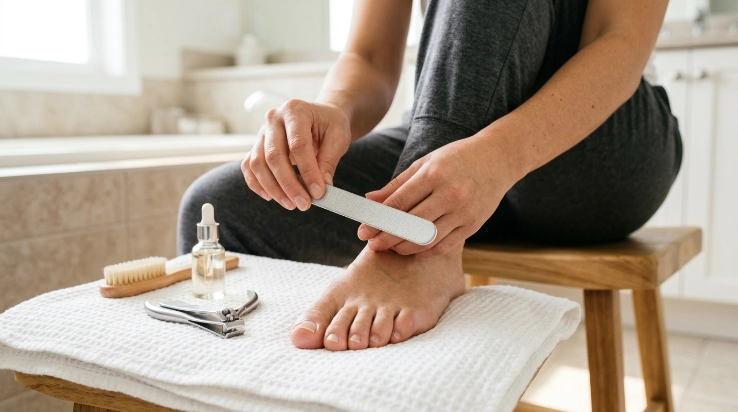
A thick toenail is not automatically unhealthy. Toenails naturally change over time, and aging is one common reason they become thicker.
Other possible causes include:
- Repeated pressure from tight shoes
- Previous nail injuries
- Psoriasis
- Fungal nail infections
- Long-term nail deformation
- Repeated trauma from sports or walking
- Certain circulation or health problems
Mayo Clinic notes that aging, psoriasis, toe injuries, tight-fitting shoes, and fungal infections can all contribute to thickened toenails.
A fungal infection is especially worth considering when thickness comes with yellow, white, or brown discoloration, crumbling, distortion, odor, or separation between the nail and nail bed. The nail bed is simply the skin underneath the hard nail plate.
For more detail about those warning signs, see the Mayo Clinic guide to nail fungus symptoms.
Do not assume every thick toenail is fungus. Filing can improve a rough edge or reduce cosmetic bulk, but it cannot diagnose or cure the cause of abnormal nail thickening.
Check Your Toenail Before You Start Filing
Before reaching for a file, look closely at the nail and surrounding skin.
At-home filing is more reasonable when the nail:
- Is thick but not painful
- Is firmly attached
- Has no drainage or bleeding
- Has no obvious swelling
- Has no intensely red surrounding skin
- Can be touched without significant tenderness
- Has not suddenly changed dramatically
Stop and consider professional care if the nail is painful, rapidly changing, badly discolored, lifting from the nail bed, bleeding, or surrounded by swollen skin.
The American Academy of Dermatology recommends having changes in nail color, texture, or shape evaluated because some changes can signal infection or another medical condition.
What Type of Nail File Is Best for Thick Toenails?
Thin, flexible manicure files can feel frustrating on a very dense toenail. You generally need something sturdy enough to smooth the nail without requiring excessive pressure.
| Tool | Best Use | Cost Level | Benefits | Limitations |
|---|---|---|---|---|
| Sturdy emery board | Mild to moderately thick nails | Low | Affordable, disposable, easy to control | Wears out quickly |
| Washable professional file | Regular maintenance | Low to moderate | Firmer and longer-lasting | Must be cleaned properly |
| Glass file | Final smoothing | Moderate | Smooth finish and reusable | May work slowly on very thick nails |
| Metal file | Tough free edges | Low to moderate | Durable and strong | Easy to become too aggressive |
| Electric nail file | Significant thickness | Moderate to high | Fast material removal | Greater risk of heat and over-filing |
| Professional nail care | Severe or difficult nails | Variable | Better visibility, equipment, and control | Requires an appointment |
For most beginners, a sturdy manual file is easier to control than an electric drill.
Electric nail files can remove nail material quickly, but speed is also their biggest disadvantage. Too much pressure or staying in one spot can create heat before you realize how much nail has been removed.
If you have sensitive skin, thin areas in the nail, limited sensation in your feet, poor visibility, or difficulty reaching your toes, manual DIY filing may not be the safest option.
Supplies You Will Need
Keep the setup simple:
- Warm water
- Clean towel
- Clean toenail clipper or nail nipper if trimming is needed
- Sturdy nail file
- Fine finishing file if desired
- Soap and water for cleaning tools
- Moisturizer for the surrounding skin
Avoid sharing nail files, nippers, or clippers between people.
The American Academy of Dermatology recommends keeping nail-care tools clean and periodically disinfecting reusable clippers and scissors. Clean, dry nails also help limit the moist environment in which bacteria and fungi can thrive.
How to File Thick Toenails Step by Step
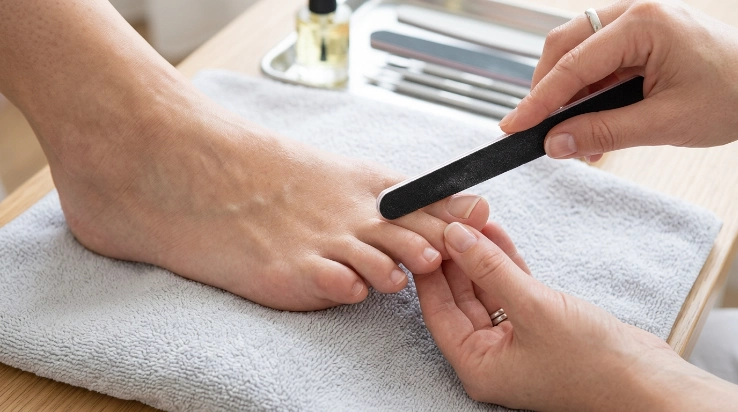
1. Examine the Nail First
Look for pain, swelling, bleeding, drainage, strong discoloration, separation from the nail bed, or severely crumbly areas.
If any of those are present, do not aggressively file the nail simply to make it look better.
If the thickness is mild, stable, and painless, you can proceed gently.
2. Soften the Toenail
Thick toenails are usually easier to work with after they have softened.
Soak your feet in comfortably warm—not hot—water for about 5 to 10 minutes. The American Academy of Dermatology specifically recommends softening nails before trimming and notes that warm water can help with nails that are thick and difficult to cut.
You can also do your toenail care shortly after a shower.
Do not soak for an excessively long time simply because the nail is thick.
3. Dry Your Feet Carefully
Dry the nail and the skin between your toes thoroughly.
This gives you a better grip and makes it easier to judge the nail’s thickness. Keeping feet and nails dry between grooming sessions is also an important part of healthy nail hygiene.
4. Trim Excess Length If Necessary
If the nail extends well beyond the toe, filing the entire length away can take a long time and tempt you to become aggressive.
Instead, use an appropriate toenail clipper or nail nipper to remove manageable amounts first.
Make several small cuts rather than trying to force a clipper through the entire nail in one squeeze.
Toenails should generally be trimmed mostly straight across rather than deeply rounding the corners, which can encourage ingrown nails. The American Academy of Dermatology nail-trimming guide provides additional guidance on correct trimming.
If your clippers cannot cut through the nail without excessive force, do not force them.
5. Smooth the Free Edge First
The free edge is the part of the toenail extending beyond the skin.
Hold your file securely and use controlled strokes across rough, jagged, or sharp areas.
Keep the file on the nail itself rather than digging into the skin beside or underneath it.
The goal is a smooth edge that does not catch on socks or press uncomfortably against shoes.
Mayo Clinic recommends gently filing thickened toenails after trimming to smooth sharp edges that could injure surrounding skin.
6. Reduce Surface Thickness Gradually
If your goal is to make a thick nail less bulky, work very conservatively across the top surface.
Use:
- Light pressure
- Slow strokes
- A stable hand
- Short filing sessions
Take off a small amount and inspect the nail.
You are not trying to make an abnormally thick toenail look like a thin fingernail in one session.
Stop immediately if you notice:
- Heat
- Burning
- Tenderness
- Throbbing
- Increased sensitivity
- A suddenly flexible or very thin area
Heat is an important warning that friction or pressure is becoming excessive.
7. Finish With a Smoother File
Once the rough shaping is complete, a finer file can help smooth sharp or scratchy areas.
The American Academy of Dermatology recommends filing in one direction rather than repeatedly sawing backward and forward, which can weaken the nail.
You do not need a perfectly polished surface. A comfortable, smooth nail is the goal.
8. Clean Your Tools
Remove visible nail debris immediately.
Wash reusable tools according to the manufacturer’s instructions and allow them to dry completely before storage.
Disposable emery boards are inexpensive enough that replacing them regularly may be more practical than trying to sanitize a badly worn file.
Never share a file that has been used on a suspicious or possibly infected toenail.
9. Moisturize the Surrounding Skin
Once the foot is clean and dry, apply a small amount of moisturizer to dry skin surrounding the nail.
Avoid packing thick cream underneath a lifting nail.
The goal is simply to keep dry skin comfortable and flexible.
How Much Should You File Off?
There is no universal amount.
Toenails vary naturally in thickness, and an abnormally thick nail may have an underlying cause that filing cannot correct.
A safe rule is:
File for comfort and smoothness, not for dramatic thinning.
If the nail still seems thick after one session but feels comfortable and smooth, leave it alone. You can reassess it during a future grooming session.
Trying to achieve an immediate visual transformation is one of the easiest ways to over-file.
Expert Tip: Use your fingertip and eyes to check the nail every few strokes. Frequent inspection is safer than filing continuously and checking only when you think you are finished.
Manual File vs. Electric Nail File
An electric file can look like the obvious solution for extremely thick toenails, but it is not necessarily the best option for beginners.
Manual filing works best when:
- The thickness is mild or moderate
- You want maximum control
- You have good hand mobility
- There is no severe pain or deformity
- You only need occasional maintenance
Professional or electric filing may make more sense when:
- The nail is extremely dense
- Several toenails are affected
- Manual filing takes excessive effort
- The nail is difficult to reach
- Thick nails repeatedly cause shoe pressure
A salon nail technician may help with cosmetic grooming of uncomplicated nails, depending on local rules and the condition of the nail. However, a nail technician is not a substitute for medical diagnosis.
If you suspect infection or disease, choose a dermatologist, podiatrist, or another qualified healthcare professional.
Hygiene Matters More Than Perfect-Looking Toenails
Toenail files collect nail dust and debris.
That means hygiene should be part of the routine—not an afterthought.
Follow these habits:
- Wash your feet before grooming.
- Work on clean, dry skin.
- Do not share files.
- Replace worn disposable files.
- Clean reusable tools.
- Dry tools completely before storage.
- Do not file over open cuts.
- Keep potentially infected tools separate.
Also avoid digging underneath the nail with sharp manicure tools. The skin under the nail is delicate, and injuring it can create an opening for irritation or infection.
Common Mistakes to Avoid
- Filing too aggressively: Thick does not mean indestructible. You can still injure the nail bed underneath.
- Trying to remove all thickness at once: Gradual maintenance gives you more control.
- Using excessive pressure: Let the abrasive surface of the file do the work.
- Ignoring heat: A warm or burning feeling means it is time to stop.
- Digging into the nail corners: This can irritate surrounding skin and worsen an ingrown nail.
- Using dirty tools: Nail debris can contaminate grooming equipment.
- Sharing files: Especially avoid sharing tools used on discolored or suspicious nails.
- Filing painful nails: Pain is information. Do not grind through it.
- Assuming thickness is only cosmetic: Fungal infection, psoriasis, injury, and other conditions can alter the nail.
- Using an electric drill without control: High speed can remove much more nail than intended.
When to See a Nail Technician or Dermatologist
Some thick toenails are reasonable to maintain at home. Others deserve professional attention.
Consider a qualified nail technician for basic cosmetic grooming when the nail is healthy-looking but difficult for you to shape because of thickness or reach.
A dermatologist, podiatrist, or healthcare professional is more appropriate when you notice:
- Increasing nail thickness
- Yellow, brown, white, or unusual discoloration
- Crumbling
- Significant distortion
- Nail separation
- Persistent pain
- Swelling
- Bleeding
- Drainage
- Bad odor
- Difficulty walking
- A nail that repeatedly becomes ingrown
Mayo Clinic advises seeking medical care when thickened toenails continue worsening, become painful, or cannot be safely trimmed at home. Its fungal nail guidance also recommends professional care for symptoms such as swelling, bleeding, difficulty walking, or suspected fungal infection in someone with diabetes.
The AAD similarly notes that very thick, overgrown nails may require a podiatrist or dermatologist rather than routine DIY cutting.
If you have diabetes, poor circulation, reduced sensation in your feet, or another condition that makes foot injuries harder to detect or heal, do not aggressively file thick toenails without professional guidance.
Can Filing Treat Toenail Fungus?
No.
Filing may make a fungal nail temporarily thinner or smoother, but it does not prove that fungus is present and does not eliminate an established infection by itself.
Fungal nails may become thick, brittle, crumbly, misshapen, discolored, or separated from the nail bed.
If you think fungus is causing your thick toenail, get appropriate advice rather than repeatedly grinding the nail thinner.
You can review the NHS overview of fungal nail infections for additional information about common symptoms and treatment.
DIY Filing vs. Professional Care
DIY care is convenient, inexpensive, and appropriate for many uncomplicated nails. The limitation is that you cannot diagnose the reason a toenail is becoming abnormal simply by looking at it.
Professional care is especially valuable when visibility, flexibility, nail thickness, pain, or underlying health conditions make self-care difficult.
The smartest choice is not always the cheapest tool or fastest technique. It is the option that lets you maintain the nail without damaging the nail plate or surrounding skin.
FAQs
Can I file down a very thick toenail?
You can gently reduce some thickness if the nail is painless and otherwise uncomplicated, but avoid trying to dramatically thin it in one session. Severely thick, distorted, painful, or discolored nails should be assessed professionally.
Should I soak thick toenails before filing?
A short warm-water soak can soften thick toenails and make grooming easier. Dry the toes thoroughly afterward so you have good control over your tools.
What kind of file should I use on thick toenails?
A sturdy manual nail file or emery board is usually easier for beginners to control. Very fine glass files may work slowly, while aggressive metal or electric tools require extra care.
Can I use an electric nail file on thick toenails?
Electric files can reduce thickness quickly, but they can also create heat or remove too much nail. Beginners should use extreme caution, and severely abnormal nails are better handled professionally.
How often should I file thick toenails?
File only when the nail develops uncomfortable thickness, roughness, or sharp edges. You do not need to thin the nail constantly. Give the nail time between sessions and avoid repeated aggressive filing.
Why is my big toenail suddenly getting thicker?
Possible causes include trauma, shoe pressure, fungal infection, psoriasis, and other nail conditions. A new or worsening change—especially with discoloration, pain, crumbling, or lifting—should be checked rather than treated only with filing.
Is it safe to file a toenail with fungus?
Light filing may sometimes be part of nail maintenance, but suspected fungal infection deserves appropriate diagnosis and treatment. Avoid sharing the file, clean reusable equipment carefully, and do not aggressively thin a painful or damaged nail.
Conclusion
Knowing how to file thick toenails safely comes down to patience and control.
Start by checking whether the nail looks appropriate for DIY care. Soften it briefly, use clean tools, remove excess length carefully if needed, smooth the free edge, and reduce thickness only a little at a time.
Most importantly, do not treat pain, severe discoloration, crumbling, swelling, or dramatic nail changes as ordinary pedicure problems. Filing can improve comfort and appearance, but it cannot diagnose or treat every reason a toenail becomes thick.
For your next at-home pedicure, choose a clean, easy-to-control file and focus on gentle maintenance rather than maximum thinning. If the nail does not look healthy, make professional evaluation your next step instead.

