How to File Toenails After Cutting Them Safely and Smoothly

Freshly cut toenails can look neat at first, but one sharp corner or rough edge can quickly catch on your socks, scratch nearby skin, or simply feel uncomfortable inside your shoes. That is why clipping is only part of a good toenail-care routine.
Learning how to file toenails after cutting them helps smooth those freshly cut edges without aggressively changing the natural shape of the nail. The goal is not to create deeply rounded corners. Instead, you want to keep the nail mostly straight across while gently removing roughness and sharp points.
The technique matters because toenails behave differently from fingernails. Cutting or filing too deeply into the sides can increase the chance of irritation and ingrown toenails.
This guide explains which file to use, how to file step by step, how much shaping is safe, what mistakes to avoid, and when a toenail problem should be handled by a nail professional or medical provider instead of at home.
Quick Answer
To file toenails after cutting them, let the nails dry, then use a clean fine- or medium-fine nail file to gently smooth the free edge. File with light strokes, concentrating only on rough or sharp areas. Keep the overall toenail shape straight across and avoid filing deeply into the side corners.
Why File Toenails After Cutting Them?
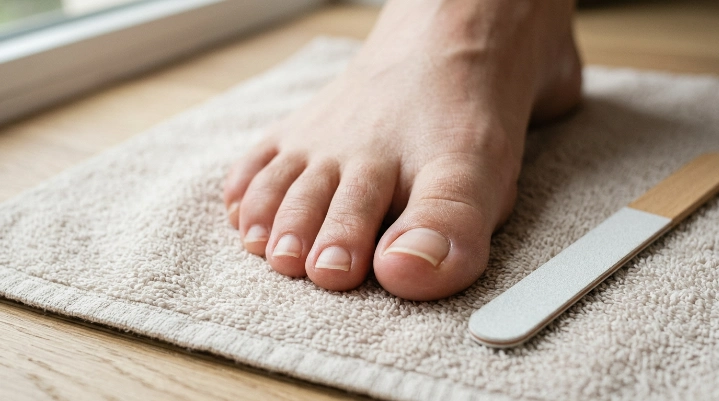
Even good toenail clippers do not always leave a perfectly smooth edge.
A freshly clipped nail may have:
- Tiny jagged areas
- Sharp corners
- Small nail splinters
- Uneven thickness
- An edge that catches on socks
- Roughness that feels uncomfortable against another toe
Filing lets you refine these areas more gradually than taking another cut with a clipper.
The American Academy of Dermatology’s nail-trimming guidance recommends smoothing uneven or rough nail edges with a nail file or emery board after trimming. It also recommends cutting toenails straight across to help reduce the chance of ingrown toenails.
Think of the clipper as the tool that removes excess length and the file as the tool that performs the finishing work.
Filing should usually smooth the cut you already made rather than completely reshape the toenail.
What You Need Before Filing Your Toenails
You do not need a complicated pedicure kit. A few clean tools are usually enough.
| Tool | Best Use | Typical Cost | Main Consideration |
|---|---|---|---|
| Emery board | Simple home filing | $1–$5 | Affordable but wears out |
| Glass/crystal file | Gentle reusable filing | $7–$20+ | Easy to clean but can break |
| Fine nail file | Smoothing natural toenails | $3–$10 | Choose a surface that is not overly coarse |
| Toenail clippers | Removing length first | $5–$20 | Larger jaws give better control on toenails |
| Nail nippers | Very thick nails | $10–$30+ | Sharp and require extra control |
| Clean towel | Drying feet and nails | Minimal | Helps prevent slipping while filing |
Prices vary by brand and quality, so there is rarely a reason to buy the most expensive file simply for routine toenail maintenance.
What Nail File Grit Should You Use?
Abrasive nail files are often labeled with a grit number. Generally, a lower number means a rougher surface, while a higher number means a finer surface.
For normal natural toenails, a file around 180–240 grit is a practical starting range for shaping and smoothing.
You may need a somewhat more effective filing surface if your toenails are unusually thick, but avoid automatically reaching for an extremely coarse file. Removing nail material too aggressively makes it easier to over-file the nail.
For thin, peeling, brittle, or sensitive nails, choose a finer and gentler surface and use very little pressure.
Glass File vs. Emery Board
Both can work.
A glass or crystal file is reusable, smooth, and easy to clean. It can be an especially comfortable choice when you regularly maintain natural nails.
An emery board is inexpensive and convenient. The downside is that the abrasive surface gradually wears out and many boards cannot be cleaned as thoroughly as nonporous tools.
Replace a disposable file when the surface becomes worn, dirty, bent, or uneven.
How to File Toenails After Cutting Them: Step by Step
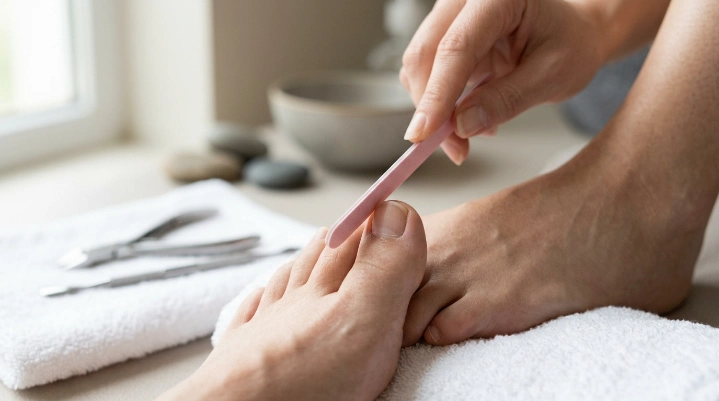
The safest approach is simple. Remove length first, then make only small corrections with the file.
1. Trim the Toenail Straight Across
Start with proper clipping technique.
Use clean toenail clippers and make controlled cuts across the nail. Avoid digging the clipper deeply into either corner.
The Mayo Clinic’s guidance on toenail trimming recommends small, straight cuts when trimming thick toenails and advises against rounding the edges with nail nippers.
Keeping the corners visible helps preserve the nail’s natural path as it grows forward.
2. Leave a Little Nail at the End
Avoid cutting the nail extremely short.
Ideally, the nail should still provide protection for the end of your toe. Removing too much length can expose sensitive skin and encourage the surrounding skin to press against the nail as it grows.
The NHS guidance on preventing ingrown toenails specifically advises against cutting toenails too short and recommends cutting straight across rather than cutting down the edges.
3. Make Sure the Nail Is Dry Before Filing
Clipping can be easier after a shower or short soak because the nail becomes softer.
Filing is different.
After trimming, gently dry your toes and nails before doing detailed filing. A dry nail edge is easier to see and gives you better control over how much material you are removing.
Also dry between the toes before continuing with your foot-care routine.
4. Hold the File at the Free Edge
Place the file against the freshly cut edge—not on top of the nail plate and not down inside the sidewall.
The free edge simply means the portion of nail extending beyond the attached nail bed.
Your goal is to smooth this edge.
Hold the file comfortably and keep your foot supported so the toe is not moving around while you work.
5. Use Gentle, Controlled Strokes
File using light pressure.
Move across the rough edge gradually instead of aggressively sawing the nail until it changes shape.
For traditional emery boards, using controlled strokes in one general direction is a simple beginner-friendly technique. The American Academy of Dermatology recommends filing in the same direction rather than repeatedly filing back and forth.
A high-quality glass file may work effectively in either direction depending on its construction, but light pressure remains important.
6. Smooth Sharp Corners Without Rounding Them Deeply
This is the part people most often overdo.
A freshly clipped corner can feel sharp, so it is reasonable to soften the very tip enough that it no longer scratches your skin or catches fabric.
However, do not keep filing farther and farther down the side until the nail becomes strongly oval or rounded.
You want:
Straight overall shape + comfortable edges
rather than:
Deeply rounded corners + shortened sides
The distinction matters because cutting or shaping toenails too far down the corners is associated with ingrown toenails.
7. Check the Edge With Your Fingertip
Run a clean fingertip gently across the freshly filed edge.
It should feel:
- Smooth
- Even
- Free of splinters
- Free of sharp points
- Comfortable against nearby skin
If one tiny spot catches, file only that area.
Do not continue filing the entire nail simply because one section needs another stroke or two.
8. Stop Once the Edge Is Smooth
More filing does not automatically mean a better pedicure.
Once the edge feels comfortable, stop.
Over-filing can make the nail unnecessarily short, thin the free edge, or tempt you to alter the corners too much.
Wipe away nail dust and clean your file according to the manufacturer’s instructions before storing it.
What Shape Should Toenails Be After Filing?
For most people, toenails should remain mostly straight across.
That does not mean the edge has to look mechanically square. The natural end of your toe and nail may have a slight contour.
The important point is that you should not carve away the corners.
A properly finished toenail usually has:
- A straight or gently natural-looking free edge
- Visible side corners
- No sharp points
- Enough length to protect the toe
- No edge pressing painfully into the skin
Your fingernails can often tolerate more cosmetic shaping. Toenails deserve a more conservative approach.
Should You File Toenails Wet or Dry?
For routine finishing, filing dry toenails gives you better control.
Water temporarily softens nails. This can help when clipping very firm nails, but aggressively filing a soft, waterlogged nail may make the edge more difficult to judge.
A practical routine is:
- Shower or briefly soak if your toenails are difficult to clip.
- Trim carefully.
- Dry your feet and nails thoroughly.
- File the rough edges gently.
If your nails are naturally thin or prone to peeling, being gentle matters more than achieving an absolutely perfect cosmetic edge.
Expert Tip: After every few file strokes, stop and feel the nail edge. Small corrections are easier to control than trying to reshape the entire toenail in one long filing session.
How to File Thick Toenails
Thick toenails require more patience.
A thick nail may be harder to clip and can leave a chunkier, sharper edge afterward. Mayo Clinic recommends softening thick toenails in warm water before trimming and using small cuts across the nail rather than trying to remove a large section at once.
After clipping:
- Dry the nail.
- Support the toe securely.
- Use a sturdy file.
- Work gradually across the free edge.
- Remove only enough material to eliminate roughness.
- Do not aggressively grind the nail surface thinner.
Persistent thickening can have several causes, including repeated trauma and fungal infection. If a toenail keeps becoming thicker, changes color, becomes crumbly, separates from the nail bed, or becomes painful, cosmetic filing alone may not address the underlying problem.
What About Brittle, Peeling, or Thin Toenails?
Fragile nails need a different touch.
Use a fine file and very light pressure. Trying to force an exact shape can make peeling worse.
If a small layer is separating at the end, smooth the snag without trying to peel or tear the loose portion away with your fingers.
Regularly changing nail texture deserves attention as well. The American Academy of Dermatology advises seeing a dermatologist when you notice unexplained changes in nail color, texture, or shape.
Nail File Hygiene Matters
A nail file comes into direct contact with keratin, skin debris, and nail dust, so cleanliness matters.
Good habits include:
- Wash your hands before and after foot care.
- Start with clean clippers.
- Clean reusable files according to their material.
- Allow washable tools to dry completely.
- Replace worn disposable emery boards.
- Avoid sharing personal nail tools.
- Store nail-care tools somewhere clean and dry.
The American Academy of Dermatology also recommends regularly disinfecting nail clippers and nail scissors as part of healthy nail trimming.
If a nail appears infected or fungal, do not casually use the same uncleaned tools on healthy nails.
Common Mistakes to Avoid
Even a simple filing routine can cause problems when too much nail is removed.
Filing Deep Into the Corners
This can change the nail’s natural shape and leave surrounding skin vulnerable as the nail grows.
Smooth a sharp tip; do not excavate the side of the nail.
Cutting the Nail Very Short Before Filing
Remember that filing removes additional nail.
If you clip extremely short and then file aggressively, the final result may be much shorter than intended.
Using an Extremely Coarse File
A rough file may remove nail quickly, but speed is not the goal.
For ordinary natural toenails, control matters more.
Applying Heavy Pressure
If you feel like you have to force the file against the nail, stop and reassess your tool.
Pressure increases the chance of removing too much material.
Trying to File Away an Ingrown Toenail
An ingrown toenail is not simply an inconvenient nail shape.
Pain, swelling, inflamed skin, and sometimes infection can occur when the edge grows into surrounding tissue.
Do not aggressively dig underneath the corner with a file or sharp manicure tool.
Sharing Nail Files
Shared nail tools can carry debris and microorganisms from one person to another.
Personal tools are the simplest choice for home use.
Ignoring Pain, Redness, or Drainage
Filing should not hurt.
Stop if you notice bleeding, significant tenderness, increasing redness, swelling, warmth, or pus.
DIY Filing vs. Professional Toenail Care
Routine filing is easy for many people, but DIY care has limits.
| Situation | DIY Filing | Professional Help |
|---|---|---|
| Small rough edge | Usually appropriate | Usually unnecessary |
| Normal cosmetic shaping | Appropriate | Optional |
| Very thick nail | Possible with caution | Helpful if difficult to manage |
| Painful ingrown corner | Avoid aggressive filing | Recommended |
| Suspected infection | Not a cosmetic DIY issue | Medical assessment may be needed |
| Nail you cannot safely reach | Higher injury risk | Professional care is safer |
| Major unexplained color/shape change | Filing won’t solve cause | Consider dermatologist/podiatrist |
A nail technician can help with ordinary grooming and cosmetic maintenance, but a salon should not be treated as a replacement for medical care when a nail appears infected, injured, or diseased.
When to See a Nail Technician or Dermatologist
A professional pedicure may make sense when your toenails are healthy but you struggle with shaping, reaching your feet comfortably, or getting an even cosmetic finish.
Choose a salon that uses clean tools and follows appropriate sanitation practices.
A dermatologist, podiatrist, or other qualified healthcare professional is a better choice if you have:
- Significant or worsening toenail pain
- Red or swollen skin around the nail
- Pus or drainage
- Repeated ingrown toenails
- Persistent thickening
- A nail that becomes crumbly or distorted
- Unexplained dark or unusual discoloration
- A nail separating from its bed
- An injury that is not healing
- Difficulty safely trimming your own nails
People with diabetes, poor circulation, reduced sensation, or other conditions that increase the risk of foot complications should be especially cautious about self-trimming or aggressively filing difficult nails. Mayo Clinic specifically advises people with diabetes, poor circulation, or reduced foot sensation to discuss safe toenail trimming with their healthcare team.
FAQs
Do you need to file toenails after cutting them?
Not always. If clipping leaves a smooth, comfortable edge, very little filing may be needed. Filing is most useful for removing sharp points, tiny splinters, and rough sections that remain after cutting.
Should toenails be rounded with a nail file?
Keep the overall nail mostly straight across. You can gently soften a sharp tip, but avoid filing deeply down the corners because strongly rounding the sides can contribute to ingrown-nail problems.
Which direction should I file toenails?
With a traditional nail file or emery board, gentle strokes in one general direction are a simple choice. Avoid aggressive back-and-forth sawing, especially on thin or brittle nails.
How short should toenails be before filing?
Do not cut them extremely short. Leave enough nail to protect the tip of the toe, then use the file only to smooth the freshly cut edge.
Can I use the same nail file for fingernails and toenails?
Technically, a clean reusable file may be used on both healthy fingernails and toenails, but keeping separate tools can simplify hygiene. Never move an unclean tool from a suspicious or infected nail to healthy nails.
Can I file thick toenails instead of cutting them?
Minor length can be reduced gradually by filing, but very thick or overgrown nails may take considerable time. If the nail is painful, badly distorted, difficult to reach, or impossible to trim safely, professional foot care is a better choice.
Why does my toenail hurt after I file it?
Pain can mean you filed too deeply into a corner, removed too much nail, irritated surrounding skin, or already had an underlying problem. Stop filing. If pain persists or is accompanied by swelling, redness, warmth, or drainage, seek professional advice.
Conclusion
Knowing how to file toenails after cutting them is mostly about restraint.
Clip the nail straight across, leave a sensible amount of length, dry it, and gently smooth only the rough portions of the free edge. Use a clean, appropriate file and light pressure. Most importantly, resist the temptation to carve deeply into the corners just to create a more rounded cosmetic shape.
For healthy toenails, this simple clip-and-file routine can keep edges smooth, comfortable, and less likely to snag.
If you notice pain, swelling, infection, significant thickening, or unexplained changes in the nail, stop treating the issue as a cosmetic problem and get appropriate professional advice.
Use your next toenail trim as an opportunity to practice gentle filing: smooth the edge, preserve the corners, keep your tools clean, and stop as soon as the nail feels comfortable.