
How to Prevent Ingrown Toenails From Shoes

If your big toe feels sore every time you put on sneakers, heels, or work shoes, your footwear may be putting more pressure on your toenail than you realize. Tight toe boxes, shoes that are too short, and repeated rubbing can push the nail and surrounding skin together until the nail edge begins growing into the skin.
Learning how to prevent ingrown toenails from shoes is mostly about reducing that repeated pressure before your toe becomes painful. Properly fitted footwear matters, but so do toenail length, trimming technique, filing, foot hygiene, and knowing when a sore nail needs professional attention.
This guide explains how shoes contribute to ingrown toenails, what footwear features to look for, how to trim and file your toenails safely, common mistakes to avoid, and when DIY nail care is no longer enough.
Quick Answer
To prevent ingrown toenails from shoes, choose footwear with enough length and a roomy toe box so your toes are not squeezed together. Keep toenails moderately long and trim them straight across instead of rounding the corners deeply. Gently file sharp edges, keep your feet dry, and replace or adjust shoes that repeatedly press on the same toe.
Why Can Shoes Cause Ingrown Toenails?
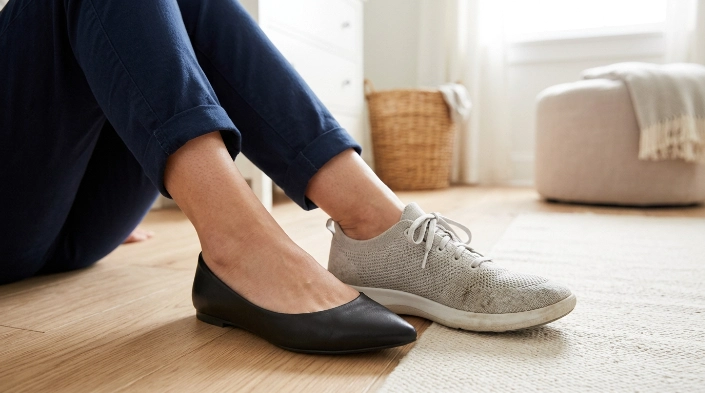
An ingrown toenail develops when the edge of the nail grows or presses into the surrounding skin. This most commonly affects the big toe.
Footwear can contribute because every step places pressure on the front and sides of your toes. When a shoe is too narrow or too short, that pressure becomes concentrated around the toenails.
The Mayo Clinic lists shoes that crowd the toenails as one of the causes of ingrown toenails and recommends properly fitted shoes as part of prevention. Mayo Clinic’s ingrown toenail prevention guidance
You may be more likely to have trouble if you regularly wear:
- Pointed-toe shoes
- Tight fashion sneakers
- Shoes that are too short
- High heels that push your foot forward
- Stiff work shoes
- Cleats or athletic footwear with limited toe space
- Shoes worn with very thick socks
- Footwear that presses against one particular toenail
Pressure does not automatically mean you will develop an ingrown nail. Nail shape, injuries, trimming habits, activity level, and individual anatomy also matter.
If you already notice recurring nail pressure, NailPrime’s guide to how shoes can damage toenails explains other changes you may notice after repeated shoe friction.
How to Tell Whether Your Shoes Are Too Tight Around Your Toenails
A shoe does not have to feel painfully tight to be causing problems.
Pay attention to what your toes feel like after you have been walking for a while.
Possible warning signs include:
- Your big toenail feels tender after wearing the shoes.
- Your toes feel squeezed together.
- A nail repeatedly hits the front of the shoe.
- You see redness along one nail edge.
- Your socks leave strong pressure marks around the toes.
- The shoe feels comfortable when you first put it on but tight later in the day.
- A toenail becomes bruised, thickened, cracked, or sore.
- You regularly want to remove your shoes because your toes feel compressed.
Feet can swell slightly during the day, so footwear that barely fits in the morning may feel much tighter after hours of walking.
Persistent nail pain is not a normal “breaking-in” symptom. If a shoe continually hurts your toenail, changing the fit is smarter than waiting for your toe to adapt.
Choose a Roomy Toe Box
The toe box is the front portion of the shoe where your toes sit.
A roomy toe box allows your toes to rest naturally without being pushed tightly together. It should also provide enough vertical space so the top of your toenail is not rubbing against the shoe.
The American Academy of Dermatology recommends shoes that fit well and have a wide toe box to help prevent nail rubbing and injury. AAD guidance on preventing nail injuries
A Simple Toe-Box Check
Put on the shoes with the socks you normally wear.
Then:
- Stand normally.
- Wiggle your toes.
- Check whether your toes are being pushed together.
- Walk around for several minutes.
- Pay attention to the big toenails.
- Notice whether your foot slides forward and jams into the front.
Your shoes should feel secure without crushing the toes.
A wide shoe is not automatically a well-fitting shoe, either. If your foot slides excessively, repeated impact against the front can still irritate your toenails.
Make Sure the Shoe Is Long Enough
Width gets a lot of attention, but length matters too.
When shoes are too short, the toenails may repeatedly hit the inside front of the shoe. This can become especially noticeable when walking downhill, running, exercising, or stopping suddenly.
You generally want enough room in front of the toes that the nails are not making hard contact with the shoe.
Be especially careful with footwear you bought years ago simply because you have always considered yourself one shoe size. Fit can vary significantly between brands and shoe designs.
Buy for comfort and fit, not the number printed inside the shoe.
Be Careful With Pointed Shoes and High Heels
You do not necessarily have to stop wearing stylish footwear forever.
The issue is repeated pressure.
Pointed shoes narrow toward the front and may push the big toe and little toe inward. High heels can also shift body weight forward, increasing pressure at the front of the foot.
If a particular pair causes soreness, consider:
- Wearing it for shorter periods
- Changing into roomier shoes for walking
- Saving very narrow footwear for occasional use
- Choosing a lower heel
- Looking for a similar style with a wider front
- Using appropriately fitted shoes for commuting and changing later
No fashion trend is worth repeatedly injuring the same toenail.
Trim Toenails Straight Across
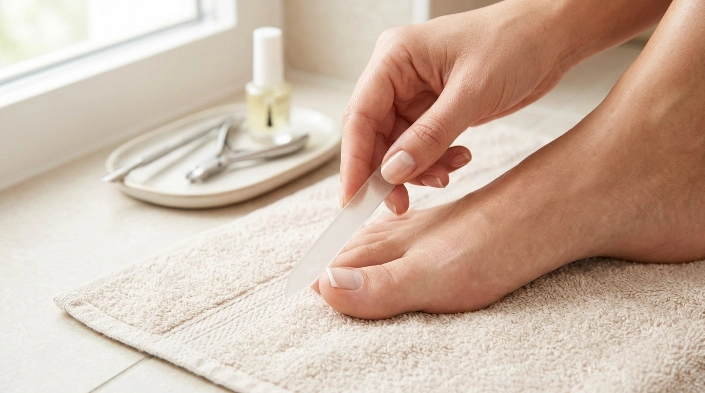
Shoes are only part of the prevention routine.
How you cut your nails matters just as much.
The NHS recommends cutting toenails straight across rather than cutting down into the edges and also advises avoiding shoes that are too tight or poorly fitting. NHS ingrown toenail guidance
Avoid dramatically rounding the corners to match the shape of your toe.
Instead:
- Use clean, sharp toenail clippers.
- Remove length gradually.
- Keep the final edge mostly straight across.
- Leave a small amount of visible free edge.
- Smooth only sharp or rough spots afterward.
NailPrime’s step-by-step guide to cutting toenails correctly gives a more detailed routine for safe trimming.
Do Not Cut Toenails Extremely Short
Cutting the nail almost level with the skin may look neat after a pedicure, but it can create problems once shoes add pressure.
The Mayo Clinic notes that when a toenail is cut too short, pressure from footwear can encourage the nail to grow into surrounding tissue.
Leave enough nail to protect the end of the toe.
If one corner seems slightly uneven, resist repeatedly cutting deeper just to make it look symmetrical.
How Nail Files Can Help
A nail file is useful after trimming because clipped toenails sometimes develop a tiny sharp point.
That point can catch on socks or irritate the skin.
However, filing should be gentle finishing, not an attempt to dig an ingrown corner out of your toe.
For healthy natural toenails, common options include:
| Nail File Type | Best Use | Cost Level | Main Consideration |
|---|---|---|---|
| Fine emery board | Small rough edges | Low | Porous and wears out |
| Glass file | Gentle edge smoothing | Medium | Reusable and easy to control |
| Metal file | Firmer toenails | Low–medium | Can feel aggressive on thin nails |
| Coarse file | Thick nails | Low–medium | Easy to over-file |
| Electric file | Specialized shaping | Higher | Usually unnecessary for basic home care |
For most beginners, a simple manual file is enough.
After clipping, keep the basic straight shape and remove only the sharpness. NailPrime’s guide to preventing sharp toenails after cutting covers this technique in more detail.
Do not push a file down between the nail and painful skin.
A nail file cannot treat an infected or significantly ingrown toenail.
Expert Tip: After trimming and filing, gently brush a soft tissue or cotton pad across the nail edge. If it catches in one tiny spot, smooth only that spot instead of continuing to shorten or round the entire nail.
Keep Feet and Shoes Dry
Sweaty feet can leave both the skin and footwear damp.
Although moisture alone does not cause an ingrown nail, maintaining clean, dry feet is useful for general foot and nail hygiene—especially if the skin is already irritated.
The American Academy of Dermatology recommends keeping feet clean and dry and allowing footwear time to dry as part of healthy foot and nail hygiene. AAD foot and nail hygiene advice
Helpful habits include:
- Change damp socks.
- Wear clean socks each day.
- Let sweaty shoes dry before wearing them again.
- Rotate between pairs when possible.
- Choose breathable footwear for hot conditions.
- Dry carefully between your toes after bathing.
If one toe already has irritated skin, keeping it clean and dry becomes even more important.
Match Your Shoes to Your Activity
Your everyday flats may be comfortable for short errands but unsuitable for a long run. Likewise, running shoes may not provide enough protection for certain workplace environments.
Choose footwear based on what your toes will experience.
Running and Exercise
Running repeatedly pushes the foot forward inside the shoe.
A properly fitting athletic shoe should hold the foot securely without compressing your toes.
If a toenail becomes sore after every run, check the shoe fit instead of simply cutting the nail shorter.
Work Shoes
Protective footwear may be essential for your job, but safety shoes still need to fit correctly.
A protective toe cap should not constantly press against your toenails.
Everyday Shoes
Rotate shoes when possible.
Wearing the same narrow pair every day repeatedly exposes the same parts of your toes to pressure.
You Do Not Need Expensive Shoes to Protect Your Toenails
Price does not guarantee a safer fit.
A moderately priced shoe with adequate toe space may be better for your toenails than an expensive designer pair that squeezes them.
Prioritize:
- Correct length
- Correct width
- Toe-box room
- Stable fit
- Comfortable material
- Appropriate design for your activity
The same principle applies to nail tools. You do not need an expensive professional pedicure kit for ordinary prevention. Clean clippers and a gentle file are usually enough for healthy toenails.
What to Do If a Toe Already Feels Tender
If the nail edge is only mildly tender and there is no pus, open wound, or significant swelling, reduce pressure first.
You can:
- Stop wearing the shoes that aggravate it.
- Switch to roomy footwear.
- Keep the toe clean.
- Avoid cutting deeper into the corners.
- Leave the nail alone to grow forward.
- Watch for worsening redness, swelling, pain, or drainage.
Do not keep trimming the painful corner because it temporarily seems to relieve pressure.
Repeatedly cutting down the side can create a cycle in which the nail remains too short.
If your trimming habits may be contributing, NailPrime’s common toenail trimming mistakes guide explains several easy-to-make grooming errors.
DIY Care vs. Professional Help
| Situation | DIY Care May Be Reasonable | Professional Help Is Smarter |
|---|---|---|
| Mild shoe pressure | Change footwear and monitor | If pain continues |
| Rough free edge | Gentle filing | If filing causes pain |
| Slightly long nail | Careful straight trimming | If nail is extremely thick |
| Repeated ingrown nails | Improve shoes and grooming | Podiatrist or dermatologist evaluation |
| Redness with pus | No | Medical evaluation |
| Spreading redness | No | Medical evaluation |
| Diabetes or poor circulation | Extra caution required | Contact a healthcare professional |
DIY nail care is maintenance. It is not a substitute for diagnosing infection, circulation problems, significant nail injury, or repeatedly ingrown toenails.
When to See a Nail Technician or Dermatologist
A licensed nail technician can help with ordinary cosmetic grooming when your nails and surrounding skin are healthy.
A nail technician should not be expected to diagnose or treat an infected, severely painful, bleeding, or badly ingrown toenail.
Contact a dermatologist, podiatrist, or other healthcare professional if you notice:
- Pus or drainage
- Significant swelling
- Increasing warmth or redness
- Severe or worsening pain
- Redness spreading beyond the nail
- Repeated ingrown toenails on the same toe
- An open wound
- Significant nail lifting
- A badly bruised or injured nail
- Symptoms that do not improve after reducing shoe pressure
Mayo Clinic advises medical evaluation for severe toe discomfort, pus, or inflamed skin that appears to be spreading. People with diabetes or conditions that reduce blood flow to the feet should also take foot wounds and infections especially seriously.
Common Mistakes to Avoid
Preventing shoe-related ingrown toenails is often easier when you stop a few common habits.
- Cutting the corners deeply. This can encourage the skin and nail edge to meet as the nail grows.
- Cutting toenails extremely short. Leave a moderate amount of nail.
- Wearing painful shoes because they “need breaking in.” Repeated nail pain deserves attention.
- Choosing shoes only by your usual size. Fit varies by brand and design.
- Ignoring toe-box width. Your toes need room as well as sufficient shoe length.
- Digging under the nail with a file. Files are for gentle smoothing, not home surgery.
- Sharing toenail files. Personal nail tools are more hygienic when kept personal.
- Filing until the nail feels hot or sore. That means you are being too aggressive.
- Covering worsening symptoms with polish. Pain, swelling, pus, or unusual nail changes deserve evaluation.
- Assuming every painful nail is cosmetic. Infection and injuries require different care.
FAQs
Can tight shoes really cause ingrown toenails?
Yes. Shoes that squeeze or crowd the toes can place repeated pressure on the nail and surrounding skin. Tight footwear is one recognized contributor to ingrown toenails.
What shoes are best if I keep getting ingrown toenails?
Look for shoes that fit securely while providing enough length, width, and toe-box space. Your toes should not be squeezed together or repeatedly strike the front of the shoe.
Should I cut an ingrown toenail corner out myself?
Avoid digging deeply into the corner. Repeatedly cutting down the side may worsen the problem. If the nail is significantly painful, swollen, infected, or repeatedly becomes ingrown, seek professional evaluation.
Should toenails be rounded or cut straight?
For ingrown toenail prevention, toenails are generally trimmed straight across rather than deeply rounded at the corners.
Can I file the sides of my toenails?
You can gently smooth a genuinely sharp free edge, but do not push a file deeply into the nail groove or surrounding skin. Filing should not hurt.
Can high heels cause ingrown toenails?
High heels can increase pressure at the front of the foot, especially when the toe box is narrow or pointed. Frequent pressure may contribute to nail irritation in people who are susceptible.
How do I know if my ingrown toenail is infected?
Increasing redness, swelling, warmth, significant pain, pus, or drainage can indicate a problem that needs medical attention. Spreading redness or systemic symptoms should not be treated as a routine DIY pedicure issue.
Conclusion
Learning how to prevent ingrown toenails from shoes comes down to reducing pressure and giving your toenails enough room to grow normally.
Start with footwear that fits comfortably through the toe box. Keep your toenails at a moderate length, cut them mostly straight across, and use a clean nail file only to smooth rough edges. Avoid repeatedly squeezing sore toes into narrow shoes or digging into nail corners at home.
Most importantly, listen to your feet. A shoe that repeatedly makes your toenail hurt is giving you useful information.
Adjust the fit early, keep your nail-care routine gentle, and get professional help when pain, swelling, infection, injury, or recurring ingrown nails go beyond ordinary home maintenance.

