
How to Shape Toenails Safely: A Simple At-Home Guide

Shaping your toenails sounds simple until you are staring at a sharp corner, a thick big toenail, or an edge that keeps catching on your socks. It is tempting to round the sides deeply or keep filing until every nail looks perfectly curved, but that can create irritation and may increase the chance of an ingrown toenail.
Learning how to shape toenails safely is less about creating a dramatic pedicure shape and more about keeping the nail neat, smooth, comfortable, and protected.
The safest approach is usually to trim toenails mostly straight across, leave the corners visible, and use a gentle nail file only to smooth rough or sharp edges. This guide explains the tools to use, the right filing technique, common mistakes, hygiene basics, and when a toenail problem should be handled by a professional instead of at home.
Quick Answer
To shape toenails safely, trim them straight across without cutting deeply into the corners, then gently smooth sharp or uneven edges with a fine nail file. Avoid creating a deeply rounded shape or filing into the sidewalls. Keep tools clean, use light pressure, and stop if you notice pain, bleeding, swelling, or signs of infection.
What Is the Safest Shape for Toenails?
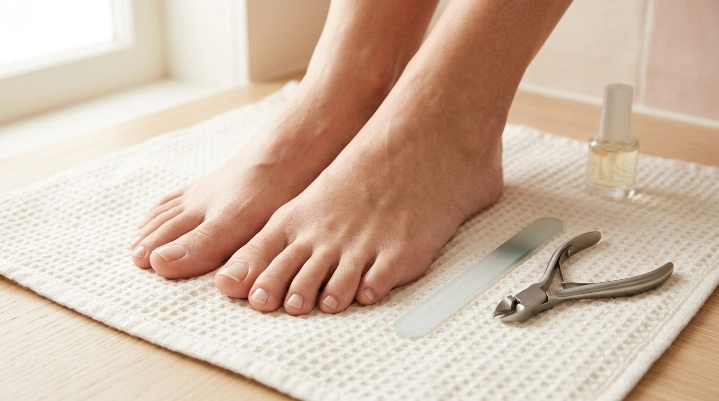
For most healthy toenails, a mostly straight-across shape with lightly softened edges is the safest choice.
This is different from fingernails. Fingernails are commonly shaped into round, oval, almond, or square styles because their edges are exposed and do not constantly press against shoes.
Toenails sit inside socks and footwear for hours at a time. If you remove too much from the corners, the surrounding skin can begin pressing against the edge as the nail grows forward.
According to the American Academy of Dermatology’s guidance on trimming nails, toenails should be cut straight across to help reduce the chance of developing an ingrown nail. Rough edges can then be smoothed with a nail file.
That does not mean your toenail has to look like a perfectly straight rectangle. A tiny amount of smoothing at a sharp corner is fine. The goal is simply to avoid digging down the sides or creating a dramatic half-moon curve.
Square vs. Rounded Toenails
A square or soft-square toenail shape is usually easier to maintain safely.
A heavily rounded shape can look attractive after a pedicure, but removing too much from the corners may encourage the nail edge to press into nearby skin as it grows.
If you prefer a softer appearance, use your file to remove only the sharpness from the visible corner. Do not file deeply into the groove where the nail meets the skin.
The Best Tools for Safe Toenail Shaping
You do not need a professional pedicure kit to maintain normal healthy toenails. A few clean, well-controlled tools are usually enough.
| Tool | Best Use | Safety Consideration | Hygiene |
|---|---|---|---|
| Toenail clipper | Removing excess length | Use small controlled cuts | Clean and dry after use |
| Fine or medium-fine nail file | Smoothing and shaping edges | Avoid excessive pressure | Wash if reusable or replace when worn |
| Glass/crystal file | Gentle precision shaping | Works slowly and gives good control | Wash and dry according to manufacturer directions |
| Emery board | Affordable everyday filing | Replace when worn or dirty | Do not share |
| Nail nipper | Very thick nails | Sharp and easier to misuse | Clean carefully; consider professional help |
| Buffer block | Light surface smoothing | Over-buffing can thin nails | Keep personal and clean |
For an average natural toenail, you usually do not need an extremely coarse file. Coarse abrasives remove material quickly but give you less room for error.
A fine or medium-fine file is slower, which can actually be an advantage when you are working near sensitive skin.
If you are comparing file materials, NailPrime’s general nail-file coverage emphasizes that file grit and material affect how aggressively a file removes nail. For toenails, control matters more than speed.
How to Shape Toenails Safely Step by Step

The easiest way to prevent mistakes is to separate trimming from shaping.
The clipper removes excess length. The file refines the edge.
1. Check the Toenail Before You Start
Before trimming or filing, look closely at the nail and surrounding skin.
You should not treat every irregular toenail as a cosmetic shaping problem.
Pause your DIY pedicure if you notice:
- Significant redness
- Swelling
- Warm skin around the nail
- Pus or drainage
- Bleeding
- Throbbing pain
- A deeply embedded nail corner
- Major yellowing, crumbling, or thickening
- A dark streak or unexplained color change
- Nail separation from the nail bed
A cosmetic file cannot correct an infection, significant ingrown nail, or underlying nail disease.
2. Wash Your Feet and Tools
Clean feet make it easier to see what you are doing and reduce the amount of dirt around the nail.
Wash your feet normally and dry them thoroughly, especially between the toes.
Your clipper and reusable file should also be clean and completely dry.
Do not share personal toenail clippers, files, or other pedicure tools. The American Academy of Dermatology’s nail-fungus prevention advice specifically recommends avoiding shared nail-grooming tools because fungal infections can spread between people.
Disposable emery boards should be replaced when they become dirty, damaged, or heavily worn rather than being passed between users.
3. Soften Very Hard Toenails if Needed
Normal toenails can often be trimmed while dry. However, very firm nails may be easier to control after a shower or short warm-water soak.
Do not soak for an unnecessarily long time. You simply want a nail that is easier to cut cleanly.
Mayo Clinic’s guidance for trimming thickened toenails recommends softening thick nails in warm water before trimming and making small straight cuts rather than trying to remove the whole edge at once.
After soaking, dry the foot before you begin.
4. Trim Straight Across
Use a sharp toenail clipper rather than trying to file a very long nail all the way down.
Position the clipper so you can clearly see the nail edge.
Then:
- Start at one side.
- Make a small cut.
- Continue across the nail in several controlled cuts.
- Keep the overall line straight.
- Leave a small visible free edge.
Do not cut the toenail extremely short.
Your goal is not to make the nail perfectly flush with the skin. Leaving a little length helps prevent the surrounding skin and shoe pressure from crowding the nail edge.
The Mayo Clinic’s ingrown-toenail prevention guidance also advises trimming straight across and keeping toenails at a moderate length rather than cutting them very short.
5. Leave the Corners Visible
This is one of the most important steps.
If a corner looks slightly sharp after trimming, resist the urge to clip diagonally down the side of the nail.
Instead, leave the corner visible and refine only the exposed sharpness with your file.
You should still be able to see where the corner of the nail ends.
Do not insert a file underneath the skin to chase a hidden corner.
If the corner is already painful, buried, or inflamed, more filing can make the situation worse.
6. File Rough Edges Gently
Hold the file comfortably and work across the free edge with light pressure.
You are trying to remove tiny snags—not dramatically shorten the nail.
For a natural toenail:
- Use slow, controlled strokes.
- Concentrate on rough spots.
- Avoid repeatedly grinding the same thin area.
- Keep the file away from the surrounding skin.
- Stop when the edge feels smooth.
If your nail tends to split or peel, filing in a controlled direction rather than aggressive back-and-forth sawing may feel gentler.
7. Lightly Soften Sharp Corners
A freshly cut corner may feel sharp against a sock even though the nail has been trimmed correctly.
You can soften that sharp point with a few gentle strokes.
The difference between safe smoothing and unsafe rounding is how much nail you remove.
Safe smoothing changes the sharpness of the exposed tip.
Aggressive rounding removes the corner itself and may extend down into the side of the nail.
8. Check the Shape From Above
When you finish, look directly down at the toe.
The nail should:
- Have a mostly straight free edge
- Retain visible corners
- Feel smooth rather than jagged
- Sit comfortably above the surrounding skin
- Have no freshly cut skin
- Have no bleeding or tenderness
Run a clean fingertip gently across the edge. If it catches, use one or two additional light file strokes rather than automatically clipping more nail.
9. Moisturize Dry Skin Around the Nail
Once your feet and tools are clean and dry, you can apply moisturizer to dry skin around the toes.
Avoid packing heavy creams between the toes where excess moisture may linger.
You also do not need to cut the cuticle to make the toenail look more polished. The cuticle forms a protective seal around the nail area, and aggressive cutting can create an unnecessary opening in the skin.
Expert Tip: When you think a toenail needs “just one more cut” at the corner, stop and use a fine file instead. Removing tiny amounts gradually gives you far more control than trying to repair a corner that has already been cut too deeply.
How Much Should You File a Toenail?
Very little, in most cases.
A file is best used for refining the free edge, not dramatically changing the architecture of the toenail.
Stop filing when:
- The edge feels smooth
- The nail is no longer catching on fabric
- Both corners remain visible
- You reach the shape you need without thinning the nail
Do not keep filing simply because the nail is not perfectly symmetrical.
Natural toenails are not always identical from side to side. Chasing perfect symmetry can lead to unnecessary thinning.
What Nail File Grit Is Best for Toenails?
For routine shaping of normal natural toenails, a fine or medium-fine abrasive is usually easier to control than a very coarse file.
The exact grit labeling can vary by product, but the principle is simple:
Lower grit numbers are generally more aggressive. Higher grit numbers generally feel finer.
Coarse files have a place when working with certain thick artificial materials or unusually thick nails, but they can remove natural nail quickly.
For everyday toenail maintenance, prioritize:
- Smooth filing
- Good control
- A comfortable grip
- An abrasive surface that is not tearing the edge
Glass or crystal files are popular because they provide controlled shaping and can often be cleaned and reused.
Emery boards are inexpensive and convenient, although they wear out more quickly.
Metal files are durable, but some people find them too aggressive for thin or brittle nails.
Should You Shape Thick Toenails at Home?
It depends on why they are thick.
A nail that has always been naturally sturdy may simply need a stronger clipper and slower trimming.
But increasing thickness can also occur after repeated trauma or with certain nail conditions.
Do not repeatedly grind the surface of a thick toenail just to make it look thinner.
If a nail becomes progressively thicker, painful, crumbly, discolored, difficult to cut, or noticeably different from your other toenails, professional evaluation is a smarter next step.
Someone with reduced sensation or poor circulation in the feet should also be especially careful about DIY trimming because a small cut may be harder to notice.
Hygiene Matters More Than a Perfect Pedicure
Toenail tools come into contact with nail debris, skin, and areas that spend much of the day inside shoes.
Good tool habits include:
- Keep personal files and clippers for your own use.
- Remove visible debris after each pedicure.
- Follow the manufacturer’s cleaning instructions for reusable files.
- Allow tools to dry fully before storing them.
- Replace disposable files when worn or contaminated.
- Store tools somewhere clean and dry.
If you visit a salon, pay attention to whether reusable instruments are properly cleaned and disinfected between clients.
A beautiful shape is not worth compromising basic hygiene.
DIY Shaping vs. a Professional Pedicure
Healthy, uncomplicated toenails are usually manageable at home.
Professional help becomes more valuable when you cannot comfortably see, reach, or control the nail.
| Situation | DIY May Be Reasonable | Professional Help Is Better |
|---|---|---|
| Normal healthy toenails | Yes | Optional |
| Minor rough edge | Yes | Usually unnecessary |
| Very thick nail | Sometimes | Often easier and safer |
| Painful ingrown edge | No aggressive DIY cutting | Yes |
| Swelling or drainage | No | Medical evaluation |
| Difficulty reaching feet | Riskier | Nail tech/podiatrist |
| Nail color or shape changes | Do not cover up repeatedly | Dermatologist/health professional |
Cost is another consideration.
A basic file and toenail clipper are relatively inexpensive and can last through many home pedicures when maintained properly. Glass files generally cost more upfront than disposable emery boards but may be reusable.
Salon care costs more per session, but paying for professional help can make sense when dexterity, reach, nail thickness, or a difficult nail shape makes DIY maintenance unsafe.
Common Mistakes to Avoid
Even careful beauty routines can create problems when too much nail is removed.
Avoid these common mistakes:
- Rounding toenails deeply at the corners. This can encourage the surrounding skin to crowd the nail.
- Cutting toenails extremely short. Leave a small free edge.
- Digging underneath an ingrown corner. Painful or embedded edges need a different approach.
- Using an extremely coarse file unnecessarily. Faster is not always safer.
- Filing aggressively back and forth. Controlled filing reduces unnecessary stress.
- Filing the skin next to the nail. Stop before the abrasive touches tender skin.
- Sharing files or clippers. Personal grooming tools can spread fungal infection.
- Cutting the cuticle for a cleaner look. Damaging the protective skin barrier can create an opening for germs.
- Trying to file away unexplained discoloration. Color or texture changes may need evaluation.
- Continuing after pain or bleeding starts. Stop immediately and inspect the toe.
When to See a Nail Technician or Dermatologist
A licensed nail technician can help with routine cosmetic shaping when the nail itself appears healthy.
However, nail technicians do not replace medical care.
See a dermatologist, podiatrist, or other appropriate healthcare professional if you notice:
- Persistent or worsening pain
- Redness, warmth, or swelling
- Pus, drainage, or unpleasant odor
- A nail growing deeply into the skin
- Significant thickening
- Crumbling or distortion
- Unexplained color changes
- A dark streak that was not previously present
- Nail separation
- Repeated bleeding
- A nail problem that does not improve
The NHS advises seeking medical attention when the skin around a nail becomes sore, red, swollen, and warm or when a nail changes shape or color without a clear reason.
If you have diabetes, poor circulation, reduced sensation in your feet, or another medical issue that makes foot injuries higher risk, do not assume routine DIY pedicure advice applies to you. Ask your healthcare team or a podiatrist how your toenails should be maintained.
FAQs
Should toenails be square or round?
A mostly straight or soft-square shape is generally the safer option. You can lightly smooth a sharp corner, but avoid cutting or filing deeply down the sides.
Can I use a regular nail file on my toenails?
Yes, if the file is clean and suitable for natural nails. A fine or medium-fine file is usually easier to control for routine shaping than a very coarse one.
Should I file toenails wet or dry?
Filing is generally easiest to control when the nail and surrounding skin are dry. If your nails are extremely hard, you can soften them briefly before trimming, then dry your feet before finishing the shape.
How short should toenails be?
Keep them at a comfortable moderate length with a small visible free edge. Avoid cutting them so short that the surrounding skin sits above or presses against the nail edge.
Can filing prevent ingrown toenails?
Proper shaping may help reduce one common risk factor by preventing deeply rounded corners. However, filing cannot guarantee that an ingrown nail will never develop because footwear, nail shape, injury, and other factors can also contribute.
What should I do if my toenail corner already hurts?
Do not keep cutting or digging into the corner. If discomfort is mild, avoid additional pressure and watch the area. Seek professional care if pain persists or you develop redness, swelling, warmth, drainage, or an obviously embedded nail edge.
Can I file down a thick yellow toenail?
Do not assume a thick or yellow nail simply needs cosmetic thinning. Thickening and discoloration can have several causes. If the change is persistent, worsening, painful, crumbly, or affecting only one nail unusually, consider a professional evaluation before aggressively filing it.
Conclusion
Learning how to shape toenails safely is mostly about knowing when to stop.
Trim the free edge mostly straight across, keep the corners visible, and use a fine nail file to smooth—not excavate—the edges. Work slowly, keep your tools clean, and avoid turning routine shaping into aggressive thinning or corner cutting.
For healthy toenails, a simple at-home routine is usually enough. But pain, inflammation, unusual discoloration, major thickening, or an ingrown edge deserves more than a cosmetic fix.
The best next step is simple: check your toenails before your next pedicure, use a controlled straight-across shape, and choose gentle tools that help you maintain the nail rather than remove more than necessary.

