
How to Store Nail Dehydrator: The Right Way to Keep It Safe and Effective

Quick Answer
Store nail dehydrator upright in a cool, dry, well-ventilated place with the cap tightly closed. Keep it away from direct sunlight, heaters, open flames, sparks, children, and pets. Because formulas vary, always follow the bottle label and the FDA’s nail product safety guidance when handling nail-care chemicals.
Quick storage steps
- Close it tightly: A secure cap helps limit evaporation, fumes, contamination, and accidental spills.
- Keep it upright: Store the bottle vertically instead of laying it on its side.
- Choose a cool spot: Use a cabinet or nail-product drawer away from direct heat and sunlight.
- Avoid ignition sources: Many nail-prep products contain volatile solvents, so keep them away from flames and sparks.
- Keep the label: Never remove the original product label or transfer the liquid into an unlabeled bottle.
- Restrict access: Store nail dehydrator where children and pets cannot reach it.
Before using it again
- Check the cap, bottle, odor, appearance, and product instructions before applying an older bottle.
Knowing how to store nail dehydrator sounds simple, but storage can affect both safety and performance. A loose cap, hot windowsill, or leaking bottle can turn a useful nail-prep product into a frustrating mess.
I prefer treating dehydrator like any other solvent-based manicure product: organized, tightly sealed, and separated from heat. This guide explains the practical storage rules, common mistakes, and warning signs to watch for in 2026.
In This Guide
- What Is Nail Dehydrator, and Why Does Storage Matter?
- Where Should You Store Nail Dehydrator?
- How Do You Store Nail Dehydrator Step by Step?
- What Temperature and Environment Are Best?
- Can You Store Nail Dehydrator in a Bathroom, Car, or Refrigerator?
- How Do You Prevent Evaporation, Leaks, and Spills?
- How Long Does Nail Dehydrator Last in Storage?
- What Should You Do If the Bottle Leaks or the Product Changes?
- Frequently Asked Questions
What Is Nail Dehydrator, and Why Does Storage Matter?
A nail dehydrator is a prep liquid designed to remove temporary surface oil and moisture from the natural nail before gel, acrylic, dip, glue, or other enhancement products are applied.
Its purpose is different from primer. Dehydrator prepares the nail surface, while a primer or bonding product may create additional adhesion between the nail and enhancement system.
Simple definition: Nail dehydrator is a fast-drying nail-prep liquid used before an enhancement system to reduce surface moisture and oil that can interfere with adhesion.
Many dehydrators rely on quickly evaporating solvents. That quick evaporation is useful on a nail, but it also means storage matters.
A cap left partly open can allow volatile ingredients to escape. Heat can also increase evaporation and create unnecessary vapor inside your storage area.
- Poor sealing can allow product to evaporate.
- Heat exposure can make solvent storage less safe.
- Direct sunlight can repeatedly heat the bottle.
- Sideways storage can expose the cap seal to liquid and encourage leaks.
- Unlabeled containers make identification and safe handling harder.
OSHA advises nail professionals to keep chemical containers closed when they’re not being used and to follow product labels and safety data sheets. That’s a sensible rule for home nail stations too.
Section Takeaway: Store nail dehydrator as a chemical nail-prep product, not like ordinary makeup. Keep it sealed, upright, identified, and away from heat.
Where Should You Store Nail Dehydrator?
The best place is usually a cool, dry cabinet or organized nail-product drawer away from direct sunlight and ignition sources.
The location should stay reasonably consistent throughout the day. Avoid shelves that become hot when sunlight hits them.
Good storage locations
- A dedicated manicure-product cabinet
- A closed drawer in a temperature-controlled room
- A salon chemical-storage area suitable for the products being used
- An upright organizer inside a secure cupboard
- A nail case stored indoors and away from heaters
Places I would avoid
- Sunny windowsills
- Near candles or open flames
- Beside space heaters
- Near hot styling tools
- Inside a parked vehicle
- On a bathroom ledge where the bottle can fall
- Anywhere accessible to young children
For a home setup, I like separating prep liquids from decorative items such as stickers, charms, and press-on tips. It makes the station easier to manage and reduces the chance of knocking over an open chemical bottle.
| Storage Location | Main Concern | Recommendation |
|---|---|---|
| Indoor nail cabinet | Low risk when cool and secure | Best choice |
| Bedroom drawer | Access by children or pets | Good if secure |
| Bathroom | Humidity and temperature swings | Usually avoid |
| Refrigerator | Food storage and unnecessary cold exposure | Do not use unless the manufacturer specifically instructs it |
| Parked car | Extreme heat and temperature swings | Avoid |
| Near flame or heater | Fire and vapor hazard | Avoid |
How Do You Store Nail Dehydrator Step by Step?
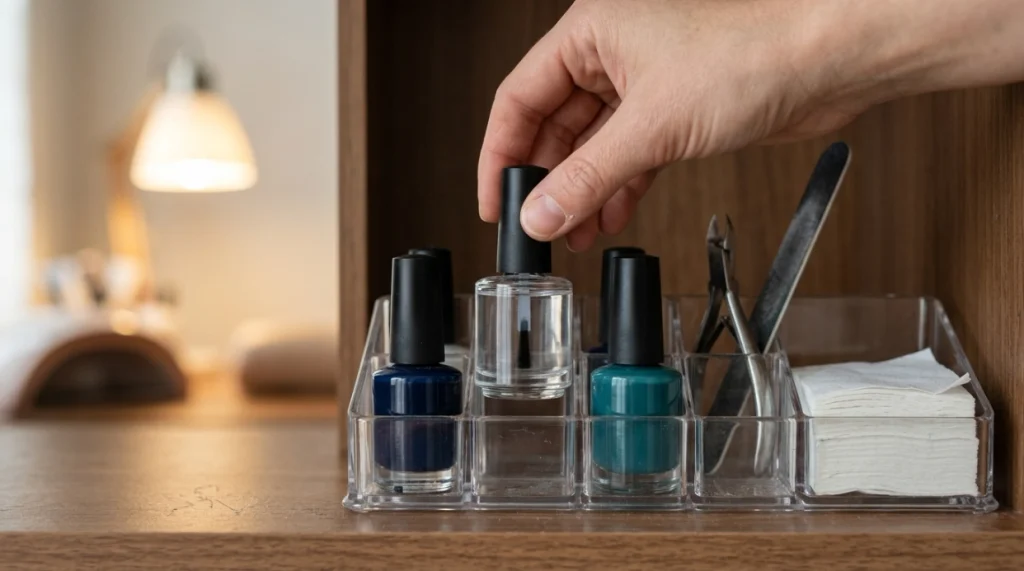
After your manicure, clean the bottle neck if necessary, close the cap completely, and return the bottle upright to its designated storage location.
Don’t leave the dehydrator open while you finish the rest of your gel or acrylic application.
- Read the bottle first. Check the manufacturer’s storage warnings and directions.
- Wipe the bottle exterior. Remove product residue before putting it away.
- Check the cap threads. Make sure dried residue isn’t preventing a proper seal.
- Tighten the cap. It should be secure without forcing or damaging the threads.
- Keep the bottle upright. Don’t intentionally store liquid bottles on their sides.
- Place it in a stable holder. A small upright compartment helps stop tipping.
- Move it away from heat. Keep it separate from lamps, candles, heaters, and hot tools.
- Secure the storage area. Children and pets shouldn’t have access.
For salon environments, follow the manufacturer’s Safety Data Sheet when one is supplied. OSHA’s nail salon chemical-hazard guidance also recommends closing bottles tightly when they’re not in use.
Should you keep the original bottle?
Yes, keeping nail dehydrator in its original labeled container is usually the simplest option. You keep the product identity, instructions, warnings, and manufacturer information together.
If a professional workplace transfers a chemical into another approved container, proper labeling becomes important. Never put nail dehydrator into a beverage, food, or anonymous cosmetic container.
What Temperature and Environment Are Best?
Use the storage conditions printed by the manufacturer whenever they’re available. Different nail dehydrators can contain different solvents, so one exact temperature rule doesn’t fit every formula.
In practical terms, a normal indoor room away from direct heat is usually preferable to a hot car, sunny shelf, or damp bathroom.
Why does heat matter?
Solvents can evaporate readily. Some commonly used alcohols are also flammable liquids.
For example, OSHA identifies isopropyl alcohol as a flammable chemical with a low flash point. That doesn’t prove every nail dehydrator contains isopropyl alcohol, so always check your own product’s label.
- Don’t assume ingredients: Formulas differ between brands.
- Don’t use heat to “fix” product: Never warm a dehydrator bottle.
- Don’t store near flames: Keep solvent-based nail products away from ignition sources.
- Use ventilation: Avoid allowing concentrated chemical vapors to collect in a small working area.
OSHA emphasizes ventilation as an important way to reduce chemical vapor exposure in nail salons. Their guidance is especially relevant for technicians who open multiple nail products throughout the day.
Section Takeaway: Follow your product’s label first. As a general practice, keep dehydrator in a stable indoor environment away from direct sun, high heat, flames, sparks, and concentrated vapors.
Can You Store Nail Dehydrator in a Bathroom, Car, or Refrigerator?
A controlled indoor cabinet is usually a better choice than a bathroom, vehicle, or refrigerator.
Those locations can introduce avoidable temperature changes, humidity, contamination concerns, or unsafe access.
Bathroom
Bathrooms often become warm and humid during showers. Bottles can also be knocked from small shelves or counters.
If the bathroom is your only option, use a secure closed cabinet away from heat, moisture, and children. Keep the bottle upright.
Car
I wouldn’t use a vehicle as permanent storage. Parked cars can experience large temperature swings, especially in direct sun.
Transport the dehydrator when necessary, then bring it back indoors. Keep it sealed and upright during transport.
Refrigerator
Don’t refrigerate nail dehydrator unless the manufacturer specifically tells you to. Household refrigerators are intended for food, and colder storage isn’t automatically better for cosmetic chemicals.
Never place an unlabeled nail chemical near food or drinks. Keeping chemicals clearly separated reduces accidental exposure.
Near a UV/LED nail lamp
A curing lamp isn’t an ideal permanent storage shelf. Keep prep bottles away from equipment that becomes warm or can be knocked during a manicure.
Your workstation works better when chemicals have their own stable storage area.
How Do You Prevent Evaporation, Leaks, and Spills?
The simplest prevention method is also the most important: close the cap immediately after use.
A bottle doesn’t need to remain open while you apply primer, base gel, extensions, or color.
Use a simple open-use-close routine
- Open the dehydrator.
- Apply the amount needed.
- Wipe excess from the brush against the bottle neck carefully.
- Return the brush.
- Close the cap immediately.
- Move the bottle away from your active work area.
Don’t pour excess product from a dappen dish or another working container back into the original bottle. That can introduce dust, nail filings, or other contaminants.
If the bottle cap becomes crusted with residue, follow the manufacturer’s cleaning guidance. Don’t use a tool that could damage the cap or bottle seal.
What about travel?
- Keep the original cap fully tightened.
- Use an upright compartment when possible.
- Protect glass bottles from impact.
- Don’t leave the product inside a hot parked vehicle.
- Check transportation rules before carrying flammable liquids on public transport or aircraft.
For acetone-containing and similar nail products, Poison Control recommends storing them away from heat and flames and keeping them out of children’s reach. You can review their nail solvent safety guidance for broader chemical-safety context.
How Long Does Nail Dehydrator Last in Storage?
There is no reliable universal shelf life for every nail dehydrator. Use the expiration date, period-after-opening symbol, batch information, or manufacturer instructions supplied with your specific product.
Don’t assume an old bottle is usable just because liquid remains inside.
Check these signs before using an older bottle
- The expiration date has passed.
- The cap no longer seals properly.
- The bottle is cracked or damaged.
- The liquid looks noticeably different from its normal appearance.
- Unexpected residue or particles appear inside.
- The odor has changed in a way not typical for that product.
- The product performs differently despite correct nail preparation.
- The label has become unreadable and you can’t identify the product safely.
Evaporation can also change the amount of product inside a poorly sealed bottle. That’s another reason not to judge shelf life by volume alone.
If you’re unsure, contact the manufacturer with the product name and batch or lot number. That gives you a more reliable answer than guessing from appearance.
Should you add alcohol or another solvent to an old dehydrator?
No. Don’t dilute, refill, or reformulate a nail dehydrator unless its manufacturer specifically provides instructions to do so.
Adding another liquid can change the formula and make performance unpredictable.
Section Takeaway: The manufacturer’s expiration and storage instructions are more reliable than a universal timeline. Replace products that are expired, damaged, contaminated, unidentified, or behaving abnormally.
What Should You Do If the Bottle Leaks or the Product Changes?
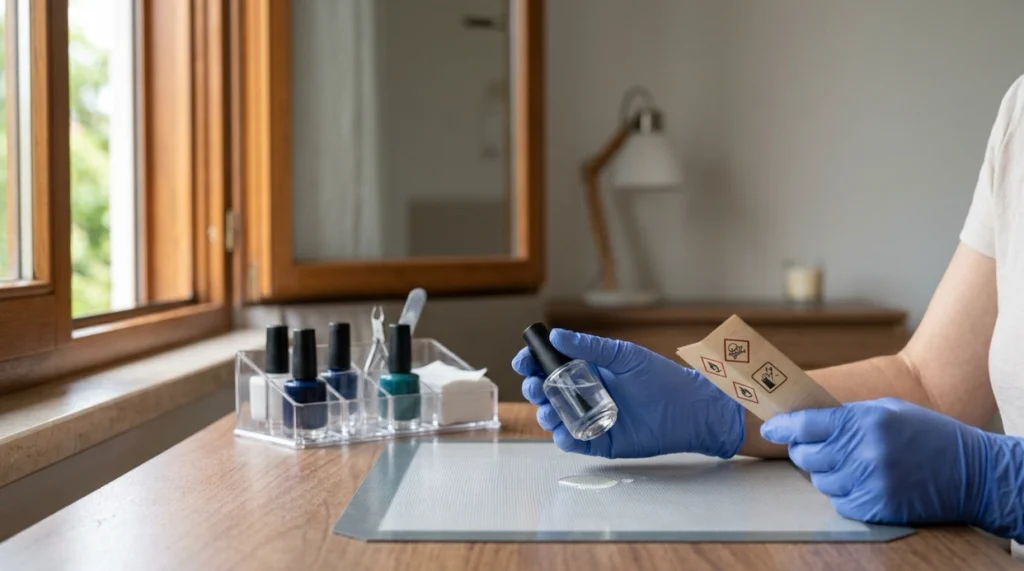
Stop using a leaking or damaged bottle until you know how the manufacturer recommends handling it. Keep the area ventilated and eliminate nearby ignition sources if the product may be flammable.
Don’t touch an unknown spill with bare skin just because it’s a cosmetic product.
If you notice a small leak
- Keep children and pets away.
- Ventilate the area.
- Read the product label and Safety Data Sheet if available.
- Follow the manufacturer’s spill and disposal directions.
- Avoid flames, smoking, sparks, and hot equipment.
- Wash exposed skin according to the label’s first-aid instructions.
OSHA recommends consulting product Safety Data Sheets to understand the hazards and safe practices for potentially hazardous salon chemicals. Their information on isopropyl alcohol also illustrates why ingredient-specific safety information matters.
What if it gets in your eyes or is swallowed?
Follow the product label and seek appropriate medical or poison-control advice promptly. Don’t intentionally induce vomiting unless a qualified professional instructs you to do so.
For significant symptoms, breathing difficulty, severe eye exposure, or loss of consciousness, seek emergency help.
Safety note: This storage guide is general information. Exact first-aid, disposal, fire, and storage requirements depend on the ingredients in your particular nail dehydrator.
Frequently Asked Questions
Does nail dehydrator need to be refrigerated?
Usually not. Store it according to the manufacturer’s instructions, typically in a controlled indoor location away from direct heat and sunlight. Don’t put nail chemicals in a household refrigerator unless the product maker specifically requires refrigerated storage.
Can nail dehydrator evaporate?
Yes, many nail dehydrators contain volatile ingredients that evaporate quickly. Leaving the cap loose or open can allow product loss, so close the bottle immediately after application and check that the cap seals correctly.
Can I leave nail dehydrator in my car?
A parked car isn’t a good permanent storage location because temperatures can change dramatically. Transport the product when needed, keep it sealed and upright, and return it to a suitable indoor storage area afterward.
Should nail dehydrator be stored upright?
Upright storage is the safer practical choice for most small nail-prep bottles. It reduces continuous contact between the liquid and cap seal and lowers the chance of leakage if the closure isn’t perfect.
Can I keep nail dehydrator beside acetone and primer?
You can organize compatible nail chemicals together when the storage area meets their label and Safety Data Sheet requirements. Keep containers closed, upright, clearly labeled, secured, and away from heat or ignition sources.
How can I tell if nail dehydrator has gone bad?
Check the expiration information, bottle condition, cap seal, liquid appearance, odor, and performance. If something has changed unexpectedly or you can’t identify the product confidently, stop using it and contact the manufacturer.
Is nail dehydrator flammable?
Some formulas may contain flammable solvents, but ingredients differ by brand. Read the label and Safety Data Sheet for your specific bottle instead of assuming every dehydrator has the same fire risk.
The easiest storage rule to remember is simple: cap it, stand it upright, keep it cool and secure, and keep it away from sunlight, heat, flames, sparks, children, and pets.
A few seconds of careful storage after each manicure can prevent leaks, unnecessary evaporation, and avoidable safety problems. Before your next set, check the bottle label first and let the manufacturer’s instructions decide any product-specific storage question.
