
Is Nail Dehydrator Safe During Pregnancy? What You Should Know

Quick Answer
Using a small amount of nail dehydrator occasionally during pregnancy is unlikely to create a significant exposure when you follow the label, keep it off your skin, and work in a well-ventilated space. However, nail dehydrator formulas vary, and there is limited pregnancy research on dehydrators specifically, so check the ingredients and follow current pregnancy guidance for nail-product exposure.
How to reduce exposure
- Check the formula: Read the ingredient list and Safety Data Sheet when one is available.
- Use very little: Apply only the thin amount needed on the natural nail plate.
- Avoid your skin: Don’t flood the cuticles or apply product to irritated or broken skin.
- Improve airflow: Use the product near fresh air or effective local ventilation.
- Close the bottle: Recap it immediately instead of leaving solvent-based products open.
- Stop if symptoms start: Move to fresh air if fumes trigger dizziness, headache, nausea, or breathing irritation.
Extra caution is sensible when
- You work with nail chemicals for hours each day, have asthma or chemical sensitivities, or cannot identify what is in the product.
Pregnancy can make an ordinary manicure feel surprisingly complicated. A bottle marked “dehydrator” suddenly raises questions about solvents, fumes, skin absorption, and whether skipping one prep step would be safer.
I approach this question by separating occasional home use from repeated salon exposure. That distinction matters far more than the word “dehydrator” on the bottle.
In This Guide
- Is nail dehydrator safe during pregnancy?
- What does a nail dehydrator actually do?
- Which nail dehydrator ingredients matter during pregnancy?
- Dehydrator vs primer vs acetone: what is the difference?
- How can you use nail dehydrator more safely while pregnant?
- What if you are a pregnant nail technician?
- When should you skip nail dehydrator?
- Do you need nail dehydrator during pregnancy?
- Frequently asked questions
- The bottom line
Is Nail Dehydrator Safe During Pregnancy?
For occasional manicures, a small amount of nail dehydrator used correctly is generally a low-exposure situation. Current pregnancy guidance on nail treatments does not suggest that normal, brief cosmetic nail use creates a known increased pregnancy risk.
The important limitation is that “nail dehydrator” describes a job, not one standardized formula. Pregnancy safety therefore depends partly on the specific ingredients, amount used, ventilation, and frequency of exposure.
- Occasional home use: Usually means a few brush strokes across ten nails before a manicure.
- Occasional salon visits: Exposure includes your products plus vapors from nearby services.
- Professional nail work: May involve multiple products and several hours of repeated exposure each day.
Those situations shouldn’t be treated as equal. Occupational exposure can be much greater than applying one thin coat at home every few weeks.
The U.S. Food and Drug Administration advises consumers to follow nail-product labels and use these products with good ventilation. Its nail care product guidance also explains that different nail products can contain ingredients with different safety concerns.
Pregnancy note: If your obstetrician or midwife has advised you to avoid specific chemicals or cosmetic treatments, follow that individual advice.
What Does a Nail Dehydrator Actually Do?
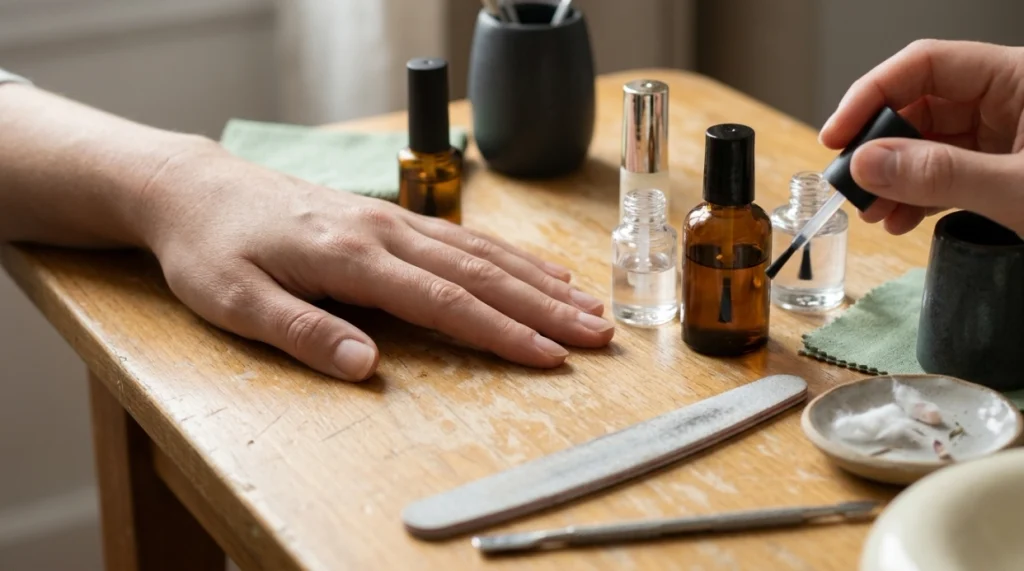
A nail dehydrator is a prep liquid that temporarily removes surface moisture and oils from the natural nail. This creates a cleaner, drier surface for gel, acrylic, press-on glue, or other enhancement products.
Definition: A nail dehydrator is a fast-drying nail-preparation product designed to remove temporary surface oil and moisture before another nail product is applied.
It isn’t supposed to permanently “dry out” the nail. Most of its effect happens at the surface and lasts long enough for the next prep or coating step.
Is nail dehydrator the same as primer?
No. This distinction matters because pregnancy questions often mix the two products together.
- Dehydrator: Cleans and degreases the nail surface.
- Primer: Promotes adhesion between the natural nail and an enhancement system.
- Base coat: Creates the first coating layer underneath polish or gel.
Some manicure kits package dehydrator and primer side by side. That doesn’t mean their ingredients or safety profiles are identical.
In particular, the FDA notes that some professional nail primers can contain methacrylic acid. You shouldn’t assume a separate dehydrator contains it unless the ingredient list says so.
Why ingredients matter more than the product name
Dehydrator formulas can differ between brands. Some rely heavily on fast-evaporating solvents, while others use different combinations of degreasing ingredients.
That’s why I check the actual bottle instead of trusting claims such as “gentle,” “acid-free,” or “pregnancy-safe.” Marketing language isn’t a substitute for an ingredient list.
Pregnancy note: If a professional-only product has no accessible ingredient information, ask the salon for its Safety Data Sheet before assuming it is suitable.
Which Nail Dehydrator Ingredients Matter During Pregnancy?
There isn’t one ingredient list that covers every dehydrator. Instead, look for solvent ingredients and any warnings about inhalation, skin contact, flammability, or professional-only use.
Solvents and fast-evaporating ingredients
Nail products can contain solvents such as acetone, ethyl acetate, butyl acetate, and other volatile ingredients. These evaporate easily, which is one reason nail products can smell strong.
Brief exposure isn’t the same as breathing concentrated vapor for hours. MotherToBaby reports that the small amounts expected from routine nail treatments are generally not expected to increase pregnancy problems.
- Keep bottles tightly closed between applications.
- Use only the amount needed.
- Don’t work in a closed bathroom, car, or small unventilated room.
- Step away if you develop headache, nausea, dizziness, or airway irritation.
Does a strong smell mean the product is dangerous?
Not necessarily. Odor alone cannot tell you whether an airborne concentration is harmful.
Some chemicals can be smelled at low concentrations, while other hazards may not have a strong warning odor. Ventilation and product instructions are more useful than the smell test.
What about methacrylates and methacrylic acid?
These chemicals appear more commonly in artificial nail and primer discussions than in basic dehydrators. They deserve attention because nail-prep products are often sold together.
The FDA distinguishes methacrylic acid used in some primers from methacrylate monomers used in artificial nail systems. Skin contact can also matter because some nail chemicals may cause irritation or allergic sensitization.
For pregnancy specifically, the better strategy is to minimize unnecessary exposure rather than trying to memorize a “safe” and “unsafe” list. The FDA’s broader cosmetics and pregnancy guidance recommends discussing ingredient concerns with your healthcare provider.
Pregnancy note: Don’t apply prep products over cuts, inflamed cuticles, dermatitis, or other damaged skin without professional medical advice.
Dehydrator vs Primer vs Acetone: What Is the Difference During Pregnancy?
These products can appear in the same manicure, but they serve different purposes. The amount and route of exposure also differ.
| Product | Main job | Typical exposure concern | Lower-exposure approach |
|---|---|---|---|
| Nail dehydrator | Removes surface oil and moisture | Solvent vapor and skin contact | One thin coat, fresh airflow, recap bottle |
| Nail primer | Improves enhancement adhesion | Formula-dependent acids or reactive ingredients | Check ingredients and avoid skin contact |
| Acetone remover | Softens or removes polish and some enhancements | Vapor, dryness, irritation | Limit open containers and ventilate well |
| Gel/acrylic products | Builds or coats the nail | Uncured product, sensitization, fumes or dust | Avoid skin contact and follow the complete system directions |
The main lesson is simple: don’t evaluate an entire manicure based only on its dehydrator. Primer, acrylic liquid, glue, gel, remover, and ventilation may contribute more to your total exposure.
Section Takeaway: A nail dehydrator is only one part of the chemical exposure picture. Evaluate the whole manicure routine, especially if you use several products.
How Can You Use Nail Dehydrator More Safely While Pregnant?
If you decide to use a dehydrator, reducing exposure is straightforward. You don’t need to soak the nail or repeatedly brush on extra product.
- Read the label first. Check ingredients, warnings, and whether the product is intended only for professional use.
- Open a window or use effective ventilation. Fresh airflow helps prevent vapor buildup around your breathing zone.
- Prepare the nails before opening the bottle. Finish filing and dust removal first so the container stays open for less time.
- Apply one thin layer. Cover the nail plate without flooding the surrounding skin.
- Let it air-dry as directed. Don’t add extra heat unless the manufacturer specifically instructs it.
- Close the bottle immediately. This reduces evaporation and accidental spills.
- Wash your hands after the manicure. Clean away accidental residue from surrounding skin.
Should you wear a mask?
A basic surgical-style mask isn’t designed to remove solvent vapors. It may help with larger droplets but shouldn’t replace ventilation.
For an occasional home manicure, controlling the source and improving airflow are more practical. Professional workers should follow the product’s SDS and workplace safety requirements.
Should you wear gloves?
You cannot cover the nails being treated with gloves, but you can minimize chemical contact with surrounding skin. Nail technicians should use the glove material recommended by the relevant Safety Data Sheet.
MotherToBaby notes that glove materials differ in chemical resistance. “Any glove” isn’t automatically suitable for every salon chemical.
Pregnancy note: If fumes make you feel dizzy, nauseated, short of breath, or unusually unwell, stop the service and get fresh air.
What If You Are a Pregnant Nail Technician?
A nail technician has a different exposure pattern from someone getting one manicure. You may handle solvents, acrylics, gels, adhesives, dust, removers, disinfectants, and prep liquids throughout an entire workday.
CDC reproductive-health guidance identifies nail and beauty salon workers as a group potentially exposed to solvents, acrylates, formaldehyde, and other chemicals. It recommends reducing workplace exposure during pregnancy when possible.
- Ask for the SDS for every product you use regularly.
- Keep containers closed whenever they aren’t actively being used.
- Use source-capture or ventilated manicure tables when available.
- Maintain the salon’s exhaust and HVAC systems properly.
- Avoid eating or drinking at the nail station.
- Wash your hands before breaks, meals, and leaving work.
- Use the PPE recommended for each product.
The CDC’s reproductive health guidance for workplace exposures emphasizes reducing exposure rather than relying on symptoms alone. That principle is especially useful when several salon products are used together.
Ventilation matters more for professionals
OSHA describes ventilation as a key way to lower chemical levels in nail salons. Local exhaust near the manicure table can remove vapors closer to their source.
Read OSHA’s nail salon chemical-hazard guidance if you work with these products regularly. Workplace precautions should protect you throughout the shift, not just when an odor becomes noticeable.
Section Takeaway: Occasional consumer use and daily professional exposure aren’t equivalent. Pregnant nail technicians should focus on ventilation, SDS information, skin protection, and total daily exposure.
Pregnancy note: Discuss your exact workplace products and exposure pattern with your prenatal healthcare provider or occupational-health professional.
When Should You Skip Nail Dehydrator?
Skipping dehydrator temporarily is reasonable if you cannot identify the formula or control your exposure. A slightly shorter-lasting manicure is a fair trade when a product makes you uncomfortable.
Consider avoiding it until you get professional advice if any of these situations apply:
- You have a previous allergy to nail products or acrylates.
- Your cuticles or surrounding skin are cracked, bleeding, or inflamed.
- You have asthma or another condition triggered by chemical vapors.
- The product causes immediate burning, rash, swelling, or breathing irritation.
- The bottle lacks usable ingredient or safety information.
- You need to work with the product repeatedly in poor ventilation.
- Your prenatal healthcare provider has advised avoiding a particular ingredient.
What symptoms deserve prompt attention?
Mild odor isn’t automatically an emergency. Physical symptoms are more important.
- Difficulty breathing or wheezing
- Facial or hand swelling after product exposure
- Widespread hives or a severe rash
- Persistent dizziness or fainting
- Severe eye exposure or chemical burns
Move away from the exposure and follow the product’s first-aid instructions. Seek urgent medical help for severe breathing difficulty, fainting, or signs of a serious allergic reaction.
Pregnancy note: Pregnancy doesn’t make every nail-product reaction pregnancy-specific. Irritation and allergy still deserve appropriate medical care.
Do You Need Nail Dehydrator During Pregnancy?
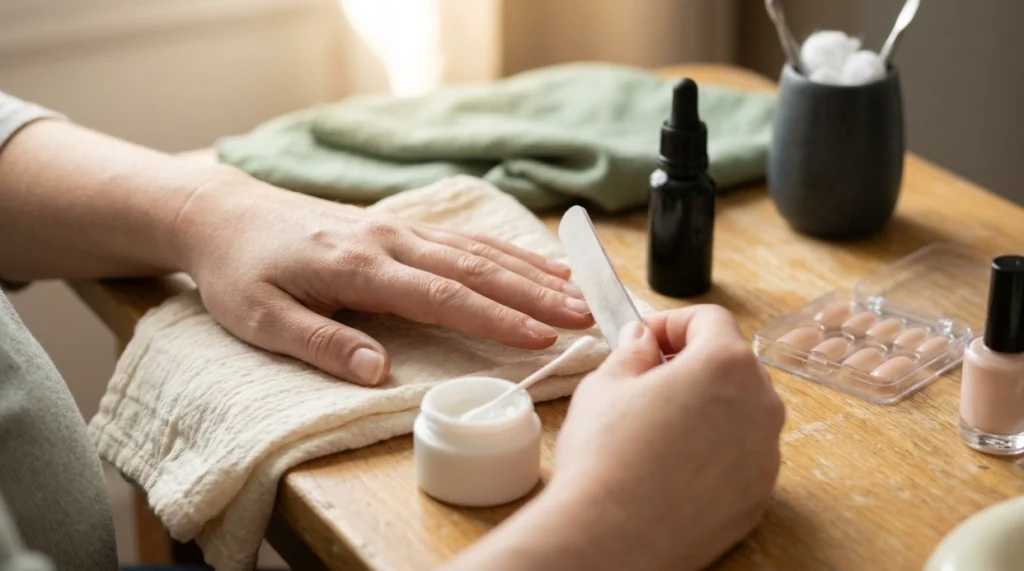
No. A dehydrator can improve adhesion, but it isn’t medically necessary and you can skip it if you prefer to reduce your product use.
Your manicure may simply lift sooner, depending on your nails and the system you’re using. Regular polish often needs less aggressive prep than acrylic or long-wear extensions.
Can alcohol replace a nail dehydrator?
Some nail systems use an alcohol-based cleansing step to remove surface oils. However, you shouldn’t automatically substitute one chemical for another if the manufacturer requires a specific prep product.
For regular polish or temporary press-ons, simpler prep may be enough. Wash your hands, dry the nails thoroughly, and follow the product manufacturer’s instructions.
Can you just skip nail enhancements?
Absolutely. Pregnancy is temporary, and there is no requirement to keep using gel, acrylic, dip, or extensions if the chemical exposure makes you uneasy.
You can keep natural nails short, shaped, and moisturized until you’re ready to return to your normal routine. That is a personal comfort choice, not proof that every nail product is dangerous.
Pregnancy note: If uncertainty about one specific product is causing concern, take a photo of its ingredient label and discuss it with your prenatal provider.
Frequently Asked Questions
Can nail dehydrator cause birth defects?
There is not good evidence showing that occasional, properly used nail dehydrator causes birth defects. Direct pregnancy research on dehydrators specifically is limited, so guidance relies on ingredient information and broader research about nail-product exposure.
Is nail dehydrator safe in the first trimester?
There isn’t a separate proven “safe amount” for first-trimester dehydrator use. If you use it, keep exposure low, ventilate the area, avoid skin contact, and discuss any ingredient-specific concerns with your prenatal provider.
Is Modelones or another specific dehydrator safe during pregnancy?
Don’t judge pregnancy suitability from the brand name alone because formulas can change. Check the exact ingredient list and SDS for your bottle, then ask your healthcare provider about any ingredient that concerns you.
Are acid-free nail dehydrators safer during pregnancy?
“Acid-free” doesn’t automatically mean pregnancy-safe or chemical-free. A dehydrator can still contain volatile solvents, so ventilation, skin avoidance, and ingredient review remain important.
Can I get acrylic or gel nails while pregnant if dehydrator is used?
Routine nail treatments generally involve small exposures, but dehydrator isn’t the only product involved. Consider the primer, uncured gel, acrylic ingredients, removers, dust, salon hygiene, and ventilation as part of the complete service.
What if I already used nail dehydrator before realizing I was pregnant?
A single brief exposure isn’t usually a reason to assume harm. Avoid panic, note the product and ingredients if available, and contact your healthcare provider or a pregnancy-exposure information service if you want individualized guidance.
Does a strong chemical smell mean I harmed my pregnancy?
No. Smell alone cannot measure how much chemical entered your body or predict pregnancy harm. Leave the area if the odor causes symptoms, improve ventilation, and seek medical advice if you had a significant exposure or feel unwell.
The Bottom Line on Nail Dehydrator During Pregnancy
As of 2026, there isn’t strong evidence that occasional, correctly used nail dehydrator creates a known pregnancy risk. There also isn’t enough dehydrator-specific research to declare every formula universally safe.
The sensible approach is to keep exposure as low as practical. Use a tiny amount, keep it off your skin, provide good ventilation, close the bottle quickly, and check what’s actually in your product.
- At home: Keep the application brief and ventilated.
- At a salon: Choose a clean space with good airflow.
- At work: Treat repeated exposure as an occupational-health issue.
- If you’re unsure: Show the ingredient list or SDS to your prenatal healthcare provider.
I wouldn’t let a marketing label such as “gentle” make the decision for me. The ingredients, exposure level, ventilation, and your own health history are more useful.
If you prefer to skip dehydrator during pregnancy, that’s also a perfectly practical choice. Nail adhesion may change, but your manicure routine can always be adjusted.
