
Is Nail Dehydrator Safe to Use? What You Should Know

Quick Answer
Yes, nail dehydrator is generally safe when you use it as directed, apply a small amount to the natural nail plate, and keep it off the surrounding skin. Because formulas vary, always check the label and follow the manufacturer’s warnings; the FDA’s nail product safety guidance also recommends good ventilation and careful use of nail cosmetics.
Safe-use essentials
- Use a thin coat: You only need enough product to lightly cover the natural nail.
- Avoid skin contact: Keep the liquid away from cuticles, sidewalls, cracks, and broken skin.
- Ventilate the room: Open-air circulation helps reduce exposure to solvent vapors.
- Follow the label: Ingredients and directions differ between brands.
- Stop if it burns: Persistent stinging, redness, swelling, or a rash is a reason to discontinue use.
One important distinction
- A nail dehydrator and an acid-based nail primer are different products, so do not assume their safety instructions are interchangeable.
When I prep nails for gel, acrylic, dip, or press-ons, I think of dehydrator as a precision step rather than something to soak the nail with. A light application is usually all that is needed.
The bigger safety questions involve skin contact, overuse, damaged nails, ventilation, and confusing dehydrator with stronger primers. This guide covers each of those points so you can decide when and how to use nail dehydrator safely.
In This Guide
- Is nail dehydrator safe to use?
- What does nail dehydrator actually do?
- When can nail dehydrator cause problems?
- How do you use nail dehydrator safely?
- Nail dehydrator vs cleanser vs primer: What is the difference?
- Can you use nail dehydrator on sensitive or damaged nails?
- Frequently asked questions
- What is the safest way to use nail dehydrator?
Is Nail Dehydrator Safe to Use?
For most people, a nail dehydrator can be used safely when the product is used according to its directions. The goal is to prepare the nail plate, not saturate the finger or surrounding skin.
As of 2026, the FDA advises consumers to follow nail-product labels, pay attention to warning statements, avoid eye exposure, and use nail products with adequate ventilation.
That matters because “nail dehydrator” describes a product category rather than one standardized formula. One brand may rely heavily on alcohol, while another may use different volatile solvents.
Definition: A nail dehydrator is a nail-preparation liquid designed to temporarily remove surface moisture and oils from the natural nail plate before polish, gel, acrylic, dip, glue, or another enhancement system is applied.
Does nail dehydrator permanently dry out your nails?
A normal application is designed to create a temporary dry surface for better adhesion. It does not literally remove all moisture from the deeper nail structure.
The nail’s surface may look chalky, matte, or less shiny for a short time. That visible change is one reason dehydrator can help the next product grip more consistently.
Is occasional home use different from salon exposure?
Yes. Someone using a small amount every few weeks has a different exposure pattern than a technician working with nail chemicals for hours each day.
The CDC and NIOSH guidance for nail technicians emphasizes controlling repeated exposure to vapors and chemicals through ventilation, closed containers, and safer work practices.
For home manicures, the same principles still make sense. Use the smallest amount needed, close the bottle promptly, and work where fresh air circulates.
What Does Nail Dehydrator Actually Do?
Nail dehydrator removes temporary surface oils, moisture, and some residue that may interfere with adhesion. It is normally used after basic nail preparation and before primer, base coat, glue, or an enhancement product.
Your natural nail surface can collect oil from the skin, hand cream, soap residue, and repeated touching. Even a nail that looks clean can have material on the surface.
Why does removing oil help?
Gel, acrylic, press-on glue, and other systems work best when they can make consistent contact with the prepared nail surface. Oil can interfere with that contact and contribute to early lifting.
This is why touching freshly prepared nails with your fingers can undo part of your prep. Oils can transfer back to the plate quickly.
What ingredients are in nail dehydrator?
There is no single ingredient list shared by every dehydrator. Depending on the brand, formulas may contain alcohols, acetates, or other fast-evaporating solvents.
Instead of choosing a product based only on the words “nail dehydrator,” check these details:
- Ingredient list: See what the actual formula contains.
- Usage directions: Confirm whether it is intended for natural nails and your chosen manicure system.
- Warnings: Check for flammability, ventilation, skin-contact, or eye-contact precautions.
- Professional-use labeling: Do not assume a salon product should be used exactly like a consumer formula.
- Manufacturer instructions: Follow the sequence recommended for that specific system.
I also avoid assuming that “acid-free” means a dehydrator is automatically harmless. Marketing terms do not replace the ingredient list or directions.
When Can Nail Dehydrator Cause Problems?
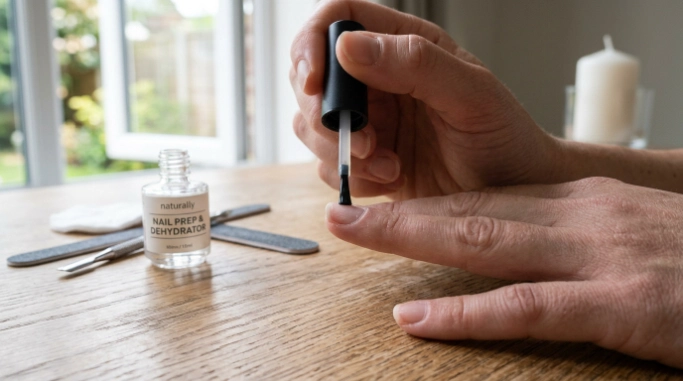
Problems are more likely when dehydrator gets on the skin, is used too heavily, is applied to damaged tissue, or is repeatedly inhaled in a poorly ventilated space. Individual sensitivity also varies.
The strongest rule is simple: the product belongs on the nail plate unless its label specifically says otherwise.
Skin and cuticle contact
Solvent-based nail products can irritate skin, especially when exposure happens repeatedly. Cracked, cut, inflamed, or recently trimmed skin may sting more easily.
Avoid flooding the cuticle and sidewalls. Wipe excess product from the brush before bringing it to the nail.
Eye exposure
Nail-prep liquids should be kept away from the eyes. Do not apply them while touching your face, wearing the brush near eye level, or working where the bottle can easily tip.
If a product enters the eye, follow the label’s first-aid directions and seek appropriate medical guidance if irritation persists.
Vapors and poor ventilation
Nail products can release vapors, especially products made with volatile solvents. A strong smell is a good reminder not to work in a tiny, sealed room.
OSHA’s nail salon chemical-safety guidance recommends ventilation and keeping chemical containers closed when they are not in use. Those habits are sensible for home nail stations too.
Flammability
Many solvent-containing nail products can be flammable. Keep dehydrator away from cigarettes, candles, open flames, heaters, and other ignition sources when the label warns of flammability.
Close the bottle immediately after application. Store it according to the manufacturer’s instructions.
Using too much product
More dehydrator does not automatically create better adhesion. A soaked nail and flooded cuticle simply increase unnecessary exposure.
For most brush-on products, one controlled, thin application is enough unless the manufacturer instructs otherwise.
Health note: Persistent burning, swelling, blistering, rash, pain, or nail separation should not be treated as a normal part of nail prep. Stop using the product and contact a healthcare professional or dermatologist when symptoms are significant or continue.
How Do You Use Nail Dehydrator Safely?
Safe use starts with clean nails, careful application, and following the order recommended by your nail system. You should not need to repeatedly soak or scrub the nail with dehydrator.
Here is a practical routine I use as a general framework:
- Wash and dry your hands. Make sure the nails are fully dry before beginning the manicure.
- Prepare the nail gently. Shape the free edge and complete any necessary surface preparation for your chosen system.
- Remove nail dust. Keep loose filing dust from mixing with later products.
- Avoid touching the nail plate. Finger oils can transfer back onto the prepared surface.
- Apply a thin layer of dehydrator. Keep the brush on the nail plate and away from the surrounding skin.
- Allow it to evaporate. Most dehydrators air-dry, but follow your product’s instructions.
- Continue with the correct next step. That may be primer, base coat, glue, acrylic, or another product depending on the system.
Do you need a UV or LED lamp?
Most traditional nail dehydrators are designed to evaporate in the air and do not need lamp curing. Never assume this for every bottle, though.
Read the product directions before placing any prep liquid under a nail lamp. Use a lamp only when the manufacturer specifically requires it.
Should you apply dehydrator twice?
Not automatically. One controlled application may be enough for many products and nail types.
If a brand recommends two applications for oily nails, follow its instructions. Repeated coats without a reason may only increase dryness or exposure.
What should happen after application?
The nail often appears less shiny and feels free of oily residue. You should not expect intense burning, throbbing, or lasting pain.
Once dry, continue the manicure without touching the nail plate. That preserves the clean surface you just created.
Nail Dehydrator vs Cleanser vs Primer: What Is the Difference?
A dehydrator removes surface moisture and oil, while a cleanser mainly removes residue and a primer prepares the surface for stronger bonding. They may appear in the same manicure routine, but they are not interchangeable.
This distinction matters for safety because primers can have different chemistry and precautions.
| Product | Main purpose | Typical timing | Lamp needed? | Key safety point |
|---|---|---|---|---|
| Nail cleanser | Removes dust, oils, or sticky residue depending on the formula | During prep or after curing, depending on its intended use | Usually no | Use only for the purpose stated on the label |
| Nail dehydrator | Temporarily removes surface oils and moisture | After basic prep and before primer, base, glue, or enhancement | Usually no | Keep it on the nail plate and avoid overapplication |
| Acid-free primer | Promotes adhesion between the nail and enhancement system | Usually after dehydrator | Depends on formula | “Acid-free” does not mean skin contact is desirable |
| Acid primer | Creates strong adhesion for certain enhancement systems | Used only when the system calls for it | Depends on formula | Requires especially careful application and strict avoidance of skin |
Is acid-free primer the same as dehydrator?
No. “Acid-free” describes a type of primer formulation, not a nail dehydrator.
The FDA specifically discusses methacrylic acid in some nail primers, which is another reason to check the bottle rather than treating every prep product as identical.
Do you always need both dehydrator and primer?
No. The correct prep sequence depends on the gel, acrylic, dip, press-on, or bonding system you are using.
Some systems recommend both products. Others need only one prep product, so adding unnecessary layers can create problems rather than solve them.
Can You Use Nail Dehydrator on Sensitive or Damaged Nails?
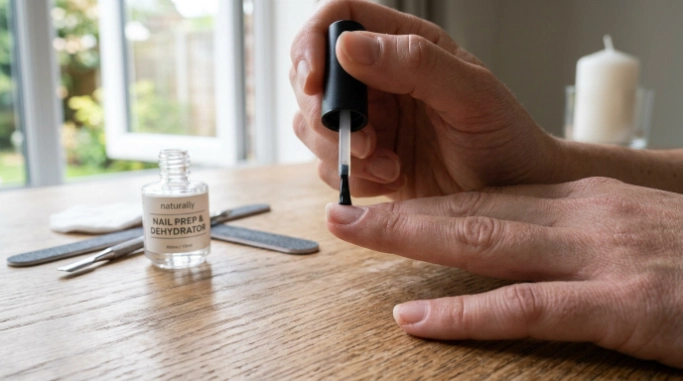
I would be more cautious when nails or surrounding skin are already sore, cracked, inflamed, unusually thin, or visibly damaged. Dehydrator is an adhesion product, not a treatment for injured nails.
If the nail area already hurts before application, improving manicure wear should not be the first priority.
When should you skip nail dehydrator?
Consider postponing a manicure when you notice any of these problems:
- Open cuts or bleeding around the nail or cuticle
- Unexplained swelling or significant redness
- Active rash around the fingers
- Painful nail separation from the nail bed
- Severely over-filed nails that feel tender
- Possible infection involving drainage, worsening pain, or unusual discoloration
The American Academy of Dermatology’s artificial-nail guidance notes that enhancement products and their application can irritate surrounding skin and worsen existing nail problems.
Giving damaged nails time to recover may make more sense than trying to improve adhesion immediately.
What if you have sensitive skin?
Check the complete ingredient list and directions instead of relying only on claims such as “gentle,” “low odor,” or “acid-free.” Sensitivity can develop to specific ingredients even when a product works well for other people.
If you have previously reacted to nail cosmetics, discuss future product use with a dermatologist or appropriate healthcare professional.
How often is it safe to use nail dehydrator?
There is no universal schedule that fits every product and every nail system. I use it only when I am preparing for a new application that calls for dehydration.
I would not apply dehydrator daily as a general nail-care treatment. It has no reason to be part of a normal moisturizing or maintenance routine.
Between manicures, focus on protecting the nail and moisturizing the surrounding skin. Repeated unnecessary degreasing works against that goal.
Health note: If your nails repeatedly become painful, thin, split, inflamed, or detached after manicures, stop the cycle of reapplication and consider a professional evaluation.
Frequently Asked Questions
Can nail dehydrator damage natural nails?
Used sparingly and according to its label, nail dehydrator is intended as a temporary preparation step. Excessive application or repeated exposure may leave the nail and surrounding skin feeling dry, so more product is not necessarily better.
Does nail dehydrator burn?
It should not cause persistent burning during normal application to an intact nail plate. Stinging can occur if the liquid touches broken or irritated skin, and significant or continuing burning is a reason to stop using the product.
Can I use nail dehydrator before gel polish?
Yes, if your gel system recommends a dehydrator as part of its prep routine. Apply it before the base or primer in the order specified by the manufacturer, and do not touch the nail afterward.
Can I use nail dehydrator before press-on nails?
Many people use a dehydrator before press-on glue to reduce surface oil and improve adhesion. Make sure the dehydrator and adhesive manufacturer instructions are compatible, because not every press-on system uses the same preparation method.
Can rubbing alcohol replace nail dehydrator?
Rubbing alcohol can remove some oil and residue, but that does not make it identical to every commercial nail dehydrator. Formulas and concentrations differ, so follow the preparation method recommended for the nail system you are applying.
Should nail dehydrator touch the cuticle?
No intentional cuticle contact is needed for normal nail dehydration. Keep the brush on the nail plate and avoid flooding the product into the skin folds around the nail.
What should I do if nail dehydrator causes redness or swelling?
Stop using the product and avoid applying more nail chemicals to the irritated area. If redness, swelling, blistering, pain, breathing symptoms, or another significant reaction develops or persists, seek appropriate medical care.
What Is the Safest Way to Use Nail Dehydrator?
Nail dehydrator can be a useful and generally safe manicure-prep step when you treat it as a concentrated product rather than a nail treatment. Use a thin application, keep it off the skin, ventilate your workspace, and follow the exact label.
Most importantly, do not confuse dehydrator with primer. They solve different preparation problems and may contain different ingredients.
If your natural nail or surrounding skin is already painful, inflamed, cracked, or damaged, postpone the manicure instead of trying to make an enhancement adhere more strongly. Healthy nail prep should never require you to ignore burning or visible irritation.
For me, the simplest rule is the most useful: use only what the manicure system calls for, in the smallest effective amount. That keeps nail prep effective without turning one useful step into unnecessary exposure.

