
Is Nail Files Good for Dogs? A Safe, Practical Guide

If you have ever looked at your dog’s long or scratchy nails and wondered, “is nail files good for dogs?”, the short answer is yes—with the right tool and technique.
A nail file can be a gentle way to smooth sharp edges or gradually shorten a dog’s nails. Some dogs even tolerate filing better than the sudden pressure and sound of nail clippers. However, dog nails are usually thicker and harder than human fingernails, so not every human nail file will work well.
The most important things are choosing an appropriate file, working slowly, avoiding the sensitive quick inside the nail, and stopping if your dog becomes stressed or uncomfortable.
This guide explains when nail files are useful for dogs, which types work best, how to file safely, and when it is smarter to visit a groomer or veterinarian instead.
Quick Answer
Yes, nail files can be good for dogs, especially for smoothing sharp edges and maintaining already-short nails. A sturdy manual file or dog-specific grinder usually works better than a delicate human file. File gradually, avoid the quick, watch for heat or irritation, and stop if your dog becomes stressed.
Are Nail Files Actually Good for Dogs?
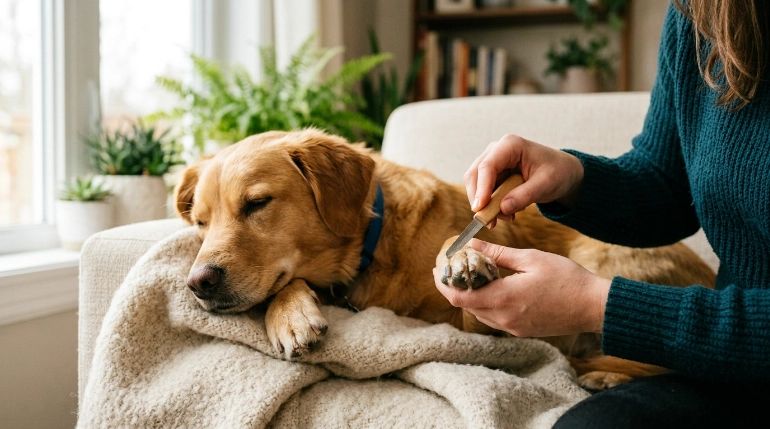
A nail file can be a useful part of a dog’s grooming routine.
According to the VCA Animal Hospitals guide to trimming dog nails, some owners use handheld files or grinders instead of clippers. Filing can leave the end of the nail smooth and may reduce the chance of accidentally reaching the quick when you work carefully.
That does not mean filing is automatically the best choice for every dog.
A manual file works particularly well for:
- Smoothing rough edges after clipping
- Removing small amounts of nail
- Maintaining nails between full trims
- Puppies or small dogs with thinner nails
- Dogs that dislike the snapping sensation of clippers
- Owners who feel nervous about cutting too much at once
Filing becomes less practical when a large dog has extremely thick, overgrown nails. Removing significant length with a small emery board can take a long time.
In those situations, dog clippers, a dog-specific grinder, or professional grooming may be more efficient.
Why Keeping Your Dog’s Nails Short Matters
Dog nail maintenance is more than a cosmetic issue.
Texas A&M Veterinary Medicine explains that overgrown nails can make normal activities such as walking and running uncomfortable. As nails grow longer, the quick—the living tissue containing nerves and blood supply—can also extend farther down the nail.
Long nails can also snag on blankets, carpets, and other materials. Severe overgrowth may interfere with how comfortably a dog places its paws on the ground.
The AKC’s dog nail trimming guidance similarly notes that regular nail care supports comfortable movement and healthier paws.
Filing regularly can therefore be useful for preventing small amounts of nail growth from turning into a much larger grooming job.
Which Type of Nail File Is Best for Dogs?
Not all files remove dog nail material at the same speed.
Here is a practical comparison.
| Nail Tool | Best For | Main Benefit | Main Limitation |
|---|---|---|---|
| Emery board | Small dogs and touch-ups | Cheap and easy to control | Can wear out quickly |
| Heavy-duty manual file | Small to medium maintenance | More effective than a thin beauty file | Slow on thick nails |
| Metal file | Smoothing and light maintenance | Reusable and durable | May require more patience |
| Dog nail grinder | Most nail sizes | Faster gradual removal | Noise, vibration, heat and dust |
| Clippers + file | Dogs needing significant shortening | Clippers remove length; file smooths edges | Requires confidence using two tools |
| Scratch board | Dogs that dislike paw handling | Dog participates voluntarily | Mainly useful for certain nails |
Regular Human Emery Boards
A sturdy human emery board can work for minor dog-nail maintenance.
However, thin beauty files designed for delicate natural fingernails may lose their grit quickly against thick canine nails.
If you already have one at home, it may be fine for smoothing one sharp edge. It is less convenient for shortening all four paws.
Dog-Specific Nail Files and Grinders
Tools designed for pets are generally more practical when nail filing becomes part of your regular grooming routine.
A dog nail grinder uses a rotating abrasive surface rather than cutting the nail in one motion. VCA notes that grinding can produce smoother nail ends and that some dogs who dislike clipping tolerate grinding better. However, grinders also need careful handling because rotating parts can catch long fur, contact skin, and generate dust.
Scratch Boards
A scratch board is another option for certain dogs.
The dog is trained to scratch an abrasive surface, gradually wearing down the front nails. This can be especially helpful for dogs that strongly dislike having their paws held.
The AKC notes that scratch boards can provide an alternative for dogs that are uncomfortable with standard nail-care tools.
Can You Use a Human Nail File on a Dog?
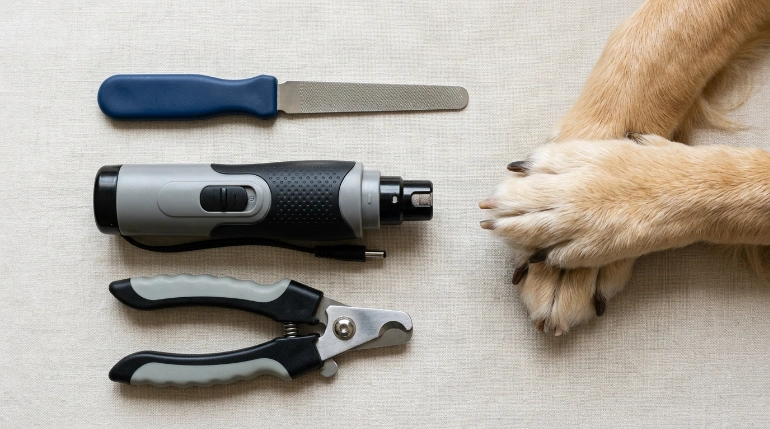
Yes, a human nail file can work on a dog, particularly for small touch-ups.
The main limitation is efficiency.
Human fingernails are much easier to file than the thick claws of many medium and large dogs. A lightweight file may work perfectly on a small puppy but feel almost useless on a large adult dog.
If you want to try a human file:
- Choose a sturdy file with enough texture to remove material.
- Use it only on a clean, healthy nail.
- Start with one or two nails.
- Use short, controlled strokes.
- Check the nail frequently.
- Stop before approaching the quick.
Do not share the same porous nail file between your own manicure routine and your dog’s paws. Keeping personal nail tools and pet-grooming tools separate is a simple hygiene habit.
Replace disposable files once they become dirty, damaged, or too smooth to work effectively.
How to File a Dog’s Nails Safely
Filing is gradual, but you still need to respect the living tissue inside each nail.
1. Get Your Dog Comfortable With Paw Handling
Do not begin by grabbing your dog’s paw and immediately filing.
Touch the paw gently. Reward calm behavior. Briefly hold one toe and release it.
Cornell University’s cooperative grooming guidance recommends gradual exposure and positive reinforcement rather than forcing a dog through grooming when it is frightened.
For a nervous dog, this preparation may take several short sessions.
2. Introduce the File
Let your dog see and investigate the tool.
For an electric grinder, turn it on at a distance first so your dog can become familiar with the sound.
Give treats for calm behavior.
Your first session does not need to end with all 18 nails perfectly groomed. Success can simply mean that your dog calmly accepts having one nail filed.
3. Examine the Nail
Look at the nail before removing material.
Light-colored nails may allow you to see the pink quick more easily. Dark nails can make it harder to judge where the sensitive tissue begins.
The quick contains nerves and blood vessels, so contacting it can cause pain and bleeding.
When you are unsure, remove tiny amounts rather than trying to finish quickly.
4. Support the Toe Gently
Hold the paw securely without squeezing.
Stabilizing the individual toe gives you better control and prevents the nail from moving while you file.
If your dog repeatedly pulls away, stiffens, growls, or becomes increasingly frightened, stop rather than escalating restraint.
5. File Small Amounts at a Time
Work gradually around the tip of the nail.
The goal is to shorten or smooth it—not aggressively grind away a large section in one pass.
With an electric grinder, short contacts are especially important because friction creates heat.
6. Check Your Progress
Pause frequently.
Look at the nail from different angles and make sure your dog remains comfortable.
If you are only smoothing a freshly clipped nail, you may need very little filing.
7. Reward Your Dog
Finish with praise, play, or a favorite treat.
Positive experiences make future nail-care sessions much easier.
Expert Tip: File one or two nails successfully rather than forcing yourself to finish an entire paw. Short, calm sessions usually build better long-term grooming habits than one stressful marathon.
Manual Nail File vs. Electric Grinder
Both options can work, but they suit different situations.
A manual file gives you excellent control. It is quiet, inexpensive, easy to store, and unlikely to frighten a dog with motor noise.
Its main disadvantage is speed.
A grinder removes material more efficiently and works well for rounding sharp edges. The VCA nail-care guide also warns that rotating grinders can catch long hair and may cause skin injury if they slip.
Keep long paw fur away from moving grinder parts.
You should also avoid holding a grinder against one spot continuously. Short passes help limit uncomfortable heat buildup.
How Often Should You File a Dog’s Nails?
There is no single schedule that works for every dog.
Nail growth varies with the individual dog, activity level, age, and the surfaces the dog regularly walks on. Dogs that frequently walk on abrasive surfaces may naturally wear their nails more than dogs that spend most of their time on carpet or soft ground.
Instead of focusing only on a calendar, inspect your dog’s paws regularly.
Signs it may be time for nail maintenance include:
- Nails becoming noticeably longer
- Sharp tips after a previous trim
- Nails frequently catching on fabric
- Changes in how the paws contact the floor
- Nails beginning to curve excessively
Small, frequent filing sessions can be easier than waiting until nails become badly overgrown.
Safety and Sensitivity Considerations
A healthy nail should not become red, swollen, cracked, painful, or repeatedly bloody after normal grooming.
Stop filing and inspect the paw if your dog suddenly reacts as if something hurts.
Also watch the skin surrounding the nail. A grinder that slips from the claw onto skin can cause injury, while overly forceful manual filing can irritate nearby tissue.
For dogs with dark nails, damaged nails, unusually thick nails, or a history of painful nail trims, professional guidance can be especially valuable.
A veterinarian or veterinary technician can also show you where and how to remove nail safely. The AKC specifically recommends asking a veterinarian or vet technician for instruction when an owner has never trimmed a dog’s nails before.
Cost: DIY Filing vs. Professional Nail Care
Manual nail files are generally the lowest-cost option because they require no battery, motor, or charging equipment.
A reusable pet file costs more initially than a disposable emery board but may last longer. Electric grinders require a larger upfront purchase, although owners who regularly maintain several dogs may appreciate the added speed.
Professional grooming adds a recurring service cost, but it can be worth paying for when:
- Your dog strongly resists paw handling.
- You cannot confidently identify a safe filing area.
- The nails are extremely thick or overgrown.
- You are afraid of causing injury.
- Your dog has previously snapped or bitten during nail care.
DIY care is most appropriate when both you and your dog are calm and the nails are healthy.
Common Mistakes to Avoid
Even though filing seems simple, a few mistakes can turn a gentle grooming session into a stressful one.
- Trying to remove too much nail at once. Work gradually.
- Using an extremely worn-out file. It makes the process unnecessarily long.
- Ignoring your dog’s body language. Pulling away, stiffening, growling, or repeatedly hiding the paw means you should reassess.
- Holding a grinder in one place. Friction may create uncomfortable heat.
- Allowing long fur near a rotating grinder. Hair can become caught in the tool.
- Forcing a frightened dog to continue. This can make future grooming more difficult.
- Sharing dirty grooming tools. Keep pet tools clean and separate.
- Assuming filing cannot reach the quick. Gradual removal lowers the risk, but excessive filing can still eventually reach sensitive tissue.
- Using a nail file on an injured nail. Cracks, bleeding, swelling, or obvious pain deserve professional assessment instead.
When to See a Nail Technician or Dermatologist
Because this article is about dog nails, a human nail technician or dermatologist is not the appropriate professional for canine nail problems. The right people are usually a veterinarian, veterinary technician, or experienced pet groomer.
Contact a veterinarian if you notice:
- A nail torn near its base
- Persistent bleeding
- Swelling around a toe
- Pus, discharge, or a bad smell
- Significant redness
- Limping or obvious pain
- A nail growing abnormally
- Repeated nail breakage
- A paw injury
- Sudden extreme sensitivity during nail care
Likewise, do not force DIY filing when your dog becomes highly distressed or may bite. Pain and fear can change even a normally friendly dog’s behavior.
A professional can determine whether the problem is simply grooming-related or needs medical treatment.
FAQs
Is filing a dog’s nails better than clipping them?
Neither method is automatically better. Filing gives you gradual control and creates smooth edges, while clippers remove significant length much faster. Some owners use clippers for shortening and a file for finishing. The best method is the one you can use safely and your dog comfortably tolerates.
Can I use an emery board on my dog’s nails?
Yes. A sturdy emery board can smooth a dog’s nails and may work well for puppies or small dogs. Thin boards may wear down quickly on thick nails, so a heavier pet file or grinder is usually more efficient for larger dogs.
Can filing a dog’s nails hurt them?
Yes, if you file excessively, contact sensitive tissue, irritate the surrounding skin, or allow an electric grinder to become too hot. Filing should be gradual and comfortable. Stop immediately if your dog reacts as though the nail or paw hurts.
Can you file black dog nails?
Yes, but black nails require extra caution because the quick is harder to see. Remove only a small amount at a time and inspect the nail frequently. If you are unsure where to stop, have a veterinarian, veterinary technician, or groomer demonstrate the process.
How do I make my dog’s nails smooth after clipping?
Use a manual file or pet nail grinder to gently round rough edges. Only a small amount of filing is usually necessary after clipping. This is one of the easiest and most useful reasons to keep a dog nail file at home.
What if my dog hates having its nails filed?
Start with paw-handling exercises without filing anything. Introduce the tool gradually and pair it with treats or another reward. Keep sessions short. If your dog shows severe fear or aggression, ask a veterinarian or qualified groomer for help rather than forcing the procedure.
Are electric nail files safe for dogs?
Dog-specific grinders can be safe when used correctly. Work in short passes, keep hair away from rotating parts, support the toe, and monitor heat. The AKC recommends grinding only small portions of nail at a time and keeping dogs comfortable throughout the process.
Conclusion
So, is nail files good for dogs? Yes. Filing can be a gentle and practical way to maintain a dog’s nails, particularly when you only need to smooth sharp edges or remove small amounts of growth.
A sturdy manual file works well for simple touch-ups, while a dog-specific grinder is usually faster for thicker nails. Whatever tool you choose, the safest approach is the same: work slowly, remove tiny amounts, avoid the quick, watch your dog’s body language, and keep grooming sessions positive.
If the nails are severely overgrown, injured, painful, or too difficult to manage safely at home, skip the DIY experiment and ask a groomer or veterinary professional for help.
The best nail-care tool is not necessarily the fastest one. It is the tool that lets you keep your dog’s paws comfortable without causing pain, fear, or unnecessary stress.

