
Difference Between Nail Dehydrator and Primer: What You Need to Know

Quick Answer
The main difference between a nail dehydrator and primer is their job. A dehydrator temporarily removes surface oil and moisture, while primer helps the next nail product adhere to the natural nail. In most routines, dehydrator goes first and primer follows when the nail system calls for it. For product safety information, see the FDA nail care product guidance.
Dehydrator vs. Primer at a Glance
- Dehydrator: Temporarily removes surface oil and moisture from the natural nail.
- Primer: Promotes adhesion between the nail plate and a compatible enhancement system.
- Correct order: Prep the nail, apply dehydrator, then apply primer if required.
- Not interchangeable: One cleans and dries the surface, while the other helps with bonding.
- System matters: Gel, acrylic, builder gel, dip, and soft-gel systems can have different prep instructions.
Best Rule to Follow
- Follow the instructions for your complete nail system instead of assuming every manicure needs every prep product.
If nail prep bottles all seem to promise better adhesion, the labels can become confusing fast. Dehydrator and primer often sit beside each other in kits, yet they aren’t doing the same thing.
I find this distinction much easier once I separate the routine into two questions: is the nail surface clean and dry, and does the chosen system need an extra adhesion step? That is exactly what this guide will break down.
In This Guide
- What Is the Difference Between Nail Dehydrator and Primer?
- What Does a Nail Dehydrator Do?
- What Does Nail Primer Do?
- Does Dehydrator or Primer Go First?
- Do You Need Both Dehydrator and Primer?
- Can Dehydrator and Primer Replace Each Other?
- Why Can Nails Still Lift After Using Both?
- How Do You Use Nail Prep Products Safely?
- Frequently Asked Questions
What Is the Difference Between Nail Dehydrator and Primer?
A nail dehydrator prepares the surface, while nail primer promotes adhesion. They work at different stages of the same prep process, so treating them as interchangeable can make a routine less predictable.
A nail dehydrator is a fast-evaporating prep liquid used on the natural nail plate. Its main purpose is to temporarily reduce surface oils and moisture before product application.
A nail primer is an adhesion-promoting product. Depending on its chemistry and the manufacturer’s system, it may create a more bondable surface or act as an interface between the natural nail and enhancement.
| Feature | Nail Dehydrator | Nail Primer |
|---|---|---|
| Main purpose | Reduces surface oil and moisture | Promotes product adhesion |
| When used | After physical prep and cleaning | After dehydrator when the system requires it |
| What happens after application | Usually evaporates quickly | Leaves the surface prepared for bonding |
| UV/LED curing | Usually not required | Depends on whether the product is a primer, bonder, or other system-specific product |
| Can replace the other? | No | No |
One complication is naming. Brands may use terms such as prep, pH bond, bonder, and primer differently.
That makes the manufacturer’s directions more important than the bottle name alone. As of 2026, I would never assume two products with similar marketing terms perform exactly the same function.
What Does a Nail Dehydrator Do?
Nail dehydrator temporarily removes or reduces surface oil and moisture so the next product meets a cleaner nail surface. It normally flashes off quickly rather than becoming a permanent layer.
Why surface oil and moisture matter
The natural nail isn’t a completely dry piece of plastic. Its surface can carry moisture, natural oils, dust, lotion, or residue from handling.
Those contaminants can interfere with close contact between the nail and the product applied over it. Dehydration is designed to reduce that problem immediately before application.
- Oily nail plates: Dehydrator can help remove the temporary surface film before application.
- Hand cream or skin oil: Residue near the nail plate can interfere with clean prep.
- Humid conditions: A properly used prep product can help create a more consistent surface.
- Finger contact: Touching a prepared nail can put oil back onto it.
What dehydrator does not do
Dehydrator doesn’t fix poor cuticle preparation, remaining dust, incorrect curing, or product touching the skin. It also cannot correct a structurally weak extension.
Think of it as one part of preparation, not a shortcut around preparation. More liquid doesn’t compensate for missed fundamentals.
Section Takeaway: Nail dehydrator is mainly a surface-preparation product. Its job is temporary drying and degreasing, not creating the full adhesion system by itself.
What Does Nail Primer Do?
Nail primer is used to improve adhesion between the natural nail and a compatible enhancement product. The exact chemistry varies, so its application should always follow the brand’s instructions.
Acid primer
Some traditional nail primers contain methacrylic acid. These products have historically been used with artificial nail systems where strong adhesion is needed.
Acid primer isn’t simply a “stronger” version of dehydrator. It is a chemically different product and requires careful, controlled application.
Acid-free or non-acid primer
Acid-free primers don’t contain free methacrylic acid in the same way traditional acid primers do. However, “acid-free” should not be interpreted as “incapable of irritation.”
These products may still contain reactive ingredients, including acrylate or methacrylate chemistry. Keep prep liquids off the surrounding skin unless the manufacturer specifically says otherwise.
- Use a thin application: More primer doesn’t automatically create better adhesion.
- Keep it controlled: Avoid flooding the cuticle and sidewalls.
- Check compatibility: Use the primer designed or approved for your enhancement system.
- Follow drying directions: Don’t guess whether the primer should air-dry, stay tacky, or be cured.
The important point is simple: primer changes the adhesion stage of the routine. Dehydrator only prepares the surface for what follows.
Does Dehydrator or Primer Go First?
Dehydrator normally goes before primer. You first prepare and clean the natural nail, reduce surface oil and moisture, then apply the compatible primer if your system requires one.
- Prepare the nail: Shape the free edge and perform cuticle-area preparation carefully.
- Remove surface dust: Leave the nail plate clean before liquid prep.
- Apply dehydrator: Use a controlled amount and allow it to evaporate as directed.
- Avoid touching the plate: Finger oils can contaminate the freshly prepared surface.
- Apply primer if required: Follow the manufacturer’s application and drying instructions.
- Continue with the system: Apply the correct base, builder, acrylic, adhesive, or other next step.
Applying dehydrator after primer can work against the logic of the sequence. You would be putting a surface-cleaning solvent over a product intended to prepare the surface for bonding.
The exact sequence can still vary when a brand uses unusual terminology. A product called “bonder,” for example, may require curing and may function differently from an air-dry primer.
When the label and a generic online tutorial disagree, follow the product manufacturer’s instructions. Mixing steps from unrelated systems introduces unnecessary variables.
Do You Need Both Dehydrator and Primer?
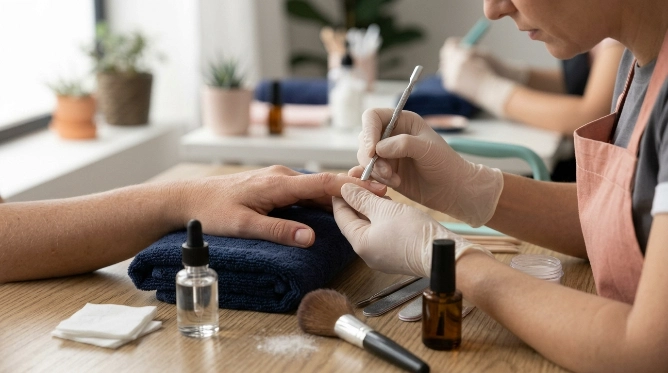
Not every manicure automatically needs both products. The right prep depends on the service, nail condition, and instructions for the products touching the natural nail.
Gel polish
Some gel polish systems call for dehydrator, primer, both, or neither beyond their own prep liquid. Don’t add an extra primer simply because another brand recommends one.
If gel repeatedly lifts, review the entire application before assuming stronger primer is the answer. The American Academy of Dermatology’s gel manicure guidance also emphasizes careful nail care rather than aggressive treatment.
Acrylic nails
Acrylic systems commonly have specific dehydration and priming protocols. Acid or acid-free primer may be chosen according to the product system and professional directions.
Artificial nails can also stress natural nails when preparation becomes too aggressive. Don’t over-file the nail plate in an attempt to create more grip.
Builder gel and hard gel
Builder systems vary considerably. Some use a separate primer, while others rely on a dedicated base or bonding gel.
That means “builder gel needs primer” isn’t a universal rule. Follow the complete system rather than combining bottles from different routines without compatibility guidance.
Dip powder and soft-gel tips
Dip and extension systems often have their own numbered liquids, prep solutions, or adhesives. Their terminology may not match a traditional gel or acrylic routine.
For artificial-nail wearers, the AAD’s artificial nail safety advice is a useful reminder to balance retention with protection of the natural nail.
Section Takeaway: Use both products when your compatible system calls for both. Don’t turn extra primer into an automatic step when the manufacturer doesn’t require it.
Can Dehydrator and Primer Replace Each Other?
No. Dehydrator and primer have different functions, so one shouldn’t be treated as a direct substitute for the other. A dry nail isn’t automatically a primed nail, and a primed nail wasn’t necessarily dehydrated correctly first.
Can you use dehydrator without primer?
Yes, when the nail system only requires dehydration or has another adhesion mechanism built into its base product. Many product lines are designed around their own specific preparation sequence.
The decision should come from the system instructions, not a blanket rule from another brand. If retention is already good, adding more chemistry may solve nothing.
Can you use primer without dehydrator?
A product system may occasionally specify its own preparation process, so always check the instructions. In a conventional two-product routine, however, dehydration normally comes before priming.
Putting primer over oil, dust, or residue doesn’t correct the contamination underneath. Surface cleanliness still matters.
Is base coat the same as primer?
No. Primer is a preparation or adhesion step, while base coat is normally part of the coating or enhancement system itself.
A base coat may require curing under a compatible lamp. Most traditional dehydrators and air-dry primers do not.
Why Can Nails Still Lift After Using Both?
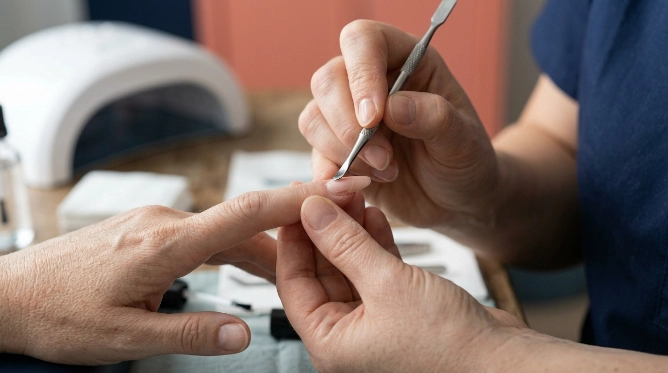
Using dehydrator and primer doesn’t guarantee perfect retention because lifting has many possible causes. Preparation, application, curing, compatibility, nail structure, and aftercare all matter.
Common prep problems
- Invisible cuticle remains: Product may be sitting on tissue instead of a clean nail plate.
- Dust remains: Fine filing dust can interfere with a clean application surface.
- You touched the nail: Skin oil can return after dehydration.
- Product flooded the skin: Gel or other enhancement touching skin can lift from the edges.
- Too much primer was used: Heavy application can create an unpredictable surface instead of improving it.
Application and curing problems
Lifting isn’t always a prep failure. A coat may be too thick, the lamp may be incompatible, curing time may be wrong, or the product combination may not be designed to work together.
Extensions introduce structural factors too. Poor apex placement, unsuitable length, or excessive leverage can create mechanical stress that no primer can fix.
My troubleshooting rule
When I troubleshoot early lifting, I change one variable at a time instead of adding every prep bottle I can find. That makes it much easier to identify whether the problem started with contamination, application, curing, or structure.
If a manicure normally lasts well without primer, I wouldn’t automatically add acid primer because one set lifted. First look for what changed in the routine.
How Do You Use Nail Prep Products Safely?
Keep dehydrators and primers controlled, ventilate the work area, avoid unnecessary skin contact, and follow the product label. Stop using a product if you develop significant irritation or another reaction.
Nail products can contain solvents, methacrylates, and other reactive chemicals. The OSHA nail salon chemical-hazard guidance recommends reading labels and safety data sheets while limiting skin, eye, and inhalation exposure.
- Use ventilation: Work where vapors don’t build up around your face.
- Avoid skin flooding: Apply primer only where its instructions direct.
- Keep bottles closed: This limits spills and unnecessary vapor release.
- Don’t mix formulas casually: Use compatible products whenever possible.
- Check warning labels: Professional-use products may need extra precautions.
- Watch for reactions: Redness, swelling, blistering, burning, or persistent itching deserves attention.
If product gets into your eyes or causes a significant chemical burn, follow the label’s first-aid instructions and seek appropriate medical help. Don’t cover a painful or badly irritated nail area with another enhancement.
Safety note: Persistent redness, swelling, blistering, pain, drainage, or a spreading rash should be evaluated by an appropriate healthcare professional rather than treated as a simple manicure problem.
The safest routine is not automatically the one with the most products. It is the one that uses the right compatible products, in the right order, with controlled exposure.
Section Takeaway: Dehydrator and primer can improve preparation, but safe use matters as much as retention. Follow product directions and keep reactive nail products off the surrounding skin.
Frequently Asked Questions
Is nail dehydrator the same as primer?
No. Nail dehydrator temporarily reduces surface oils and moisture, while primer helps create an adhesion-promoting surface for compatible gel, acrylic, or enhancement products.
Which goes first, nail dehydrator or primer?
Dehydrator normally goes first. Allow it to evaporate as directed, then apply the compatible primer before continuing with the rest of the nail system.
Do I need both primer and dehydrator for gel nails?
Not necessarily. Gel systems have different preparation requirements, so check your specific base, builder, or gel manufacturer’s instructions before adding either product.
Can I use nail dehydrator without primer?
Yes, if your nail system doesn’t require primer. Dehydrator can still help create a cleaner, temporarily drier surface, but it doesn’t perform the same adhesion function as primer.
Can I use primer instead of nail dehydrator?
Primer shouldn’t be treated as a direct replacement. In a routine that calls for both, the nail is normally dehydrated first so the primer is applied to a clean, prepared surface.
Is acid-free primer safer than acid primer?
Acid-free primer avoids the free methacrylic acid used in traditional acid primers, but that doesn’t make every formula harmless. Other ingredients may still irritate or sensitize skin, so avoid skin contact and follow the label.
Why are my nails lifting even after dehydrator and primer?
Check for remaining cuticle tissue, dust, finger contact after prep, product touching skin, incorrect curing, incompatible products, or structural issues. Primer can’t compensate for every cause of lifting.
Final Takeaway: Dehydrator Prepares, Primer Bonds
The easiest way to remember the difference between nail dehydrator and primer is this: dehydrator prepares the surface, while primer supports adhesion. They are partners in some systems, but they aren’t interchangeable.
Use dehydrator first when your routine calls for it, then apply the correct primer if required. Most importantly, follow the instructions for the actual gel, acrylic, builder, dip, or extension system you’re using.

