
Are Nail Files and Buffers the Same Thing? Complete Beginner Guide

If you have ever looked through a manicure kit and wondered, “Are nail files and buffers the same thing?”, you are definitely not alone. They can look surprisingly similar, especially when both come in rectangular foam-board styles.
But they do different jobs.
A nail file is mainly used to shorten, shape, and smooth the free edge of your nail. A nail buffer works mostly on the surface of the nail plate to smooth ridges, refine texture, or create shine.
Understanding the difference matters because using the wrong tool—or using either one too aggressively—can leave natural nails thin, rough, sensitive, or prone to peeling.
This guide explains exactly how nail files and buffers differ, when to use each one, how grit works, what materials to choose, and how to use both tools safely at home.
Quick Answer
No, nail files and buffers are not the same thing. A nail file is primarily designed to shape and smooth the edge of your nail, while a nail buffer is designed to smooth or polish the nail’s surface. Some multi-sided tools combine both functions, but they should still be used differently.
Nail File vs. Nail Buffer: What’s the Main Difference?
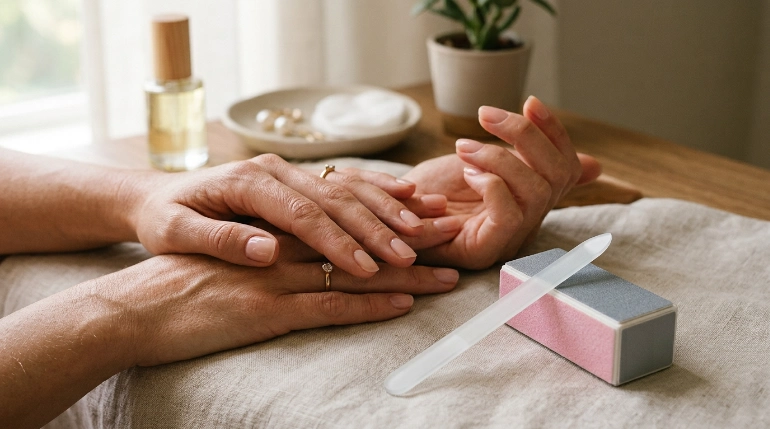
The easiest way to remember the difference is:
File = shape the edge. Buffer = smooth the surface.
A nail file removes small amounts of nail material from the free edge—the white portion extending past your fingertip. This helps you shorten nails, change their shape, and remove rough or snagging edges.
A nail buffer usually has a softer, cushioned surface and is used across the top of the nail plate. Depending on its grit, it can reduce visible ridges, smooth uneven texture, or give natural nails a polished shine.
The American Academy of Dermatology’s healthy nail recommendations specifically include keeping nails shaped and free from snags with an emery board, which supports the basic role of a nail file in routine nail maintenance.
Nail File and Buffer Comparison
| Feature | Nail File | Nail Buffer |
|---|---|---|
| Main purpose | Shape and shorten nails | Smooth and polish nail surface |
| Typical area of use | Free edge of nail | Top surface of nail plate |
| Texture | Usually firmer and more abrasive | Often softer or cushioned |
| Common forms | Emery board, glass, metal, ceramic | Foam block, padded board, multi-sided block |
| Removes nail material? | Yes | Yes, but usually from the surface |
| Used for shaping? | Yes | Not usually |
| Used for shine? | No | Some fine-grit buffers can |
| Overuse risk | Splitting or rough edges | Thinning the nail plate |
What Does a Nail File Actually Do?
A nail file gives you control over the length and shape of your nails.
After clipping nails, you may notice tiny sharp corners or rough areas. Filing smooths those spots and lets you refine the shape without removing another large section with clippers.
You can also use a file without clipping when you only need to remove a small amount of length.
Common nail shapes created with a file include:
- Round
- Oval
- Square
- Squoval
- Almond
- Coffin or ballerina
- Stiletto
The more dramatic the shape, the more carefully you need to file because excessive pressure can weaken the sidewalls of natural nails.
Common Types of Nail Files
Not every nail file feels or performs the same.
Emery boards are inexpensive and widely available. They are convenient for basic home manicures but eventually wear out.
Glass or crystal files have an etched abrasive surface rather than a paper coating. They can be washed and reused when the manufacturer’s instructions allow it.
Ceramic files are another reusable option and can provide controlled shaping.
Metal files are durable, but very aggressive versions may feel harsh on thin or fragile natural nails. Use light pressure if you choose one.
For many beginners with natural nails, a gentle-to-medium file is easier to control than a very coarse professional-style file.
What Does a Nail Buffer Do?
A buffer works differently because it is designed mainly for the top of the nail plate rather than the free edge.
A multi-sided buffer may include several stages, such as:
- A slightly abrasive side for refining texture.
- A finer side for smoothing.
- An even finer surface for polishing.
- A very smooth side for creating shine.
You do not necessarily need to use every side every time.
In fact, if your natural nails are thin or flexible, frequent aggressive buffing is usually unnecessary.
Why People Buff Their Nails
People commonly use buffers to:
- Reduce the appearance of minor surface ridges.
- Smooth small rough areas.
- Remove some surface shine before certain manicure systems.
- Create a natural-looking shine without polish.
- Refine the nail surface during manicure preparation.
The key word is lightly.
Buffing physically removes a tiny amount from the nail’s surface. Repeatedly buffing the same area can gradually make the nail thinner.
What Is Nail Grit?
Grit tells you how abrasive a nail file or buffer is.
This can initially feel backward:
Lower grit numbers are generally coarser. Higher grit numbers are generally finer.
A coarse tool removes material more quickly. A fine surface removes less and produces a smoother finish.
For example, a very coarse file intended for artificial enhancements may be unnecessarily aggressive on a thin natural nail.
Always check the manufacturer’s intended use before filing or buffing.
Why Grit Matters for Natural Nails
Imagine sanding a delicate wooden surface.
If you start with extremely rough sandpaper, you can remove much more material than you intended. Nail tools work on a similar principle.
Natural nails generally benefit from a gentler approach.
If your nails are:
- Thin
- Peeling
- Flexible
- Brittle
- Recently damaged by enhancements
- Sensitive after product removal
avoid reaching automatically for the roughest file or buffer in your kit.
Can a Nail Buffer Be Used as a Nail File?
Sometimes—but it depends on the tool.
A multi-sided nail buffer may include an abrasive edge that can lightly shape the nail. However, a soft polishing surface will be inefficient for shortening or reshaping nails.
If you need to remove noticeable length or refine your nail shape, a proper nail file gives you much better control.
Likewise, do not assume the rough side of every buffer is appropriate for natural nails. Some manicure tools are designed for acrylic, gel, or other artificial enhancements.
Check the label before using it.
Can You Use a Nail File as a Buffer?
You generally should not take an ordinary nail file and aggressively rub it across the surface of your natural nail.
A file designed for shaping may be much more abrasive than a surface buffer.
Using it over the nail plate could remove too much material, particularly if you apply pressure or repeatedly work over the same spot.
If you want to smooth the nail surface, use a tool specifically designed for buffing and choose an appropriate grit for natural nails.
How to Use a Nail File Safely
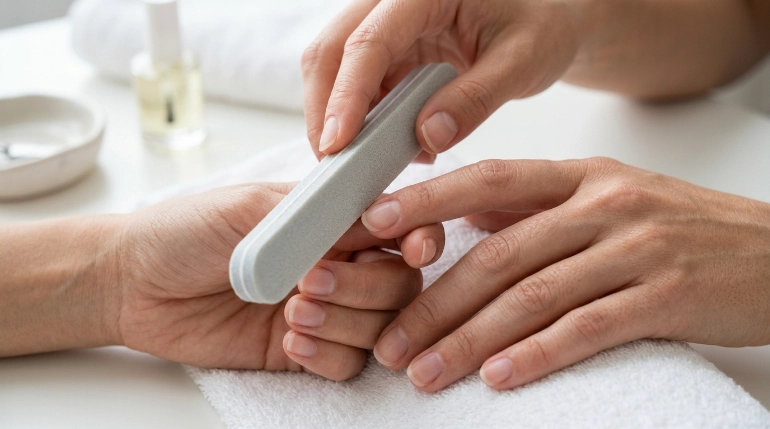
Filing looks simple, but technique matters.
Step 1: Start With Clean Nails
Remove anything that prevents you from seeing the true shape of the nail clearly.
Make sure your hands and tools are clean.
Step 2: Choose an Appropriate File
Use a file designed for your nail type.
Natural nails generally do not require the same aggressive abrasiveness used to reshape thick artificial enhancements.
Step 3: File With Light Pressure
You should not need to grind forcefully against the nail.
Use controlled movements and regularly stop to check the shape.
Step 4: Refine the Corners Carefully
Sharp corners can snag, while excessively filing into the sides may weaken your nail.
Aim for a smooth edge without digging deeply into the sidewalls.
Step 5: Stop Once the Edge Is Smooth
More filing is not automatically better.
Once you have achieved the shape and smoothness you want, stop.
How to Use a Nail Buffer Safely
Buffing requires even more restraint because you are working directly on the nail plate.
Step 1: Check Your Nails First
Do not buff simply because a nail looks unusual.
If you notice significant discoloration, pain, swelling, separation from the nail bed, or a sudden change in nail shape or texture, covering or buffing away the appearance may hide an issue that needs attention.
Step 2: Choose a Fine Buffer for Natural Nails
Confirm that the tool is intended for natural-nail surface buffing.
Avoid assuming that every manicure block has interchangeable sides.
Step 3: Use Very Light Pressure
Move gently over the surface rather than repeatedly grinding one area.
You are refining the nail—not trying to remove a visible layer.
Step 4: Focus Only Where Needed
If you have one slightly rough area, you do not necessarily need to buff the entire nail aggressively.
Step 5: Stop Before the Nail Feels Thin or Sensitive
Pain, heat, tenderness, or noticeable sensitivity are signs to stop.
Buffing should never hurt.
Expert Tip: If you find yourself buffing repeatedly because your nails constantly look rough or ridged, stop treating the appearance as the only problem. Gentle maintenance is fine, but persistent or changing nail texture may deserve professional evaluation.
How Often Should You Buff Natural Nails?
There is no benefit to treating buffing like a daily beauty step.
Your nail plate cannot instantly replace material that you remove. Fingernails grow gradually from the nail matrix near the base of the nail.
This means repeated aggressive buffing can leave part of the nail thin until it grows out.
For routine at-home grooming, use buffing only when you have a clear reason and keep it conservative.
If you simply want attractive natural nails, moisturizing and gentle shaping can often accomplish more than constant polishing.
Hygiene: Should You Share Nail Files or Buffers?
It is better to keep personal manicure tools personal whenever possible.
Files and buffers come into contact with nails and surrounding skin. Some porous disposable tools are also difficult to thoroughly clean.
At a salon, cleanliness should be taken seriously. The American Academy of Dermatology’s manicure and pedicure safety guidance advises consumers to pay attention to salon hygiene and also cautions against cutting or aggressively pushing back cuticles because the cuticle helps protect against infection.
At home:
- Do not casually share porous files or buffers.
- Follow the manufacturer’s cleaning directions for reusable tools.
- Replace disposable tools when worn or contaminated.
- Keep tools dry between uses.
- Do not use the same tool on obviously infected and healthy nails.
- Clean reusable manicure equipment appropriately before storing it.
If you go to a salon, you can also ask how reusable tools are cleaned and disinfected.
Nail File or Buffer: Which One Should You Buy?
For most home manicure kits, having both makes sense because they solve different problems.
Choose a nail file when your main goal is:
- Shortening nails.
- Changing nail shape.
- Smoothing rough edges.
- Removing snags.
Choose a nail buffer when your main goal is:
- Gently smoothing surface texture.
- Softening the appearance of minor ridges.
- Creating natural shine.
- Preparing a nail surface when the manicure system specifically calls for it.
What About a Multi-Sided Buffer Block?
A multi-sided block can be convenient because one tool may provide several levels of abrasiveness.
However, convenience does not mean every side should be used during every manicure.
Read the labels carefully. If the sides are numbered or marked “file,” “smooth,” “buff,” and “shine,” follow that sequence only when appropriate for your nails and the manufacturer’s directions.
Cost and Material Considerations
You do not need an expensive professional manicure kit to maintain natural nails safely.
Disposable emery boards are usually among the simplest options for occasional shaping. Reusable glass or ceramic files generally cost more upfront but may last longer when properly cared for.
Buffers also range from basic disposable foam blocks to more durable multi-surface tools.
Instead of choosing by price alone, consider:
- Whether it is made for natural or artificial nails.
- Grit or abrasiveness.
- Whether the tool can be properly cleaned.
- How frequently you plan to use it.
- Whether your nails are naturally thin or sensitive.
- Whether replacement surfaces are available.
A more aggressive tool is not necessarily a better tool. For natural nail care, control and gentleness matter more than removing material quickly.
Common Mistakes to Avoid
Even simple nail tools can cause problems when used incorrectly.
Avoid these common mistakes:
- Using an artificial-nail file aggressively on natural nails. Coarse abrasives can remove material quickly.
- Buffing until every ridge disappears. Some natural texture is normal; chasing a perfectly flat surface can thin the nail.
- Applying heavy pressure. Filing and buffing should be controlled, not forceful.
- Buffing already thin or peeling nails. This may remove even more of the weakened nail plate.
- Using worn or dirty tools indefinitely. Replace disposable tools when appropriate.
- Sharing porous files and buffers. Personal tools are easier to keep hygienic.
- Ignoring pain or discoloration. A cosmetic tool cannot diagnose or treat a nail disorder.
- Trying to file away a suspected infection. Changing the surface appearance does not address the underlying cause.
- Using a buffer as a daily shine treatment. Frequent material removal can eventually weaken nails.
What If Your Nails Are Thin, Brittle, or Sensitive?
If your nails already peel, split, bend easily, or feel unusually sensitive, take a conservative approach.
Rather than aggressively smoothing every imperfection, focus on protecting the existing nail plate.
Keep nails at a manageable length, smooth obvious snags gently, moisturize your nails and surrounding skin, and reduce unnecessary trauma.
The AAD recommends keeping nails clean and dry, trimming them carefully, filing snags, and avoiding nail biting or cuticle removal as part of healthy nail care.
Also consider whether your manicure routine itself may be contributing to damage.
Repeated enhancement removal, picking off gel polish, aggressive scraping, or excessive surface preparation can leave nails temporarily weak.
When to See a Nail Technician or Dermatologist
A nail technician can help when your main issue is cosmetic—such as choosing an appropriate shape, learning how to prepare nails for a manicure, or understanding which file is suitable for a particular enhancement system.
A dermatologist is the better choice when the problem appears to involve nail health rather than nail styling.
Consider seeking medical advice if you notice:
- Persistent pain or tenderness.
- Swelling around the nail.
- Pus or drainage.
- A nail separating significantly from the nail bed.
- Unexplained dark discoloration.
- Major changes in nail shape.
- Persistent thickening.
- A nail problem that continues to worsen.
- Changes affecting several nails without an obvious cosmetic cause.
The NHS overview of nail problems notes that changes in nail color, shape, texture, or surrounding skin can have many causes and should not simply be ignored when they persist or are concerning.
The AAD also advises having certain unexplained changes in nail color, shape, or texture examined by a board-certified dermatologist.
Do not try to buff away a suspicious nail change just to make it less visible.
What About Nail Products Used Alongside Files and Buffers?
Files and buffers themselves are mostly mechanical tools, but your manicure may also involve polish, removers, adhesives, gels, acrylic systems, or other cosmetic products.
Follow product instructions carefully, especially when using professional-style manicure systems at home.
The FDA’s nail-care product guidance explains that nail products may contain ingredients that require careful use and emphasizes using cosmetic nail products according to their directions.
If a product causes burning, significant redness, swelling, blistering, or another unexpected reaction, stop using it rather than trying to file or buff through the irritation.
DIY Nail Care vs. Salon Care
For ordinary shaping and gentle maintenance, DIY nail care is usually manageable for many people.
A salon may make more sense when:
- You want a complicated nail shape.
- You wear acrylic, hard gel, or another enhancement.
- You are unsure which grit is appropriate.
- You repeatedly damage your nails while filing.
- You need professional product removal.
- You want guidance on maintaining an enhancement safely.
However, a nail salon is not a substitute for medical diagnosis.
If the nail or surrounding skin appears infected, injured, painful, or unusually discolored, a dermatologist or other qualified healthcare professional is the appropriate next step.
FAQs
Are nail files and buffers the same thing?
No. A nail file primarily shapes and smooths the free edge of the nail. A buffer is mainly used on the nail surface to smooth texture or create shine. Some combination tools include both functions, which is why they can look similar.
Do I need both a nail file and a buffer?
Not necessarily, but having both can be useful. A file is more important for routine shaping and snag removal. A buffer is optional and is mainly useful when you specifically want to refine surface texture or shine.
Can I buff my nails instead of filing them?
Not if your goal is to shorten or reshape the nail. A soft buffer is not designed to efficiently remove length from the free edge. Use an appropriate nail file for shaping.
Does buffing make nails weaker?
It can if you overdo it. Buffing removes a small amount from the nail surface. Excessive pressure, coarse grit, or frequent repeated buffing can thin the nail plate and make it more vulnerable to bending, peeling, or sensitivity.
Can I use a nail file on top of my nail?
A standard shaping file may be too abrasive for the nail surface. Unless the tool is specifically intended for surface preparation or buffing, use a proper nail buffer instead.
Should I buff nail ridges completely smooth?
Usually, no. Trying to eliminate every ridge may require removing too much of the nail plate. Gentle cosmetic smoothing may be appropriate for minor texture, but new, deep, persistent, or changing ridges should not simply be aggressively buffed away.
Final Thoughts
So, are nail files and buffers the same thing? No—although they may look similar, they have different jobs.
A nail file is your shaping tool. It helps shorten nails, refine their shape, and remove rough edges. A nail buffer works mainly on the nail surface to smooth minor texture or add shine.
For healthy natural nails, the most important rule is to stay gentle. Choose tools designed for your nail type, use light pressure, keep your tools hygienic, and avoid unnecessary aggressive buffing.
And remember: not every nail imperfection needs to be filed or polished away. If you notice persistent pain, swelling, discoloration, separation, or another unusual nail change, skip the DIY fix and get appropriate professional advice.
Use the right tool for the right job, and your at-home manicure routine will be simpler, safer, and much easier on your nails.

