
Professional Nail Colors That Look Polished, Modern, and Office-Ready

A manicure can say a lot before you speak. In a work setting, the best shades sharpen the overall impression without stealing attention. They make hands look neat, intentional, and quietly confident. That’s the real sweet spot for professional nail colors: polished enough for the office, refined enough for interviews, and stylish enough to feel like you.
The good news is that “professional” does not have to mean plain. A beautiful nude, a soft blush, or even a muted red can read as elegant rather than conservative when the tone, finish, and nail length are working together. The key is balance: enough color to look finished, not so much contrast that the manicure becomes the first thing people notice.

What Makes a Nail Color Look Professional?
Professional nail color usually has three things in common: restraint, clarity, and harmony.
Restraint means the shade feels controlled rather than loud. That’s why soft pinks, beige nudes, taupes, mauves, and classic reds often work so well in office settings. They have presence, but they don’t compete with your outfit or your expression. For example, a sheer blush on short nails can look polished in a client meeting, while a neon coral on long nails is more likely to pull focus in a way that feels less work-appropriate.
Clarity is about finish. A color can be neutral and still look messy if the finish is chalky, streaky, or overly flat. A glossy or softly sheer manicure tends to read cleaner and more intentional. Even a matte finish can work, but it usually looks more modern and less universally conservative than gloss. A smooth, even application matters just as much as the shade itself.
Harmony is the part many people overlook. A shade that looks elegant on one person may look washed out on another if it clashes with undertones. That’s why a “best nude” is never just one color. It’s a family of tones that should sit comfortably against your skin rather than fight it. Shades that are too close to your skin tone can sometimes disappear, while shades with a little contrast usually look more defined and polished.
For a broader color reference, you can also browse Nailprime’s best nail colors guide after this article if you want to compare more everyday shades beyond workwear.
The Best Professional Nail Colors at a Glance
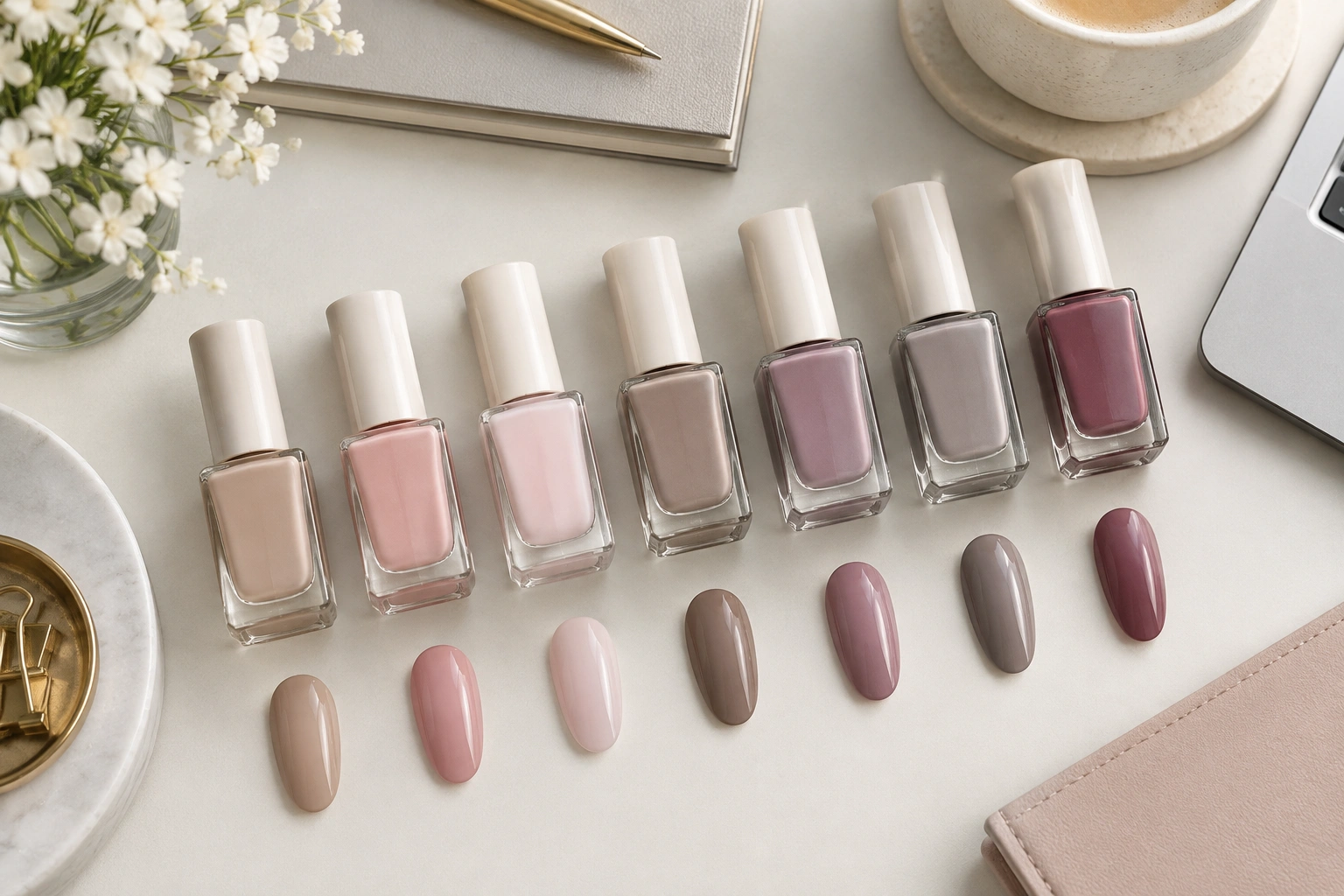
Before we get into the details, here’s the quick map. If you want the safest choice for conservative settings, lean nude beige or sheer milky pink. If you want something slightly more modern, taupe and greige are excellent. If you want polish with personality, muted berry or classic red can still feel completely appropriate, especially on short, neat nails.
Here’s the short version:
| Shade family | Best for | Undertone direction | Overall effect |
|---|---|---|---|
| Nude beige | Interviews, conservative offices | Warm or neutral | Clean, safe, refined |
| Soft pink | Everyday office wear, client meetings | Cool or neutral | Fresh, feminine, polished |
| Sheer milky pink | Minimal, natural-looking manicure | Neutral | Barely-there, intentional |
| Taupe | Modern office style | Neutral to cool | Sophisticated, understated |
| Mauve | Those who want a little depth | Cool or neutral | Soft color with personality |
| Classic red | Formal settings, confident dress codes | Warm or neutral | Strong, elegant, timeless |
| Muted berry | Slightly trend-forward workplaces | Cool or neutral | Rich without being flashy |
| Cool gray or greige | Minimalist wardrobes | Cool or neutral | Sleek, modern, crisp |
| Warm caramel or toffee nude | Medium to deep skin tones | Warm | Elegant, flattering, grounded |
OPI’s color-theory guidance is useful here: the brand notes that soft sheer pinks and nudes are reliable work-friendly choices, and that a bold red can look flattering across many skin tones. That’s brand guidance rather than a universal rule, but it does help explain why red remains a professional option when the shade is balanced and the manicure is neat. You can see that approach in OPI’s nail color theory guide.
Nude vs Pink vs Red: Which Works Best for Professional Settings?
If you’re deciding between the three most common office-friendly families, here’s the simplest way to think about it:
- Nude is the most discreet. It’s best when you want your nails to blend in and look clean, especially for interviews or conservative offices.
- Pink is the most versatile. It adds freshness without looking bold, so it works well for everyday office wear and most client-facing roles.
- Red is the most assertive. It can still be professional, but it reads stronger, so it’s better for formal events, polished workplaces, or situations where a more confident look fits the setting.
A nude manicure says “refined and safe.” A soft pink says “polished and approachable.” A classic red says “confident and intentional.” None of them are wrong; the best choice depends on how much attention you want the nails to attract.
1. Nude Beige
If the brief is “look polished without making a point,” nude beige is the quiet hero.
This is the shade I’d choose for a conservative office, a job interview, or any setting where you want your nails to disappear into the overall look in the best possible way. Beige nudes tend to feel crisp and clean, especially when the polish is even and the nail shape is tidy. On short nails, the effect is especially refined.
The trade-off is that beige can be too close to your skin tone if you choose the wrong depth. Too light, and it can look chalky. Too close, and it may blur into the skin and lose definition. The best version is one step richer than your complexion or one step lighter, depending on undertone.
2. Soft Pink
Soft pink is the manicure equivalent of good lighting.
It flatters without trying too hard, which is why it works so well for interviews, client meetings, and everyday office wear. The color brings a little freshness to the hands, but it still reads as composed. Corporette’s work-nail recommendations include classic soft options like Essie Ballet Slippers and Mademoiselle for interviews, which shows how consistently this family of shades earns its place in professional settings.
Soft pink is especially useful if you want a manicure that feels feminine and clean rather than stark. Compared with beige nude, it has more life in it. Compared with red, it feels gentler and less declarative. If your workplace leans traditional, soft pink is often the safest way to add a hint of color.
3. Sheer Milky Pink
For readers who love a barely-there manicure, sheer milky pink is the cleanest option in the room.
This shade works because it looks intentional, not empty. The translucence softens the nail bed and gives a polished finish without full opacity. That makes it ideal for conservative offices, formal daytime events, and anyone who wants nails that look “done” without looking painted.
The main trade-off is coverage. Sheer polish can be beautiful, but if it’s too thin, it may look unfinished. A good milky pink needs enough pigment to blur the nail line and enough body to feel deliberate. Think of it as the difference between a whisper and a missed opportunity.
4. Taupe
Taupe is where professional starts to feel modern.
It has the restraint of a neutral, but the gray-brown balance gives it more design sense than a basic beige. That’s why taupe often looks especially elegant with tailored clothing, monochrome outfits, and minimalist jewelry. It says you know what you’re doing without needing sparkle or contrast.
Taupe is a smart choice if nude shades tend to look too warm or too pink on you. It also works beautifully when you want a neutral that feels current rather than traditional. Compared with beige, taupe has a cooler, more editorial edge.
5. Mauve
Mauve is the soft-spoken color with a little more depth.
It’s one of the best choices for someone who wants color in a professional setting but doesn’t want to cross into obvious territory. The muted purple-pink undertone adds dimension, especially on medium to deeper skin tones, while still feeling restrained enough for office wear. Makeup.com lists mauves among versatile shades that work for formal, professional, and everyday occasions, which matches how mauve behaves in real life: quietly adaptable.
If nude feels too safe and berry feels too bold, mauve sits in the middle. It’s especially nice in fall and winter, when slightly richer shades tend to feel more natural against heavier fabrics and deeper wardrobe colors.
6. Classic Red
Yes, red can be professional.
The key is choosing a classic red rather than a neon, orange-red, or overly glossy statement shade. A balanced red on short, neatly shaped nails can look incredibly polished, especially in formal offices or client-facing roles where confidence reads as part of the job. It can also work well for evening events where a more elevated look makes sense.
The trade-off is context. In a very conservative environment, red may feel stronger than nude or pink. In a creative or polished business setting, it can look perfectly appropriate. If you want to wear red to work, keep the nail length tidy and the finish smooth. That combination turns red from dramatic into elegant.
7. Muted Berry
Muted berry is the subtle statement shade.
It gives you more depth than red, but it doesn’t read as flashy the way bright pinks or high-saturation tones can. Berry shades are especially flattering in cooler months, though they can work year-round if the tone stays subdued. Think wine-tinged rose, softened plum-red, or a dusty berry rather than a jewel-tone punch.
This is a strong pick for someone who wants her manicure to feel a little more personal. Compared with red, berry is softer. Compared with mauve, it has more richness. It’s the shade you reach for when you want people to notice your nails only after they’ve noticed the rest of your look.
8. Cool Gray or Greige
Gray and greige are the sleek neutrals of the modern office.
They feel clean, architectural, and slightly unexpected without becoming distracting. If your style leans minimalist, these shades can look more intentional than a standard nude. Greige, in particular, gives you a soft blend of gray and beige that works beautifully with silver jewelry, charcoal tailoring, and cooler wardrobe palettes.
This family is especially useful if you want something professional that doesn’t feel overly feminine or traditional. The trade-off is that gray can look flat if it’s too pale or too chalky. A little depth helps. Think polished stone rather than cement.
9. Warm Caramel or Toffee Nude
Warm caramel and toffee nudes are the unsung heroes for medium to deep skin tones.
These shades often look richer and more elegant than a pale beige that might wash the skin out. A deeper nude creates contrast while still feeling understated, which is exactly what makes it so effective in professional settings. It looks intentional, not muted.
This is where undertone matters most. Warm, golden, or olive-leaning skin often benefits from a nude with warmth in it. The manicure feels cohesive instead of ashy. If your usual nude disappears too much, moving one or two shades deeper can make the whole hand look more refined.
How to Choose the Right Professional Shade for Your Skin Tone
The simplest rule is this: match the temperature of the polish to the temperature of your skin, then adjust depth.
If your skin has warm undertones, look at beige nude, caramel nude, toffee, warm taupe, and soft red-brown berry. These shades tend to blend smoothly and look rich rather than chalky. On fair warm skin, a peach-beige or pale caramel nude can look softer than a stark beige. On medium warm skin, a honey nude or warm taupe usually feels balanced. On deep warm skin, toffee, chestnut nude, or warm berry often looks especially polished.
If your skin has cool undertones, soft pink, milky pink, mauve, cool taupe, greige, and blue-based red create the cleanest effect. They usually look crisp and balanced. On fair cool skin, a blush pink or sheer rose can look fresh without turning orange. On medium cool skin, mauve or rosy taupe tends to look elegant. On deep cool skin, berry, wine, or a cool red can look rich and refined.
If you have neutral undertones, you have the most flexibility. You can wear either warm or cool versions, so the decision becomes more about the mood you want: softer, richer, cleaner, or more modern. Fair neutral skin often looks good in sheer pinks and light beige nudes. Medium neutral skin can handle taupe, soft pink, and muted berry. Olive skin often looks especially good in beige with a slight green-gray cast, greige, dusty rose, or warm taupe. Deep neutral skin can wear caramel nude, cocoa nude, berry, or classic red very naturally.
One useful test: if a shade makes your hands look tired, gray, or overly red, it’s probably the wrong temperature. If it makes the skin look smoother and the nails look neater, you’re close.
Professional Nail Colors by Workplace Dress Code
A conservative office usually calls for the least contrast. That means nude beige, sheer milky pink, soft pink, or a very restrained taupe. These shades blend in gracefully and tend to feel safe in traditional environments. Bright coral, neon pink, and high-shine metallics usually feel too loud here, even if they are not strictly forbidden.
A standard office gives you a little more room. Mauve, greige, muted berry, and classic red all fit here, especially if your manicure is neat and your nail length is moderate. Brighter colors can sometimes work, but the line usually appears when the shade is saturated enough to become the focal point of your look. A vivid orange-red or hot pink may feel a bit much even in a flexible office, while a softened version of the same color can still pass.
A slightly trend-forward workplace can handle deeper neutrals and more personality. Think cool gray, richer taupe, berry, and even a more saturated red. The shade can be stylish as long as it still feels controlled. In these settings, a bright color is not automatically unprofessional, but it usually works best when the rest of the manicure is disciplined: shorter length, smooth finish, and no extra embellishment.
If you like reading beyond color choice and into prep, Nailprime’s professional nail files and buffers guide can help you understand why a smooth shape changes the whole impression of a manicure.
How Finish Changes the Look: Sheer, Glossy, or Matte
Finish matters almost as much as color.
Sheer finishes feel softer and more natural. They’re ideal for interviews, formal daytime events, and conservative offices because they don’t create a hard block of color. Glossy finishes, on the other hand, usually look the most polished and classic. They sharpen almost every shade, from nude beige to red.
Matte can be beautiful, but it changes the mood. A matte taupe or berry can feel fashion-forward and editorial, yet it may read less traditional than a glossy version. If your workplace is strict, gloss is usually the safer bet. If your office leans creative, matte can add sophistication.
Best Professional Nail Colors for Short Nails vs. Longer Nails
Short nails make almost every professional shade easier to wear.
That’s because the smaller surface area keeps color from feeling overpowering. A classic red on short nails can look chic rather than bold. A muted berry or greige can feel modern instead of dramatic. If your job is hands-on or your style is practical, short nails also help softer shades stay neat-looking longer between manicures.
Longer nails can carry more visual weight, which means the same color may look stronger. A sheer pink or taupe often feels safest on longer lengths. If you want to wear red or berry on longer nails, a more restrained tone and a clean shape keep the result polished.
Quick Picks for Interviews, Office Wear, and Formal Events
For interviews, I’d reach for soft pink, sheer milky pink, or nude beige. These shades communicate polish without pulling focus. If you want the safest option, choose the least contrast and the cleanest finish.
For everyday office wear, taupe, mauve, and greige are the sweet spot if you want something slightly more interesting than a basic nude. They feel modern but still restrained. If your office is more conservative, stay on the softer end; if it’s trend-forward, a deeper mauve or berry can work.
For formal events, classic red and muted berry are the best ways to add elegance without going flashy. If the event is very conservative, stay with nude beige or sheer pink. If it’s a professional dinner, presentation, or evening function, a deeper red or berry can feel beautifully composed. In other words: interviews reward subtlety, office wear rewards balance, and formal events can handle a little more drama.
When to See a Nail Technician
If you’re unsure whether a shade is reading too warm, too cool, too pale, or too strong on your skin, a nail technician can help you narrow it down quickly. A good technician will consider your undertone, the occasion, and your personal style rather than treating every nude as interchangeable. That’s especially useful if you’re choosing for a specific workplace dress code or a high-stakes event like an interview.
Final Thoughts
Professional nails are not about hiding your style. They’re about editing it. The best shades make your hands look neat, your outfit look finished, and your overall presence feel considered. Whether you prefer a whisper-soft milky pink, a polished taupe, or a confident classic red, the right manicure should feel like a small detail that quietly does a lot of work.

