
Can You Use Rubbing Alcohol Instead of Nail Prep? What Actually Works

If you are doing gel nails, press-ons, acrylics, or even a regular manicure at home, you have probably heard that the nail surface needs to be clean and oil-free before you apply anything.
But what happens when you do not have a bottle of nail dehydrator or nail prep solution nearby? Can you use rubbing alcohol instead of nail prep?
In some situations, yes. Rubbing alcohol can remove surface oils, dust, and residue from the natural nail, making it useful as a basic cleansing step. However, it does not always replace a dedicated nail dehydrator, bonder, or primer, especially when you are using a professional gel or acrylic system.
Knowing the difference can help you avoid premature lifting, irritation, and unnecessary damage to your natural nails.
Quick Answer
Yes, you can use rubbing alcohol instead of nail prep for basic cleaning and degreasing before some manicures, press-ons, and polish applications. However, rubbing alcohol is not a true replacement for every nail dehydrator or primer. For gel, acrylic, or extension systems, follow the product manufacturer’s recommended prep routine for the best adhesion and safety.
What Does Nail Prep Actually Do?

“Nail prep” can mean several different things, which is why this question can become confusing.
For some people, nail prep simply means cleaning and preparing the natural nail before polish. For nail technicians and enhancement systems, however, prep may involve several separate products and steps.
A typical nail-prep routine can include:
- Shaping the free edge with a nail file
- Gently removing surface shine when appropriate
- Removing filing dust
- Cleaning oil and residue from the nail plate
- Applying a nail dehydrator
- Applying an acid-free or acid primer when required
- Keeping products away from the surrounding skin and cuticle
The goal is to create a clean surface that the nail product can bond to without unnecessarily thinning or damaging the natural nail.
The American Academy of Dermatology’s healthy nail tips also emphasize keeping nails clean and dry and using gentle nail-care practices rather than aggressively manipulating the nail.
So, Can You Use Rubbing Alcohol Instead of Nail Prep?
Yes, but only for certain parts of nail prep.
Rubbing alcohol, usually made with isopropyl alcohol, can help remove:
- Natural surface oils
- Light moisture
- Dust from filing
- Lotion residue
- Small amounts of surface contamination
That makes it useful as a final cleansing wipe before applying regular polish, some press-ons, or certain gel systems.
What rubbing alcohol cannot reliably do is replace every specialized bonding product.
A nail dehydrator is designed specifically to temporarily remove moisture and oils from the nail surface. A primer or bonder works differently by helping the enhancement system adhere to the nail.
If your gel, acrylic, builder gel, Gel-X, or dip system specifically requires a dehydrator or primer, do not automatically replace that product with rubbing alcohol.
The FDA recommends following the labeled directions and warnings supplied with nail products because different nail systems contain different ingredients and have different application requirements. You can find more information in the FDA’s guide to nail care product safety.
Rubbing Alcohol vs. Nail Dehydrator vs. Primer
These products may appear similar during a manicure, but they are not interchangeable in every situation.
| Product | Main Purpose | Typical Use | Approximate Cost | Main Limitation |
|---|---|---|---|---|
| Rubbing alcohol | Removes surface oil, dust, and residue | Basic cleaning before polish, press-ons, or some gel systems | About $2–$6 | May not provide enough prep for enhancement systems |
| Nail dehydrator | Temporarily removes moisture and oils | Gel, acrylic, extensions, builder products | About $6–$15 | Can cause dryness if overused |
| Acid-free primer | Helps product bond to the nail | Gel, acrylic, builder gel, extensions | About $8–$20 | Must be compatible with the nail system |
| Acid primer | Stronger adhesion preparation | Mainly specialized acrylic applications | About $10–$25+ | More irritating and generally better suited to trained use |
Prices vary widely by brand, bottle size, retailer, and professional versus consumer formulas.
The important point is that alcohol mainly cleans, dehydrator mainly removes surface moisture and oils, and primer mainly promotes adhesion.
Some products combine functions, so always check the label instead of assuming two bottles perform the same job.
When Rubbing Alcohol Is Usually Enough
Rubbing alcohol can be a practical option when you simply need a clean, oil-free nail surface.
Before Regular Nail Polish
For traditional polish, a light alcohol wipe can remove lotion, cuticle oil, and natural oils before your base coat.
You usually do not need a strong professional primer for ordinary nail polish.
Before Press-On Nails
Press-ons often adhere better when the natural nail is clean, dry, and free from moisturizer.
After shaping and lightly preparing the nails, wiping each nail with rubbing alcohol can help remove oil before applying nail glue or adhesive tabs.
However, rubbing alcohol will not correct other causes of poor adhesion, such as:
- Incorrect press-on sizing
- Too little or too much glue
- Moisture trapped underneath
- Cuticle tissue remaining on the nail plate
- Frequently wet hands immediately after application
After Filing or Light Buffing
Filing produces fine dust that can interfere with adhesion.
After shaping the nails, use a clean dust brush first. Then wipe the nail plate with a lint-free pad lightly moistened with rubbing alcohol.
This is especially helpful because simply brushing away visible dust may leave behind oils or tiny particles.
Where Nail Files Fit Into Proper Nail Prep
Nail filing is another area where more is not necessarily better.
The purpose of filing a natural nail is usually to shape the free edge and smooth rough areas. Some enhancement systems also call for gently removing surface shine.
That does not mean you should aggressively sand the nail.
The American Academy of Dermatology’s nail-trimming guidance recommends smoothing rough edges with a nail file or emery board and using careful nail-grooming techniques.
For natural nails, a fine or medium-fine file is usually easier to control than a very coarse file.
Over-filing can leave your nails:
- Thin
- Tender
- Flexible
- Sensitive to pressure
- More likely to peel or split
Rubbing alcohol cannot fix damage caused by over-filing. Prep should improve adhesion without sacrificing healthy natural nail layers.
How to Use Rubbing Alcohol During Nail Prep
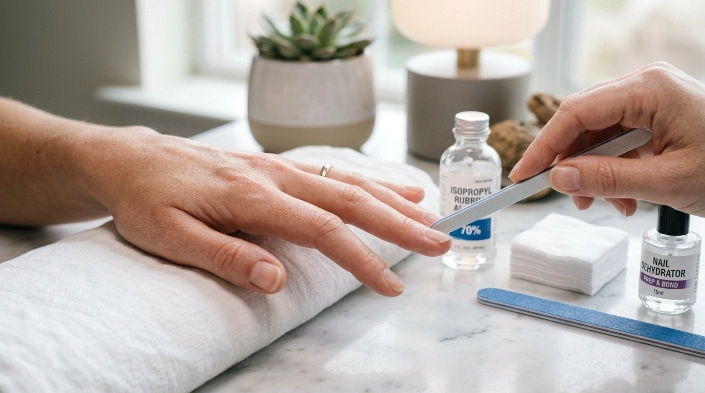
If rubbing alcohol is appropriate for the manicure system you are using, keep the process simple.
1. Wash and Dry Your Hands
Start with clean hands.
Then dry your hands and nails thoroughly. Avoid soaking the nails immediately before applying enhancements because nails temporarily absorb water.
2. Shape the Nail
Use a clean nail file to shape the free edge.
If the product instructions call for removing shine, use a fine buffer with very light pressure. Do not repeatedly grind the same area.
3. Remove Filing Dust
Use a clean nail brush or lint-free wipe to remove visible dust.
Pay attention to the sidewalls and area near the cuticle.
4. Wipe the Nail Plate With Alcohol
Put a small amount of rubbing alcohol onto a lint-free nail wipe.
Wipe from the cuticle area toward the free edge without flooding the surrounding skin.
Use a clean section of the wipe as you move between nails instead of spreading oil and dust from one nail to another.
5. Allow the Nail to Air-Dry
The alcohol should evaporate quickly.
Do not touch the nail surface afterward. Touching it with your fingertips can immediately transfer natural skin oils back to the nail.
6. Continue With Your Nail System
Apply the base coat, adhesive, dehydrator, primer, or enhancement product required by the system you are using.
If the manufacturer specifically requires both dehydrator and primer, use them rather than assuming the alcohol wipe replaces both.
Expert Tip: After cleaning your nails, hold them by the sides of the fingertips instead of touching the nail plates. A single fingerprint can transfer enough oil to interfere with an otherwise careful prep routine.
What Strength of Rubbing Alcohol Should You Use?
You will commonly see rubbing alcohol sold in different concentrations.
For nail prep, you do not need to soak the nail or surrounding skin. The goal is simply to use enough product to wipe away surface residue and allow it to evaporate.
Higher-percentage isopropyl alcohol contains less water, but that does not automatically mean stronger is always better for every person.
Frequent exposure can dry the skin around the nails. According to Poison Control’s guidance on rubbing alcohol, small external amounts are generally tolerated, but irritation and dryness can occur. Rubbing alcohol should also never be swallowed.
If the skin around your nails is already cracked, irritated, or peeling, minimize contact.
Safety Considerations When Using Rubbing Alcohol
Rubbing alcohol is common, but it is still a chemical product that should be handled carefully.
Keep It Off Broken Skin
If you have a bleeding hangnail, cut, cracked cuticle, or irritated skin, alcohol may sting and worsen dryness.
Avoid flooding the sidewalls and cuticle.
Remember That It Is Flammable
Keep rubbing alcohol away from:
- Candles
- Cigarettes
- Gas flames
- High heat
- Sparks and ignition sources
Keep the bottle closed when you are finished using it.
Avoid Excessive Exposure
More alcohol does not produce a better manicure.
You only need enough to clean the nail plate. There is no reason to soak your fingertips in rubbing alcohol for routine nail prep.
Moisturize After the Manicure
Once the manicure is finished and the product has cured or dried as required, apply cuticle oil or hand cream around the nails.
This helps replace some of the moisture removed during prep.
Why Your Nails May Still Lift After Using Alcohol
If you cleaned your nails with rubbing alcohol and your manicure still lifts quickly, alcohol may not be the real problem.
Common causes include:
Cuticle Tissue on the Nail Plate
Thin, nearly invisible tissue can remain attached to the nail near the cuticle.
Enhancement material applied over that tissue may lift as the skin naturally moves and sheds.
Touching the Nail After Prep
Running a finger over the nail to see whether it feels smooth transfers skin oils directly back onto the surface.
Using Incompatible Products
Mixing a base coat, primer, adhesive, gel, and lamp from unrelated systems can sometimes lead to inconsistent results.
Whenever possible, follow the instructions for the specific products you are using.
Over-Buffing
It is easy to assume that rougher nails equal stronger adhesion.
In reality, aggressive buffing can thin and damage the natural nail.
Incorrect Application
Thick gel layers, product touching the skin, incorrect curing, or poor press-on sizing can all cause lifting even when prep is perfect.
Rubbing Alcohol vs. Salon Nail Prep
For a basic home manicure, rubbing alcohol may be all you need to remove oil before regular polish or press-ons.
Professional enhancement services are different.
A trained nail technician can evaluate:
- Your natural nail condition
- Whether your nail plate is unusually oily
- Which enhancement system is being used
- Whether dehydrator or primer is necessary
- Which file grit is appropriate
- Whether previous damage changes the prep process
If you repeatedly experience lifting, burning, painful filing, or product-related irritation, continuing to add stronger prep chemicals is not necessarily the solution.
Sometimes the safest choice is to have a professional identify what is going wrong.
Common Mistakes to Avoid
When substituting rubbing alcohol for part of your nail-prep routine, avoid these common mistakes:
- Assuming alcohol and primer are identical. They perform different jobs.
- Soaking the nails in alcohol. A quick wipe is normally enough.
- Using alcohol on injured skin. Cuts and cracked skin may become painful or irritated.
- Touching the nail after cleaning it. This puts oils back on the nail plate.
- Over-filing before cleaning. Aggressive filing can thin natural nails.
- Skipping product instructions. Gel and acrylic systems may require specific prep products.
- Applying cuticle oil immediately before adhesion products. Oil can interfere with bonding.
- Using dirty files or brushes. Prep is less effective when tools are contaminated.
- Using stronger chemicals because a manicure lifted once. First check your technique and product compatibility.
When to See a Nail Technician or Dermatologist
Most minor nail-prep problems are cosmetic. But pain, swelling, discoloration, or persistent nail changes deserve more attention.
Consider seeing an experienced nail technician if:
- Your gel or extensions repeatedly lift despite careful prep
- You are unsure which primer works with your system
- You continually over-file your natural nails
- You need help removing an enhancement without damaging the nail
A dermatologist is more appropriate if you notice:
- Persistent redness or swelling
- Pus or drainage
- Increasing pain
- A nail separating from the nail bed
- Significant changes in nail color
- Persistent thickening or crumbling
- A new or changing dark streak
- Repeated itching or blistering after nail products
Do not cover a painful or possibly infected nail with another enhancement just to hide it. Nail changes can have many causes, and cosmetic products cannot diagnose or treat an infection or skin condition.
FAQs
Can I use 70% rubbing alcohol instead of nail dehydrator?
You can use 70% rubbing alcohol to clean oil, dust, and residue from the nail surface. However, it is not automatically equivalent to a dedicated nail dehydrator. If your gel, acrylic, or extension system specifically calls for dehydrator, follow those instructions.
Can I use rubbing alcohol before gel nails?
Yes, rubbing alcohol can be useful as a cleansing step before gel application. But some gel systems also require a dehydrator, bonder, or primer. Check the manufacturer’s directions before replacing those products.
Can rubbing alcohol help press-on nails last longer?
It can help by removing oils from the nail plate before glue or adhesive tabs are applied. Proper sizing, application technique, nail dryness, and avoiding water immediately after application also affect wear time.
Does rubbing alcohol damage natural nails?
Occasional wiping is unlikely to be a problem for most healthy nails, but repeated exposure can contribute to dryness, especially around the skin and cuticles. Avoid soaking your nails in alcohol and moisturize after the manicure.
Can I use acetone instead of rubbing alcohol for nail prep?
Acetone can remove oils and moisture very effectively, but it is also more drying. It is not automatically the correct prep product for every manicure. Follow the instructions for your specific nail system rather than freely substituting chemicals.
Do I need to buff my nails before using rubbing alcohol?
Not always. Regular polish and some press-on applications may require little or no surface buffing. If your product does require buffing, use light pressure and a suitable fine grit. The goal is gentle preparation, not thinning the nail plate.
What can I use if I have no nail dehydrator?
A careful alcohol wipe may work as a temporary cleansing and degreasing step for some applications. However, if your enhancement system requires a dehydrator or primer for proper bonding, purchasing the recommended product is the more reliable choice.
Conclusion
So, can you use rubbing alcohol instead of nail prep? You can use it for part of the process, especially when your goal is removing surface oils, filing dust, or lotion before polish or press-ons.
What you should not do is assume rubbing alcohol replaces every nail dehydrator, bonder, or primer.
For the best results, start with clean, dry nails, file gently, remove dust, avoid touching the nail after cleaning, and follow the instructions for your specific nail system.
If your manicure repeatedly lifts or your nails become painful, thin, irritated, or discolored, stop experimenting with stronger prep products and get advice from an experienced nail technician or dermatologist.
Good nail prep is not about using the harshest product possible. It is about creating a clean surface while keeping your natural nails and surrounding skin healthy.
