
What Toenail Changes Should You Pay Attention To?

Toenails are easy to ignore until one suddenly looks yellow, thick, cracked, painful, or just different. While many toenail changes come from harmless things like tight shoes, polish staining, or minor injuries, others can point to fungal infections, skin conditions, or problems that deserve professional attention.
So, what toenail changes should you pay attention to? Changes in color, thickness, texture, shape, attachment to the nail bed, or the skin around the nail are worth watching—especially when they appear suddenly, keep getting worse, or cause pain.
This guide explains the most important warning signs, what may cause them, when basic nail care is reasonable, and when it is safer to stop DIY treatment and see a nail technician, podiatrist, or dermatologist.
Quick Answer
Pay attention to toenails that suddenly change color, become unusually thick or brittle, lift from the nail bed, develop dark streaks, crumble, change shape, or become painful. Redness, swelling, bleeding, drainage, or changes that continue getting worse also deserve attention. A new or changing dark streak should be medically evaluated.
Which Toenail Changes Matter Most?

A healthy toenail is generally smooth, firmly attached, and reasonably consistent in color and thickness. Small variations are common, but a noticeable change that persists is more important than a tiny cosmetic imperfection.
The American Academy of Dermatology’s guide to nail changes notes that changes in nail color, texture, shape, or attachment can sometimes signal conditions that need evaluation.
Here is a quick overview:
| Toenail change | Possible explanation | What to do |
|---|---|---|
| Yellow, white, or brown discoloration | Fungus, staining, trauma | Monitor and seek evaluation if persistent |
| Thickened nail | Fungus, repeated pressure, aging, skin condition | Avoid aggressive filing; consider professional evaluation |
| Crumbling or brittle edges | Fungus, dryness, damage | Keep clean and dry; watch for progression |
| Nail lifting | Trauma, fungus, psoriasis, irritation | Do not pull the nail off |
| New dark streak | Trauma, pigment change, occasionally melanoma | Have a dermatologist evaluate it |
| Red or swollen skin | Ingrown nail, irritation, infection | Seek care if painful or worsening |
| Pits or deep grooves | Nail growth disruption or skin condition | Consider dermatology evaluation |
| Sudden shape change | Trauma or another underlying condition | Get checked if unexplained |
1. Yellow, White, Brown, or Greenish Toenails
A change in color is one of the easiest toenail differences to notice.
A yellowish nail can happen after wearing pigmented nail polish for long periods, especially without a base coat. Repeated pressure from shoes can also change a nail’s appearance.
However, yellow, white, or brown discoloration combined with thickening, crumbling, or lifting may suggest a fungal nail infection.
According to the Mayo Clinic’s overview of nail fungus, fungal infections can make nails discolored, thickened, brittle, ragged, misshapen, or separated from the nail bed.
A greenish-black appearance can sometimes be associated with bacterial infection rather than ordinary polish staining.
Pay more attention when discoloration is spreading, affecting several nails, or appearing together with pain, odor, swelling, or nail separation.
2. A New or Changing Dark Streak
A brown or black streak under a toenail can have several explanations.
Sometimes it follows an injury. Running, hiking, dropping something on your toe, or wearing shoes that repeatedly push against the nail can cause bleeding under the nail.
Pigmentation can also naturally occur in nails, particularly in people with darker skin tones.
However, a new or changing dark streak should not automatically be dismissed as bruising. The American Academy of Dermatology recommends having a new or changing dark band evaluated because melanoma can rarely develop beneath or around a nail.
Watch especially for:
- A streak that appears without a known injury
- A streak that becomes wider or darker
- Uneven or irregular pigmentation
- Darkening of the surrounding skin
- Nail splitting or lifting around the affected area
- A lump or bump under the nail
You cannot reliably diagnose the cause by looking at photos online.
A dermatologist is the right person to evaluate a suspicious dark streak.
3. Toenails Becoming Much Thicker
Toenails can gradually become thicker, and the change is not always dangerous.
Repeated shoe pressure, previous injuries, aging, psoriasis, and fungal infection are among the possible explanations. Mayo Clinic notes that fungal infection is one common cause of thickened toenails, while trauma and tight footwear can also contribute.
Thick nails may become harder to trim and file. This is where aggressive DIY care can create a second problem.
Do not:
- Saw deeply into the nail with a coarse file
- Force regular fingernail clippers through an extremely thick nail
- Cut into the skin around the nail
- Peel away layers
- Use sharp objects underneath the nail
If the toenail is extremely thick, painful, distorted, or difficult to manage safely, professional trimming may be a better choice.
4. Brittle, Crumbling, or Ragged Nails
A small split after an injury is different from a toenail that repeatedly flakes, crumbles, or breaks apart.
Brittleness can occur from dryness or repeated trauma, but when it appears with yellowing, thickening, or debris beneath the nail, fungal infection becomes one possible explanation.
The NHS guidance on fungal nail infections describes affected nails as potentially brittle, discolored, thicker than usual, and crumbly.
Avoid repeatedly buffing away damaged areas simply to make the nail look smoother. That can thin healthier parts of the nail while leaving the actual cause untreated.
5. A Toenail Lifting Away From the Nail Bed
The skin underneath your toenail is called the nail bed. When part of the nail separates from it, the condition is known as onycholysis.
You may notice that the detached portion appears white or pale because there is air underneath it.
Possible triggers include:
- Toe injuries
- Repetitive pressure from footwear
- Fungal infection
- Psoriasis
- Irritation or trauma from nail care
The important rule is simple: do not pull the lifted nail off.
Keep the area clean and avoid digging underneath it with a metal tool. If the separation is spreading, painful, discolored, or unexplained, get it evaluated.
6. Redness, Swelling, Tenderness, or Drainage
Changes to the skin surrounding your toenail can matter just as much as changes to the nail itself.
Redness and tenderness along one nail edge can happen with an ingrown toenail. Cutting the corners too deeply may encourage the nail to grow into the surrounding skin.
Increasing warmth, swelling, throbbing pain, pus, or drainage may indicate infection.
Do not try to cut deeply into an inflamed nail corner or perform your own minor “surgery.” Creating an open wound can make the problem worse.
Seek professional care when pain or swelling is increasing or when you notice drainage, bleeding, or spreading redness.
7. Tiny Pits, Dents, or Rough Areas
Small dents that resemble tiny pinpricks are called nail pits.
One isolated imperfection may simply reflect minor damage. Multiple pits, however, can sometimes occur with skin or inflammatory conditions such as psoriasis, eczema, or alopecia areata.
If you already experience persistent skin rashes, scaling, or other unusual nail changes, mention them when talking with a dermatologist.
Avoid trying to buff deep pits completely smooth. Heavy buffing removes nail material rather than fixing the reason the pits developed.
8. Deep Horizontal Grooves
A noticeable groove running across the width of a toenail may form when nail growth has temporarily slowed or stopped.
These grooves are sometimes called Beau’s lines.
They can occur after trauma, severe illness, physical stress, or another event that disrupted normal nail growth.
A single groove that gradually moves toward the tip as the nail grows may reflect an old event.
If several nails suddenly develop deep grooves and you cannot identify a reason, discussing the change with a healthcare professional is sensible.
9. A Toenail Changing Shape
Repeated shoe pressure can gradually distort toenails, particularly when footwear is too short or narrow.
But significant unexplained changes deserve attention.
A nail may:
- Become unusually curved
- Grow thicker and more distorted
- Develop an uneven surface
- Start growing in a different direction
A nail that becomes severely thickened or curved can be difficult to manage safely with ordinary home tools.
A podiatrist or dermatologist can determine whether the problem is mechanical, fungal, inflammatory, or related to another condition.
10. Pain That Does Not Go Away
Cosmetic changes are one thing. Persistent pain is another.
Pay attention if your toe hurts when you:
- Press the nail
- Wear normal shoes
- Walk
- Trim the nail
- Touch the surrounding skin
Pain may be associated with an injury, ingrown nail, pressure beneath a thickened nail, or infection.
Mayo Clinic recommends medical evaluation when suspected nail fungus is accompanied by swelling, pain, bleeding around the nails, or difficulty walking.
Can You Use a Nail File on a Changed Toenail?
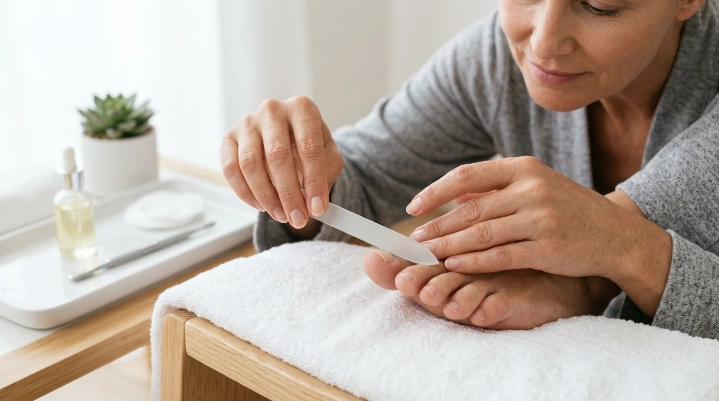
Sometimes—but only for basic grooming.
A nail file can gently smooth a rough edge or shorten a healthy toenail after clipping. It cannot diagnose or cure an unexplained nail change.
For routine grooming, the American Academy of Dermatology’s nail-trimming guidance recommends cutting toenails straight across and smoothing rough edges with a nail file or emery board.
Safer Filing Tips
- Start with clean, dry tools.
- Use a clean file intended for personal use.
- File gently instead of applying heavy pressure.
- Stop if filing causes pain.
- Do not file aggressively into the sides of the nail.
- Never dig beneath a lifting nail.
- Clean reusable tools according to their manufacturer’s instructions.
- Do not share personal nail files or clippers.
Disposable files are useful when hygiene is a concern because they can be discarded after use.
A durable glass or metal file may cost more initially but can be reused when properly cleaned. Basic emery boards are inexpensive but wear out faster.
Tool price should never be the deciding factor when the nail itself looks infected, injured, or medically unusual.
Expert Tip: Take a clear photo of an unusual toenail every one to two weeks in similar lighting. Comparing photos can help you notice whether discoloration, lifting, or a dark streak is actually changing instead of relying on memory.
DIY Care vs. Professional Help
Minor grooming problems are often manageable at home. Health concerns are different.
Home care may be reasonable when:
- You have a small rough edge
- The nail was recently stained by polish
- You know you mildly bumped the toe
- There is no significant pain or swelling
- The nail looks otherwise normal
- The change is improving as the nail grows
Consider a nail technician when:
- You need routine cosmetic shaping
- Healthy nails are difficult for you to trim neatly
- You want help choosing appropriate grooming tools
Remember that a nail technician’s role is primarily grooming and cosmetic care. A technician should not be expected to diagnose fungal infection, melanoma, psoriasis, or other medical conditions.
Consider a healthcare professional when:
- The nail change is unexplained
- Symptoms keep worsening
- There is significant pain
- The surrounding skin is swollen
- You see pus or drainage
- The nail is bleeding
- A dark streak is new or changing
- The nail is lifting significantly
- Several nails change unexpectedly
- Walking becomes uncomfortable
Hygiene Matters More Than Perfect-Looking Toenails
When a toenail looks rough or discolored, it is tempting to focus entirely on appearance.
Instead, prioritize hygiene.
Keep feet clean and dry, wear shoes that fit properly, and avoid sharing clippers, files, or other personal nail tools.
If you use a reusable tool on a suspicious or possibly infected nail, do not immediately use the same uncleaned tool on healthy nails. Fungi can spread through contaminated personal items and damp shared environments.
A perfectly polished pedicure is not worth creating tiny cuts or irritating already-inflamed skin.
Common Mistakes to Avoid
- Assuming every yellow nail is fungus. Polish staining and trauma can look similar.
- Assuming every dark mark is a bruise. A new or changing dark streak deserves professional evaluation.
- Filing an extremely thick nail aggressively. This can cause discomfort or damage surrounding skin.
- Digging underneath a lifting nail. The exposed area may be vulnerable to irritation.
- Cutting toenail corners deeply. This may contribute to ingrown nails.
- Sharing files or clippers. Personal nail tools should be kept personal.
- Covering a worsening nail with polish repeatedly. Cosmetic coverage can make changes harder to monitor.
- Trying to diagnose nail disease from internet photos alone. Several conditions can look similar.
- Ignoring pain or drainage. These symptoms deserve more attention than a simple cosmetic flaw.
- Going to a salon for a medical diagnosis. Nail technicians can provide grooming services, but medical concerns belong with qualified healthcare professionals.
When to See a Nail Technician or Dermatologist
A nail technician can help with ordinary pedicure maintenance and safe cosmetic shaping when the nail and surrounding skin appear healthy.
A dermatologist or other qualified healthcare professional is more appropriate when the toenail change may reflect disease, infection, or injury.
Make an appointment when you notice:
- A new or changing brown or black streak
- Persistent yellowing plus thickening or crumbling
- Significant lifting from the nail bed
- Redness, heat, swelling, or drainage
- Bleeding without an obvious minor injury
- Repeated or unexplained nail loss
- Significant distortion
- Pain that interferes with shoes or walking
- Changes that continue despite basic care
People with diabetes, poor circulation, reduced sensation in the feet, or other conditions that make foot injuries more serious should be especially cautious about self-treating toenail problems.
FAQs
Can toenail changes be harmless?
Yes. Toenails can change because of polish staining, minor injuries, pressure from shoes, normal aging, or temporary disruptions in nail growth. The key is noticing whether the change improves, grows out normally, or becomes worse.
What color toenail should I worry about?
There is no single color that automatically means something serious. Persistent yellow, brown, greenish-black, white, or dark changes may need evaluation depending on other symptoms. A new or changing dark streak deserves particular attention.
Does a yellow toenail always mean fungus?
No. Nail polish staining and trauma can also produce yellow discoloration. Fungal infection becomes more suspicious when yellowing occurs with thickening, crumbling, distortion, buildup, or nail lifting.
Why is my big toenail suddenly thick?
Repeated shoe pressure, injury, fungal infection, psoriasis, and other factors can cause thickening. If the change is significant, unexplained, painful, or difficult to trim safely, have it professionally evaluated.
Should I file down a thick toenail?
Light filing may smooth a rough surface, but aggressively thinning an unusually thick nail is not a good substitute for finding out why it changed. Stop if you feel pain or expose sensitive tissue.
Can a pedicurist tell if I have toenail fungus?
A nail technician may recognize that a nail looks unusual, but a salon visit should not replace medical diagnosis. A dermatologist, podiatrist, or other qualified healthcare professional can evaluate suspicious changes and determine whether testing or treatment is appropriate.
How long should I watch a changed toenail before getting help?
There is no universal waiting period. Minor trauma may gradually grow out, but worsening pain, redness, swelling, drainage, significant nail lifting, or a new or changing dark streak should not simply be watched indefinitely. Seek professional guidance when you are uncertain.
Conclusion
Knowing what toenail changes you should pay attention to can help you separate everyday cosmetic issues from signs that deserve a closer look.
Watch for persistent discoloration, thickening, crumbling, unusual grooves, nail lifting, significant shape changes, redness, swelling, drainage, and pain. Be especially cautious with a new or changing dark streak.
For normal grooming, keep toenails clean, trim them straight across, and smooth rough edges gently with a clean nail file. But when the problem looks like more than routine nail care, resist the urge to file, cut, polish, or cover it until you know what is happening.
Check your toenails regularly, photograph unusual changes, and choose professional evaluation when a change is unexplained, worsening, or painful.

