
What Toenail Damage Should You Not Ignore? 8 Warning Signs

A damaged toenail is easy to brush off. Maybe you stubbed your toe, wore tight shoes all day, noticed a dark spot after a workout, or discovered that one nail suddenly looks thicker than the others.
Most small toenail problems are not emergencies. But some changes deserve more attention than a quick trim, polish cover-up, or pass with a nail file.
So, what toenail damage should you not ignore? Persistent pain, spreading redness, swelling, drainage, major bruising, nail lifting, unexplained dark streaks, and sudden changes in nail shape or color can all be reasons to stop DIY care and get professional advice.
Here is how to recognize the warning signs, what you can safely do at home, and when your nail file needs to stay in the drawer.
Quick Answer
What toenail damage should you not ignore? Pay attention to severe pain, major bruising, bleeding, pus, redness or swelling, significant nail lifting, unexplained dark streaks, or a nail that suddenly changes shape, thickness, or color. Mild damage can often be protected at home, but worsening or unexplained changes deserve professional evaluation.
1. A Black or Purple Toenail After a Significant Injury

A dark toenail after hitting your toe or dropping something on it often comes from blood trapped beneath the nail.
This is sometimes called a subungual hematoma. In simple terms, the nail was injured and bleeding occurred underneath the hard nail plate.
A tiny bruise with mild soreness may simply grow out with the nail.
However, do not automatically assume every black toenail is harmless.
The American Academy of Dermatology advises seeking medical care when an injured nail is especially painful, looks black or purple, or has blood covering more than half of the nail. You can review its guidance for caring for an injured nail for additional details.
Get help sooner if:
- Pain is severe or throbbing.
- The toe is badly swollen.
- You cannot comfortably move the toe.
- A large portion of the nail is filled with blood.
- The nail is split or partially torn away.
- The injury involved a heavy object or crushing force.
- Bleeding will not stop.
Should You File a Bruised Toenail?
Usually, no.
A file cannot remove blood trapped underneath an injured nail. Aggressive filing may simply thin the protective nail plate and make the area more sensitive.
If the nail has a small rough free edge and the injury has otherwise settled, you may gently smooth that edge later. Do not grind the surface trying to remove the dark color.
2. A New or Changing Dark Streak
A dark streak deserves a different kind of attention, especially when there was no obvious injury.
Brown or black pigmentation can have several causes, and not every dark line is dangerous. Nail pigmentation can also be more common in people with darker skin tones.
Still, a new or changing dark band should not be diagnosed at home.
The American Academy of Dermatology lists a dark streak beneath a fingernail or toenail as one possible sign of nail melanoma, a rare form of skin cancer. Other concerning changes can include darkening of nearby skin, nail splitting, nail lifting, or a bump under the nail. Its guide to checking nails for melanoma explains these warning signs in more detail.
See a dermatologist if you notice:
- A new brown or black streak without a known injury.
- A streak becoming wider or darker.
- An irregular band of several shades.
- Dark color spreading onto nearby skin.
- Splitting or lifting around the streak.
- A bump or unusual growth beneath the nail.
Do not file, buff, bleach, or cover an unexplained dark streak simply to improve its appearance.
A dermatologist needs to see the actual change clearly.
3. Redness, Heat, Swelling, or Pus Around the Nail
Soreness after a pedicure or minor bump may settle quickly.
Soreness that becomes more red, warm, swollen, painful, or filled with drainage is different.
Those changes can suggest inflammation or infection around the nail.
The NHS recommends medical evaluation when skin around a nail becomes sore, red, swollen, and warm. An infected ingrown toenail may also produce pus, and systemic symptoms such as feeling hot or shivery deserve medical attention.
Watch for:
- Increasing redness.
- Warm skin around the toenail.
- Swelling that is getting worse.
- Yellow, white, or green drainage.
- A bad smell along with drainage or inflammation.
- Throbbing pain.
- Fever, chills, or feeling unusually unwell.
Avoid cutting deeply into the area or trying to drain it yourself.
And do not run a nail file over infected-looking tissue. Files can irritate broken skin and may collect debris or microorganisms.
4. A Toenail That Is Lifting From the Nail Bed
When a toenail separates from the skin beneath it, the detached portion often looks white or hollow.
This separation is known as onycholysis.
It can happen after trauma, repeated pressure from shoes, nail product irritation, fungal infection, or another nail condition.
A small area of separation after a known injury may gradually grow out. But significant, unexplained, painful, or worsening lifting deserves attention.
The AAD includes nail lifting among the nail changes that dermatologists may need to examine.
Do Not Try to Reattach It
A lifted section cannot be fixed by:
- Gluing it down.
- Pressing it against the nail bed.
- Filling the gap with gel.
- Scraping underneath it.
- Aggressively filing it thinner.
Trying to clean deeply beneath a lifting toenail can injure exposed tissue.
If only a completely free, painless edge is catching on socks, you can sometimes smooth that tiny edge carefully. Stop if the attached part of the nail moves while you file.
5. Thick, Yellow, Brittle, or Crumbling Toenails
Not every thick toenail is damaged.
Age, footwear pressure, repeated trauma, skin conditions, and fungal infections can all change nail thickness and texture.
Fungal nail infections commonly cause discoloration, thickening, brittleness, cracking, crumbling, buildup beneath the nail, or lifting. The NHS fungal nail infection guide notes that toenails are commonly affected and treatment may take months.
The important point is this:
You cannot reliably diagnose nail fungus by appearance alone.
An old injury can create a thick, distorted nail that looks fungal. Other nail conditions can look similar too.
Repeatedly grinding the nail thinner does not identify or treat the cause.
Consider professional evaluation if:
- The nail keeps getting thicker.
- Several nails become affected.
- The nail is crumbling.
- Discoloration spreads.
- The nail starts lifting.
- There is pain or surrounding inflammation.
- Over-the-counter care has not helped.
6. Persistent Pain That Does Not Improve
Pain is one of the easiest warning signs to underestimate.
A nail that looks slightly rough but feels completely normal is different from a toenail that hurts whenever you put on shoes or walk.
Persistent pain can occur with:
- Nail trauma.
- Pressure beneath the nail.
- An ingrown toenail.
- Infection.
- Significant nail lifting.
- A thick or distorted nail pressing against the toe.
- Repeated pressure from poorly fitting shoes.
If pain keeps returning, gets stronger, or makes normal walking uncomfortable, stop trying to fix the nail cosmetically.
A salon service may make a nail look neater, but appearance is not the priority when the nail hurts.
7. An Ingrown Toenail That Is Getting Worse
An ingrown toenail happens when the edge of the nail presses or grows into nearby skin.
Early cases may cause tenderness and mild redness.
A worsening ingrown nail may become swollen, very painful, or infected.
Seek professional care if:
- Pain keeps increasing.
- Swelling becomes significant.
- Pus appears.
- The skin begins bleeding repeatedly.
- Home care is not helping.
- You feel feverish or shivery.
The NHS specifically recommends medical advice when an ingrown toenail is painful and swollen with pus or when systemic symptoms develop.
Do Not File Deep Into the Corners
Trying to “dig out” an ingrown edge with a metal file can make things worse.
You may cut the skin, create a sharp nail spike, or introduce bacteria.
For routine prevention, toenails are generally trimmed straight across rather than deeply rounded at the sides. The AAD’s nail-trimming guidance also recommends using a nail file only to smooth rough or uneven edges.
8. A Toenail That Changes Shape or Keeps Growing Abnormally
A toenail may look unusual for months after a major injury.
That is because the nail grows from an area beneath the skin called the nail matrix. If trauma disrupts that area, new nail may grow differently.
You might notice:
- Deep ridges.
- Repeated splitting.
- Thickening.
- Curving.
- Uneven growth.
- Long-term distortion.
- Very slow or absent visible regrowth.
Some post-injury changes simply need time.
But if you do not remember injuring the nail, the change keeps worsening, or the nail repeatedly grows abnormally, a dermatologist or podiatrist can help determine what may be happening.
Toenail Damage Warning Signs at a Glance
| Toenail Change | DIY Care May Be Reasonable When | Get Professional Advice When |
|---|---|---|
| Small bruise | Mild pain and known minor injury | Severe pain, major discoloration, large blood collection |
| Dark streak | Known bruise clearly growing outward | New, changing, widening, or unexplained |
| Lifting nail | Tiny painless free edge only | Significant, painful, spreading, or unexplained lifting |
| Thick nail | Stable, painless, easy to maintain | Rapid change, pain, severe distortion, crumbling |
| Ingrown edge | Mild tenderness only | Pus, increasing redness, swelling, severe pain |
| Split nail | Small split at free edge | Split reaches attached nail or repeatedly bleeds |
| Red skin | Very mild temporary irritation | Warmth, swelling, pus, worsening pain |
| Fungal-looking change | Mild and already professionally assessed | Uncertain diagnosis, spreading changes, pain |
Can You Use a Nail File on a Damaged Toenail?
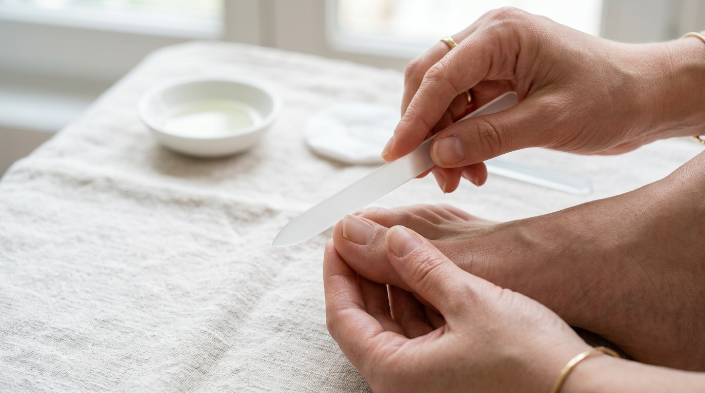
Sometimes.
A nail file is useful for grooming stable nail material. It is not a treatment for unexplained nail disease or a serious injury.
A file can be reasonable for:
- Smoothing a rough free edge.
- Preventing a healthy nail from catching on socks.
- Refining the edge after trimming.
- Very gradually reducing a stable, thick nail when it is painless.
Avoid filing when you have:
- An open wound.
- Active bleeding.
- Severe tenderness.
- Pus or drainage.
- Major bruising from a recent injury.
- An unexplained dark streak.
- Loose nail tissue that moves while filing.
- Inflamed skin around the nail.
Choosing a Nail File
Different materials feel very different on toenails.
| File Type | Best For | Cost Level | Main Limitation |
|---|---|---|---|
| Emery board | Light smoothing | Low | Hard to thoroughly disinfect and wears out |
| Glass/crystal file | Controlled edge finishing | Medium | Slow on very thick toenails |
| Metal file | Firm or thick free edges | Low–Medium | Easy to use too aggressively |
| Coarse manual file | Thick stable nails | Low–Medium | Can remove nail quickly |
| Electric nail file | Fast material removal | Higher | Heat and over-filing risk for beginners |
For most at-home nail care, a manual file gives you more control.
If a nail is painful or medically unusual, upgrading to a stronger file is not the solution.
Nail File Hygiene Matters
Do not share personal nail files.
Disposable emery boards are inexpensive and convenient, but they should be replaced when dirty, worn, or used on a suspicious nail.
Reusable files should be cleaned according to their material and manufacturer instructions.
The goal is simple: avoid moving nail debris and possible microorganisms from one nail to another.
Expert Tip: If you are watching an unusual toenail change, take a clear photo every one or two weeks in similar lighting. It is much easier to notice whether a dark spot, lifted area, or distorted section is moving or changing when you compare photos instead of relying on memory.
What You Can Safely Do After Minor Toenail Damage
For a minor injury without serious warning signs:
- Clean the area gently. Use soap and water if the surrounding skin was injured.
- Protect exposed or tender tissue. Avoid repeated rubbing from shoes.
- Choose roomy footwear. Your toe should not hit the front or top of the shoe.
- Leave attached nail in place. Do not pull off nail that is still connected.
- Smooth only obvious snags. File a stable free edge gently if needed.
- Monitor the nail. Look for increasing pain, redness, swelling, drainage, or discoloration.
- Give it time. Toenails grow slowly, so visible damage may take months to completely grow out.
The AAD recommends gently cleaning mild nail injuries, protecting them while they heal, and avoiding adhesive directly on damaged nail tissue.
Common Mistakes to Avoid
Toenail damage often becomes worse because we keep trying to “fix” it.
Avoid these common mistakes:
- Grinding away discoloration. Dark color underneath a nail is not surface polish.
- Filing until the nail feels hot. Heat is a sign that you are creating too much friction.
- Digging beneath a lifting nail. This can injure delicate exposed tissue.
- Cutting deep into nail corners. This may contribute to ingrown nails.
- Pulling off partially attached nail. You can tear healthy tissue.
- Buffing a thin nail even thinner.
- Sharing nail files or clippers.
- Covering a suspicious nail with opaque enhancements before evaluation.
- Assuming every thick yellow nail is fungus.
- Ignoring worsening pain simply because the nail still looks “okay.”
DIY Care vs. a Salon Visit
A nail technician can be helpful when the problem is cosmetic.
For example, a trained technician may help shape a stable, healthy thick toenail or smooth rough edges during a pedicure.
However, nail technicians are not there to diagnose infections, melanoma, circulation problems, or unexplained nail disorders.
A salon is generally a better fit when:
- The nail is painless.
- There is no redness or drainage.
- The nail is firmly attached.
- You only need routine trimming or shaping.
Skip the salon and choose medical care when you have unexplained discoloration, infection signs, major trauma, significant lifting, persistent bleeding, severe pain, or a suspicious dark streak.
When to See a Nail Technician or Dermatologist
Choosing the right professional can save you a lot of unnecessary filing and guessing.
See a Nail Technician For:
- Routine pedicures.
- Gentle shaping.
- Smoothing healthy rough edges.
- Cosmetic maintenance of stable nails.
Always tell your technician if the nail was previously injured.
See a Dermatologist For:
- A new or changing dark streak.
- Unexplained nail color changes.
- Persistent nail lifting.
- Suspected fungal infection when the cause is uncertain.
- Repeated abnormal nail growth.
- Nail changes involving the surrounding skin.
- A bump or growth beneath the nail.
Consider a Podiatrist For:
- Difficult thick toenails.
- Painful ingrown toenails.
- Nails that interfere with walking.
- Foot-related nail problems that are hard to manage safely.
People with diabetes, reduced sensation, poor circulation, or other conditions that affect foot healing should be particularly cautious about aggressive DIY nail care.
FAQs
Can a damaged toenail heal by itself?
Minor damage often grows out as new nail forms. Toenails grow slowly, though, so the process can take months. Significant injury to the nail-producing area can sometimes cause longer-lasting changes.
Should I remove a damaged toenail?
Do not pull off nail that is still attached. If a tiny section is completely detached and catching, careful trimming may be appropriate, but painful or extensively loose nails should be professionally assessed.
How do I know if a bruised toenail is serious?
Seek care when bruising covers a large portion of the nail, pain is severe, the toe is badly swollen, the nail is black or purple after significant trauma, or you may have a deeper injury.
Can I file a black toenail?
Do not file the nail surface in an attempt to remove black discoloration underneath it. A file cannot remove a bruise beneath the nail. Unexplained or changing dark pigmentation should be evaluated instead.
Can toenail fungus look like damage?
Yes. Fungal infections may cause thickening, yellow or brown discoloration, crumbling, splitting, buildup, or nail lifting, and these changes can sometimes resemble trauma. Proper diagnosis may require professional examination.
Is a lifting toenail an emergency?
A small painless area after a known injury may not be an emergency, but significant lifting, severe pain, drainage, bleeding, or unexplained separation should be checked.
When should I worry about a dark line in my toenail?
A new or changing brown or black line—especially one that widens, becomes irregular, affects nearby skin, or appears without an obvious injury—should be examined by a dermatologist.
Final Thoughts
So, what toenail damage should you not ignore?
The biggest warning signs are persistent or severe pain, significant bruising, bleeding, redness, warmth, swelling, drainage, major nail lifting, unexplained dark streaks, and sudden changes in how a toenail grows.
A nail file is useful for smoothing a healthy rough edge. It cannot diagnose an infection, remove a bruise from beneath the nail, repair a lifted nail, or explain a suspicious dark line.
When a toenail is stable, painless, and clearly healing, gentle home care may be enough. When something keeps getting worse or simply does not look right, stop filing and let a qualified professional take a closer look.
Treat your nail according to what it is telling you—not just how you want it to look.

