
Can Toenail Shape Increase the Risk of Ingrown Toenails?

If you have ever finished a pedicure, looked at a perfectly rounded toenail, and wondered whether that shape is actually good for your feet, you are asking an important question.
Can toenail shape increase the risk of ingrown toenails? Yes. Both the natural curve of your nail and the way you trim or file it can affect whether the nail edge presses into the surrounding skin.
A very curved toenail may naturally be more likely to cause trouble. But even a fairly flat, healthy toenail can become ingrown if the corners are cut too short, rounded deeply, or repeatedly filed down along the sides.
The good news is that you do not need a complicated pedicure routine. A conservative, straight-across shape, moderate nail length, properly fitting shoes, clean tools, and gentle filing can go a long way toward protecting your toes.
This guide explains which toenail shapes deserve extra attention, how trimming and filing affect the nail edge, what tools are safest for everyday care, and when an uncomfortable toenail is no longer a DIY beauty problem.
Quick Answer
Yes, toenail shape can increase the risk of ingrown toenails. Naturally very curved nails and toenails that are cut too short or rounded deeply at the corners are more likely to press into surrounding skin. For most people, trimming toenails straight across and gently smoothing sharp edges is the safer approach.
How Toenail Shape Can Affect Ingrown Toenail Risk
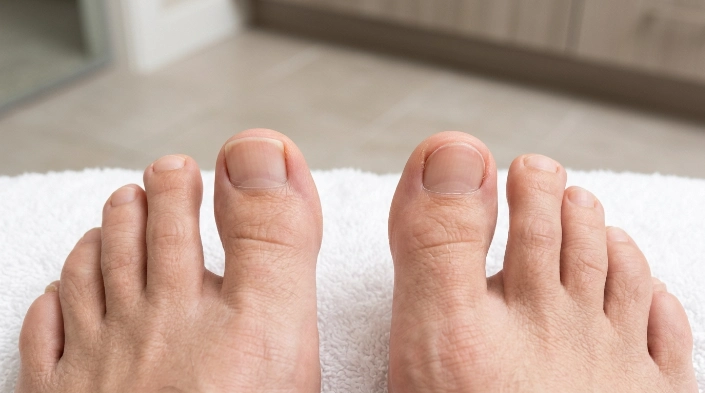
An ingrown toenail develops when part of the nail grows or presses into the skin beside it. This commonly affects the big toe.
Toenail “shape” can mean two different things, and both matter.
The first is your natural nail shape. Some toenails grow relatively flat, while others curve noticeably downward at the sides. The second is the shape you create during trimming or filing.
According to the Mayo Clinic’s overview of ingrown toenail causes, very curved toenails can increase the risk of an ingrown nail. Cutting toenails too short or failing to cut them straight across can also contribute.
That means you cannot always change every risk factor. You may have inherited naturally curved nails, for example. But you can avoid grooming habits that make those nails more likely to irritate the skin.
Natural Curvature Matters
Look straight at the tip of your toenail.
Does the nail plate appear fairly flat from side to side? Or does it bend downward strongly around the toe?
A stronger natural curve can bring the nail edges closer to the surrounding skin. If the toe is also squeezed inside narrow shoes, the combination of nail curvature and pressure may make irritation more likely.
This does not mean everyone with curved toenails will develop ingrown nails. It simply means you should be especially conservative about trimming the sides.
Avoid trying to “correct” a curved nail by digging into the corners with clippers or a sharp file.
The Shape You Cut Matters Too
A common pedicure habit is trimming a toenail into a smooth, rounded shape that follows the front of the toe.
It can look neat, but taking too much nail away from the corners may allow the skin beside the nail to move into the space. As the nail grows forward, its edge can then press against or enter that skin.
The American Academy of Dermatology’s nail-trimming guidance recommends cutting toenails straight across to help reduce the chance of an ingrown toenail.
For toenails, think straight and conservative rather than deeply rounded.
Which Toenail Shapes Are More Likely to Cause Problems?
Here is a practical way to compare common toenail shapes.
| Toenail Shape or Trimming Style | Ingrown Nail Concern | Better Approach |
|---|---|---|
| Straight across | Generally the preferred trimming shape | Keep a moderate length and smooth only sharp edges |
| Slightly softened sharp corners | Usually reasonable when only the free edge is filed | Use a fine file gently without digging down the sides |
| Deeply rounded corners | Can increase irritation risk | Allow the corners to grow forward |
| Corners cut very short | Higher concern because skin may crowd the growing edge | Avoid cutting below the surrounding skin |
| Naturally very curved nail | May have a greater tendency to press into skin | Trim conservatively and monitor for tenderness |
| Narrow or pointed shape | Can remove too much supporting nail at the sides | Keep more of the natural width |
The goal is not to make every toenail perfectly square.
Instead, preserve enough of the corners that you can see where the nail ends. Your nail should not disappear deeply into the side grooves of the toe.
What Is the Safest Shape for Toenails?
For most healthy toenails, a straight-across free edge with minimal corner filing is the easiest shape to maintain safely.
You do not need a ruler-straight salon line. Small natural variations are normal.
A simple at-home routine looks like this:
- Clean your tools and feet first. Start with clean, dry skin and a clean toenail clipper.
- Trim in small cuts across the nail. Avoid one deep curved cut around the entire toe.
- Leave a moderate amount of nail. Do not trim the nail far below the tip of the toe.
- Keep the corners visible. Avoid cutting deeply into the sidewalls.
- File only rough or sharp free edges. Use light pressure rather than trying to reshape the entire side of the nail.
- Check your shoes afterward. Even well-trimmed toenails can become irritated if your shoes constantly squeeze the toes.
If your nail is extremely thick, strongly curved, painful, or difficult to reach safely, aggressive DIY trimming is not worth the risk.
Can a Nail File Change Your Risk?

A nail file can be very useful for toenail care, but it should be considered a finishing tool, not a tool for digging out corners.
After trimming, a file can smooth a sharp edge that might catch on socks or scratch nearby skin.
Problems can develop when you slide the file deeply into the side of the nail and repeatedly remove material in an attempt to create a narrow or rounded shape.
That technique may leave a small nail edge or point that continues growing toward the skin.
Choosing a Toenail File
The ideal tool depends partly on your nail thickness and how much shaping is needed.
| Tool Type | Best Use | Cost & Durability | Main Caution |
|---|---|---|---|
| Fine emery board | Light smoothing of normal nails | Low cost; disposable | Wears out quickly |
| Glass file | Gentle finishing on normal natural nails | Moderate initial cost; reusable | Can break if dropped |
| Metal file | Stronger nails and rough edges | Reusable and inexpensive to moderate | Easy to over-file with pressure |
| Diamond-coated file | Thick or hard nail edges | Higher initial cost; durable | Requires a light, controlled hand |
| Toenail clipper or nipper | Removing length before filing | Usually low to moderate cost | Sharp jaws can cut skin if poorly controlled |
Whatever material you choose, the safest tool is one you can control comfortably.
Do not force a coarse tool under a painful nail corner. A nail file cannot treat an already embedded nail edge.
Expert Tip: Use your file to remove a sharp edge you can clearly see—not to search underneath the skin for a corner you cannot see. If you have to dig, probe, or cause pain to reach the nail, stop.
Other Factors That Can Raise the Risk
Toenail shape is only one part of the picture.
The Mayo Clinic identifies several other factors associated with ingrown toenails, including tight footwear, toe injuries, cutting toenails too short, and nail-care habits that encourage the corners to grow into the skin.
Tight or Pointed Shoes
Shoes that squeeze your toes can push the skin and nail against each other throughout the day.
This matters even more if your big toenail is already strongly curved.
Check whether your toes have enough room to move naturally inside your shoes. Pay special attention to athletic shoes, work footwear, heels, and pointed dress shoes.
Cutting Toenails Too Short
Shorter does not automatically mean cleaner or healthier.
If you trim until almost no free edge remains, pressure from shoes and daily movement may encourage the surrounding skin to crowd the nail.
Keep your toenails comfortably short, but do not shave them down to the skin.
Repeated Toe Injuries
Running, kicking sports, dropping something on a toe, or repeatedly hitting the end of a shoe can change how a toenail grows.
If an injured toenail becomes painful, detached, unusually thick, or distorted, cosmetic filing alone may not solve the problem.
Thick or Abnormally Shaped Nails
A thick nail can be harder to trim evenly. That makes accidental corner cutting and splitting more likely.
Thickening can have several causes, including previous injury or nail disease, so a nail that keeps changing should not automatically be treated as a simple grooming problem.
DIY Toenail Shaping vs. a Salon Pedicure
Routine toenail shaping is usually manageable at home when the nail and surrounding skin are healthy.
DIY care gives you complete control over how little nail you remove. It is also inexpensive when you already own clean clippers and a file.
A professional pedicure can be helpful if you have difficulty reaching your feet or want cosmetic finishing. However, a nail technician should not be expected to diagnose or medically treat an infected or deeply ingrown toenail.
If you visit a salon, you can specifically ask your nail technician to keep the toenails straight across and avoid digging into the corners.
Hygiene matters too. Reusable metal tools should be properly cleaned and disinfected between clients, while single-use files and buffers should not be reused from another customer.
If a salon service causes bleeding, significant pain, or obvious skin injury, continuing the pedicure is not worth achieving a prettier shape.
What If Your Toenail Is Already Starting to Feel Ingrown?
Do not respond by aggressively cutting away the painful corner.
That may temporarily remove pressure, but cutting deeper and deeper into the side can create another short edge that grows back toward the skin.
Instead, pay attention to the severity of your symptoms.
The NHS guidance on ingrown toenails advises against picking at the toe or continuing to cut an ingrown nail and recommends comfortable, roomy footwear while the area settles.
If you notice only mild early tenderness, reduce shoe pressure and stop unnecessary trimming or filing.
More significant symptoms need professional attention.
Watch for:
- Increasing or severe pain
- Redness that is spreading
- Warmth or obvious swelling
- Pus or other drainage
- Bleeding
- Skin growing noticeably over the nail edge
- Symptoms that continue to worsen instead of improving
These signs move the problem beyond cosmetic nail shaping.
When to See a Nail Technician or Dermatologist
A nail technician is appropriate for routine cosmetic trimming, filing, polish, and pedicure care when your nail and surrounding skin are healthy.
A nail technician is not the right person to manage a painful infection, significant swelling, pus, open skin, or a deeply embedded nail.
See a dermatologist, podiatrist, or other qualified healthcare professional if:
- The toe is becoming increasingly painful.
- Redness or swelling is spreading.
- You see pus or drainage.
- The nail repeatedly becomes ingrown in the same place.
- The nail has become unusually thick, curved, discolored, or distorted.
- Home care is not improving the problem.
- You cannot safely trim the nail yourself.
Medical care is especially important if you have diabetes, poor blood circulation, reduced feeling in your feet, or another condition that can interfere with healing. Mayo Clinic advises people with diabetes or poor circulation to seek medical guidance for foot sores or infections rather than relying on routine home care.
In those situations, skip the salon experiment and ask your healthcare team how your toenails should be managed.
Nail and Skin Sensitivity Considerations
Toenail grooming should never feel like a test of how much discomfort you can tolerate.
If your skin is naturally sensitive, use light pressure and avoid repeatedly filing the same corner. Friction from a rough file can irritate the skin even when the nail itself is healthy.
Also pay attention to products used during a pedicure.
Fragranced foot products, adhesives, polish systems, or other treatments may irritate some people. Burning, persistent itching, blistering, swelling, or a worsening rash is a reason to stop using the product.
For ordinary shaping, you rarely need complicated products. A clean clipper and an appropriate file are often enough.
Hygiene Matters More Than a Perfect Shape
Clean tools reduce the chance of turning a tiny accidental cut into a bigger problem.
Before and after toenail care:
- Remove visible debris from reusable tools.
- Follow appropriate disinfection instructions for the tool material.
- Allow tools to dry completely before storage.
- Do not share personal nail files.
- Replace worn or damaged disposable files.
- Avoid filing directly over broken or infected skin.
- Wash and thoroughly dry your feet, especially around the toes.
The American Academy of Dermatology also recommends properly cleaning nail-trimming tools and smoothing uneven edges after trimming.
You do not need sterile surgical equipment for an everyday pedicure, but your tools should be genuinely clean.
Common Mistakes to Avoid
Rounding toenail corners too deeply. A pretty curved edge is not worth removing the protective corner of the nail.
Cutting toenails extremely short. Leave enough nail to protect the tip of the toe.
Digging into the sidewall with a file. Files are designed to smooth accessible nail edges, not perform DIY treatment under inflamed skin.
Pulling or tearing a nail corner. A torn edge may become jagged and irritate nearby skin.
Ignoring footwear. Perfect trimming cannot fully compensate for shoes that constantly squeeze your toes.
Using someone else’s file or dirty tools. Good grooming includes good hygiene.
Trying to hide an unhealthy nail with polish. Pain, swelling, drainage, unexplained discoloration, or major shape changes deserve attention before cosmetic coverage.
Continuing when grooming hurts. Significant pain is information. Stop and look for the cause rather than removing more nail.
FAQs
Can naturally curved toenails become ingrown more easily?
They can. Very curved toenails are recognized as a risk factor for ingrown nails because the sides sit closer to the surrounding skin. Careful straight-across trimming and avoiding tight footwear become especially important when your nails naturally curve downward.
Should toenails be square or rounded?
For most people, toenails should be trimmed generally straight across rather than deeply rounded. You can gently smooth a sharp free edge, but avoid cutting or filing deeply into the corners.
Can filing the corners of toenails cause ingrown nails?
Aggressively removing the corners may increase the chance of trouble. Gentle filing of a visible sharp edge is different from narrowing the nail or digging down the side. Keep the corners intact whenever possible.
Can I file an ingrown toenail instead of cutting it?
Do not use a file to dig into a painful or embedded nail corner. If the skin is swollen, red, draining, or very painful, filing is unlikely to solve the underlying problem and can cause more irritation.
How short should I cut my toenails?
Keep them at a moderate length rather than trimming them flush with the skin. The edge should remain visible, and the corners should not be cut deeply below the surrounding skin.
Can tight shoes cause an ingrown toenail even if I trim correctly?
Yes. Shoes that crowd or pinch the toes can create pressure between the nail and surrounding skin. Safe trimming works best when combined with footwear that gives your toes enough room.
Should I get an ingrown toenail treated during a pedicure?
A routine nail technician can help maintain healthy toenails, but painful, infected, bleeding, or deeply ingrown nails need medical evaluation rather than a cosmetic pedicure. A dermatologist, podiatrist, or other qualified healthcare professional can determine appropriate treatment.
Conclusion
So, can toenail shape increase the risk of ingrown toenails? Yes—but shape is only part of the story.
Naturally very curved toenails may be more likely to press into the surrounding skin. At the same time, rounding the corners too deeply, cutting nails extremely short, wearing tight shoes, or repeatedly injuring the toes can create additional risk.
For everyday care, keep things simple. Trim toenails generally straight across, leave the corners visible, keep a moderate length, and use a clean nail file only to smooth rough free edges.
Most importantly, do not treat pain, swelling, pus, or repeated ingrown nails as a beauty problem that needs more aggressive filing.
Shape healthy toenails gently. When a toenail starts showing warning signs, put the tools down and get the right professional help.

