
What Causes Horizontal Ridges in Toenails?

You look down at your toes during a pedicure and notice a groove running straight across one of your toenails. Maybe there is only one line, or perhaps several nails have similar dents. It is natural to wonder whether the change is simply cosmetic or a sign that something is wrong.
So, what causes horizontal ridges in toenails? These grooves are often called Beau’s lines. They form when normal nail growth temporarily slows or stops. An injury, pressure on the toe, a significant illness, certain medications, or another health issue may be responsible.
The ridge itself usually is not something you can simply buff away. Understanding why it appeared is more useful than trying to hide it.
Below, we’ll look at common causes, what different ridge patterns may mean, safe at-home care, mistakes to avoid, and when an unusual toenail deserves professional attention.
Quick Answer
Horizontal ridges in toenails are often Beau’s lines, grooves caused by a temporary interruption in nail growth. Possible triggers include toe injuries, repeated pressure, significant illness or fever, certain medications, and some health or nutritional problems. One ridge may grow out normally, but recurring or unexplained ridges should be evaluated by a healthcare professional.
What Are Horizontal Ridges in Toenails?
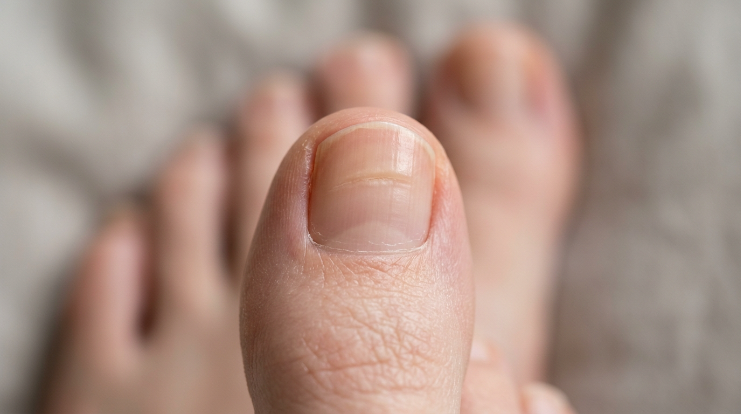
A horizontal ridge runs from one side of the toenail toward the other, rather than from the base of the nail toward the tip.
Doctors commonly call deeper horizontal grooves Beau’s lines.
According to the American Academy of Dermatology’s guide to nail changes, a deep groove across a nail can develop when something temporarily slows or stops normal nail growth.
Your nail begins growing from an area underneath the skin at its base called the nail matrix. Think of the matrix as the nail’s growth center.
If growth is disrupted for a period of time, the affected section of nail can emerge thinner or depressed. As the nail begins growing normally again, that depression gradually moves toward the end of the toe.
This is why an old illness or injury can sometimes leave a visible “timeline” in a toenail months later.
Horizontal vs. Vertical Toenail Ridges
The direction of a ridge matters.
| Nail change | Common meaning | What to do |
|---|---|---|
| Vertical ridges | Often become more noticeable with age or normal nail changes | Monitor unless other symptoms develop |
| One horizontal ridge | May follow a temporary injury, illness, or growth interruption | Watch whether it grows toward the tip |
| Horizontal ridges on several nails | May reflect a broader interruption in nail growth | Consider medical evaluation |
| Repeated horizontal grooves | May mean nail growth is being interrupted repeatedly | Discuss with a healthcare professional |
| Ridge with redness, swelling or drainage | May indicate injury or infection around the nail | Seek professional care |
The Mayo Clinic’s guidance on nail ridges notes that vertical ridges are often common, while new horizontal ridges deserve more attention because they can sometimes be associated with underlying health changes.
What Causes Horizontal Ridges in Toenails?
There is no single cause of every horizontal toenail ridge. The pattern, number of affected nails, your recent health history, and other symptoms all matter.
Here are some of the most common possibilities.
1. Injury to the Toenail
Physical trauma is one of the simplest explanations.
You might develop a ridge after:
- Stubbing your toe
- Dropping something heavy on your foot
- Repeatedly bumping the nail
- Wearing footwear that puts excessive pressure on a toe
- Damaging the area near the base of the nail
An injury near the nail matrix may temporarily interfere with nail production. Once growth returns to normal, the damaged section slowly moves forward.
If only one toenail has a ridge and you remember injuring that toe, local trauma becomes a reasonable possibility.
However, you should not assume every isolated ridge is caused by an injury—especially if it keeps returning.
2. A Significant Illness or High Fever
The body sometimes temporarily redirects its resources during a major illness.
When this happens, nail growth can slow enough to leave a horizontal depression.
The Cleveland Clinic’s overview of Beau’s lines explains that illnesses, injuries and certain skin conditions can interrupt nail growth and produce these grooves.
Possible triggers may include a serious infection, a period of high fever or another significant health event.
Because toenails grow slowly, you may notice the ridge well after you have recovered. That can make the connection less obvious.
Think back over the previous several months rather than only the last few days.
3. Surgery or Major Physical Stress
A major operation or other significant physical stress can temporarily disrupt normal nail production.
This does not mean that every person who has surgery will develop nail ridges. It simply means that a major event affecting the body can sometimes leave a temporary change in nail growth.
The groove should gradually move outward as healthy nail grows behind it if the underlying trigger has resolved.
4. Certain Medications and Medical Treatments
Some treatments can affect rapidly growing tissues, including nails.
Chemotherapy is a well-recognized example associated with Beau’s lines. Both the American Academy of Dermatology and Cleveland Clinic identify chemotherapy among the possible triggers for horizontal nail grooves.
If your nail changes began after starting a medication, do not stop taking prescribed medicine on your own.
Instead, ask the healthcare professional who prescribed it whether the nail change could be related.
5. Skin Conditions Around the Nail
Inflammation or skin disease affecting the nail area may interfere with normal nail growth.
For example, eczema and other inflammatory conditions can sometimes affect the nails. MedlinePlus information on nail abnormalities also notes that Beau’s lines can occur after illness, nail injury, eczema around the nail, chemotherapy, or inadequate nutrition.
If the skin around your toenails is persistently:
- Red
- Scaly
- Cracked
- Itchy
- Swollen
- Painful
the skin condition itself deserves attention rather than simply smoothing the nail.
6. Nutritional Problems
Nutrition is frequently blamed for almost every nail change, but it is important not to jump directly to a vitamin deficiency.
Significant nutritional problems can affect nail growth, and MedlinePlus includes inadequate nutrition among possible causes of Beau’s lines.
However, a horizontal ridge by itself cannot tell you which nutrient you are lacking—or whether you have a deficiency at all.
Avoid taking high-dose supplements based solely on the appearance of a toenail.
If you have recurring nail changes along with fatigue, unexplained weight changes, a restrictive diet, digestive problems, or other symptoms, a healthcare professional can decide whether testing is appropriate.
7. Other Health Conditions
Some broader health problems may change nail growth or appearance.
For example, Cleveland Clinic lists peripheral vascular disease among conditions associated with horizontal ridges.
This is one reason repeated Beau’s lines should not automatically be treated as a cosmetic problem.
Still, seeing a ridge does not mean you have a serious disease. Nail changes are nonspecific, meaning different conditions can create similar-looking changes.
A medical history and examination are much more useful than trying to diagnose yourself from photos online.
Does One Ridge Mean Something Different From Several?
Sometimes the distribution provides a clue.
One Toenail Is Affected
When one nail has a horizontal ridge while the others look normal, consider whether that toe experienced:
- A recent injury
- Repeated shoe pressure
- A sports-related impact
- Damage during nail trimming
- Trauma around the cuticle or nail base
A local cause becomes more plausible because only one nail’s growth center may have been disturbed.
Several Toenails Have Similar Ridges
Similar grooves appearing across multiple nails at approximately the same time may deserve more attention.
A body-wide event such as significant illness can affect more than one nail because multiple nail matrices experience the same interruption.
This pattern is a clue, not a diagnosis.
If you cannot identify an obvious reason—or new ridges keep appearing—show them to a healthcare professional.
How Long Do Horizontal Toenail Ridges Take to Go Away?
You generally cannot make a Beau’s line disappear immediately.
The damaged portion of nail has to grow outward.
Toenails grow much more slowly than fingernails, so visible improvement can take months. A deep ridge may remain noticeable for quite a while even after the original trigger is gone.
The important question is whether healthy-looking nail is appearing behind the ridge.
You can occasionally take a clear photo every few weeks under similar lighting. If the groove gradually moves toward the end of the nail, that suggests the nail is continuing to grow.
Do not repeatedly scrape or aggressively buff the surface to make the line disappear faster.
That removes nail material but does not correct the reason the groove formed.
How to Care for a Ridged Toenail at Home
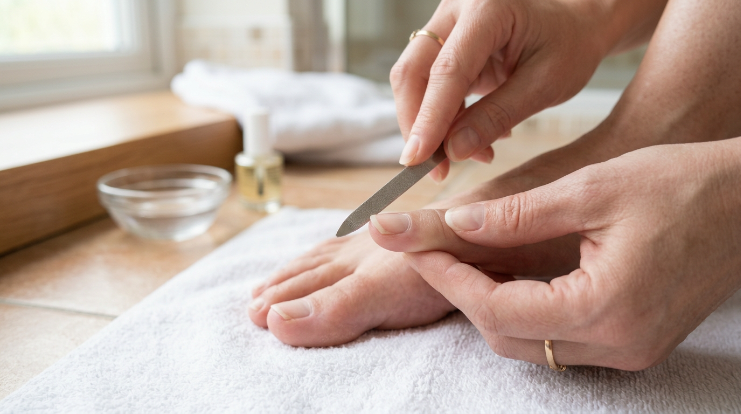
If the nail is otherwise healthy and you are not experiencing signs of infection or injury, basic protective care is usually more sensible than aggressive cosmetic treatment.
1. Keep the Nail Trimmed
Trim the nail carefully so it does not catch on socks or shoes.
Avoid cutting extremely short or digging deeply into the corners.
2. File Only Rough Free Edges
A nail file can help smooth a sharp or snagging edge after trimming.
Use gentle pressure.
Do not repeatedly file across the top of a deep horizontal ridge. The groove represents a thinner or altered area of nail, and excessive filing can make the nail more fragile.
3. Reduce Toe Pressure
Check the fit of your footwear.
Your toes should not constantly press against the end or top of your shoes. This is especially important if one particular toenail repeatedly develops damage.
4. Keep Feet and Tools Clean
Toenail clippers and files should be kept clean and allowed to dry between uses.
Avoid casually sharing personal nail tools.
If you have an obvious nail infection, do not use the same file on healthy nails and then continue using it without appropriate cleaning or replacement.
5. Moisturize Dry Skin Around the Nail
If the skin around the nail is dry, apply moisturizer to the surrounding skin.
Avoid forcing products beneath the nail plate or cutting healthy cuticle tissue simply because the nail looks ridged.
Expert Tip
Expert Tip: Instead of trying to erase a horizontal ridge, photograph the toenail and watch whether the line gradually moves toward the tip. Growth progression can be more useful information than aggressively buffing the groove.
Can You Buff Horizontal Ridges Away?
You may be tempted to buff until the nail looks perfectly flat.
That is usually not the best approach for a deep groove.
Light cosmetic smoothing and aggressive thinning are very different things. Repeatedly filing the top of the nail can weaken an already uneven plate and potentially create:
- Thinning
- Tenderness
- Splitting
- Peeling
- Increased breakage
A ridge caused by interrupted nail growth has to grow out.
Buffing changes the surface; it does not treat the underlying cause.
If appearance is your main concern before an event or pedicure, a professional nail technician may be able to help you improve the cosmetic finish if the nail and surrounding skin otherwise appear healthy.
DIY Care vs. Professional Help
| Situation | DIY care may be reasonable | Professional evaluation is better |
|---|---|---|
| Single old ridge growing outward | Yes | If it stops progressing or returns |
| Known minor toe injury | Usually | If pain, bleeding or nail lifting occurs |
| Several nails develop ridges | Monitor briefly | Recommended if unexplained |
| Ridge keeps returning | No DIY fix addresses the cause | Healthcare evaluation |
| Redness, warmth or drainage | No | Medical evaluation |
| Cosmetic smoothing only | Gentle home care or nail technician | Avoid aggressive filing |
| Possible medical cause | No self-diagnosis | Dermatologist, podiatrist or primary-care professional |
When to See a Nail Technician or Dermatologist
A nail technician can help with cosmetic maintenance such as careful trimming, shaping and polish application when your nails and surrounding skin are otherwise healthy.
A nail technician, however, should not be expected to diagnose the medical cause of Beau’s lines.
Consider seeing a dermatologist, podiatrist or other qualified healthcare professional if:
- Horizontal ridges appear on several nails without an obvious explanation.
- New grooves continue to form.
- The ridge is becoming deeper or the nail is deforming.
- The nail separates from the skin underneath.
- The toe becomes painful, swollen, hot or increasingly red.
- You notice pus, drainage or another possible sign of infection.
- Nail changes appeared with other unexplained health symptoms.
- You have a condition that makes foot problems higher risk.
- You notice a new or changing dark pigment in or around the nail.
The American Academy of Dermatology specifically recommends paying attention to significant nail changes because some abnormalities can reflect conditions beyond the nail itself.
For a painful injury, rapidly spreading redness, severe swelling or other urgent symptoms, do not wait for a routine manicure appointment.
Common Mistakes to Avoid
When a horizontal ridge appears, avoid these common DIY mistakes:
- Buffing aggressively. You can thin the nail without fixing the cause.
- Assuming it is automatically a vitamin deficiency. Nail appearance alone cannot identify a specific deficiency.
- Taking large doses of supplements without guidance. More is not always safer or more effective.
- Picking at the groove. This can create additional splitting or damage.
- Cutting the cuticle to “help the nail grow.” The cuticle helps protect the area where the nail meets the skin.
- Ignoring repeated ridges. Recurring growth interruptions deserve attention.
- Covering suspicious nail changes indefinitely with polish. Cosmetic coverage can make it harder to monitor changes.
- Expecting a salon treatment to diagnose a health problem. Nail technicians provide cosmetic nail services; unexplained medical changes belong with a healthcare professional.
Can a Pedicure Fix Horizontal Toenail Ridges?
A pedicure can improve the appearance of a mildly uneven toenail, but it cannot correct a medical or physical event that temporarily interrupted growth.
If you book a pedicure, tell the technician that the nail has a ridge.
Avoid aggressive drilling or thinning over a deep groove.
You should also postpone a cosmetic pedicure and seek appropriate care instead if you have:
- Open skin
- Bleeding
- Significant pain
- Drainage
- Severe swelling
- A suspected infection
A salon service should never replace medical evaluation when the nail change is unexplained or accompanied by warning signs.
How to Reduce Future Toenail Damage
Not every Beau’s line can be prevented. You cannot prevent every illness, medication side effect or health condition.
You can, however, reduce unnecessary mechanical damage.
Try these habits:
- Wear properly fitting shoes. Make sure your toes have enough room.
- Trim toenails carefully. Avoid cutting extremely short.
- Use files gently. Smooth rough edges instead of grinding the nail surface.
- Protect your toes during physical activities. Appropriate footwear can reduce repeated impacts.
- Keep nail tools clean.
- Watch recurring changes. Photos can help you notice whether a ridge is growing outward or returning.
- Address persistent skin or nail problems instead of covering them repeatedly.
Simple care is useful, but there is no nail product that can guarantee prevention when the underlying trigger comes from inside the body.
FAQs
Are horizontal ridges in toenails serious?
Not always. A single ridge may follow an old injury or temporary interruption in nail growth. However, deep, recurring or unexplained horizontal ridges—especially across several nails—are worth discussing with a healthcare professional.
What are horizontal ridges in toenails called?
Deep horizontal grooves are commonly called Beau’s lines. They form when nail growth temporarily slows or stops at the nail matrix.
Can tight shoes cause horizontal toenail ridges?
Repeated pressure or trauma to a toe can interfere with normal nail growth, so poorly fitting footwear may contribute to an injury-related ridge. If the same toenail repeatedly becomes damaged, check how your shoes fit and consider professional evaluation if the problem continues.
Can vitamin deficiency cause horizontal ridges in toenails?
Significant nutritional problems can affect nails, but a ridge alone cannot tell you whether you are deficient in a particular vitamin or mineral. MedlinePlus includes inadequate nutrition among possible causes of Beau’s lines, but proper assessment requires more than looking at the nail.
Will horizontal toenail ridges grow out?
Often, yes. If the original growth interruption has ended, healthy nail can grow behind the groove and gradually push it toward the tip. Because toenails grow slowly, this process may take many months.
Should I file down horizontal toenail ridges?
Avoid aggressively filing or buffing a deep ridge. It does not correct the cause and can unnecessarily thin the nail. A file is better used gently on rough free edges.
Why do I keep getting horizontal ridges on my toenails?
Repeated grooves suggest that nail growth may be getting interrupted more than once. Possible explanations range from recurring mechanical trauma to health-related factors. Because the appearance alone cannot identify the cause, repeated unexplained lines should be medically evaluated.
Conclusion
So, what causes horizontal ridges in toenails? Most true horizontal grooves develop because normal nail growth was temporarily disrupted. This can happen after an injury, significant illness, physical stress, certain medical treatments, skin problems or, in some cases, broader health or nutritional issues.
A single old ridge that steadily grows toward the tip may simply represent a past event. What matters more is a ridge that keeps returning, affects several nails, stops progressing, or appears alongside pain, inflammation, drainage or other unusual changes.
Resist the urge to aggressively buff the groove away. Protect the nail, keep your tools clean, reduce unnecessary toe pressure and watch how the ridge changes as the toenail grows.
If you cannot explain the ridge or new grooves continue to appear, make your next step a professional evaluation rather than another DIY nail treatment.

