
What Does Healthy Toenail Growth Look Like?

If you have been watching a damaged, short, ridged, or recently trimmed toenail grow out, you may wonder whether what you are seeing is actually normal. Toenails change slowly, so it can be difficult to tell healthy new growth from a nail that needs more attention.
So, what does healthy toenail growth look like? In most cases, healthy growth appears as a gradual, consistent movement of new nail from the base toward the tip. The nail should generally remain attached, reasonably smooth, comfortable, and free from major discoloration, crumbling, swelling, or drainage.
Healthy does not mean perfectly glossy, completely ridge-free, or identical from toe to toe. This guide explains what normal growth can look like, how quickly toenails grow, how nail files fit into a healthy routine, which changes deserve attention, and when DIY nail care should stop.
Quick Answer
Healthy toenail growth usually looks like a slowly advancing nail that is firmly attached, reasonably smooth, similar in color to your other healthy nails, and free from pain, swelling, crumbling, or significant thickening. Toenails grow slowly, so visible improvement after damage may take several months rather than several weeks.
What Healthy Toenail Growth Actually Looks Like

A healthy toenail grows from an area under the skin at the base of the nail called the nail matrix. New nail cells form there, harden into the nail plate, and gradually push the older nail forward.
You will not normally see the growth happening from day to day. Instead, you may notice that the free edge becomes longer over several weeks or that an old mark, ridge, bruise, or damaged area gradually moves toward the tip.
Common signs of healthy-looking growth include:
- A nail that remains firmly attached to the nail bed
- Gradual growth from the base toward the free edge
- Relatively consistent thickness
- A generally smooth or mildly ridged surface
- No persistent pain or tenderness
- No swelling or drainage around the nail
- No progressive crumbling or splitting
- No major new color change
- A cuticle and surrounding skin that are not red or inflamed
Small differences between toenails are common. Your big toenail, for example, may not grow at exactly the same rate as the nail on your smallest toe.
How Fast Should Healthy Toenails Grow?
Toenails are naturally slow growers.
Research involving healthy adults found an average toenail growth rate of about 1.62 millimeters per month, although individual growth rates vary. PubMed study on fingernail and toenail growth rates
That slow pace means you should not expect a damaged toenail to look completely different after only two or three weeks.
If an entire toenail is lost, complete replacement may take around 12 to 18 months. The NHS also notes that a toenail lost after injury can take up to 18 months to grow back. NHS guidance on nail problems and regrowth
This long timeline is one reason patience matters so much with toenail care.
A healthier-looking section may already be forming at the base while the older damaged section remains visible farther up the nail.
A Simple Way to Track Toenail Growth
Checking your nail every day usually makes progress difficult to notice.
Instead:
- Remove polish so you can clearly see the natural nail.
- Take a well-lit photo.
- Take another photo about four weeks later.
- Compare the position of ridges, discoloration, or damaged areas.
- Look for the older area gradually moving toward the tip.
If the same mark moves forward with the nail, that can be reassuring because it shows that new nail is growing behind it.
However, a new or changing dark streak deserves professional evaluation rather than simple monitoring.
What Color Should Healthy New Toenail Growth Be?
There is no single perfect shade that every healthy toenail must have.
Natural toenails are often translucent with pinkish or flesh-toned coloring underneath because you can partially see the nail bed through the nail plate. The exact appearance varies with skin tone, nail thickness, lighting, and whether the nail has recently been polished.
More important than matching a specific color is looking for stability.
Healthy new growth should generally not develop progressively:
- Yellow or brown discoloration
- Green coloration
- Chalky white patches
- Black areas without a known injury
- A new dark vertical streak
- Worsening cloudy discoloration
One small white mark after minor trauma can be harmless. A major or continuing change is different.
Should Healthy Toenails Be Completely Smooth?
Not necessarily.
Many healthy nails have subtle vertical ridges or slight surface variations. Nails may also change somewhat with age.
What matters more is whether the texture is stable and comfortable.
Changes worth paying attention to include:
- Increasing thickness
- Deep grooves
- Repeated splitting
- Crumbling edges
- A powdery surface
- Significant lifting
- Dramatic changes in shape
The American Academy of Dermatology recommends having meaningful changes in nail color, texture, or shape examined because some nail changes can reflect an infection or another condition. American Academy of Dermatology nail-trimming and nail-health guidance
Healthy Toenail Growth After Damage
Toenails are frequently damaged by everyday pressure.
Common causes include:
- Tight shoes
- Long-distance walking or running
- Stubbing a toe
- Dropping something on the foot
- Cutting the nail too short
- Aggressive filing
- Picking under the nail
- Repeated pedicures
- Sports-related pressure
The damaged portion of a nail does not usually repair itself the way a small skin cut does.
Instead, the goal is for healthier new nail to grow forward from the base, gradually replacing the damaged portion.
Imagine a horizontal ridge halfway up your big toenail. If the nail is growing normally, that ridge should slowly travel toward the tip over the following months.
That movement is often more useful to watch than expecting the damaged area itself to disappear.
How Nail Files Fit Into Healthy Toenail Growth
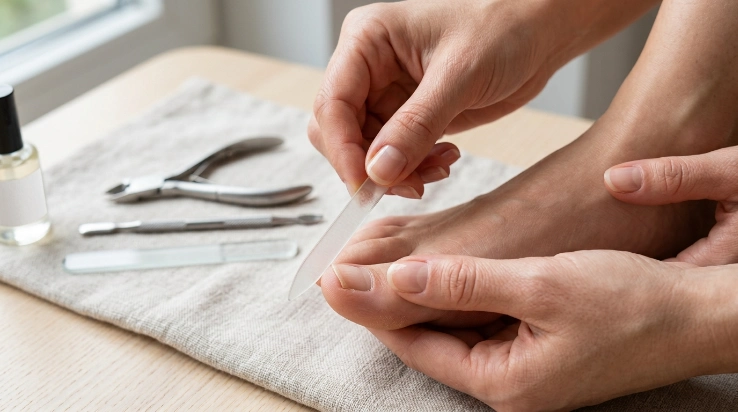
A nail file does not make the nail matrix produce new nail faster.
Its job is much simpler: a file helps protect the growth you already have.
A rough or jagged toenail edge can catch on socks, bedding, or neighboring toes. That can lead to splitting or additional trauma.
Gently smoothing the edge reduces that risk.
Which Nail File Is Best for Natural Toenails?
Different file materials feel different in use.
| Tool | Best Use | Typical Cost | Main Benefit | Main Caution |
|---|---|---|---|---|
| Fine emery board | Everyday edge smoothing | $2–$10 | Affordable and easy to replace | Wears out and should not be shared |
| Glass/crystal file | Gentle natural-nail shaping | $8–$20 | Smooth, reusable surface | Can break if dropped |
| Metal file | Occasional thicker-edge smoothing | $3–$15 | Durable | Can feel aggressive with heavy pressure |
| Buffer block | Very light surface smoothing | $3–$10 | Easy to control | Over-buffing can thin the nail |
| Toenail clipper | Removing excess length | $5–$20 | Faster than filing long nails | Dull blades can crush or split the edge |
These are general retail ranges rather than fixed prices. You do not need an expensive professional kit for routine healthy toenail care.
For most natural nails, a clean clipper and a gentle file are enough.
How to File Toenails Without Damaging Them
The American Academy of Dermatology recommends smoothing rough edges with a nail file and filing in the same direction rather than repeatedly sawing backward and forward.
For a simple routine:
- Clip excess length first. Do not try to file away a large amount of nail.
- Hold a fine file against the free edge.
- Use light, controlled strokes.
- Focus only on rough or sharp areas.
- Avoid grinding deeply into the sides.
- Stop when the edge feels smooth.
- Clean reusable tools according to their instructions.
Do not keep filing just because a nail looks thick. Thickening can sometimes be associated with trauma or infection and deserves attention if it is new or worsening.
Expert Tip: After filing, lightly run a soft piece of tissue or cotton across the free edge. If fibers repeatedly catch in one small spot, give that area one or two additional gentle strokes rather than filing the entire nail again.
How to Support Healthy Toenail Growth at Home
You cannot force a normal toenail to grow dramatically faster, but you can protect it from repeated damage.
1. Trim Toenails Straight Across
Toenails should generally be cut straight across rather than deeply rounded at the corners.
Cutting too far into the sides can irritate the surrounding skin and contribute to ingrown nails.
Leave a small amount of visible nail instead of cutting down to the skin.
2. Wear Shoes With Enough Toe Room
Shoe pressure is an easy-to-miss source of nail trauma.
Your toes should have enough space to move without repeatedly hitting the front or top of the shoe.
If a toenail keeps bruising, thickening, or becoming sore after wearing one particular pair of shoes, the fit deserves attention.
3. Keep Feet Clean and Dry
Wash your feet regularly and dry carefully, including between the toes.
Warm, damp environments can encourage fungal growth.
Change sweaty socks after exercise and give damp shoes time to dry.
4. Moisturize Dry Nails and Surrounding Skin
Clean and dry does not mean dehydrated.
If the nail plate and surrounding skin feel dry, a simple moisturizer can help maintain flexibility.
Apply it around the nail folds and over dry nail surfaces.
Avoid leaving thick layers of cream between the toes if that area tends to stay damp.
5. Protect the Cuticle
The cuticle helps form a protective seal around the growing nail.
Aggressive cutting, scraping, or pushing can damage this barrier.
For routine home care, gentler is usually better.
6. Keep Your Tools Personal
Do not casually share nail clippers, files, or other pedicure tools.
Reusable tools should be cleaned appropriately between uses, while disposable emery boards should be replaced when worn or contaminated.
Can Diet Make Toenails Grow Faster?
Your nails are made primarily from keratin, a protein produced by your body.
A balanced diet that provides enough protein, calories, vitamins, and minerals supports normal body functions, including nail formation.
That does not mean every slow-growing toenail needs a supplement.
There is no single vitamin that guarantees dramatically faster healthy toenail growth for everyone.
Be cautious with products promising instant nail growth.
If you believe a nutritional deficiency may be affecting your nails, particularly if you have other symptoms, discuss it with a healthcare professional rather than relying on high-dose supplements without guidance.
Signs That Growth May Not Be Healthy
Slow growth by itself is not necessarily a problem.
Pay more attention to changes in appearance, comfort, and surrounding skin.
Possible warning signs include:
- Increasing yellow, brown, white, or unusual discoloration
- Thickening that continues to worsen
- Brittle or crumbling nail
- Nail lifting away from the nail bed
- Drainage or pus
- Redness and swelling around the nail
- Persistent pain
- Bleeding without an obvious recent injury
- Repeated ingrown nail edges
- A nail becoming markedly misshapen
- A new or changing dark streak
Nail fungus, for example, can cause thickening, discoloration, brittleness, crumbling, lifting, and shape changes. American Academy of Dermatology guide to nail fungus signs and symptoms
Do not assume every yellow or thick toenail is fungus. Trauma and other nail conditions can sometimes look similar. Proper diagnosis may require examination or testing.
Healthy Growth vs. Possible Trouble
| What You Notice | Often More Reassuring | Worth Professional Attention |
|---|---|---|
| Growth speed | Slow but steadily progressing | Nail appears to stop growing or changes dramatically |
| Surface | Mild stable ridges | Crumbling, deep grooves, severe distortion |
| Color | Stable natural color | New or worsening discoloration |
| Thickness | Relatively consistent | Progressive thickening |
| Attachment | Nail remains attached | Significant lifting |
| Comfort | No pain | Persistent or increasing pain |
| Skin around nail | Calm and intact | Redness, swelling, warmth, drainage |
| Damaged area | Gradually moves toward tip | Damage spreads toward the base |
This table is a guide, not a diagnostic test.
When you are unsure, especially if a nail change persists or worsens, professional assessment is safer than repeatedly filing, trimming, or covering it with polish.
DIY Care vs. Salon Care
Routine home care works well when your toenails are healthy, easy to reach, and painless.
A nail technician can be helpful when you want:
- Cosmetic shaping
- Polish application
- Gentle routine pedicure maintenance
- Help creating a neat, even appearance
However, a nail technician should not be expected to diagnose an infection, unexplained discoloration, significant inflammation, or another medical nail problem.
A salon visit may also cost considerably more over time than maintaining a simple home kit. If your goal is basic shaping, a reusable glass file and good clipper may last through many home pedicures.
Professional cosmetic care becomes worthwhile when technique, convenience, or appearance matters more to you than minimizing cost.
When to See a Nail Technician or Dermatologist
Choose the professional based on the problem.
A nail technician is appropriate for cosmetic services on otherwise healthy nails, such as trimming, filing, shaping, or polish.
A dermatologist, podiatrist, or other qualified healthcare professional is the better choice when you notice:
- Persistent pain
- Increasing redness or swelling
- Pus or drainage
- Significant nail lifting
- Severe thickening
- Repeated ingrown toenails
- Unexplained discoloration
- A new or changing dark streak
- Suspected fungal infection
- A nail that suddenly changes shape
- Nail problems that make walking uncomfortable
If you have diabetes, poor circulation, reduced sensation in your feet, or another condition that makes foot injuries difficult to detect or heal, get professional guidance before aggressively cutting or filing a troublesome nail.
Common Mistakes to Avoid
Healthy toenail growth is often easier to protect when you stop repeatedly traumatizing the nail.
Avoid these common mistakes:
- Cutting toenails extremely short. Leave a small free edge instead of trimming down to skin.
- Rounding deeply into the corners. Toenails are generally safer trimmed straight across.
- Using a very coarse file unnecessarily. Natural nails usually need gentle smoothing rather than aggressive grinding.
- Filing until the nail feels hot or sore. Pain is a sign to stop.
- Buffing away too much surface. A thinner nail is not automatically a healthier nail.
- Picking underneath the nail with sharp tools. This can injure the tissue supporting the nail.
- Cutting healthy cuticles. They help protect the nail-growing area.
- Sharing nail files or clippers. Personal grooming tools can spread infectious organisms.
- Ignoring tight footwear. Repeated pressure can keep damaging new growth.
- Covering unexplained changes with polish month after month. Occasionally examine the bare natural nail.
- Expecting instant results. Toenail improvement is usually measured in months.
FAQs
What does new healthy toenail growth look like?
New healthy toenail growth usually appears at the base of the nail and gradually moves forward. It should generally look attached, reasonably smooth, and free from significant swelling, pain, crumbling, or progressive discoloration.
How can I tell if my damaged toenail is growing out?
Watch a ridge, bruise, or damaged area over several weeks. If the mark gradually moves toward the free edge while newer-looking nail appears behind it, the nail is growing forward.
How long does healthy toenail growth take?
Toenails commonly grow only around 1–1.6 millimeters per month. Complete replacement of a toenail can take approximately 12–18 months, especially after significant damage or nail loss.
Does filing toenails help them grow?
Filing does not directly speed up growth because new nail forms at the matrix near the base. Gentle filing can still help protect healthy growth by removing snags that could split or catch.
Is a thick toenail still healthy?
Some people naturally have thicker toenails, but new or increasing thickness can also occur after trauma or with nail conditions such as fungal infection. If thickening is significant, painful, discolored, or worsening, get it evaluated.
Why is one toenail growing differently from the others?
Growth naturally varies between toes. Previous injury, repeated shoe pressure, infection, nail thickness, and other factors can also make one toenail appear different. Sudden or progressive changes deserve more attention.
Should I stop wearing toenail polish while tracking growth?
You do not necessarily have to avoid polish completely, but periodically removing it lets you inspect the natural nail. If you are monitoring discoloration, lifting, injury, or other changes, leaving the nail visible can make progress easier to evaluate.
Conclusion
So, what does healthy toenail growth look like? Think slow, steady, comfortable progress rather than instant transformation.
Healthy new nail usually grows gradually from the base, remains attached, keeps a reasonably consistent texture and thickness, and does not cause persistent pain, swelling, drainage, or major discoloration.
Support that growth with simple habits: trim straight across, use a gentle nail file to smooth rough edges, wear shoes with enough toe room, keep feet clean and dry, moisturize dry nails, and avoid repeatedly traumatizing the cuticle or nail plate.
Most importantly, do not treat every nail change as a cosmetic problem. If something looks progressively different, becomes painful, or shows signs of infection, put down the file and get qualified professional advice.
Start by checking your bare toenails today. Look at their color, texture, attachment, comfort, and growth pattern. Then give healthy new growth the time and protection it needs.

