
What a Nail Salon Fill Means: A Practical Guide to Maintaining Your Nails

If you wear acrylic, gel, builder gel, BIAB, or other enhancement nails, a fill is one of the most common maintenance services you’ll hear about. In plain language, a fill refreshes the grown-out area near the cuticle so your nails keep looking balanced and polished without removing the whole set.
That sounds simple, but the term gets used a few different ways depending on the salon and the product system. Some techs say fill, others say infill, refill, touch-up, or rebalance. The service is usually the same idea: keep the existing enhancement in place and restore the area that has grown out.
What a Nail Salon Fill Means
A fill is a maintenance appointment for enhancement nails. As your natural nails grow, a gap appears between the cuticle area and the old product. A fill closes that gap by removing some of the grown-out product, preparing the nail, and adding new product where it’s needed.
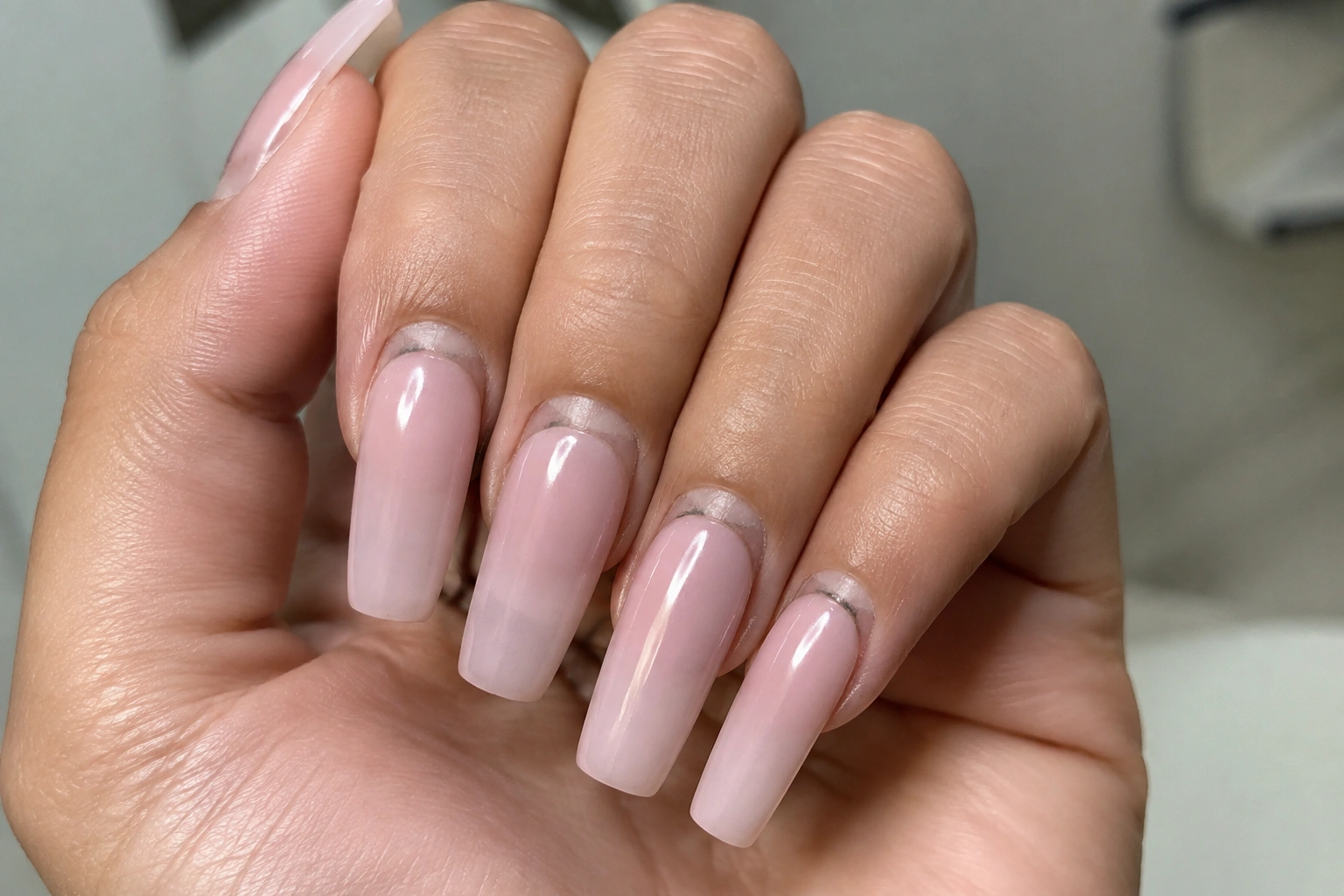
At salons, a fill is often used for acrylic nails, builder gel, hard gel, BIAB, and some extension systems. In some salons, dip powder nails can also be filled, but not every salon or product system handles dip the same way, and some will recommend removal and a new application instead. The exact method depends on the salon and the product line.
The practical benefit is that you keep the length and shape you already paid for, while restoring the area that has grown out. That makes fills faster and usually less expensive than starting over.
Why Fills Are Needed as Nails Grow Out
Natural nails keep growing even when they’re covered with enhancements. Over time, the product sits farther away from the cuticle, and the balance of the nail can shift. That’s why fills matter: they help keep the enhancement looking even and reduce the chance of obvious outgrowth.
There’s also a structural reason. When the nail grows out, the stress point moves. If the set is left too long without maintenance, the product can start to look lifted, uneven, or more prone to breakage.
A fill is not just cosmetic. It’s the scheduled maintenance that keeps the set wearable.
Which Nail Types Can Usually Be Filled
Not every enhancement is maintained the same way, but several common systems are often fillable:
- Acrylic nails
- Builder gel nails
- Hard gel nails
- BIAB
- Some nail extension systems
- Some dip powder systems, depending on the salon and product line
That said, the salon’s product line matters. A fill on acrylic is not always handled exactly like a fill on builder gel or dip powder. Some salons use fill for one system and rebalance for another, especially when more structure needs to be restored.
If you’re unsure what you have on your nails, tell the salon the shape, length, and whether the product feels hard, flexible, or layered. That gives the tech more to work with than guessing the brand name.
Fill vs Full Set, Refill, Infill, Repair, and Removal
This is where people get tripped up, so a simple comparison helps.
| Service | What it means | Best for | Trade-off |
|---|---|---|---|
| Fill / refill / infill | Maintains the existing enhancement and fills the grown-out area | Nails that are still structurally sound | Faster and often cheaper, but not ideal for major damage |
| Rebalance | A more structural maintenance service that restores balance and apex placement | Sets that need more reshaping or correction than a basic fill | More involved than a standard fill |
| Full set | Removes the current enhancement and applies a new set | A fresh start, major shape change, or a set that can’t be maintained | Takes longer and usually costs more |
| Repair | Fixes one or a few damaged nails | A broken, cracked, or missing nail in an otherwise good set | May be an add-on, not included in a standard fill |
| Removal and new set | Takes off the old enhancement and starts over | Heavy lifting, repeated breakage, or a set that no longer fits well | More time, but better when the old set is unstable |
A fill preserves what’s already there; a full set resets everything. A rebalance is often what a salon calls it when the nail needs more than a simple growth-area refresh but not a complete restart.
There’s also a terminology difference. Some salons say refill or infill instead of fill. In everyday salon conversation, those usually mean the same thing.
How to Tell It Is Time for a Fill
A practical rule: if you can clearly see the natural nail growing out near the cuticle, it’s probably time to book. Many clients notice this after a few weeks, but the exact timing depends on how fast their nails grow and how the set is worn.
Use these decision points:
- Visible gap near the cuticle: the most obvious sign
- Lifting at the edge: a reason not to wait much longer
- Loss of balance or shape: when the nail looks top-heavy or uneven
- Minor chips or wear: often fine for a fill if the set is otherwise stable
- Breaks, cracks, or multiple lifted areas: may need repair or removal instead
That last point matters: a small amount of lifting can sometimes be maintained, but lifting that is spreading, catching on hair or clothing, or exposing too much of the natural nail is usually beyond a routine fill. In those cases, a technician may recommend a repair, a rebalance, or a full removal if the structure is no longer sound.
What Happens During a Fill Appointment
A standard fill appointment usually follows a pattern like this:
-
The technician checks the set
They look for lifting, cracks, breaks, and how much the nails have grown out. -
Old product is reduced in the grown-out area
The salon removes the part that has grown out and any loose or lifted product, then reshapes what remains. -
The nails are prepped
The surface is cleaned and prepared so the new product can adhere properly. -
New product is added
Product is applied to the regrowth area and blended into the existing enhancement. -
Shape and balance are refined
The tech files and smooths the nails so the set looks even again. -
Color or design is finished
Some salons can keep the original color if it still works. Others may file off the old design and repaint. Original design doesn’t always have to stay the same during an infill.
If you’re used to a full set, a fill is usually less dramatic. The goal is maintenance, not rebuilding every nail from scratch.
How Long a Fill Usually Takes
A fill is often quicker than a full set, but the exact timing depends on the product, the condition of the nails, and whether repairs are needed. A simple, healthy set with minimal growth is usually quicker than a set with lifting or heavy decoration.
Expect more time if:
- the set is very grown out
- several nails need repair
- the shape is long or detailed
- the salon is changing color or design
- the product system needs more restructuring
How Much a Nail Fill Usually Costs
Fill pricing varies by salon, location, nail system, and the amount of work involved. A basic fill is usually less expensive than a full set because the technician is maintaining existing nails rather than building everything from scratch. As a general note, prices can vary widely by region and salon tier, so it’s best to ask locally for a quote.
What affects the price most:
- Product type: acrylic, gel, builder gel, or hard gel may be priced differently
- Length: longer nails often take more time and product
- Condition of the set: lifting or damage can turn a fill into a more involved service
- Design: simple color is usually less than detailed art or a redesign
- Salon level: a high-end salon may price maintenance differently than a budget salon
- Add-ons: repairs, reshaping, or extra finishing may cost more
If you want a precise quote, ask the salon whether the price includes a standard fill only or whether repairs and redesigns are extra.
For broader salon budgeting, you may also find this guide to builder gel pricing helpful.
When a Fill Is Not the Right Choice
A fill is not the best service when the set is no longer stable enough to maintain.
Skip a fill and ask about repair or removal if you notice:
- major lifting, especially if it is widespread or the product is separating from the natural nail
- a cracked or broken structure that affects the nail’s strength
- multiple nails that feel loose or move when touched
- pain, redness, swelling, or anything that looks unusual
- product that has separated from the nail in a way that can’t be safely blended
- damage near the sidewalls or stress area that would make the enhancement unsafe to keep
In practical terms, a technician may refuse a fill if the enhancement is too lifted, the nail plate is damaged, or the set is unstable enough that covering it would trap problems underneath. If that happens, first-time clients should expect the salon to recommend removal, a repair, or a new set instead of trying to force a maintenance service.
The reason is simple: a fill is meant to maintain a sound set. If the base is unstable, covering it up is not a good fix. In those cases, a technician may recommend removing the old enhancement and starting fresh.
For general salon hygiene questions, the CDC and NIH are good places to look for broad health guidance, but a nail technician should still assess the nails in person before any service.
How Often You Should Get Fills and How to Make Them Last Longer
Many clients book fills every few weeks, but the right interval depends on growth, product type, and wear. Some builder gel clients may come in every 2 to 3 weeks, while longer gaps may require more restructuring.
A simple maintenance rhythm:
- 2 to 3 weeks: common for many enhancement clients who want a tidy, balanced look
- Longer than that: may still be possible, but the service can become more involved
- If you notice lifting early: book sooner rather than waiting for the next convenient date
To help fills last longer:
- wear gloves for heavy cleaning
- avoid using nails as tools
- keep cuticle oil in your routine if your tech recommends it
- don’t pick at lifting edges
- book the next appointment before the set looks heavily grown out
That last point matters. The earlier you catch growth, the easier the maintenance appointment usually is.
What to Say When Booking a Fill Appointment
If you’re calling a salon for the first time, keep it simple and specific. You do not need to sound like a pro.
Say something like:
“I have acrylic nails and I’d like a fill. A couple of nails have grown out, and one may need repair. Do you need me to come in for a fill or a removal and new set?”
If you’re unsure what product you have, mention that too:
“I have enhancement nails, but I’m not sure whether they’re acrylic or gel. Can someone look at them and tell me whether they’re fillable?”
That gives the salon the information they need to book the right amount of time and avoid surprises at the appointment.
When to See a Nail Technician or Dermatologist
See a nail technician soon if the set is lifting, cracked, or growing out enough that it looks unbalanced. Book a removal or repair consultation if several nails are damaged or the enhancement feels unstable.
If you notice pain, swelling, or signs that concern you, pause the nail service and seek medical advice from a dermatologist or another qualified healthcare professional. A fill is a cosmetic maintenance service, not a treatment for nail disease or injury.
The Bottom Line
A nail salon fill is the maintenance service that keeps enhancement nails looking neat as your natural nails grow. It preserves the existing set, refreshes the grown-out area, and helps you avoid starting from scratch every time.
If your nails are still solid and only need growth maintenance, a fill is usually the right booking. If the set is badly lifted, broken, or uncomfortable, ask for repair advice or a removal instead. That one decision can save you time, money, and a lot of frustration.

