
What to Tip at a Nail Salon: A Practical Guide for Every Service

If you’re trying to figure out what to tip at a nail salon, the simplest answer is this: 15% is a solid default for a basic service, and 20% is a better choice for detailed, labor-intensive, or especially well-done work. For quick, low-cost services, many clients round up to a flat amount. One industry source notes that a tip is typically added at the end and recommends about 15% to 20% of the bill, while another notes that cash tips are often preferred by technicians (V Beauty Pure, Moodby).
That said, the “right” tip is easier to choose when you break it down by service type, complexity, and whether more than one technician worked on your nails. Below is the practical version I’d give a client in the chair.
Quick answer: how much to tip at a nail salon
Here’s a fast rule you can use without overthinking it:
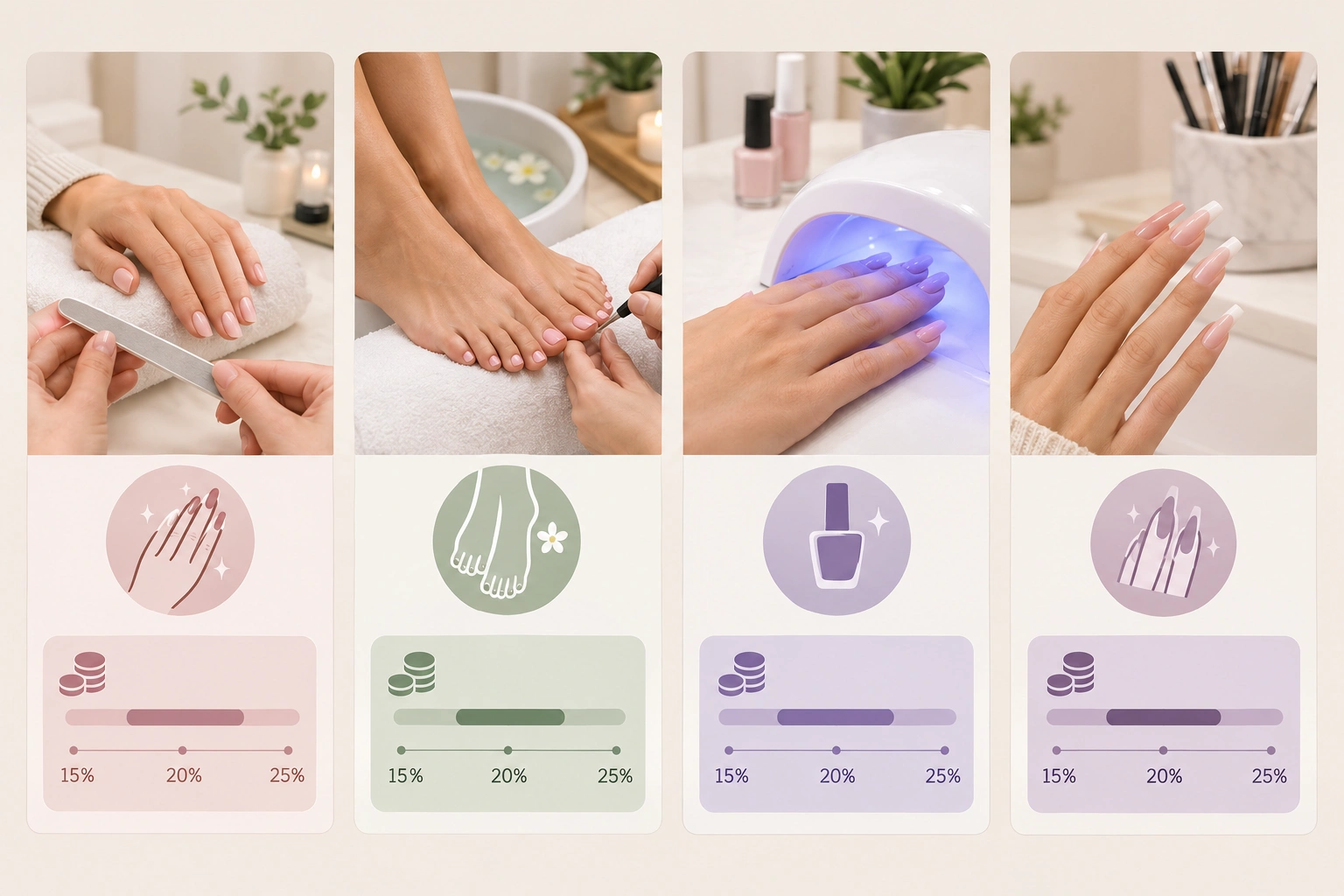
- Basic manicure: 15%
- Pedicure: 15%
- Gel manicure: 15% to 20%, with 20% for careful prep or longer appointments
- Acrylic or full set: 20% if the service was detailed or labor-intensive
- Nail art or add-ons: tip a little extra if the add-on was detailed or time-consuming
- Quick polish change: a flat $3 to $5 tip is common if the bill is small
If you prefer a flat amount instead of percentages, that often feels easier on small services. For example, a $25 manicure can reasonably get a $5 tip, while a $40 pedicure can get $8 if you want to stay near 20%.
Standard tipping amounts for manicures, pedicures, gel, and acrylic services
The most common nail salon tipping range is still 15% to 20%, but the service itself matters. A basic polish service is not the same as a full set that requires prep, sculpting, shaping, and finishing. That’s why many clients tip by percentage for higher-priced services and by flat amount for lower-priced ones.
Basic manicure
For a standard manicure, 15% is usually acceptable, and 20% is a strong way to show appreciation if the service felt polished and efficient. If the manicure was inexpensive, a percentage can produce a very small tip, so some people simply leave $5 to $8 instead.
Pedicure
Pedicures often take longer than a basic manicure and involve more hands-on work, so many clients tip on the higher end of the range. If the pedicure included exfoliation, massage, callus work, or extra finishing steps, tipping closer to 20% is a fair choice.
Gel manicure
A gel manicure usually involves more prep and curing than a basic polish service. If the technician took extra care with cuticle work, shaping, or clean application, 15% to 20% is a practical range. If the service was quick and straightforward, 15% still sits within normal etiquette.
Acrylics or full sets
Acrylic services can be more labor-intensive, especially when shaping and symmetry matter. A percentage tip works well here because the service price usually reflects the time and skill involved. If one technician did prep and another finished the set, see the split-tip section below so each person is recognized fairly.
Nail art and add-ons
For detailed nail art, charms, French tips, or other add-ons, the best approach is to think in terms of time and detail rather than a fixed rule. A small add-on may not need a large extra tip, but intricate hand-painted work deserves more than a token amount.
Here’s a simple way to compare the usual approach:
| Service type | Common tip approach | When to lean higher |
|---|---|---|
| Basic manicure | 15% or a small flat tip | Great attention to detail |
| Pedicure | 15% to 20% | Longer service, more care |
| Gel manicure | 15% to 20% | Extra prep or precision |
| Acrylic/full set | 20% | Shaping, sculpting, or long appointment |
| Nail art/add-ons | Add a little extra | Detailed, custom work |
How to adjust your tip for service quality and complexity
A good tipping rule should reflect both the experience and the effort. You do not need to overcomplicate it.
If the service was excellent
If your technician was careful, clean, efficient, and attentive, tipping at the higher end of the normal range is appropriate. For a detailed service, that often means going from 15% to 20%, or rounding up to a cleaner number.
If the service was average
Average service usually gets the standard range. If nothing was wrong and nothing was especially memorable, 15% is a reasonable middle ground.
If the service was poor
If the result had issues, you still may choose to tip something if the technician completed the service, but you are not obligated to leave a generous tip for a disappointing experience. A smaller tip can reflect the gap between the price and the experience. If the problem was serious, it’s better to address it with the salon manager rather than use the tip as your only feedback tool.
If the appointment was unusually complicated
Long appointments, correction work, custom shaping, or detailed nail art usually justify tipping more. The main question is simple: did the service require more time, skill, or patience than a standard visit? If yes, the higher end of the range makes sense.
How to tip when multiple nail technicians work on one service
This is one of the most common etiquette questions, and the cleanest rule is to tip the people who actually worked on your service. One source specifically recommends tipping separately when you receive multiple services in one visit, such as a manicure and pedicure, and that logic also applies when more than one technician handles one nail appointment (V Beauty Pure).
A simple split-tip method
If one technician prepped your nails and another completed the set, you can:
- Estimate the total tip you planned to leave.
- Split it based on who did the larger share of the work.
- Hand each technician their portion directly if possible.
For example, if you planned to tip $20 on a service and one tech did most of the work while another only helped briefly, you might give $15 to the main technician and $5 to the helper.
When to tip separately
Tip separately when:
– one person does prep and another finishes
– one technician handles nails and another handles pedicure add-ons
– different people complete manicure and pedicure services
– a senior tech corrects or refines work done by someone else
If you’re unsure who should get what, ask the front desk. That’s normal and usually appreciated.
Should you tip on the pre-tax total, post-tax total, discounts, coupons, or gift cards?
This is where many people pause, but the rule is straightforward: tip on the pre-tax service total, then adjust only if a discount changes what you actually paid for the service itself.
Pre-tax vs. post-tax
If you want the most common, uncomplicated method, use the pre-tax subtotal as your base. That keeps the math cleaner and avoids tipping on tax.
Discounts and coupons
Use the discounted service price as your base when a coupon applies. If the coupon reduced the cost of the service, tipping on the lower amount is the standard, practical choice. If the appointment was long or especially detailed, you can still round up or tip a little extra, but you do not need to calculate the tip from the original price unless you want to be more generous.
Gift cards
A gift card usually covers the service, not the tip. Plan to bring cash or another payment method for gratuity unless the salon offers an easy way to add it separately.
A useful rule of thumb
If the technician’s effort was unchanged, don’t let the discount make the tip feel artificially tiny. The discount helped your wallet, not the workload.
What to do when the salon adds a service charge or gratuity
This part matters because a service charge is not always the same thing as a tip. Some salons add a fee automatically, and some label it as gratuity. Read the bill carefully.
If the charge is clearly a gratuity
If the receipt says gratuity or tip, that is usually the technician’s tip. In that case, you do not need to add another tip unless you want to reward exceptional service.
If the charge is a mandatory service fee
If the salon says the fee is mandatory but also says it is not a gratuity, that charge may go to the business rather than the technician. In that case, a separate tip is still appropriate if you want to tip the person who did your nails.
If the wording is unclear
If the receipt says “service charge,” “admin fee,” or something similar and you can’t tell whether it goes to the technician, ask one direct question at checkout:
“Does this charge go to my technician, or should I leave a separate tip?”
That takes 10 seconds and prevents awkward guessing.
Cash tip vs. card tip: what’s best at a nail salon
Cash is often preferred because it is immediate and simple. Many salon clients keep a few small bills ready for that reason, but card tipping is still a normal backup when cash isn’t practical.
Cash tip
Pros:
– easy for the technician to receive right away
– no processing delay
– simple for splitting between multiple staff members
Trade-off: you need to remember to bring cash.
Card tip
Pros:
– convenient if you’re already paying by card
– good backup when you don’t have cash
Trade-off: not every salon handles card tips the same way, so it’s smart to confirm how the money is distributed.
If you have both options, cash is the safer choice for clarity. If not, card tipping is still perfectly normal.
Tipping for quick services, packages, and mobile appointments
Quick polish changes
For a fast polish change, a flat tip often makes more sense than a percentage. The bill may be too small for a percentage to feel meaningful, so a modest flat amount is a practical solution.
Bundled services
If you get a manicure and pedicure in one visit, think of them as two services, not one. That’s especially true when different technicians handle each part. A bundled appointment can deserve a larger overall tip simply because more work happened.
Mobile or in-home nail appointments
House-call or mobile services often involve travel time, setup, and cleanup. Because the technician is bringing the service to you, a good rule is to tip 20% to 25%, or at least add $10 to $20 if the appointment was short but the technician traveled to you. For example, a $60 in-home service might reasonably get a $12 to $15 tip, and a longer or more detailed visit could justify more.
Simple tipping examples by bill amount
These examples make the math easier in real life.
- $25 manicure: 15% is about $3.75, so many people round to $5
- $40 pedicure: 20% is $8
- $50 gel manicure: 15% is $7.50, and 20% is $10
- $60 acrylic service: 20% is $12
- $50 gel manicure + $60 spa pedicure: tip each service separately if different technicians handled them, or combine the bill and tip the total if one person did both
If you want the easiest method, use this: round to the nearest clean dollar that still lands near 15% to 20%. That keeps you from getting stuck on exact math at the front desk.
When to see a nail technician or dermatologist
If your question is about the service itself rather than the tip, ask a nail technician before your appointment. A technician can help you choose the right service, estimate timing, and explain what the salon charges for add-ons.
If you’re dealing with nail changes, pain, swelling, or a skin issue around the nails, a dermatologist is the better professional to consult. For general nail-salon choices and safety-minded planning, our guide on how to find a safe nail salon can help you evaluate a salon before you book.
FAQ
Do you tip at every nail salon?
Tipping is customary in many salons, but it is still a gratuity, not a mandatory fee. If the salon has a posted policy or service charge, check that first.
Is 15% rude at a nail salon?
No. Fifteen percent is within the normal range for many services. If the work was detailed or the experience was excellent, you may want to move closer to 20%.
Should I tip each technician separately?
Yes, if different people worked on your service. That is the fairest way to recognize the actual work done.
Do I tip on the tax amount?
Usually no. Most people calculate the tip from the pre-tax subtotal.
What if I used a gift card?
Plan to tip separately. A gift card usually covers the service, not the gratuity.
What if the salon already added a service charge?
Read the receipt carefully. If it is a gratuity, you may not need to add more. If it is only a fee, a separate tip may still be appropriate.
Is cash really better?
Cash is often easier for technicians to receive directly, but card tipping is still a normal backup when cash isn’t practical.
For more context on service types and pricing structure, you may also find our guide to what is a full set at a nail salon useful when you’re comparing acrylic or enhancement services.

