
Why Are Cats Obsessed With Nail Files? 7 Likely Reasons

If you have ever pulled out an emery board and watched your cat suddenly appear, you are not alone. Some cats sniff nail files, rub their faces against them, lick the rough surface, chew the edges, or even steal them and run away.
So, why are cats obsessed with nail files?
There is no single proven scientific answer. In most cases, the attraction probably comes from a mix of texture, smell, movement, curiosity, and normal scratching instincts. A used nail file may also carry your scent and tiny bits of nail dust, making it even more interesting.
Most casual sniffing is not a reason to panic. But chewing, swallowing pieces, or constantly seeking out non-food objects deserves more attention.
This guide explains the likely reasons cats like nail files, whether nail files are safe around pets, what behaviors are normal, and when it is smart to put the file away and call a veterinarian.
Quick Answer
Cats may be obsessed with nail files because the rough texture, interesting smell, nail dust, movement, and scratching-like feel appeal to their natural curiosity. Some cats also enjoy rubbing against textured objects. Occasional sniffing is usually harmless, but chewing or swallowing a nail file is not safe and may require veterinary advice.
Why Are Cats Obsessed With Nail Files?
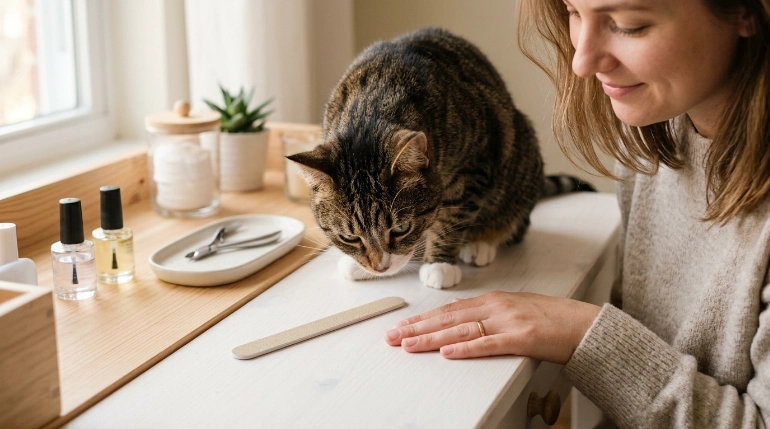
A nail file is a surprisingly interesting object from a cat’s point of view.
It is small enough to grab. It moves quickly in your hand. It makes a scraping sound. An emery board has a coarse surface, and a used file carries smells from your hands and nails.
Put all those features together, and a simple manicure tool can become much more exciting to a curious cat.
Still, it is important to separate reasonable explanations from internet myths. There is very little direct scientific research specifically studying cats and human nail files.
The explanations below are therefore best understood as likely behavioral reasons rather than proven facts.
1. The Rough Texture May Feel Interesting
The texture is one of the simplest explanations.
Cats naturally interact with rough surfaces. Scratching is a normal feline behavior that helps with claw maintenance, stretching, marking, and physical activity.
The Cornell Feline Health Center’s guidance on scratching behavior recommends giving cats acceptable scratching surfaces and redirecting them toward those surfaces when necessary.
An emery board is obviously much smaller than a scratching post, but its gritty surface may still feel interesting beneath a cat’s paws, teeth, face, or tongue.
Your cat may:
- rub her cheek along the file;
- tap it with a paw;
- bite the edge;
- lick the rough surface;
- drag it across the floor.
These actions do not necessarily mean your cat is trying to “file her nails.” She may simply enjoy investigating an unusual texture.
2. A Used Nail File Smells Like You
Cats rely heavily on scent to understand their surroundings.
Your nail file spends time in your hands and against your fingernails. That means a used file can carry traces of skin oils, nail debris, hand cream, soap, or other personal scents.
To you, the smell may be almost impossible to notice.
To your cat, the object may be much more interesting.
Cats also commonly rub their cheeks against people and objects. This behavior is associated with scent communication and environmental familiarity.
If your cat rubs against the nail file rather than chewing it, scent may be a bigger part of the attraction than taste.
3. Nail Dust May Get Your Cat’s Attention
Filing a natural nail creates fine nail debris.
That material can remain on the surface of an emery board, especially after repeated use. Some cats seem especially interested in sniffing or licking used files rather than brand-new ones.
This has led to theories that cats are attracted to components of human nails.
However, there is not enough research to say that cats seek used nail files because they need minerals or nutrients.
That distinction matters.
A cat showing interest in nail dust does not automatically have a nutritional deficiency. Cats eating complete and balanced diets generally should not need to hunt for nutrients on manicure tools.
If your cat persistently eats non-food objects, that is a different issue and deserves veterinary attention.
4. The Movement Can Look Like Play
Think about what happens while you file your nails.
Your hand moves back and forth. The file flashes through the air. Your fingers move. The file may occasionally fall or slide across a table.
To a playful cat, this can look a lot like an invitation.
Cats commonly stalk, chase, bat, grab, and pounce during play. Younger and more energetic cats can be especially responsive to small moving objects.
Your cat may not care about the nail file itself until you start moving it.
One useful clue is timing.
If your cat ignores a file sitting on a table but suddenly attacks it when you begin your manicure, movement and play are probably major parts of the attraction.
5. The Scraping Sound May Spark Curiosity
Nail filing produces a distinctive scratching or scraping sound.
Cats have sensitive hearing and often investigate unfamiliar noises. The repetitive sound may tell your cat that something interesting is happening nearby.
You might notice your cat:
- entering the room once you begin filing;
- staring at your moving hands;
- reaching toward the file;
- trying to grab it between strokes.
In this situation, your cat’s “obsession” may really be simple curiosity.
She hears something unusual, comes over to investigate, and then discovers an object that is also lightweight, rough, and easy to steal.
That is a lot of entertainment packed into one tiny beauty tool.
6. Scratching Is a Normal Feline Need
Cats do not scratch furniture because they are trying to ruin your décor.
Scratching is normal behavior.
It allows cats to interact with surfaces, stretch their bodies, maintain their claws, and leave visual and scent signals. The ASPCA also notes that cats naturally scratch during play, stretching, and marking.
This helps explain why textured objects can attract cats.
It does not, however, mean that your manicure file should become your cat’s scratching tool.
A proper cat scratcher gives her a larger, more stable, and safer surface.
If she loves abrasive textures, experiment with cat-safe scratching materials such as:
- corrugated cardboard;
- sisal;
- sturdy scratching posts;
- horizontal scratching pads;
- rough pet-safe scratching boards.
Pay attention to orientation too. Some cats love vertical posts, while others strongly prefer horizontal cardboard scratchers.
7. Sometimes It Is Simply a Fun Object to Steal
Cats do not need a complicated biological reason to like every object.
A disposable nail file is lightweight, narrow, easy to bite, easy to carry, and easy to push off a table.
That makes it a pretty good cat-sized object.
If your cat grabs the file and races away, she may simply be turning it into a game.
The safest response is not to chase her around the house with great excitement. That can accidentally make stealing the file more rewarding.
Instead, calmly trade it for a favorite toy or treat and store your manicure tools somewhere your cat cannot reach them.
What Your Cat’s Behavior May Mean
| What Your Cat Does | Likely Explanation | Concern Level |
|---|---|---|
| Sniffs the nail file | Scent and curiosity | Low |
| Rubs her cheek on it | Texture or scent behavior | Low |
| Bats it across the floor | Play and movement | Low |
| Tries to steal it | Play or object interest | Usually low |
| Licks a used file | Scent, texture, or nail residue | Monitor |
| Chews the file repeatedly | Texture interest or non-food chewing | Moderate |
| Tears off and swallows pieces | Unsafe ingestion | High |
| Regularly eats many non-food objects | Possible pica or health/behavior issue | Veterinary check recommended |
The key difference is interaction versus ingestion.
Sniffing an object is very different from swallowing it.
Are Nail Files Safe for Cats?
Nail files are designed for people, not pets.
That alone is a good reason not to treat one as a cat toy.
Emery Boards
A paper or cardboard emery board may look harmless, but a determined cat can chew pieces from it.
Those fragments are not intended to be eaten.
The rough surface may also irritate the mouth if your cat aggressively licks or bites it.
Metal Nail Files
Metal files should be kept away from unsupervised cats.
Their narrow shape, rigid construction, and sometimes pointed ends can create an unnecessary injury risk during rough play.
Glass or Crystal Nail Files
Glass files can be excellent human manicure tools, but they are not cat toys.
A file that chips, cracks, or breaks could create sharp edges.
Store it in its case after use.
Electric Nail Files
An electric nail drill creates a completely different set of risks.
Keep the rotating bit, cord, nail dust, and device away from curious pets. Do not let a cat investigate the tool while it is running.
Be Extra Careful With Files Used Around Nail Products
If you file gel polish, acrylic enhancements, dip powder, nail glue, or other artificial nail products, do not let your cat lick the dust or chew the file.
The U.S. Food and Drug Administration notes in its nail care product safety guidance that some nail-product ingredients can be harmful if swallowed and that nail products should be used according to their safety directions.
A good rule is simple:
If a file has product residue on it, keep it completely out of your pet’s reach.
Wash your hands after your manicure before handling your cat if you have loose filing dust on your fingers.
Should You Let Your Cat Lick Your Nail File?
I would discourage it.
A quick sniff is one thing. Repeated licking and chewing are unnecessary risks.
There is no health benefit your cat needs to get from your emery board.
Instead, remove the file and redirect her toward something designed for feline play or scratching.
This is especially important if the file contains:
- acrylic dust;
- gel residue;
- polish;
- nail glue;
- oils or creams;
- blood from an accidentally damaged cuticle;
- broken or loose abrasive material.
Keeping your tools clean also protects your own manicure routine. The CDC’s nail hygiene recommendations advise cleaning nail grooming tools, including files, before use.
If your cat has been licking or chewing a reusable file, clean it appropriately before using it again. With a cheap disposable emery board, replacement is often the simpler choice.
What If My Cat Actually Eats the Nail File?
This is where casual curiosity becomes a safety concern.
Persistent eating of non-food materials is known as pica. International Cat Care explains in its guide to pica in cats that the behavior involves eating materials that are not food and can have behavioral or medical causes.
Call your veterinarian if your cat swallows pieces of an emery board, especially if a large amount is missing.
Also seek veterinary help if you notice:
- repeated vomiting;
- gagging;
- loss of appetite;
- unusual tiredness;
- abdominal discomfort;
- difficulty passing stool;
- repeated attempts to eat non-food objects.
Foreign objects can sometimes cause digestive obstruction, which may become serious.
Do not deliberately make your cat vomit unless a veterinarian specifically tells you to do so.
Is a Mineral Deficiency Making My Cat Love Nail Files?
You may see this claim online, but it should be treated carefully.
There is no good evidence showing that ordinary nail-file attraction proves a cat has a mineral deficiency.
Sniffing, rubbing, playing, or occasional licking can have much simpler behavioral explanations.
However, persistent consumption of non-food objects should not be ignored.
Pica can sometimes occur alongside medical or nutritional problems. For example, International Cat Care notes that pica may occur in cats with anemia.
Your veterinarian can decide whether an exam, diet review, or testing is appropriate.
Do not start giving mineral supplements simply because your cat likes your nail file. Unnecessary supplements can create their own problems.
How to Stop Your Cat From Stealing Your Nail Files
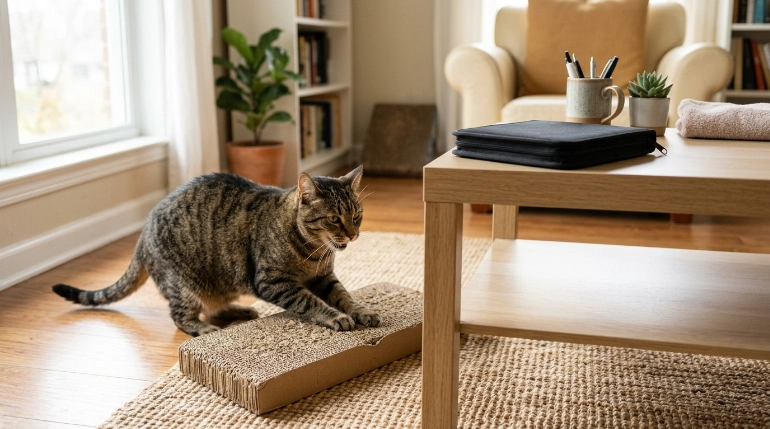
You do not need to punish your cat.
Instead, make the file boring and give her a better option.
1. Store Files After Every Manicure
Use a drawer, closed organizer, makeup bag, or manicure case.
Do not leave files on a coffee table where they become an easy target.
2. Give Your Cat a Better Scratching Surface
Place a scratching pad near the area where your cat usually interrupts your manicure.
Try different textures until you find one she likes.
3. Redirect Instead of Chasing
If your cat grabs the file, calmly exchange it for a toy.
A dramatic chase can turn stealing into a very rewarding game.
4. Add Daily Play
Use safe cat toys that encourage stalking, chasing, and pouncing.
A cat whose play needs are met may be less determined to turn your manicure tools into entertainment.
5. Do Your Nails Away From Your Cat
For cats that are completely fascinated by filing, the simplest solution may be doing your manicure behind a closed door.
This is especially useful when using gel, acrylic, glue, remover, or an electric nail drill.
Expert Tip: Keep a cat toy or scratching pad near your manicure area. Redirect your cat before she grabs the file. Preventing the stealing game is easier than trying to make an exciting stolen object boring afterward.
Nail File Types and Cat Safety
| Nail File Type | Human Use | Cat Risk | Best Practice |
|---|---|---|---|
| Disposable emery board | Natural nail shaping | Can be chewed or swallowed | Replace if heavily licked or damaged |
| Metal file | Durable shaping | Hard, narrow, sometimes pointed | Store securely |
| Glass/crystal file | Gentle nail shaping | Breakage or sharp-edge risk | Keep in protective case |
| Electric nail drill | Gel/acrylic removal and shaping | Moving bit, cord, dust | Keep pets out of work area |
| Used salon-style file | Product removal | May contain cosmetic residue | Never give to a cat |
A regular disposable file has a low replacement cost, so there is little reason to keep using one after a cat has badly chewed it.
Reusable glass or metal tools cost more, but secure storage and proper cleaning make more sense than allowing your cat to play with them.
Common Mistakes to Avoid
Cat owners and nail lovers can usually avoid problems with a few simple habits.
- Do not assume nail-file licking means your cat needs supplements. Ask a veterinarian before changing her diet.
- Do not give an old nail file to your cat as a toy. It was not designed for chewing or swallowing.
- Do not let your cat lick acrylic, gel, polish, glue, or filing dust.
- Do not chase your cat excitedly every time she steals a file. You may accidentally turn stealing into a game.
- Do not leave glass, metal, or electric nail tools within reach.
- Do not ignore repeated non-food eating. Persistent ingestion is different from simple curiosity.
- Do not reuse a badly chewed disposable file. Replace it.
- Do not punish normal scratching instincts. Redirect your cat toward an appropriate scratching surface instead.
When to See a Nail Technician or Dermatologist
This topic involves both your cat’s safety and your own nail health, so it helps to know which professional you actually need.
A licensed nail technician may help when your natural or enhanced nails need routine cosmetic maintenance, safe product removal, or reshaping.
A dermatologist is more appropriate if you develop persistent nail discoloration, swelling, pain, skin irritation, suspected infection, or changes that do not improve.
Neither professional should diagnose your cat.
For your cat, call a veterinarian if she repeatedly eats nail files or other non-food items, swallows a piece of a file, vomits, stops eating, seems painful, or suddenly develops unusual compulsive behavior.
This is one area where DIY guessing is not worth the risk.
FAQs
Why does my cat lick my nail file?
Your cat may like the rough texture, your scent, or residue left from filing your natural nails. There is no proven single explanation. Discourage repeated licking, especially if the file contains nail-product residue.
Why does my cat rub her face on nail files?
Cats commonly rub their faces against objects as part of scent-related behavior and environmental exploration. The rough texture of an emery board may also feel interesting.
Why does my cat steal my emery board?
An emery board is light, narrow, movable, and easy to carry. Those features can make it feel like a toy. Offer a safe cat toy instead and store nail files in a closed container.
Are emery boards toxic to cats?
An emery board should not be considered a pet-safe chew toy. Even if a brief sniff causes no problem, pieces of cardboard and abrasive material are not meant to be swallowed.
Can cats eat human nail dust?
Cats should not be encouraged to eat nail dust. There is no nutritional reason to feed it to them, and files used on artificial nails may contain cosmetic product residue.
Does liking nail files mean my cat has a mineral deficiency?
Not necessarily. Texture, smell, play, and curiosity are more ordinary explanations. If your cat persistently eats non-food items, speak with a veterinarian rather than giving supplements on your own.
What can I give my cat instead of a nail file?
Try corrugated cardboard scratchers, sisal posts, horizontal scratching pads, and safe interactive toys. Experiment with textures and positions until you discover what your cat prefers.
Conclusion
So, why are cats obsessed with nail files?
For many cats, the answer is probably a combination of rough texture, scent, movement, sound, normal scratching instincts, and plain curiosity. A used file can be especially interesting because it carries smells and debris from your manicure.
Most sniffing or occasional pawing is not alarming.
The important line is chewing and swallowing.
Nail files are human grooming tools, not cat toys. Keep reusable files stored safely, replace disposable files that have been badly chewed, and keep cats away from files covered in gel, acrylic, polish, or other product residue.
If your cat repeatedly eats nail files or other non-food items, contact your veterinarian rather than assuming it is just a quirky habit.
Give your curious cat a proper scratcher, keep your manicure tools clean and stored away, and you can protect both your pet and your nails.

