
Why Are My Toenails Brittle? Causes, Care, and When to Get Help

Brittle toenails can be frustrating. One day your nails seem normal, and then you notice an edge splitting, peeling, cracking, or crumbling when you try to trim or file it.
If you are wondering, “Why are my toenails brittle?”, there is not one single answer. Fungal nail infections are a common possibility, but repeated shoe pressure, nail injuries, aggressive filing, dryness, aging, and some health conditions can also affect nail strength.
The good news is that mildly brittle toenails can often be managed with gentler grooming, better footwear, clean nail tools, and a little patience. The important part is knowing when brittleness is just a grooming concern and when the nail needs professional attention.
This guide explains the most likely causes, how nail files fit into safe care, what you can try at home, and which warning signs you should not ignore.
Quick Answer
Why are my toenails brittle? Common causes include fungal nail infections, repeated pressure or injury, dryness, aggressive filing, and natural nail changes. Gentle filing, moisturizing, proper footwear, and keeping feet clean and dry may help. If your toenails are also discolored, thickened, painful, lifting, or crumbling, consider professional evaluation.
What Does a Brittle Toenail Look Like?
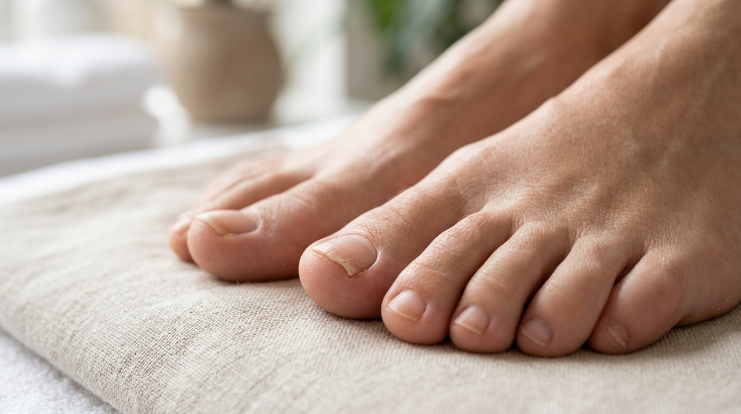
A brittle toenail does not always break completely.
You may notice smaller changes first, such as:
- Cracks along the free edge
- Peeling or splitting layers
- Rough, flaky edges
- Small pieces breaking off during trimming
- A nail that crumbles when filed
- Increased ridging or uneven texture
- A nail that repeatedly catches on socks
- Reduced flexibility
- A nail that looks unusually dry or chalky
Sometimes brittleness is limited to one toenail. Other times, several nails are affected.
That pattern can offer clues.
One repeatedly damaged big toenail may point toward footwear pressure or an old injury, while several brittle, discolored, thickened nails may deserve a closer look for a fungal infection or another nail condition.
Why Are My Toenails Brittle? Common Causes
1. A Fungal Nail Infection
Toenail fungus, medically called onychomycosis, is one of the first possibilities to consider when brittleness comes with other visible nail changes.
The American Academy of Dermatology lists brittle nails that crack, split, or crumble among possible signs of nail fungus. Infected nails may also become thickened, discolored, misshapen, lifted, or painful. American Academy of Dermatology’s nail fungus symptom guide
The NHS similarly notes that fungal nail infections can make toenails brittle, discolored, or thicker than normal. NHS guidance on fungal nail infections
Signs that make fungus more worth considering include:
- Yellow, white, or brown discoloration
- Crumbling around the nail edge
- Increasing thickness
- Material collecting underneath the nail
- Nail lifting
- Several nails gradually becoming affected
Do not assume every brittle or yellow nail is fungal. Injury, polish staining, psoriasis, and other nail conditions can look similar.
A dermatologist or podiatrist may sometimes need to examine or test the nail before recommending treatment.
2. Repeated Pressure From Shoes
Your shoes can affect your toenails more than you might think.
If the toe repeatedly hits the front of a shoe, tiny injuries can occur over and over. Running shoes that are too short, pointed shoes, narrow toe boxes, high heels, and work shoes that squeeze the toes may all contribute.
Repeated pressure may make a toenail:
- Split
- Crack
- Develop ridges
- Become thicker or harder
- Grow unevenly
- Lift slightly
- Break at the edge
The big toenail is particularly vulnerable because it often takes the most pressure.
Check your shoes while standing. Your toes should have enough room to sit naturally without constantly pushing against the front or sides.
3. An Old Nail Injury
A toenail can remain different long after the original injury stops hurting.
You may have:
- Stubbed your toe
- Dropped something on your foot
- Bruised a toenail during running
- Damaged it during a pedicure
- Worn tight shoes repeatedly
The injury may affect how the new nail grows.
A previously injured nail can remain ridged, uneven, brittle, thick, or prone to splitting as it grows forward.
If the nail keeps growing abnormally or becomes painful, do not keep trying to file away the problem. Professional evaluation may be more useful.
4. Dryness and Repeated Wet-Dry Cycles
Nails contain keratin and need some flexibility to resist splitting.
When nails repeatedly become wet and then dry out, they may become easier to split or peel.
The American Academy of Dermatology notes that excessive water exposure can weaken nails and contribute to splitting, peeling, or breaking. AAD tips for healthier nails
For toenails, you also need to balance moisturizing with fungal prevention.
Moisturizing a dry nail and surrounding skin can be helpful, but constantly damp feet are not healthy either. Dry your feet carefully after bathing, swimming, or exercise, especially between the toes.
5. Aggressive Filing or Buffing
A nail file is useful for brittle toenails, but only when you use it gently.
Repeatedly grinding the nail surface can make an already fragile nail thinner.
Problems are more likely when you:
- Use an extremely coarse file
- Apply heavy pressure
- File for too long
- Aggressively buff the top of the nail
- Keep filing after the nail feels warm
- Use an electric nail drill without enough control
For brittle natural toenails, think of a nail file as a smoothing tool, not a tool for removing large amounts of nail.
6. Nail Polish, Gel, Acrylic, and Removal Damage
Toenails can also become dry or fragile after repeated cosmetic treatments.
This is especially possible when the natural nail is heavily buffed before application or aggressively filed during removal.
Acetone and other removal processes may leave nails feeling temporarily dry as well.
That does not mean you can never enjoy a pedicure.
Instead, give visibly damaged nails a break from aggressive treatments and avoid covering a painful, discolored, lifting, or suspicious nail simply to hide it.
7. Aging and Natural Nail Changes
Nails naturally change over time.
Toenail growth is slow, and nails may become harder, thicker, more ridged, or less flexible with age.
Those changes can make trimming and filing more difficult.
However, do not automatically blame age for a new nail problem. A nail that suddenly becomes brittle, painful, discolored, or dramatically different deserves more attention.
8. Health or Nutritional Factors
Occasionally, brittle nails occur alongside a health or nutritional issue.
For example, Mayo Clinic lists brittle nails as one possible symptom of iron-deficiency anemia. Mayo Clinic information about iron-deficiency anemia
However, brittle toenails alone are not enough to diagnose a vitamin deficiency, anemia, thyroid condition, or another health problem.
Avoid starting high-dose supplements simply because your nails are breaking.
If several nails change unexpectedly or you have other symptoms, talk with a healthcare professional.
Choosing a Nail File for Brittle Toenails
The roughest file is rarely the best file for a fragile natural toenail.
| Nail File Type | Best Use | Typical Cost | Main Benefit | Main Caution |
|---|---|---|---|---|
| Fine emery board | Basic edge smoothing | $1–$5 | Affordable and easy to control | Hard to disinfect thoroughly |
| Glass/crystal file | Brittle natural nails | $5–$15 | Smooth, precise filing | Can break if dropped |
| Fine metal file | Firmer nail edges | $3–$10 | Durable and washable | Can feel aggressive |
| Buffer block | Very light surface smoothing | $3–$10 | Easy to handle | Over-buffing can thin nails |
| Electric nail file | Specialized filing | $20+ | Fast material removal | Easier to over-file or create heat |
Prices vary by brand, material, and quality.
For most brittle natural toenails, a fine glass file or fine emery board gives you more control than an aggressive coarse file.
How to File Brittle Toenails Safely
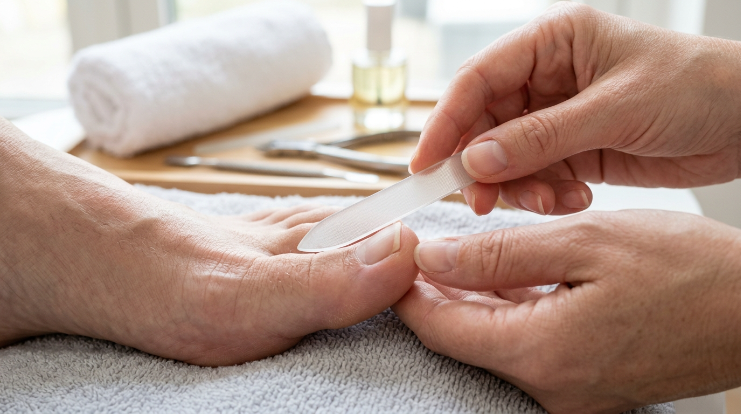
If the nail is not painful, infected, severely distorted, or lifting, gentle filing may help prevent small cracks from catching and spreading.
1. Examine the Nail First
Before filing, look for:
- Redness
- Swelling
- Drainage
- Bleeding
- Significant discoloration
- Nail lifting
- Severe crumbling
- A new dark streak
- Pain underneath or around the nail
If any of these are present, heavy filing is not the best next step.
2. Make Sure You Can See Clearly
Good lighting matters.
Sit somewhere comfortable where you can reach the toenail without twisting your foot or forcing the file into the surrounding skin.
3. Start With a Fine File
Use a clean, fine nail file.
Avoid starting with an extremely coarse surface just because the nail feels rough.
4. Smooth the Free Edge
Focus mainly on the edge of the nail that extends beyond the skin.
The American Academy of Dermatology recommends smoothing rough nail edges with a file or emery board and filing in the same direction instead of repeatedly sawing backward and forward. AAD guidance on trimming and filing nails
Use light, controlled strokes.
5. Stop When the Snag Is Gone
You do not need to make every ridge or imperfection disappear.
Stop once the sharp or rough edge feels smooth.
Pain, heat, burning, or tenderness means you should stop immediately.
Expert Tip: After filing, lightly run a cotton pad or soft tissue across the nail edge. If fibers catch on one small spot, give only that area another gentle stroke instead of filing the entire nail again.
How to Care for Brittle Toenails at Home
A simple routine is usually better than constantly adding new strengthening products.
Keep Nails at a Manageable Length
Long toenails have more opportunity to hit shoes and split.
Trim them regularly without cutting them down into the skin.
Toenails are generally trimmed mostly straight across to reduce the risk of ingrown edges.
Moisturize Dry Nails
If the nail and surrounding skin are dry, massage a small amount of moisturizer around the nail after bathing.
Do not leave your feet wet inside socks or shoes.
Choose Shoes With Enough Toe Room
Your toes should not constantly press against the front of the shoe.
This is especially important for running, hiking, dancing, and long work shifts.
Keep Feet Clean and Dry
Change sweaty socks.
Allow damp shoes to dry.
Wear appropriate footwear in communal showers, locker rooms, and pool areas.
These habits are particularly useful because fungal infections thrive in warm, moist environments.
Keep Nail Tools Clean
Do not share nail clippers, files, or other personal pedicure tools.
Wash reusable tools according to their material and manufacturer instructions and let them dry thoroughly before storage.
Disposable emery boards should be replaced when worn or contaminated rather than shared.
What About Nail Strengtheners?
A strengthening polish may temporarily make the surface feel harder, but it cannot correct every reason a toenail is brittle.
Strengtheners will not treat:
- Nail fungus
- Repeated shoe trauma
- A damaged nail-growing area
- An ingrown nail
- An underlying health condition
If you use a strengthening product, stop if the nail or nearby skin becomes irritated.
Brittle does not always mean the nail simply needs something harder painted over it.
DIY Care vs. Professional Help
| Situation | DIY Care May Be Reasonable | Professional Care Is Better |
|---|---|---|
| Mild roughness at the edge | Yes | Usually unnecessary |
| Small split with no pain | Usually | If it keeps spreading |
| Nail repeatedly hits footwear | Change footwear and monitor | If deformity continues |
| Yellow, thick, crumbly nail | Limited grooming only | Yes |
| Nail lifting from the nail bed | Avoid aggressive filing | Yes |
| Redness or swelling | No | Yes |
| Drainage or bleeding | No | Yes |
| Significant pain | No | Yes |
| New or changing dark streak | No | Dermatologist |
| Difficulty safely reaching the feet | Not ideal | Nail professional or healthcare provider |
When to See a Nail Technician or Dermatologist
A nail technician can be helpful for routine grooming when your toenails and surrounding skin appear healthy.
For example, a technician may help smooth mildly rough edges, shorten healthy nails, or suggest gentler cosmetic grooming.
However, a nail technician is not a substitute for medical diagnosis.
Consider a dermatologist, podiatrist, or another healthcare professional if your brittle toenail is also:
- Becoming increasingly thick
- Yellow, brown, white, green, or unusually dark
- Crumbling significantly
- Separating from the nail bed
- Painful
- Bleeding
- Surrounded by redness or swelling
- Producing drainage
- Changing shape rapidly
- Developing a new or changing dark streak
The American Academy of Dermatology specifically advises having unexplained changes in nail color, texture, or shape evaluated because some nail changes can signal infection or another condition.
You should also be more cautious with DIY foot care if you have diabetes, poor circulation, reduced sensation, poor wound healing, or a weakened immune system.
Common Mistakes to Avoid
Brittle toenails can become worse when you try to fix them too aggressively.
Avoid these common mistakes:
- Filing until the nail feels thin. More filing is not always better.
- Peeling off loose nail layers. You may pull away healthy nail with them.
- Using dirty or shared tools. This increases hygiene concerns.
- Assuming every yellow brittle nail is fungus. Several nail conditions can look alike.
- Trying random supplements first. Brittleness alone does not prove a nutrient deficiency.
- Ignoring shoe pressure. Repeated trauma can undo your nail-care routine.
- Digging into the nail corners. This can injure surrounding skin.
- Covering suspicious changes with polish. Cosmetic camouflage does not solve an underlying problem.
- Using an electric nail drill aggressively at home. Excessive speed and pressure can create heat and remove too much nail.
- Ignoring pain, swelling, drainage, or nail lifting. These changes deserve more than a cosmetic fix.
FAQs
Why are my toenails brittle but my fingernails are fine?
Your toenails face different conditions from your fingernails. Shoe pressure, sports, old toe injuries, sweaty footwear, and fungal infections can specifically affect toenails. If only one nail keeps breaking, repeated trauma or an old injury may also be worth considering.
Can toenail fungus make nails brittle?
Yes. Fungal nail infections can cause toenails to become brittle, cracked, split, crumbly, thickened, discolored, or lifted. However, brittleness alone cannot confirm fungus.
Can I file a brittle toenail?
Yes, if the nail is otherwise healthy-looking and painless. Use a fine file with light pressure to smooth rough edges. Avoid aggressively thinning the top of the nail.
Should I moisturize brittle toenails?
Moisturizing can help nails and surrounding skin that feel very dry. Apply a small amount of moisturizer after washing or bathing, but keep your feet clean and dry overall and avoid leaving moisture trapped inside socks or shoes.
How long does it take a brittle toenail to grow out?
Toenails grow slowly, so visible improvement takes patience. Even after you correct the cause of repeated breakage, the damaged section must gradually grow forward before it can be trimmed away.
Do brittle toenails mean I have a vitamin deficiency?
Not necessarily. Some nutritional or medical conditions can affect nails, but brittle toenails are also associated with much more ordinary causes such as trauma, fungus, dryness, and grooming damage. Do not self-diagnose a deficiency from your nails alone.
Is a glass file better for brittle toenails?
A fine glass or crystal file can be a good option because it offers controlled smoothing without requiring heavy pressure. The best choice depends on how thick and fragile your nail is, but extremely coarse tools are usually unnecessary for a brittle natural nail.
Conclusion
If you keep asking, “Why are my toenails brittle?”, start by looking at the whole picture rather than the broken edge alone.
Fungal infection, repeated shoe pressure, old injuries, dryness, aggressive filing, cosmetic treatments, and normal nail changes can all play a role. A clean fine file, gentle trimming, better-fitting shoes, good foot hygiene, and moisturizing dry nails may be enough for mild brittleness.
But DIY nail care has limits.
A brittle toenail that is also painful, increasingly discolored, thickened, swollen, crumbling, bleeding, or lifting should be professionally evaluated rather than repeatedly filed or covered with polish.
Start with gentle care, protect the nail from repeated damage, and give healthy new nail time to grow. If the changes continue or you are unsure what is causing them, make your next step a dermatologist or podiatrist rather than a more aggressive home treatment.

