
Why Are My Toenails Cracking? Common Causes and Safe Care Tips

A cracked toenail can be annoying, uncomfortable, and sometimes a little worrying. You may notice a tiny split at the edge, layers peeling from the tip, or a deeper crack running through part of the nail.
So, why are my toenails cracking? Often, the cause is something fairly simple, such as dryness, repeated pressure from shoes, minor injuries, or aggressive trimming and filing. However, cracked toenails can also appear with fungal infections, skin conditions, or other nail problems.
The important thing is not to immediately cut, peel, or grind away the damaged area. First, look at how the nail has changed and whether you have other symptoms.
This guide explains the common reasons toenails crack, how nail files and everyday pedicure habits can contribute, what you can safely do at home, and when it is better to get professional help.
Quick Answer
Why are my toenails cracking? Common causes include dry or brittle nails, tight shoes, repeated toe injuries, improper trimming or filing, and fungal nail infections. Gentle filing, moisturizing, comfortable footwear, and good hygiene may help minor cracking, but painful, discolored, thickened, crumbling, or repeatedly splitting nails should be professionally evaluated.
What Does a Cracked Toenail Look Like?
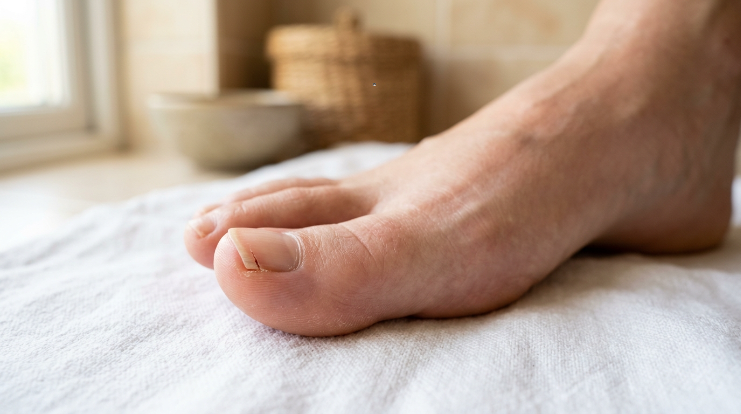
Not every damaged toenail looks the same.
A crack may appear as:
- A small split along the free edge
- Peeling layers at the tip
- A vertical crack running toward the base
- A corner that repeatedly breaks
- A rough, crumbly edge
- A crack combined with thickening or discoloration
- A nail that begins separating from the skin underneath
The hard visible part of your toenail is called the nail plate. Beneath it is the nail bed, while the nail matrix near the base produces new nail cells.
Minor damage limited to the free edge may simply grow out. A crack extending deeper toward the attached part of the nail deserves more caution because pulling or cutting it may injure the sensitive tissue underneath.
Why Are My Toenails Cracking?
Several different problems can make toenails more likely to split.
1. Your Toenails Are Dry and Brittle
Dry nails are less flexible. Instead of bending slightly when pressure is applied, they may split or crack.
Dryness can become more noticeable during colder weather, with repeated exposure to drying products, or when the nail naturally becomes more brittle.
The American Academy of Dermatology notes in its nail-trimming guidance that moisturizing after trimming can help nails stay flexible and that dry nails split more easily.
If your toenails mainly have rough edges or small superficial splits without pain, swelling, major discoloration, or thickening, dryness may be part of the problem.
2. Tight Shoes Keep Pressing on the Nail
Your shoes can affect your toenails more than you might realize.
A narrow toe box may repeatedly push your toes against the front or sides of the shoe. Running, hiking, dancing, or standing for long periods can add even more repetitive pressure.
Over time, that small amount of trauma can weaken the nail.
You may notice:
- Cracking on one particular toe
- Tenderness after wearing certain shoes
- A bruised-looking area
- A nail becoming thicker or uneven
- Damage that keeps appearing in the same spot
Try shoes that give your toes enough room to move without allowing your foot to slide excessively inside them.
3. A Previous Toe Injury Damaged the Nail
Dropping something on your toe, stubbing it against furniture, or repeatedly hitting the toe inside athletic shoes can affect the nail as it grows.
The damage may not always appear immediately.
Because toenails grow slowly, an injury around the nail matrix can produce visible changes later. Cleveland Clinic explains that injuries can interfere with nail growth and may cause changes such as ridges, discoloration, or other abnormalities.
If the crack keeps growing outward with the nail and healthy-looking nail gradually replaces it from the base, previous trauma may have been responsible.
4. You May Be Filing the Toenail Too Aggressively
A nail file is useful for smoothing sharp edges, but more filing is not always better.
Using a very coarse file on a natural toenail can remove nail material too quickly. Heavy pressure may leave the edge thin, rough, or vulnerable to splitting.
Repeatedly sawing back and forth can also be unnecessarily harsh.
The American Academy of Dermatology recommends smoothing rough nail edges with a file or emery board and filing in the same direction rather than aggressively moving backward and forward.
For routine natural-toenail maintenance, control matters more than speed.
5. You Are Cutting the Toenails Too Short
Very short toenails may seem neat, but trimming aggressively can create problems.
Avoid cutting deeply into the corners or removing so much length that the nail bed feels exposed.
For most routine care:
- Use clean toenail clippers.
- Trim conservatively.
- Cut mostly straight across.
- Smooth only rough edges with a gentle file.
- Do not dig underneath the nail.
Leaving a small amount of free edge also gives you something to file without repeatedly thinning the attached nail.
6. A Fungal Nail Infection May Be Involved
A fungal infection can make a toenail brittle enough to crack, split, or crumble.
Look beyond the crack itself.
Possible signs include:
- Yellow, white, brown, or otherwise unusual discoloration
- Thickening
- Crumbling
- Material accumulating beneath the nail
- Nail lifting
- Changes affecting more of the nail over time
The NHS fungal nail infection guide notes that infected nails may become brittle, discolored, thicker than usual, or crumbly.
Do not assume every cracked nail is fungal. Injury and other nail disorders can look similar. If you suspect an infection, getting the cause confirmed is smarter than repeatedly filing the nail thinner or applying random DIY treatments.
7. Skin or Nail Conditions Can Affect Nail Strength
Certain skin conditions can change how a nail grows.
For example, psoriasis and some inflammatory skin conditions may affect nail texture, thickness, attachment, or strength. Cleveland Clinic notes that injuries, infections, skin diseases, and other conditions can cause nails to crack or break more easily.
This is especially worth considering when you have nail changes along with skin symptoms elsewhere.
8. Less Common Health Factors May Play a Role
A single cracked toenail is usually more suggestive of local problems such as trauma, pressure, dryness, or infection than a nutritional deficiency.
However, widespread or persistent nail changes can sometimes occur alongside medical conditions, medications, skin disorders, or nutritional problems.
Avoid diagnosing a deficiency simply from your toenails or starting high-dose supplements because of something you saw online.
If several nails suddenly become weak, thin, misshapen, or unusually brittle, mention the change to a healthcare professional.
How to Tell What May Be Causing the Cracking
This quick comparison can help you decide what to look at next.
| What You Notice | Possible Explanation | Reasonable Next Step |
|---|---|---|
| Small dry splits at the edge | Dryness or normal brittleness | Moisturize and file gently |
| Crack repeatedly appears on one toe | Shoe pressure or repeated trauma | Check footwear and activities |
| Crack after a clear injury | Nail trauma | Protect it and watch new growth |
| Thin, rough edge after pedicures | Over-filing or aggressive trimming | Reduce filing and pressure |
| Yellow, thick, crumbly nail | Possible fungal infection | Seek professional evaluation |
| Nail lifting from the nail bed | Trauma, infection, or another nail disorder | Avoid filing underneath; get advice |
| Pain, swelling, warmth, or drainage | Possible infection or injury | Seek medical care |
| New changing dark streak | Requires medical evaluation | See a dermatologist |
The American Academy of Dermatology advises having significant changes in nail color, texture, or shape examined because some changes may indicate infection or another medical condition.
How to Care for a Minor Cracked Toenail at Home
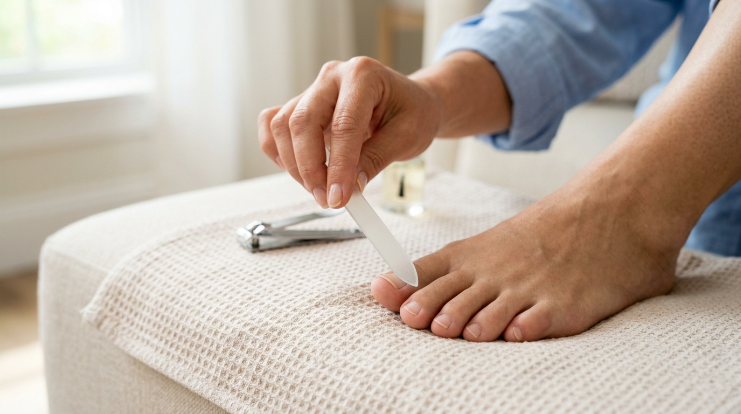
If the crack is small, painless, and limited to the free edge, basic care may be enough while it grows out.
Step 1: Clean the Toe
Wash your foot gently with soap and water.
Dry carefully, especially around and between your toes.
Good foot hygiene matters because damaged nail edges can catch on socks and may expose surrounding skin to irritation.
Step 2: Do Not Peel the Cracked Section
A partially split piece of nail can be tempting to pull.
Don’t.
Peeling it may extend the split farther into healthy nail or expose tender skin underneath.
Step 3: Trim Only Loose Excess Nail
If a clearly detached edge is catching on your socks, use clean toenail clippers to remove only what can be safely trimmed.
Never force your clipper through a deep crack.
If trimming causes pain, stop.
Step 4: Smooth the Edge With the Right Nail File
Use a fine or moderately fine nail file intended for natural nails.
File gently rather than trying to grind the crack away.
For many healthy natural toenails, an emery board or glass file is enough. Very coarse salon files and electric files can remove nail material faster than a beginner expects.
Step 5: Moisturize the Nail and Surrounding Skin
Apply a simple moisturizer to the nail and surrounding skin after bathing or before bed.
This is particularly useful when your nails and feet feel dry.
Avoid packing thick products beneath a lifted nail.
Step 6: Reduce Repeated Pressure
Take a look at your shoes.
Your toes should have space without constantly striking the front of the shoe.
If the cracking improves when you switch footwear, repeated pressure may have been contributing.
Step 7: Let Healthy Nail Grow Out
A damaged toenail cannot be instantly restored to its original structure.
Your goal is to prevent additional damage while healthy nail gradually grows forward.
That process takes patience because toenails grow considerably more slowly than fingernails.
Choosing a Nail File for Cracked Toenails
The best tool is not necessarily the most aggressive one.
| File Type | Typical Cost Level | Best Use | Main Limitation |
|---|---|---|---|
| Emery board | Low | Smoothing routine rough edges | Wears out and is difficult to sanitize fully |
| Glass/crystal file | Moderate | Gentle shaping of natural nails | Can break if dropped |
| Metal file | Low to moderate | Durable reusable filing | May feel aggressive with heavy pressure |
| Electric file | Higher | Specialized shaping or thick product removal | Easy to over-file without training |
For a simple crack on an otherwise healthy natural toenail, a gentle manual file is usually easier to control than an electric file.
Avoid aggressively thinning the nail surface simply because the nail looks uneven.
Expert Tip: When smoothing a cracked toenail, focus only on removing the snag. You do not need to make the entire nail perfectly thin or smooth. The less healthy nail you remove, the more structure remains to protect the toe while the damage grows out.
Hygiene Matters When Filing Cracked Toenails
Your nail tools come into contact with skin, nail debris, and occasionally tiny breaks in the skin.
Keep them clean.
Good habits include:
- Wash reusable tools after use.
- Dry them completely before storing.
- Replace disposable files when worn or dirty.
- Do not share personal nail files.
- Avoid using the same porous file on a suspicious fungal nail and then on healthy nails.
- Store tools somewhere clean and dry.
If a file becomes damaged, heavily worn, or impossible to clean properly, replacing it is usually the smarter choice.
Common Mistakes to Avoid
A minor cracked toenail can become more troublesome when you over-treat it.
Avoid these common mistakes:
- Peeling the split nail off. This can extend the crack.
- Filing aggressively until the nail feels thin. Thin nails may become even easier to damage.
- Cutting deeply into the corners. This may irritate the surrounding skin and contribute to ingrown nails.
- Using an electric file without good control. It is easy to remove too much nail.
- Covering suspicious nail changes with polish indefinitely. Cosmetic coverage does not address a possible infection or medical condition.
- Sharing nail files or pedicure tools. Personal nail tools should remain personal.
- Assuming every cracked nail means vitamin deficiency. Many cracks have local causes.
- Trying to file away a fungal infection. Filing may improve appearance temporarily but does not establish or treat the underlying cause.
- Ignoring pain, swelling, drainage, or major color changes. Those symptoms deserve more attention than routine home grooming.
DIY Care vs. a Professional Pedicure
A nail technician can be helpful when your nail is healthy but difficult to shape neatly.
DIY care is reasonable for a small cosmetic split when:
- The nail is not painful.
- There is no swelling or drainage.
- The surrounding skin looks normal.
- There is no major discoloration.
- The nail is still firmly attached.
- You can trim and file it without discomfort.
A professional nail technician may help with conservative cosmetic shaping, but a salon visit should not replace medical evaluation of a suspicious nail.
If infection or disease might be involved, a dermatologist, podiatrist, or other qualified healthcare professional is the more appropriate choice.
When to See a Nail Technician or Dermatologist
Consider a nail technician for routine cosmetic shaping when the nail otherwise looks healthy and you simply have trouble achieving an even edge.
Consider a dermatologist, podiatrist, or medical professional when you notice:
- Cracking that repeatedly returns
- Significant pain or tenderness
- Redness, swelling, warmth, or drainage
- Yellow, brown, green, white, or black changes you cannot explain
- A thick, crumbly nail
- Nail separation from the nail bed
- Bleeding beneath or around the nail
- A crack extending deeply toward the base
- Multiple toenails changing at the same time
- A new or changing dark streak
The American Academy of Dermatology’s guidance on nail changes that should be examined emphasizes that certain color, texture, and shape changes deserve evaluation by a dermatologist.
You should also be more cautious with home pedicure procedures if you have diabetes, poor circulation, reduced sensation in your feet, immune-system problems, or another condition that makes foot injuries harder to manage.
How to Help Prevent Toenails From Cracking Again
Prevention usually means reducing repeated stress.
Try these habits:
- Trim conservatively and mostly straight across.
- Smooth rough edges instead of tearing them.
- Use a gentle file for natural toenails.
- Avoid excessive back-and-forth filing.
- Moisturize dry nails and surrounding skin.
- Wear shoes with adequate toe space.
- Keep feet clean and dry.
- Don’t share nail tools.
- Replace worn or unhygienic files.
- Pay attention to persistent color, texture, or thickness changes.
Small changes to your routine can matter more than adding another complicated nail treatment.
FAQs
Why do my toenails keep cracking down the middle?
Repeated trauma, dryness, structural weakness, or a problem affecting how the nail grows can contribute to recurring cracks. A crack that repeatedly extends toward the base should be evaluated rather than continually filed down.
Can toenail fungus cause cracking?
Yes. Fungal nail infections can make toenails brittle, thick, discolored, crumbly, and prone to cracking. However, cracking alone does not prove you have fungus.
Should I cut off a cracked toenail?
Only trim loose nail that can be removed comfortably and safely. Do not pull a crack or cut deeply into attached nail. Stop if trimming hurts or causes bleeding.
What nail file is best for a cracked toenail?
For minor cracks in otherwise healthy natural toenails, a gentle emery board or glass file is usually easier to control than a very coarse or electric file. File only enough to smooth the snag.
Can I put nail polish over a cracked toenail?
You can sometimes use polish over a minor cosmetic crack if the nail and surrounding skin are healthy. Avoid repeatedly hiding discoloration, crumbling, lifting, pain, or other suspicious changes that should be evaluated.
Does moisturizing help cracked toenails?
Moisturizing can help when dryness contributes to brittleness because more flexible nails are less likely to split from minor stress. Apply moisturizer to the nail and surrounding skin regularly, especially if your feet tend to be dry.
How long does a cracked toenail take to grow out?
Toenails grow slowly, so visible damage may take several months to move from the attached nail toward the free edge. Severe damage, especially on a big toenail, can take much longer to completely grow out.
Conclusion
So, why are my toenails cracking? In many cases, the answer involves dryness, repeated shoe pressure, minor injuries, improper trimming, or overly aggressive filing. Fungal infections and other nail or skin conditions can also cause cracking, especially when the nail becomes thick, discolored, crumbly, painful, or detached.
For a small cosmetic crack, keep things simple: clean the toe, avoid peeling the nail, trim conservatively, smooth the snag with a gentle file, moisturize dry areas, and reduce pressure from footwear.
Most importantly, don’t try to grind away a nail problem you do not understand.
If the cracking repeatedly returns or appears with pain, swelling, drainage, significant discoloration, thickening, or nail lifting, move beyond DIY nail care and get professional advice. Protecting the healthy nail now gives it the best chance to grow out smoothly and safely.

