
Why Are My Toenails Splitting? Common Causes and What to Do

If you keep noticing cracks, peeling layers, or rough splits at the ends of your toenails, you may be wondering, “Why are my toenails splitting?” It can be frustrating, especially when a nail keeps catching on socks or ruining an otherwise neat pedicure.
Splitting toenails often come from everyday causes such as dryness, repeated pressure from shoes, minor trauma, or filing and trimming habits. Sometimes, however, persistent splitting can be connected with a fungal infection or another nail condition.
Below, you’ll learn what different types of splitting can mean, how nail files may affect weak toenails, what you can safely do at home, and when it is better to let a nail technician, podiatrist, or dermatologist take a closer look.
Quick Answer
Toenails may split because they are dry or brittle, repeatedly squeezed by tight shoes, damaged by an injury, filed too aggressively, or affected by a fungal or skin condition. Gentle filing, proper trimming, moisture control, and better-fitting shoes can help minor damage, but persistent, painful, thick, or discolored nails should be professionally evaluated.
What Does a Splitting Toenail Actually Mean?

Your visible toenail is called the nail plate. It is made from tightly packed layers of keratin, a strong protein also found in your hair and skin.
When those layers become weakened or damaged, they may separate, crack, flake, or split.
Not every split looks the same.
You might notice:
- Thin layers peeling from the tip
- A crack starting at one corner
- A vertical line that eventually opens
- A rough edge that repeatedly breaks
- A thick nail that crumbles when trimmed
- Part of the nail separating from the skin underneath
A small split near the free edge after wearing tight shoes is different from a toenail that becomes yellow, thick, crumbly, and repeatedly breaks apart.
That is why looking at the whole nail, rather than the split alone, is important.
Common Reasons Your Toenails Keep Splitting
1. Your Toenails Are Dry and Brittle
Dry nails are less flexible, so they are more likely to crack when pressure is applied.
You may notice that the nail feels unusually hard, rough, or flaky rather than smooth and slightly flexible.
Dryness may become more noticeable if you frequently expose your toenails to polish remover, leave polish on for long periods, or repeatedly move between wet and very dry conditions.
The American Academy of Dermatology’s nail-trimming guidance notes that dry nails split more easily and recommends moisturizing after trimming. It also recommends smoothing rough edges by filing in one direction rather than sawing backward and forward.
A small amount of moisturizer around the nail and surrounding skin can be helpful when dryness is the main problem. You do not need to keep your feet damp, though. Constant moisture inside socks and shoes can create different problems.
2. Tight Shoes Are Putting Pressure on the Nail
One of the most overlooked reasons for splitting toenails is repeated pressure.
Your toes may hit the front or top of your shoes thousands of times during walking, exercise, or work. That repeated impact can gradually damage the nail even when you do not remember a specific injury.
Possible clues include:
- Splitting mainly affects the big toenail
- The problem is worse after running or long walks
- Your toe touches the end of your shoe
- The nail is bruised or tender after exercise
- The same nail repeatedly cracks in the same area
Mayo Clinic lists injury and tight-fitting shoes among causes of toenail changes and thickening, along with aging and fungal infections.
Check the toe box of your everyday shoes. Your toes should have enough room that the nail is not constantly being compressed.
3. You Are Filing the Nail Too Aggressively
A nail file should smooth an edge. It should not grind away large amounts of healthy nail.
Using an overly coarse file, filing very thin toenails repeatedly, or rapidly sawing backward and forward can weaken an already fragile edge.
According to the AAD, filing back and forth can weaken nails, while filing in one direction helps smooth rough areas more gently.
This is especially important if your toenail has already started peeling into thin layers.
Do not keep filing simply because the surface still looks imperfect. Removing more nail can make a weak area even thinner.
4. Your Toenails Are Being Trimmed Incorrectly
Toenails usually do best when they are trimmed straight across rather than deeply rounded at the corners.
Cutting the nail extremely short can also leave the edge more vulnerable to irritation and pressure.
If a thick nail needs shortening, forcing a clipper through the entire nail in one large cut may cause cracking or splintering.
Mayo Clinic recommends making small, straight cuts across thickened toenails rather than trying to remove a large section at once.
After trimming, use a file only to smooth sharp or uneven areas.
5. The Nail Has Been Injured
Dropping something on a toe, kicking furniture, repeated running, or simply wearing shoes that constantly strike the nail can damage the nail plate.
The split may not always appear immediately.
Toenails grow slowly, so damage can remain visible for months as the affected section gradually moves toward the tip.
If the nail is still attached, comfortable, and growing normally, minor trauma often needs time more than aggressive treatment.
Protect the nail from additional pressure and keep loose edges smooth so they do not catch.
6. A Fungal Nail Infection May Be Involved
A fungal infection can make a toenail weaker and more likely to crack, crumble, or split.
Possible warning signs include:
- Yellow, white, or brown discoloration
- Thickening
- Crumbling around the edge
- Material collecting under the nail
- Nail lifting
- Distorted nail shape
- Multiple nails becoming affected
The American Academy of Dermatology’s guide to nail fungus symptoms specifically lists brittle nails that crack, split, or crumble among possible signs of a fungal nail infection.
The NHS fungal nail infection guide also notes that infected nails may become brittle, discolored, thicker than normal, and crumbly.
Do not assume every split toenail is fungus. Trauma and ordinary brittleness can look similar, especially during the early stages.
If you are unsure, a healthcare professional can determine whether antifungal treatment is actually appropriate.
7. Aging or a Nail/Skin Condition May Change the Nail
Toenails commonly change as we age. Their growth may slow, and some nails become thicker or harder to manage.
Certain skin conditions can affect the nails as well. Mayo Clinic, for example, lists psoriasis among conditions associated with thickened toenails.
If several nails are changing without an obvious reason, or if splitting is accompanied by major changes in thickness, shape, color, or attachment, it is worth discussing with a dermatologist or podiatrist rather than repeatedly covering the problem with polish.
Is My Split Toenail Minor Damage or Something More?
This quick comparison can help you decide what to do next.
| What You Notice | Possible Clue | Sensible Next Step |
|---|---|---|
| Small split at the tip after filing | Mechanical damage | Smooth gently and reduce aggressive filing |
| Peeling, dry nail edges | Brittleness or dryness | Moisturize and protect from repeated trauma |
| Split mainly after running | Shoe pressure or repetitive impact | Check shoe fit and toe-box space |
| Thick, yellow, crumbly nail | Possible fungal infection | Ask a pharmacist or healthcare professional |
| Red, swollen, painful skin | Irritation or infection | Stop DIY treatment and seek professional care |
| Nail lifting from underneath | Trauma, infection, or another nail problem | Get the nail evaluated |
| Repeated unexplained splitting | Ongoing nail or health issue | Consider a dermatologist or podiatrist |
This table cannot diagnose the cause, but it can help you recognize when ordinary grooming changes may not be enough.
Can Nail Files Make Toenails Split?
Yes, they can if they are used incorrectly.
The file itself is not necessarily the problem. Grit, pressure, technique, and the condition of your nail all matter.
Emery Boards
Traditional emery boards are inexpensive and easy to replace.
They can work well for gently smoothing an ordinary toenail edge. However, coarse boards may feel harsh on thin, peeling nails.
Because many are designed to be disposable, replacing them regularly can also be simpler from a hygiene standpoint.
Glass Nail Files
Glass files generally have a smoother filing surface and are reusable.
They usually cost more upfront than a basic disposable emery board, but many people prefer the controlled feel when dealing with natural nails.
If you use a reusable file, follow its cleaning instructions and allow it to dry completely before storing it.
Metal Files
Metal files are durable, but some have relatively aggressive surfaces.
They can remove nail quickly, which is not always a benefit when your toenail is already splitting.
If the nail is thin, peeling, or fragile, a gentler tool is often easier to control.
Coarse Files
Very coarse files are generally better suited to situations where substantial thickness needs professional management rather than routine smoothing of a fragile natural nail.
If you find yourself filing and filing because a toenail is unusually thick, hard, or distorted, consider finding out why the nail changed instead of simply removing more material.
How to File a Splitting Toenail Safely
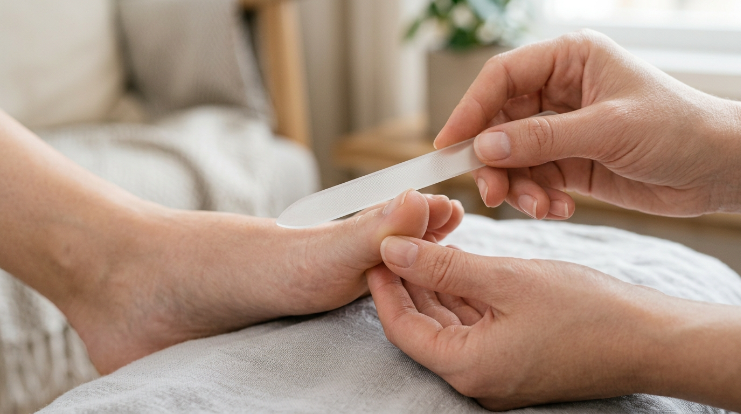
For a small cosmetic split at the edge of an otherwise normal-looking nail, try this gentle approach.
1. Start With Clean Tools
Use your own nail file rather than sharing one.
If the file is reusable, clean it according to the manufacturer’s instructions. Disposable files should be replaced when they become worn, dirty, or contaminated.
2. Examine the Nail Before Filing
Look for redness, swelling, drainage, significant discoloration, nail lifting, or a deep crack extending into attached nail.
If any of these are present, filing may not be the right first step.
3. Trim Only If Necessary
If the toenail is long, trim it straight across.
Do not cut deeply into the corners or try to remove the entire split in one aggressive cut.
4. Choose a Gentle File
Use a fine or moderate file that gives you good control.
Avoid reaching automatically for the roughest file because it works faster.
Faster removal can also mean faster thinning.
5. File in One Direction
Place the file against the rough free edge and move it gently in one direction.
Use light pressure.
Your goal is simply to remove the portion that is catching on socks or fabric.
6. Stop Before the Nail Becomes Thin
Do not continue filing until every visual imperfection disappears.
If the remaining split extends into attached nail, allow it to grow out whenever possible instead of grinding deeper into the nail plate.
7. Moisturize Dry Nail Edges
After grooming, apply a small amount of moisturizer to the nail and surrounding skin if they feel dry.
Let it absorb before putting on socks.
Expert Tip: When a toenail keeps splitting in the same place, look for the cause of repeated pressure before buying a stronger file. Changing shoe fit or filing technique may help more than removing additional nail.
How to Help a Split Toenail Grow Out
Toenails grow slowly, so improvement is usually gradual.
You can support the damaged nail while it grows by focusing on protection rather than trying to make it look perfect immediately.
Keep the Edge Smooth
A snagged nail can tear farther.
Gently smooth only the loose, rough edge instead of peeling or pulling it away.
Wear Shoes With Enough Toe Room
Make sure the front of your shoe does not constantly press against the nail.
This matters particularly for running shoes, work shoes, boots, and heels.
Avoid Picking at Peeling Layers
It can be tempting to pull away a thin layer that has already separated.
Unfortunately, that layer may continue farther into healthy nail than you expect.
Clip or gently file only the loose portion.
Give the Nail a Break From Aggressive Cosmetic Work
If your nail is thin or damaged, repeated buffing, forceful filing, and frequent product removal may make it harder to protect the weak area.
You can still care about how your toes look while giving the natural nail time to grow.
Keep Feet Clean and Dry
This does not mean allowing the nail to become painfully dry.
Instead, avoid leaving damp socks and shoes against your toes for long periods.
Good foot hygiene becomes particularly important when a nail is cracked because damaged areas can be harder to keep clean.
DIY Care vs. a Salon Visit
A nail technician can be very helpful when your problem is primarily cosmetic.
For example, a technician may be able to:
- Smooth a superficial split
- Shorten an awkward edge
- Recommend a gentler nail-file grit
- Help prevent additional damage during pedicures
- Explain how to maintain the nail between appointments
However, a nail technician cannot diagnose fungal infections, skin diseases, or other medical causes of nail changes.
Avoid asking a technician to aggressively grind down, cover, or disguise a nail that is painful, swollen, draining, lifting significantly, or showing unexplained discoloration.
A cosmetic cover-up can make a nail look better without addressing the reason it is changing.
When to See a Nail Technician or Dermatologist
A minor split near the free edge can often be managed with careful grooming.
Professional evaluation becomes more important when you notice:
- Persistent or repeated splitting without an obvious cause
- Increasing pain or tenderness
- Redness or swelling around the nail
- Pus or drainage
- Significant yellow, brown, white, green, or dark discoloration
- Thickening and crumbling
- The nail separating from the nail bed
- Several toenails changing at once
- A nail that has stopped growing normally
- A major injury or bleeding under the nail
Mayo Clinic advises seeking medical guidance for changes such as major alterations in nail color or shape, thickening, thinning, separation, bleeding, swelling, pain, or failure to grow.
People with diabetes, poor circulation, or reduced sensation in their feet should be particularly careful about self-treating toenail problems. Mayo Clinic recommends discussing toenail trimming concerns with a healthcare professional when these conditions are present.
Common Mistakes to Avoid
When a toenail starts splitting, avoid these common DIY mistakes:
- Sawing aggressively with a nail file. Repeated back-and-forth filing can weaken a fragile edge.
- Using the coarsest file available. More abrasive does not automatically mean better.
- Cutting the nail extremely short. This can increase irritation and make shoe pressure uncomfortable.
- Rounding deeply into the corners. Toenails are generally better trimmed straight across.
- Pulling off peeling layers. You may tear healthy attached nail along with them.
- Sharing nail files or clippers. Nail tools should be kept clean and personal whenever possible.
- Assuming discoloration is cosmetic. Thick, discolored, crumbly nails may need evaluation.
- Covering a suspicious nail immediately with polish. A prettier surface does not solve an underlying infection or injury.
- Ignoring shoe fit. Repeated toe pressure can continue damaging the new nail as it grows.
- Filing through pain. Pain is a reason to stop and examine what is happening.
FAQs
Why are my toenails splitting down the middle?
A split through the middle can happen after repeated trauma, pressure, or weakening of the nail plate. If the crack begins near the base, repeatedly returns, hurts, or is accompanied by major color or texture changes, have the nail professionally evaluated rather than repeatedly filing it.
Why are my toenails splitting horizontally?
Horizontal splitting or peeling near the free edge is often associated with mechanical damage or brittle nail layers. Aggressive filing and repeated pressure can make the problem worse. Protect the nail and allow the damaged section to grow out.
Can tight shoes cause toenails to crack?
Yes. Repeated pressure or impact against the front or top of a shoe can damage toenails over time. If splitting becomes worse after walking, running, wearing boots, or wearing heels, check whether your toes have enough room.
What is the best type of nail file for splitting toenails?
A gentle, fine-to-moderate file that gives you good control is usually better than an extremely coarse surface for a fragile natural toenail. The technique matters just as much: use light pressure and file the rough edge in one direction.
Should I file a cracked toenail every day?
Usually not. File only when a loose or rough edge is catching and needs smoothing. Repeatedly filing the same area can make the nail thinner. Allow the damaged portion time to grow toward the tip.
Does a splitting toenail mean I have fungus?
Not necessarily. Trauma, dryness, filing habits, and shoe pressure can also cause splitting. Fungus becomes more suspicious when splitting occurs along with thickening, discoloration, crumbling, lifting, or changes in several nails.
Can a split toenail grow back normally?
Often, yes, especially when the problem came from temporary trauma or grooming damage and the nail-producing area was not seriously injured. Toenails grow slowly, so the damaged section may remain visible for months while healthy nail grows forward.
Conclusion
If you have been asking, “Why are my toenails splitting?”, start by looking at the simple things: how you trim and file your nails, whether your shoes are putting pressure on your toes, and whether the nail is dry, damaged, thickened, or discolored.
For a small split in an otherwise healthy-looking nail, gentle filing, straight-across trimming, better shoe fit, and careful protection may be enough while the damaged area grows out.
But do not treat every split as a cosmetic problem. Persistent pain, swelling, discoloration, thickening, crumbling, or nail lifting deserves professional attention.
Treat your nail gently, correct the cause when you can identify it, and choose professional care when the nail is telling you that ordinary DIY grooming is no longer enough.

