
Why Are My Toenails Thick and Yellow? Causes, Care, and When to Get Help

Looking down and seeing a toenail that is suddenly thicker, harder, and more yellow than the others can be worrying. You may wonder if it is fungus, damage from shoes, or simply a normal change.
So, why are my toenails thick and yellow? A fungal nail infection is one common cause, but it is not the only one. Repeated pressure, old injuries, aging, psoriasis, and even nail polish staining can change how toenails look.
The key is knowing which signs you can safely manage at home and which ones deserve professional attention. Below, we will cover the most likely causes, safe filing and trimming, hygiene, treatment limitations, and warning signs you should not ignore.
Quick Answer
Why are my toenails thick and yellow? Common causes include fungal nail infections, aging, repeated shoe pressure, past toe injuries, and nail psoriasis. Fungus is especially possible when the nail is also crumbly, brittle, distorted, or lifting. Because several nail problems look alike, persistent or worsening changes should be professionally evaluated.
What Causes Thick and Yellow Toenails?
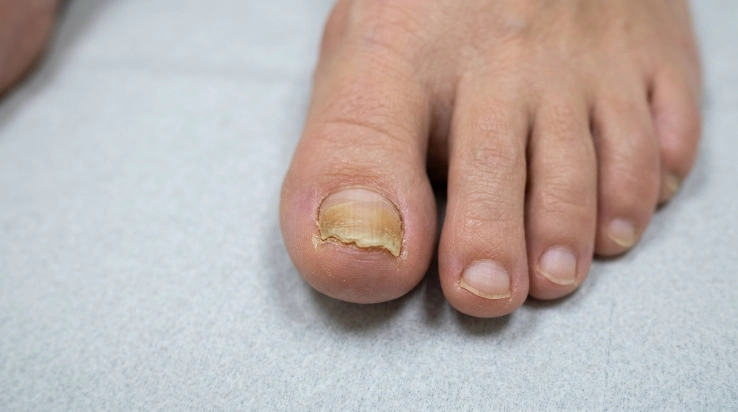
A yellow toenail does not automatically mean fungus.
Color is only one clue. Thickness, texture, pain, odor, lifting, and the number of affected nails can tell you more.
Here is a quick comparison.
| What You Notice | Possible Cause | What to Do Next |
|---|---|---|
| Thick, yellow, crumbly nail | Fungal infection | Consider medical evaluation |
| Slowly thickening nail with age | Normal age-related change | Gentle trimming and filing |
| One damaged nail after running or tight shoes | Repeated trauma | Reduce pressure and monitor |
| Yellow nail with pits or lifting | Nail psoriasis | See a dermatologist |
| Yellow surface after dark polish | Nail staining | Give nails a polish break and monitor |
| Redness, swelling, drainage, or pain | Infection or injury | Stop DIY care and seek professional help |
Appearance can point you in the right direction, but it cannot always confirm the cause.
1. Fungal Nail Infection
A fungal nail infection, also called onychomycosis, is one of the most common explanations for toenails that become both thick and yellow.
According to the American Academy of Dermatology’s guide to nail fungus symptoms, fungal nails may become thick, discolored, brittle, crumbly, misshapen, or partly separated from the nail bed.
You may notice:
- Yellow, white, or brown discoloration
- Thickening that gets worse over time
- Rough or crumbly edges
- Debris underneath the nail
- Nail lifting
- An unpleasant smell
- More than one nail gradually changing
- Athlete’s foot at the same time
Fungus often starts near an edge or tip and slowly spreads.
However, do not diagnose fungus based on yellow color alone. Other nail conditions can look surprisingly similar.
2. Repeated Pressure From Shoes
Your toenails experience pressure every day.
Shoes that are too short, narrow, or tight can repeatedly push against the nail. Running, hiking, dancing, and other high-impact activities may create similar stress.
Over time, repeated pressure can affect how the nail grows.
The nail may become:
- Thicker
- Harder
- Ridged
- Slightly yellow or brown
- Uneven
- More difficult to cut
The big toenail is especially vulnerable because it often absorbs more pressure inside a shoe.
If only one nail is affected and you regularly wear tight shoes or have a history of toe trauma, repeated pressure is worth considering.
3. An Old Toenail Injury
Sometimes the cause happened months or even years ago.
Maybe you dropped something on your toe, jammed it into a shoe, lost the nail after running, or badly bruised it.
Damage to the nail matrix—the area that produces the nail—can change the way new nail grows.
The new nail may stay:
- Thick
- Ridged
- Uneven
- Discolored
- Harder than neighboring nails
Toenails also grow slowly, so damage can remain visible for a long time.
A previous injury does not rule out fungus, though. A damaged nail can sometimes become more vulnerable to infection.
4. Aging
Toenails commonly change as people get older.
The nail may grow more slowly and become thicker. Years of pressure from footwear and everyday activity can add to the change.
The Mayo Clinic’s guide to thickened toenails notes that aging is a common reason for nail thickening, while fungal infections, psoriasis, injury, and tight-fitting shoes are other possible causes.
Age-related thickening tends to be gradual.
A nail that changes suddenly, becomes painful, starts crumbling, or develops significant discoloration deserves a closer look.
5. Nail Psoriasis
Psoriasis does not only affect skin.
It can also change fingernails and toenails.
Nail psoriasis may cause yellow, white, or brown discoloration along with:
- Tiny dents or pits
- Thick buildup beneath the nail
- Crumbling
- Roughness
- Nail lifting
- Increased thickness
The American Academy of Dermatology’s nail psoriasis guide explains that nail psoriasis can even occur in someone who does not have obvious psoriasis elsewhere on the skin.
This is another reason not to assume that every yellow, thick toenail is fungal.
6. Nail Polish Staining
Dark polish can sometimes leave toenails looking yellow after removal.
This tends to affect the surface color more than the actual thickness of the nail.
If your toenail is both very thick and yellow, polish staining probably does not explain everything.
Try leaving the nail unpolished for a while and watch how the new nail looks as it grows.
Do not aggressively buff away the yellow color. Over-buffing can make the nail thin, tender, and more vulnerable to damage.
How Can I Tell if My Thick Yellow Toenail Is Fungus?
There is no perfect home test.
Fungus becomes more likely when several changes occur together.
For example, be more suspicious if the nail is:
- Yellow or brown
- Increasingly thick
- Brittle
- Crumbling
- Misshapen
- Lifting from the nail bed
- Collecting debris underneath
You may also develop changes in several toenails rather than just one.
Still, psoriasis and old injuries can imitate fungal infection.
A dermatologist or other qualified healthcare professional may take a clipping or scraping when the diagnosis is uncertain. The sample can be examined to help determine whether fungus is actually present.
That can save you from spending months treating the wrong problem.
Can I File Down Thick Yellow Toenails?
You can sometimes gently file a thick toenail for comfort, but filing does not cure the reason it became thick.
This distinction matters.
If fungus is responsible, the organisms can live within the nail and tissue beneath it. The American Academy of Dermatology notes that filing cannot remove all nail fungus.
Think of a nail file as a grooming tool.
It may help you:
- Smooth sharp edges
- Reduce snagging on socks
- Make a manageable nail easier to trim
- Remove minor roughness
- Improve comfort
It should not be used to grind an abnormal toenail aggressively until it looks thin again.
Which Nail File Is Best for Thick Toenails?
Different nail-file materials behave differently.
| File Type | Best For | Cost Level | Main Limitation |
|---|---|---|---|
| Emery board | Light smoothing | Low | Wears out quickly and is difficult to thoroughly clean |
| Glass or crystal file | Controlled edge smoothing | Medium | Slow on very thick nails |
| Metal file | Harder nails | Low to medium | Can remove nail quickly if too much pressure is used |
| Coarse professional file | Limited thickness reduction | Low to medium | Easy to over-file |
| Electric nail file | Professional-level reduction | Medium to high | Can cause injury when used incorrectly |
For most DIY care, control matters more than speed.
An electric file may look convenient, but it can remove nail very quickly. Incorrect use can create heat, soreness, thinning, or injury to the skin underneath.
If a toenail requires heavy grinding to make it manageable, professional care is the safer choice.
Expert Tip: If you cannot clearly tell where the hard nail ends and sensitive tissue begins, do not keep thinning it. Smooth the rough edge and let a qualified professional handle major thickness reduction.
How to File a Thick Toenail More Safely
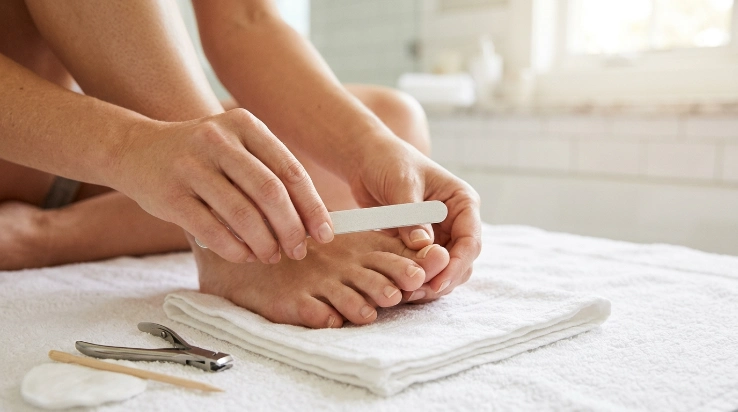
If the toenail is painless, firmly attached, and shows no swelling, drainage, or bleeding, gentle grooming may be reasonable.
1. Wash Your Feet and Tools
Start with clean feet.
Also clean the nail file, clipper, or nipper you plan to use.
If you suspect fungus, do not use that same uncleaned tool on healthy nails.
2. Make the Nail Easier to Work With
A thick toenail may be easier to trim after bathing because it is temporarily less hard.
Dry the foot well before you begin filing, especially between the toes.
3. Trim Only What You Can Safely Reach
Use a proper toenail clipper if the nail can be trimmed without excessive pressure.
Make small cuts instead of trying to remove a large piece at once.
Avoid digging deeply into the corners.
4. Smooth the Free Edge
Use light, controlled strokes to remove sharp or rough areas.
Do not aggressively saw the file across the nail.
5. Reduce Surface Thickness Only Slightly
If the top is extremely uneven, you may gently smooth it.
Stop immediately if you notice:
- Pain
- Heat
- Tenderness
- Sensitivity
- Bleeding
- Pink or unusually thin-looking nail
You are not trying to make a thick nail match a normal nail in one session.
6. Clean Your Tools Again
Nail hygiene becomes especially important when fungus is possible.
The American Academy of Dermatology’s nail fungus prevention advice recommends keeping feet clean and dry, avoiding shared nail-grooming tools, and disinfecting grooming tools to reduce fungal spread.
If you use disposable emery boards on a suspicious nail, replacing them rather than sharing or repeatedly reusing them is the simpler hygiene choice.
What Not to Do to a Thick Yellow Toenail
It is easy to get too aggressive when a nail looks unhealthy.
Avoid:
- Peeling away loose-looking layers
- Digging underneath the nail
- Cutting deeply into the corners
- Filing until the nail feels hot
- Using excessive pressure with an electric file
- Sharing files or clippers
- Applying random treatments without knowing the cause
- Covering painful or infected-looking nails with cosmetic products
Also avoid assuming that making the nail look thinner means you have fixed the problem.
Cosmetic improvement and medical treatment are not the same thing.
What If It Really Is Toenail Fungus?
Treatment depends on how much of the nail is affected and other individual factors.
Options may include prescription treatments applied to the nail or oral antifungal medicine. Dermatologists may also reduce nail thickness in some cases to improve comfort or help treatment work better.
One frustrating part is that results are slow.
Even after the infection has been successfully treated, the damaged-looking section has to grow out. A big toenail can take a year or longer to look clear again.
That is why a treatment should not automatically be judged as a failure simply because yellow nail is still visible after a few weeks.
How to Prevent Thick Yellow Toenails From Getting Worse
Good everyday habits help whether your problem comes from repeated trauma or fungal risk.
Try to:
- Keep feet clean and dry
- Change damp or sweaty socks
- Wear shoes with enough toe room
- Let shoes dry between wears
- Keep toenails reasonably short
- Trim toenails straight across
- Clean nail tools before use
- Avoid sharing nail files and clippers
- Wear sandals in shared showers and locker rooms
- Address athlete’s foot rather than ignoring it
Your shoes matter more than you may think.
If your toes constantly hit the front of your shoes, filing the nail every few weeks will not remove the repeated source of trauma.
DIY Care vs. Professional Care
You do not need a dermatologist for every slightly thick toenail.
But there are limits to what a home pedicure should accomplish.
| Situation | DIY Grooming | Nail Technician | Dermatologist/Podiatrist |
|---|---|---|---|
| Mild rough edge | Usually reasonable | Yes | Usually unnecessary |
| Healthy but slightly thick nail | Gentle filing may help | Often appropriate | Usually unnecessary |
| Very thick nail | Difficult to manage safely | May help cosmetically | Often safer |
| Possible fungus | Cannot diagnose | Should not diagnose | Can evaluate and treat |
| Painful or lifting nail | Avoid aggressive care | Cosmetic service may be inappropriate | Recommended |
| Redness, drainage, bleeding | Stop DIY care | Avoid routine pedicure | Seek medical care |
| Psoriasis-like changes | Filing will not treat cause | Cosmetic care only | Dermatologist evaluation |
At-home tools have the lowest upfront cost, while professional nail services and medical treatment cost more and vary widely by location, insurance, treatment type, and how complicated the nail problem is.
The cheapest option is not always the safest one. If you keep buying stronger tools because you cannot cut the nail, professional trimming may make more sense.
When to See a Nail Technician or Dermatologist
A nail technician can help groom a healthy nail that is simply difficult to shape or smooth.
However, a nail technician should not be expected to diagnose fungus, psoriasis, bacterial infection, or another medical condition.
Consider a dermatologist, podiatrist, or other healthcare professional when:
- Yellowing keeps spreading
- The nail continues getting thicker
- The nail becomes crumbly or badly distorted
- It starts lifting away from the nail bed
- You have pain when walking or wearing shoes
- Skin around the nail is swollen or very red
- You see bleeding or drainage
- You develop a new unexplained dark streak
- Several nails start changing
- Home treatment is not helping
You should also be especially cautious about DIY cutting or filing if you have diabetes, poor circulation, reduced sensation in your feet, or another condition that makes foot injuries harder to detect or heal.
Mayo Clinic’s nail fungus guidance recommends medical advice when suspected nail fungus occurs with diabetes, bleeding, swelling, pain, or difficulty walking.
Common Mistakes to Avoid
- Assuming yellow automatically means fungus. Several conditions can cause similar nail changes.
- Grinding the nail aggressively. A thinner-looking nail does not mean the underlying problem has been fixed.
- Using the same dirty file on every nail. This can spread organisms between nails.
- Sharing nail tools. Keep personal grooming tools personal.
- Ignoring footwear. Tight shoes can repeatedly traumatize toenails.
- Cutting deeply around corners. This may irritate the skin and contribute to ingrown nails.
- Covering unusual changes with polish indefinitely. Check the bare nail occasionally so you can notice changes.
- Ignoring pain or swelling. These are not merely cosmetic concerns.
- Expecting overnight results. Toenails grow slowly, so healthy-looking replacement nail can take many months.
FAQs
Why are my toenails thick and yellow but not painful?
Fungal infection, aging, repeated shoe pressure, or old injuries can cause thick yellow toenails without immediate pain. Lack of pain does not reveal the cause. Monitor the nail and seek professional advice if the change progresses, crumbles, lifts, or spreads.
Does a thick yellow toenail always mean fungus?
No. Fungus is common, but trauma, psoriasis, aging, and other nail changes can create a similar appearance. A professional examination or nail sample may be needed when the diagnosis is unclear.
Can I file away toenail fungus?
No. Filing may reduce roughness or thickness, but it cannot remove fungus living deeper within the nail and tissue underneath it. Filing should be considered grooming, not fungal treatment.
Should I use a coarse file on thick yellow toenails?
A moderately coarse file can remove hard nail faster, but use very light pressure. Aggressive filing can cause heat, tenderness, or accidental thinning. Stop if the nail becomes sensitive.
Can a pedicure fix yellow thick toenails?
A pedicure may improve the look of a healthy thick nail, but it cannot diagnose or cure a fungal infection or psoriasis. Painful, crumbling, swollen, bleeding, or suspicious nails should be medically evaluated before cosmetic treatment.
How long does a damaged yellow toenail take to grow out?
Toenails grow slowly. A big toenail can take a year or longer to fully replace damaged nail, particularly after treatment for fungal disease. That means appearance can improve much more slowly than the underlying condition.
When should I worry about toenail discoloration?
Seek professional advice if discoloration is getting worse, comes with pain, swelling, bleeding, nail lifting, drainage, major distortion, or a new unexplained dark line. Significant or rapidly changing nail abnormalities should not be handled only as a cosmetic problem.
Conclusion
If you have been asking, “Why are my toenails thick and yellow?”, fungus is certainly one possibility, but it is not the only answer.
Aging, repeated shoe pressure, previous injury, and nail psoriasis can create similar changes. That is why the safest approach is to look at the whole picture rather than focusing only on the yellow color.
For a mildly thick, painless nail, gentle trimming, careful filing, clean tools, dry feet, and better-fitting shoes may help with everyday maintenance.
But do not aggressively grind, cut, or cover up a nail that is painful, crumbling, lifting, swollen, or continuing to change. When the cause is unclear, a dermatologist or podiatrist can help determine what you are actually dealing with and whether treatment is needed.
Take a good look at the nail today, clean your grooming tools, and choose the safest next step based on what you see—not simply on how you want the nail to look.

