Why Are My Toenails Thick? Causes, Care, and When to Get Help

If you have looked down at your feet and wondered, “Why are my toenails thick?”, you are definitely not alone. Toenails can become harder, wider, more difficult to trim, or noticeably different in color and texture for several reasons.
Sometimes thick toenails are simply related to aging or repeated pressure from shoes. In other cases, they can be connected to a fungal infection, previous nail injury, or a skin condition such as psoriasis.
The important thing is not to immediately assume that every thick nail is fungus—or aggressively file it thinner before knowing what may be causing the change.
Below, we will go through the most common causes of thick toenails, signs worth paying attention to, safer ways to trim and file them, hygiene tips, and situations where a nail technician, podiatrist, or dermatologist may be the better choice.
Quick Answer
Why are my toenails thick? Common causes include normal aging, fungal nail infections, repeated pressure from tight shoes, previous toe injuries, and conditions such as psoriasis. Mild thickening can sometimes be managed with careful trimming and filing, but painful, discolored, crumbling, swollen, or worsening nails should be evaluated by a healthcare professional.
What Does a Thick Toenail Look Like?

A thick toenail is more than a nail that simply feels strong.
You may notice that the nail plate—the hard visible part of your nail—has become noticeably deeper from top to bottom. It may also feel unusually hard when you try to clip it.
Other changes can include:
- Yellow, white, brown, or darker discoloration
- A rough or uneven surface
- Crumbling around the edge
- Changes in nail shape
- Material building up underneath the nail
- Separation between the nail and nail bed
- Difficulty fitting comfortably inside shoes
- Tenderness when pressure is placed on the toe
According to the American Academy of Dermatology’s information on nail fungus symptoms, fungal nail infections can cause thickening along with discoloration, cracking, crumbling, lifting, and changes in nail shape.
However, fungus is only one possibility.
Why Are My Toenails Thick? Common Causes
Several different things can make a toenail thicker. Looking at how the nail changed and whether other symptoms are present can help you decide what to do next.
1. Normal Aging
Toenails often change as we get older.
Nails grow more slowly with age, and toenails may gradually become thicker and harder. The change can happen slowly enough that you barely notice it until cutting your nails becomes more difficult.
The Mayo Clinic’s guide to thickened toenails identifies aging as a common reason toenails become thicker.
Age-related thickening is not necessarily a problem by itself. The main issue is that very hard nails can become difficult to trim safely.
2. Toenail Fungus
A fungal nail infection, medically called onychomycosis, is another common reason for toenail thickening.
Fungus tends to thrive in warm, moist environments, which is one reason toenails are affected more frequently than fingernails.
Along with thickening, you may notice:
- Yellowish, whitish, or brown discoloration
- Brittle or crumbly edges
- Debris beneath the nail
- An unpleasant odor
- Nail lifting
- An irregular or distorted nail shape
One important point: you cannot reliably diagnose nail fungus based only on appearance.
Nail injuries and psoriasis can sometimes resemble a fungal infection. A dermatologist may examine the nail and, when appropriate, test a nail clipping or sample before recommending treatment.
3. Repeated Pressure From Shoes
Your favorite shoes could potentially be contributing to the problem.
Shoes that repeatedly press against your toes can cause small amounts of trauma to the nails over time. You may not remember a specific injury because the pressure happens gradually.
This is particularly relevant if you:
- Wear shoes with narrow toe boxes
- Run or walk long distances
- Spend hours standing
- Frequently wear shoes that are too short
- Notice your toes hitting the front of your footwear
Persistent pressure can alter nail growth and contribute to thickening.
Make sure your shoes leave enough space for your toes to lie naturally rather than being compressed together.
4. Previous Nail Injury
Have you ever dropped something on your toe, stubbed it badly, or lost a toenail?
An old injury can affect the area where the nail grows. The replacement nail may return thicker, ridged, irregular, or slightly different in shape.
Because toenails grow slowly, changes related to an injury can remain visible for many months.
If one toenail is noticeably different while the others look normal, previous trauma is one possibility worth considering.
5. Psoriasis
Psoriasis can affect nails as well as skin.
Nail psoriasis may cause thickening, discoloration, separation from the nail bed, small pits in the surface, or buildup underneath the nail.
This can sometimes look similar to toenail fungus.
If you already have psoriasis—or notice suspicious skin patches along with nail changes—consider discussing your toenails with a dermatologist rather than assuming you need an antifungal product.
6. Severely Overgrown Nails
In some cases, nails can become extremely thick, curved, and overgrown.
A condition known as onychogryphosis can produce very thick, distorted nails that sometimes resemble a horn or claw. This is not something you should aggressively cut or grind down at home.
The American Academy of Dermatology recommends professional care for severely thick, overgrown nails because safe cutting and treatment may require a dermatologist or podiatrist.
Is a Thick Toenail Always Fungus?
No.
This is one of the biggest misconceptions surrounding thick toenails.
Fungal infections certainly can make toenails thick, but so can:
- Aging
- Repetitive trauma
- Tight footwear
- Nail psoriasis
- Previous injury
- Certain nail-growth disorders
That matters because treatments are different.
Using antifungal products repeatedly on a nail that is thick because of trauma will not address the underlying cause. Likewise, simply filing down a fungal nail does not eliminate the infection.
If the cause is unclear and the nail keeps changing, professional evaluation is more useful than guessing.
Thick Toenail Symptoms: What They May Suggest
| What You Notice | Possible Explanation | Best Next Step |
|---|---|---|
| Gradual thickening without pain | Aging or repeated pressure | Monitor and maintain carefully |
| Thick, yellow, crumbly nail | Possible fungal infection | Consider professional evaluation |
| One thick nail after an injury | Nail trauma | Protect it and monitor regrowth |
| Thick nail plus skin psoriasis | Possible nail psoriasis | Dermatologist evaluation |
| Nail lifting from the nail bed | Fungus, trauma, or another nail problem | Avoid pulling it off; seek advice |
| Redness, warmth, swelling, or drainage | Possible infection | Seek medical care |
| Very thick, curved, difficult-to-cut nail | Severe overgrowth | Podiatrist or dermatologist |
This table is only a guide. Appearance alone cannot confirm the cause of a nail condition.
How to Trim Thick Toenails More Safely
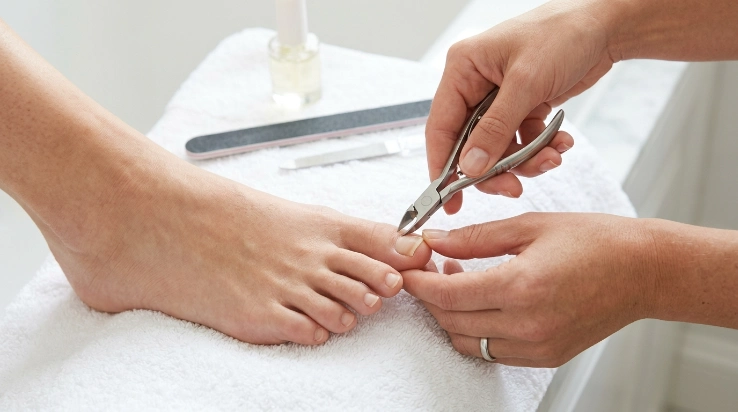
If your toenails are only mildly thick, are not infected-looking, and you can safely reach them, careful home grooming may make them easier to manage.
The American Academy of Dermatology’s nail-trimming guidance recommends softening nails before trimming and cutting toenails straight across.
Step 1: Soften the Nail
Trim your toenails after bathing or showering when possible.
You can also soak your feet in lukewarm water for several minutes.
Softening the nail can make cutting easier and reduce the temptation to force a clipper through a very hard nail.
Dry your feet thoroughly afterward, especially between your toes.
Step 2: Use the Right Tool
Regular fingernail clippers may struggle with thick toenails.
Depending on the nail thickness, you might use:
- Standard toenail clippers
- Heavy-duty toenail clippers
- Nail nippers
- A manual nail file or emery board
A nail nipper can give you more leverage for thick nails, but it is also sharp.
Never force a clipper through a nail if you cannot control the tool comfortably.
Step 3: Take Small Cuts
Avoid trying to remove the entire nail edge in one large clip.
Instead, make several small cuts across the nail.
This gives you more control and may reduce cracking or splitting.
Step 4: Cut Straight Across
Toenails should generally be trimmed straight across rather than deeply rounded at the corners.
Digging into the corners can increase your risk of an ingrown toenail.
Step 5: Smooth the Edge
Once the nail is trimmed, use a nail file to remove sharp or rough areas.
A smooth edge is less likely to snag on socks or scratch nearby skin.
Can I File Down a Thick Toenail?
Yes, gentle filing can help manage some thick toenails, particularly after trimming.
But filing should be used for smoothing and controlled thinning—not aggressive grinding.
If you file too deeply, you can make the nail tender and potentially damage the nail plate or skin underneath.
For routine at-home care, manual filing usually gives beginners more control than an electric nail drill.
Choosing a Nail File
You may come across several options.
Emery boards: Affordable and easy to find. They wear out relatively quickly and are difficult to disinfect thoroughly.
Glass or crystal files: Durable and washable, although very fine glass files may work slowly on extremely thick toenails.
Metal files: Strong and durable but potentially aggressive if used with too much pressure.
Electric nail files: Fast, but they create more risk of heat, excessive thinning, and accidental skin injury when used without training.
For a thick natural toenail, the goal should be controlled grooming—not creating a paper-thin nail.
Expert Tip: If you cannot tell where thick nail ends and sensitive tissue begins, stop filing. Leaving the nail slightly thicker is much safer than accidentally filing into living tissue.
Nail File Grit and Thick Toenails
Grit describes how coarse or fine a nail file is.
A lower grit number generally means a rougher, more aggressive file. A higher number indicates a finer surface.
Very coarse files can remove material quickly, but beginners can also remove too much nail quickly.
When working on a natural toenail, use controlled pressure and finish with a smoother file rather than aggressively sawing at the nail.
If the nail is extremely thick, painful, crumbly, or difficult to control, professional thinning may be safer.
Thick Toenail Tool and Cost Considerations
You do not need an expensive pedicure kit simply because your toenails are thick.
Your main priorities should be control, cleanliness, comfort, and appropriate tool strength.
| Option | Relative Cost | Best For | Main Limitation |
|---|---|---|---|
| Emery board | $ | Light smoothing | Wears out quickly |
| Glass file | $$ | Gentle finishing | Slow on very thick nails |
| Heavy-duty toenail clipper | $–$$ | Moderately thick nails | Requires good hand control |
| Nail nipper | $$ | Harder, thicker nails | Sharp and easier to misuse |
| Electric nail file | $$–$$$ | Faster material removal | Higher risk of over-filing |
| Professional nail reduction | Varies | Very thick or difficult nails | Requires an appointment |
Professional prices vary considerably depending on whether you visit a salon, podiatrist, or dermatologist and whether medical treatment is needed.
A salon pedicure may improve appearance, but a nail technician should not diagnose or medically treat suspected infections or nail disease.
Hygiene Matters More When Nails Are Thick
Thick nails can develop uneven areas where moisture and debris collect.
Basic foot hygiene therefore matters.
The CDC’s foot-hygiene recommendations include washing your feet regularly, drying them completely, wearing appropriate footwear, and checking your feet for cuts, swelling, and infected toenails.
For your nail tools:
- Keep personal clippers and files separate from other people’s tools.
- Do not share nail files.
- Clean reusable tools appropriately.
- Replace worn disposable emery boards.
- Allow washable tools to dry completely before storing them.
- Do not file visibly infected nails and then use the same uncleaned tool on healthy nails.
If you visit a salon, choose one that follows appropriate cleaning and disinfection practices.
What Not to Do to a Thick Toenail
Trying to “fix” the appearance too aggressively can create a bigger problem.
Avoid:
- Peeling layers off the nail
- Digging underneath the nail with sharp tools
- Cutting deep into the corners
- Filing until the nail feels hot or sensitive
- Using an electric drill at high speed without proper experience
- Cutting inflamed or bleeding skin
- Covering suspicious changes indefinitely with polish
- Assuming every yellow thick nail is fungus
- Sharing files or clippers
If you suspect an infection, cosmetic grooming should not replace proper evaluation.
Common Mistakes to Avoid
Filing Too Aggressively
More pressure does not necessarily give a better result.
Aggressive filing can make the nail tender, weaken it, and irritate surrounding skin.
Trying to Make the Nail Thin in One Session
A thick nail that developed over months or years does not need to become perfectly thin during one pedicure.
Prioritize comfort and safety.
Using Dirty Nail Tools
Reusable tools can collect nail dust and debris.
Clean them between uses and never share personal nail tools when infection is a possibility.
Cutting the Corners Deeply
Rounded, deeply cut toenail corners can contribute to ingrown nails.
Keep your cut reasonably straight across.
Treating Before Knowing the Cause
Toenail fungus can resemble other nail conditions. The American Academy of Dermatology’s nail fungus diagnosis and treatment guidance explains that dermatologists may test nail material because psoriasis and injuries can look similar to fungus.
That is especially important before committing to lengthy treatment.
Can a Pedicure Help Thick Toenails?
A careful pedicure can improve the appearance and smoothness of uncomplicated thick toenails.
A nail technician may be able to:
- Trim manageable nail growth
- Smooth rough edges
- Improve the cosmetic appearance
- Suggest basic grooming tools
However, a salon is not the right place to diagnose a suspicious nail.
If there is pain, swelling, bleeding, drainage, significant discoloration, severe distortion, or suspected infection, medical or podiatric care should come first.
When to See a Nail Technician or Dermatologist
A nail technician can help with cosmetic grooming of otherwise healthy nails.
A dermatologist or other healthcare professional is more appropriate when the nail change may have a medical cause.
Consider professional medical advice if:
- Your toenail keeps getting thicker
- The nail becomes painful
- Several nails suddenly change
- The nail becomes increasingly yellow, brown, green, or black
- The nail crumbles significantly
- The nail separates from the nail bed
- Skin around the nail becomes red, swollen, warm, or painful
- You notice bleeding or drainage
- You have difficulty walking because of the nail
- You cannot safely cut the nail yourself
You should also be especially cautious about DIY foot care if you have diabetes, reduced sensation in your feet, or circulation problems. Small cuts can become more significant in people with these conditions.
A podiatrist can also be a valuable option when nails are too thick or difficult to cut safely.
Can Thick Toenails Become Normal Again?
It depends on the cause.
A toenail that became thick after temporary trauma may gradually improve as healthier nail grows.
If pressure from footwear is contributing, changing shoe fit may help prevent continued damage.
Fungal infections may require specific treatment, and improvement is slow because the damaged nail has to grow out.
Age-related thickening may not completely disappear but can often be managed with appropriate grooming.
Remember that toenails grow slowly. Visible improvement can take months rather than weeks.
How to Help Prevent More Toenail Problems
You cannot prevent every reason a toenail may become thick, but basic habits can reduce avoidable irritation and infection risk.
Try to:
- Wear shoes with adequate toe room.
- Keep feet clean and dry.
- Change damp socks promptly.
- Trim toenails straight across.
- Smooth sharp edges gently.
- Avoid sharing nail tools.
- Wear protective footwear in communal wet areas.
- Treat athlete’s foot rather than ignoring it.
- Check toenails periodically for new changes.
- Avoid repeatedly traumatizing the same toe.
Consistency matters more than aggressive grooming.
FAQs
Why are my toenails getting thicker as I get older?
Toenails can naturally become thicker with age because nail growth changes and slows. However, new discoloration, crumbling, pain, or major shape changes should not automatically be blamed on aging.
Why is only one toenail thick?
A single thick toenail may be related to an old injury, repeated shoe pressure, fungus, or another localized nail problem. If you cannot identify a cause or the nail keeps changing, consider having it examined.
Are thick yellow toenails always fungus?
No. Fungus is a common possibility, especially when thickening occurs with yellowing and crumbling, but psoriasis, trauma, and other nail conditions can look similar.
Can I use a nail file on thick toenails?
Yes, gentle filing can smooth rough edges and reduce some thickness. Avoid aggressive filing or drilling into the nail. Stop if you experience pain, heat, bleeding, or sensitivity.
What is the best tool for cutting very thick toenails?
Heavy-duty toenail clippers or nail nippers may work better than small fingernail clippers. However, extremely hard, curved, painful, or difficult-to-reach nails may be safer for a podiatrist or other qualified professional to trim.
Will thick toenails grow out?
Sometimes. If the thickening resulted from temporary trauma, healthier nail may gradually replace the damaged section. Fungal, age-related, or chronic nail conditions may require ongoing management or treatment.
Should I get a pedicure if I have thick toenails?
A routine pedicure may be appropriate for uncomplicated cosmetic thickening. If the nail appears infected, painful, swollen, bleeding, significantly discolored, or detached, seek medical guidance before having it cosmetically treated.
Conclusion
If you keep asking, “Why are my toenails thick?”, remember that there is not one universal answer. Aging, fungal infections, repetitive shoe pressure, old injuries, psoriasis, and other nail conditions can all change toenail thickness.
For uncomplicated nails, careful straight-across trimming, gentle filing, clean tools, and properly fitting shoes may make everyday care much easier.
The biggest mistake is trying to aggressively thin or treat a nail without understanding what caused the change. Pain, swelling, bleeding, crumbling, major discoloration, severe overgrowth, or worsening thickness deserves professional attention.
Treat your toenails like the rest of your beauty routine: keep them clean, use the right tools, avoid unnecessary damage, and get expert help when something does not look or feel right.