
Why Do Toenails Develop Ridges? Causes, Care, and When to Worry

Have you looked down during a pedicure and suddenly noticed lines running across or along your toenails? Some ridges are subtle enough that you only see them when the light hits your nail. Others feel rough, deep, or noticeably different from the rest of the nail.
So, why do toenails develop ridges? Often, mild vertical ridges are simply part of normal nail growth and may become more noticeable with age. Other ridges can appear after pressure, injury, illness, or changes that temporarily interrupt nail growth.
The direction of the ridge matters, as do other symptoms such as discoloration, thickening, pain, swelling, or nail lifting.
Below, you will learn what different toenail ridges can mean, when they are usually harmless, how nail files fit into safe care, which mistakes can make ridges worse, and when a nail technician or dermatologist is the better choice.
Quick Answer
Toenails can develop ridges because of normal aging, natural nail-growth changes, repeated shoe pressure, previous injury, dryness, or temporary interruptions in nail growth. Mild vertical ridges are often harmless. Deep horizontal ridges, sudden changes, discoloration, pain, swelling, thickening, or nail lifting deserve closer attention and may require professional evaluation.
What Exactly Are Toenail Ridges?

A toenail ridge is a raised line, groove, or uneven area in the nail plate.
The nail plate is the hard part you trim and polish. It grows from the nail matrix, which is located beneath the skin near the base of the nail.
As new nail cells form, they harden and slowly move forward. If nail production changes temporarily, the finished nail can develop differences in texture.
Toenail ridges generally fall into two categories:
- Vertical ridges: Lines running from the base of the nail toward the tip.
- Horizontal ridges: Lines or grooves running from one side of the nail to the other.
That difference is important because the two patterns can have very different meanings.
Why Do Toenails Develop Vertical Ridges?
Vertical ridges are the pattern many people notice first.
They run in the same direction the toenail grows, beginning near the cuticle and extending toward the free edge.
Mild vertical ridging can occur naturally and tends to become more noticeable as people get older. Mayo Clinic notes that vertical nail ridges are common and can become more prominent with age because of changes in nail-cell turnover. Mayo Clinic’s guidance on nail ridges
Normal Aging and Nail Growth
Toenails do not stay perfectly smooth throughout life.
As the nail-producing cells beneath the skin change with age, the surface may become slightly more uneven. Think of it like subtle texture rather than damage that needs to be removed.
If your ridges:
- Run vertically
- Have appeared gradually
- Are similar across several nails
- Are not painful
- Are not accompanied by major color changes
- Have remained relatively stable
they may simply represent normal variation.
A perfectly smooth toenail is not required for a healthy-looking nail.
Repeated Pressure From Shoes
Toenails deal with more mechanical pressure than fingernails.
Tight shoes, running shoes with inadequate toe room, high heels, or repeated contact with the front of footwear can place pressure on the nail and surrounding tissue.
That repeated stress may affect how the nail grows.
Ask yourself whether the ridged nail is also the toe that commonly:
- Rubs against your shoes
- Becomes sore after walking
- Bruises after running
- Hits the front of your footwear
- Develops thickened skin nearby
If so, footwear may be contributing to the problem.
Previous Nail Injury
A toenail can record an old injury for months because toenails grow slowly.
Stubbing your toe, dropping something on it, cutting it too short, or having an aggressive pedicure may temporarily disturb nail growth.
The resulting irregularity can remain visible long after the toe stops hurting.
As the nail grows, the damaged area should gradually move toward the tip.
What Causes Horizontal Ridges in Toenails?
Horizontal ridges deserve more attention, particularly when they are deep or suddenly appear.
A deep horizontal groove is sometimes called a Beau’s line.
These lines can develop when nail growth slows or temporarily stops. The American Academy of Dermatology explains that deep grooves running across a nail can appear when something interrupts nail growth, including illness, injury, or significant physical stress. AAD guidance on nail changes that should be examined
One horizontal ridge does not automatically mean something serious.
Context matters.
Injury to the Toe
A strong impact can temporarily affect the nail matrix.
For example, you might develop a horizontal line weeks after:
- Stubbing the toe badly
- Dropping a heavy object on your foot
- Wearing shoes that repeatedly crush the nail
- Having aggressive toenail work performed
Because toenails grow slowly, you may have forgotten about the original injury by the time the line becomes obvious.
Illness or Physical Stress
If the body temporarily slows nail production during an illness or another major physical stressor, a groove can later become visible in the nail.
That does not mean you should diagnose an illness based on a toenail ridge.
Instead, think of a horizontal line as one piece of information.
A new deep groove across several nails, especially when you cannot connect it to an injury, is worth discussing with a healthcare professional.
Toenail Ridge Patterns at a Glance
| What You Notice | Possible Explanation | Reasonable Next Step |
|---|---|---|
| Mild vertical lines | Normal nail variation or aging | Gentle routine care and observation |
| Vertical ridges with rough edges | Dryness or ordinary wear | Moisturize and smooth only the free edge |
| Ridge after toe injury | Temporary growth disturbance | Protect the nail and watch it grow forward |
| Deep horizontal groove | Interrupted nail growth | Consider professional evaluation if unexplained |
| Ridges plus yellowing or thickening | Could involve another nail condition | Avoid assuming the cause; get it checked |
| Ridge plus redness or swelling | Irritation or possible infection | Stop DIY filing and seek professional advice |
| New dark streak | Pigment change requiring assessment | See a dermatologist |
This table can help you decide what to do next, but it cannot diagnose the cause of a nail change.
Can Toenail Fungus Cause Ridges?
Toenail fungus can change nail texture, but ridges alone do not prove that you have fungus.
Fungal nail infections may cause:
- Yellow, brown, or white discoloration
- Thickening
- Brittle or crumbly texture
- Nail lifting
- Buildup beneath the nail
- Changes in nail shape
The American Academy of Dermatology lists thickening, discoloration, crumbling, lifting, and misshaping among common signs of nail fungus. AAD guide to nail fungus symptoms
Because trauma and other nail conditions can create similar changes, avoid treating every ridged or yellow toenail as fungus without a proper diagnosis.
A nail file cannot cure nail fungus.
Filing may temporarily smooth an edge, but fungi can live within the nail and tissue beneath it.
Can Nutritional Problems Cause Toenail Ridges?
Nail changes are sometimes associated with nutritional deficiencies, but a ridge is not a reliable at-home test for vitamin or mineral levels.
It is easy to see a social-media post saying that one particular ridge means you are deficient in iron, zinc, magnesium, or another nutrient.
The reality is less simple.
Many nail changes can have multiple possible causes.
If your toenail ridges are accompanied by other symptoms or you are concerned about your nutrition, discuss those concerns with a healthcare professional instead of starting high-dose supplements based only on how your nails look.
Should You File Ridges Off Your Toenails?
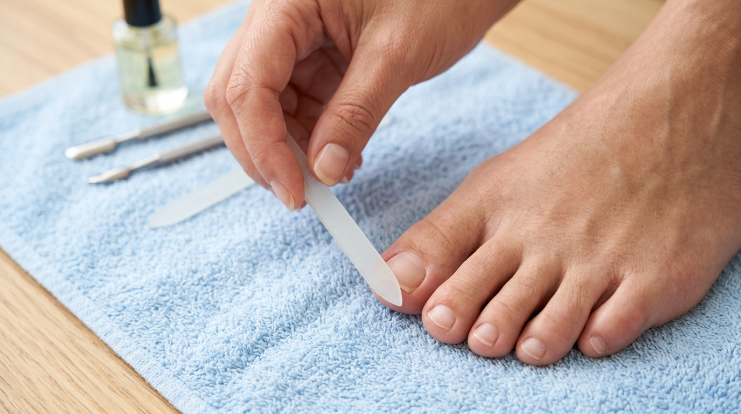
Usually, you should not aggressively file or buff the top of a ridged toenail simply to make it perfectly smooth.
Your nail plate has limited thickness.
Repeatedly grinding down the raised portions can leave the nail thinner, weaker, sensitive, or more likely to split.
A nail file is much better used for smoothing the free edge of the toenail.
The American Academy of Dermatology recommends smoothing rough nail edges with a nail file or emery board and filing in the same direction rather than repeatedly sawing back and forth. AAD nail-trimming and filing guidance
Choosing a Nail File for Ridged Toenails
For otherwise healthy natural toenails, gentler tools are generally easier to control.
| Tool | Best Use | Cost Level | Benefits | Main Caution |
|---|---|---|---|---|
| Fine emery board | Smoothing free edges | Low | Inexpensive and disposable | Wears out quickly |
| Glass/crystal file | Gentle edge finishing | Moderate | Smooth feel and reusable | Can break if dropped |
| Metal file | Small rough areas | Low–Moderate | Durable | Heavy pressure can feel aggressive |
| Buffer block | Very light cosmetic smoothing | Low | Easy to hold | Over-buffing can thin the nail |
| Electric file | Specialized shaping | Moderate–High | Fast material removal | Easy to over-file natural nails |
You do not need an expensive professional tool to care for ordinary toenail edges.
For most people, a basic toenail clipper plus a gentle manual file is enough.
How to File a Ridged Toenail Safely
If the nail itself looks otherwise healthy and you simply need to remove a snag:
- Wash and thoroughly dry your feet.
- Use your own clean nail file.
- Trim excess length straight across if needed.
- Hold the file against the free edge rather than grinding the top surface.
- Use light strokes in one direction.
- Smooth only areas that catch on socks or neighboring toes.
- Stop immediately if the nail feels hot, tender, or painful.
- Clean reusable tools after use.
Do not dig underneath a lifting nail or aggressively file into its sidewalls.
Expert Tip
Expert Tip: Instead of trying to erase a ridge, take a clear photo of the bare toenail once a month. If the ridge gradually moves toward the tip as the nail grows, you can track progress without repeatedly filing and thinning the nail.
How to Care for Ridged Toenails at Home
If the ridges are mild and there are no warning signs, simple protective care is usually more useful than trying to polish the surface perfectly flat.
Moisturize Dry Toenails
Dry nails can feel rougher and may split more easily.
After bathing, apply a small amount of moisturizer to the nail plate and surrounding skin.
This does not remove existing ridges, but it can help keep dry nail and skin more flexible.
Trim Toenails Straight Across
Toenails should generally be trimmed straight across rather than deeply rounded into the corners.
This helps reduce irritation and the risk of ingrown toenails.
Do not cut them down to the skin.
Check Your Shoes
Your toenails should not repeatedly strike the front of your footwear.
If one particular shoe causes tenderness, bruising, or nail pressure, consider whether you need:
- A wider toe box
- More length
- Different socks
- Better lacing
- Different footwear for exercise
Removing repeated trauma can be more useful than filing the resulting ridge.
Protect Your Cuticles
The cuticle is a protective seal around the growing nail.
Avoid cutting it aggressively or repeatedly pushing it back.
Damaging this area can increase irritation and make it easier for germs to enter around the nail.
Keep Nail Tools Hygienic
Toenail tools should be treated as personal hygiene items.
Do not casually share:
- Nail clippers
- Files
- Buffers
- Cuticle tools
Disposable emery boards should be replaced when dirty or worn.
Reusable files and clippers should be cleaned according to their material and manufacturer instructions.
This matters especially when a nail looks suspicious for fungus or another infection.
What If the Nail Is Thick, Yellow, or Crumbling Too?
A ridge becomes more important when other changes appear with it.
Pay attention if your toenail becomes progressively:
- Thicker
- Yellow, brown, greenish, or unusually white
- Brittle
- Crumbly
- Painful
- Misshapen
- Detached from the nail bed
Do not try to grind a thick, abnormal nail until it looks normal.
Aggressive filing may create heat, tenderness, or small injuries without addressing the underlying cause.
If you suspect fungus, psoriasis, significant trauma, or another nail condition, proper evaluation is more useful than cosmetic filing.
DIY Care vs. Professional Care
DIY nail care is reasonable when your toenails are painless, stable, easy to reach, and mainly need ordinary trimming or smoothing.
A basic home kit is also inexpensive. A clipper and emery board may cost only a few dollars, while reusable glass files and higher-quality tools typically cost more upfront but may last longer.
A salon pedicure costs more per visit but can provide convenience and cosmetic shaping.
However, a nail technician is not a substitute for a dermatologist or podiatrist when the problem may be medical.
Beauty care should never delay evaluation of a painful, infected, or unexplained nail change.
When to See a Nail Technician or Dermatologist
A nail technician can help when your toenails are otherwise healthy and you want:
- Cosmetic shaping
- Polish application
- Routine pedicure care
- Gentle smoothing of ordinary rough edges
Choose a salon that uses good hygiene practices and properly cleans reusable tools.
A dermatologist, podiatrist, or other qualified healthcare professional is more appropriate when you notice:
- A deep horizontal groove with no obvious explanation
- Sudden changes involving several nails
- Increasing redness
- Swelling or warmth
- Pus or drainage
- Persistent pain
- Significant nail lifting
- Progressive thickening
- Crumbling
- Unexplained color changes
- A new or changing dark streak
- Repeated ingrown toenails
- Difficulty walking because of the nail
The NHS also advises seeking medical help for unexplained changes in nail shape or color and for sore, swollen, warm skin around a nail. NHS guidance on nail problems
If you have diabetes, reduced sensation in your feet, poor circulation, or difficulty safely reaching your toenails, get professional guidance before attempting aggressive DIY care.
Common Mistakes to Avoid
Ridged toenails often need patience more than aggressive treatment.
Avoid these common mistakes:
- Buffing until the ridge disappears. This may thin and weaken the nail plate.
- Assuming every ridge means a vitamin deficiency. Nail appearance alone cannot reliably diagnose nutritional problems.
- Treating every thick nail as fungus. Several nail conditions can look similar.
- Filing a painful toenail. Pain is a reason to stop and investigate the cause.
- Using extremely coarse files on natural nails. Faster material removal also increases the chance of damage.
- Cutting deeply into the nail corners. This may contribute to irritation and ingrown nails.
- Sharing files and clippers. Personal nail tools can spread infectious organisms.
- Ignoring footwear pressure. Repeated shoe trauma can continue affecting new nail growth.
- Covering unexplained nail changes with polish indefinitely. Periodically inspect your bare toenails.
- Expecting ridges to disappear quickly. Toenails grow slowly, so visible changes may take months to move toward the tip.
FAQs
Are vertical ridges in toenails normal?
Mild vertical ridges can be normal and tend to become more noticeable with age. If the nail is otherwise comfortable and stable without major discoloration, swelling, crumbling, or lifting, the ridges may simply be a normal variation.
Why did a ridge suddenly appear across my toenail?
A horizontal ridge may appear after an injury, illness, or another event that temporarily slowed nail growth. Because toenails grow slowly, the event may have happened weeks or months before you noticed the groove.
Can I buff vertical ridges off my toenails?
Light cosmetic buffing may temporarily reduce the appearance of superficial unevenness, but aggressive or repeated buffing can thin the nail. It is usually better to accept mild ridging and focus on keeping the nail protected.
Do toenail ridges mean I have a vitamin deficiency?
Not necessarily. Toenail ridges have many possible causes, including normal aging and trauma. A nail ridge alone cannot tell you whether you have a nutrient deficiency. Discuss concerns with a healthcare professional before taking supplements specifically to treat nail ridges.
Can toenail fungus cause ridges?
Fungal infections can change nail texture, but ridges alone are not enough to diagnose fungus. Yellowing, thickening, crumbling, lifting, or buildup under the nail can also occur with fungal infection and deserve evaluation.
Will toenail ridges eventually grow out?
A ridge caused by a temporary injury or growth interruption may gradually move toward the tip as new nail grows from the base. Age-related vertical ridges may remain because they are part of the nail’s ongoing growth pattern.
What nail file is best for ridged toenails?
For ordinary natural toenail care, a gentle emery board or glass file is usually enough to smooth rough free edges. Avoid using an extremely coarse file to grind away the top of the ridged nail.
Conclusion
So, why do toenails develop ridges? The answer depends largely on what the ridges look like and what else is happening with the nail.
Mild vertical ridges are often a normal part of nail growth and may become more visible with age. Ridges can also follow repetitive shoe pressure or previous nail trauma. Deep horizontal grooves may indicate that nail growth was temporarily interrupted and deserve more attention when the cause is unclear.
Your safest approach is usually simple: keep toenails trimmed straight across, smooth rough edges gently, protect them from tight shoes, moisturize dry nails, keep grooming tools clean, and resist the urge to file every ridge perfectly flat.
Most importantly, pay attention to the whole nail rather than the ridge alone.
Pain, swelling, drainage, major discoloration, progressive thickening, lifting, or a new dark streak are reasons to stop treating the problem as cosmetic and get qualified professional advice.
Take a look at your bare toenails today and compare them over time. Gentle care and careful observation will usually tell you far more than aggressive filing.

