
Why Do Toenails Have White Lines? Common Causes and What to Do

You take off your polish, look down at your feet, and suddenly notice one or more white lines running across a toenail. It is easy to wonder whether the mark means you have a vitamin deficiency, nail fungus, or something more serious.
So, why do toenails have white lines? In many cases, the answer is surprisingly simple: minor pressure or injury to the nail as it grows. Tight shoes, repetitive rubbing, a stubbed toe, or an aggressive pedicure can all leave white marks behind.
However, not every white line has the same cause. The appearance of the line, how many nails are affected, and whether the nail is thick, crumbly, painful, or lifting can provide useful clues.
This guide explains the most common causes, how to care for your toenails safely at home, when fungus may be involved, and when a nail change deserves professional attention.
Quick Answer
White lines on toenails are often caused by minor injury or repeated pressure from shoes, sports, or pedicures. These marks usually grow out with the nail. Fungal infection, nail lifting, certain medications, and less commonly health conditions can also cause white discoloration. Persistent or unusual changes should be checked professionally.
What Do White Lines on Toenails Actually Mean?
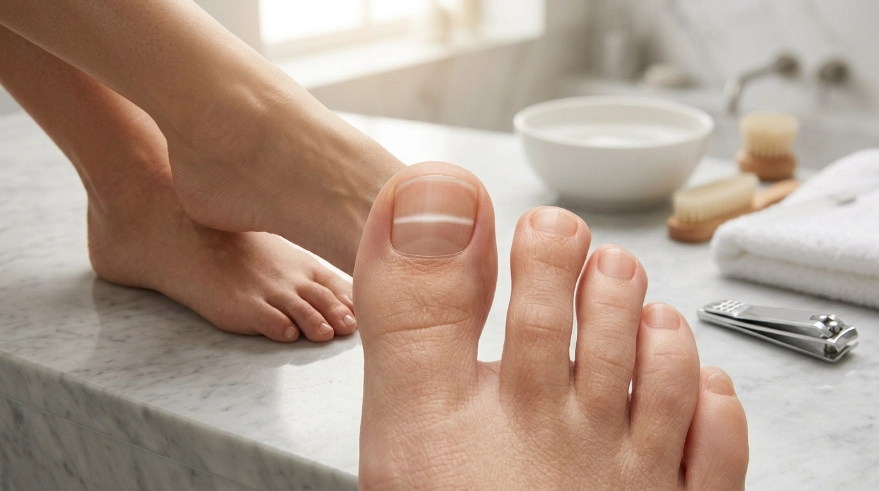
The medical term often used for white spots or streaks in nails is leukonychia. The white area may develop within the hard nail plate, underneath it, or on its surface.
The Cleveland Clinic’s explanation of leukonychia divides white nail changes into three general types: true leukonychia involving the nail plate, apparent leukonychia involving the nail bed underneath, and pseudoleukonychia caused by something affecting the nail’s surface, such as fungus.
You do not need to identify these medical categories yourself. What matters at home is noticing the pattern.
Ask yourself:
- Is there one small white line or are several nails affected?
- Does the mark seem to move toward the tip as the nail grows?
- Is the nail still smooth and firmly attached?
- Is there yellowing, thickening, crumbling, or debris underneath?
- Have you recently worn tight shoes, increased your exercise, stubbed your toe, or had a pedicure?
Those details can help you decide whether simple observation is reasonable or whether the nail should be examined.
The Most Common Causes of White Lines on Toenails
1. Minor Trauma or Pressure
Minor trauma is one of the most common explanations for white lines or spots.
You do not necessarily have to remember injuring your toe. Toenails experience small amounts of stress every day.
Possible triggers include:
- Shoes that press against the end of your toes
- Running, hiking, dancing, or other repetitive activity
- Stubbing a toe
- Dropping something lightweight on your foot
- Cutting or filing the nail too aggressively
- Excessive buffing during a pedicure
- Pressure from artificial toenails or product removal
If the area where your toenail forms is briefly disturbed, the new nail may develop a white mark.
This is especially common on big toenails because they receive considerable pressure inside shoes.
Cleveland Clinic notes that injury to the nail plate or nail matrix is a common cause of white nail markings, including pressure from shoes that are too small.
What It Usually Looks Like
Trauma-related white marks are often:
- Limited to one or two toenails
- Smooth rather than powdery
- Not painful
- Surrounded by otherwise normal-looking nail
- Slowly moving toward the tip as the nail grows
If that sounds like your toenail, monitoring it may be all that is necessary.
Toenails grow slowly. Cleveland Clinic notes that a trauma-related white spot on a toenail can sometimes take 12 to 18 months to completely grow out.
2. Tight Shoes and Repeated Toe Pressure
Your favorite pair of shoes may be cute but still create trouble if your toes constantly hit the front.
Shoes that are too short, narrow, or tight can repeatedly press the toenail against the toe. Over time, that repeated pressure can damage the nail as it develops.
This is especially common if you:
- Run regularly
- Walk long distances
- Wear pointed-toe shoes frequently
- Spend hours standing
- Wear high heels that push your feet forward
Check your shoes before blaming your diet or supplements.
There should be enough room for your toes to move comfortably without repeatedly hitting the front of the shoe.
If the same white lines keep returning, footwear is worth investigating.
3. Fungal Nail Infection
White areas can sometimes be caused by toenail fungus, also called onychomycosis.
Fungus does not always begin as the classic thick yellow toenail people imagine. Some fungal infections can produce white or whitish-yellow areas.
According to the American Academy of Dermatology’s guide to nail fungus symptoms, fungal nails may develop white discoloration along with thickening, brittleness, cracking, crumbling, lifting, or buildup beneath the nail.
A superficial fungal infection may also create a white area that looks:
- Chalky
- Powdery
- Rough
- Dry
- Irregular rather than forming a perfectly smooth line
Do not aggressively scrape or sand away suspicious white areas. That can thin the nail and may spread fungal material to other nails or tools.
A dermatologist, podiatrist, or other healthcare professional can examine the nail and, when needed, test nail clippings before recommending treatment.
4. Nail Lifting
Sometimes what looks like a white line is actually an area where the toenail has started separating from the skin underneath.
This separation is called onycholysis.
When air gets beneath the nail, the detached area may look white rather than pink.
Possible triggers include:
- Trauma
- Tight footwear
- Fungal infection
- Psoriasis
- Repeated nail product exposure
- Aggressive cleaning beneath the nail
The American Academy of Dermatology’s guide to nail changes recommends professional evaluation when a nail starts lifting because infection or another nail condition may be involved.
Avoid digging underneath a lifted nail. The space is easier to injure and can collect moisture and debris.
5. Pedicure or Nail Product Damage
A pedicure should not hurt.
Aggressive cuticle work, heavy buffing, forceful filing, scraping, or repeated product removal can irritate the nail and surrounding tissue.
Even when you do not feel significant pain, the nail matrix—the area that produces new nail—may experience enough stress to create a temporary white mark.
Nail products can occasionally contribute too. Polish, removers, hardeners, adhesives, and artificial nail products may irritate or damage sensitive nails in some people.
If white lines repeatedly appear after pedicures, consider taking a product break and asking your nail technician to use a gentler approach.
6. Psoriasis and Other Nail Conditions
Psoriasis can affect toenails as well as skin.
Nail psoriasis may cause:
- White, yellow, or brown discoloration
- Small pits
- Crumbling
- Thickening
- Nail lifting
- Buildup underneath the nail
The American Academy of Dermatology notes that nail psoriasis can sometimes appear even when skin symptoms are not obvious.
Because psoriasis, fungus, and trauma can sometimes produce similar-looking nail changes, appearance alone may not provide a reliable diagnosis.
7. Medications or Underlying Health Conditions
White lines across several nails are much less commonly related to medication exposure or an underlying medical problem.
Certain patterns of white lines have historically been associated with severe illness, medication effects, chemotherapy, heavy-metal exposure, or changes involving proteins in the blood.
That does not mean a single white toenail line should make you worry about serious disease.
The pattern matters.
White lines caused by everyday trauma are much more likely when only one or two toenails are affected and you otherwise feel well. Broader white bands appearing at similar levels across several nails deserve more attention, especially when there is no obvious history of injury.
Are White Lines on Toenails Caused by Vitamin Deficiency?
This is one of the most common nail myths.
You may have heard that white marks automatically mean you need more calcium, zinc, or another supplement. The evidence is not that straightforward.
Cleveland Clinic states that researchers are not certain whether mineral or vitamin deficiencies directly cause typical leukonychia and that available evidence is not strong enough to assume a deficiency simply from white nail markings.
So avoid starting high-dose supplements based only on the appearance of your toenails.
If you are also experiencing symptoms such as unusual fatigue, weakness, unexplained weight changes, or other health concerns, a healthcare professional can decide whether blood testing is appropriate.
White Lines vs. Fungal Toenails: A Quick Comparison
| Nail Feature | Minor Trauma/Pressure | Possible Nail Fungus |
|---|---|---|
| White mark | Smooth spot or line | White, yellowish, or irregular patch |
| Nail thickness | Usually normal | May become thicker |
| Surface | Usually smooth | May become rough or powdery |
| Crumbling | Uncommon | More common |
| Debris under nail | Usually absent | Can develop |
| Nail lifting | Possible after trauma | Can occur |
| Number of nails | Often one or two | May spread to other nails |
| Pain | Usually none | Sometimes develops |
| Best next step | Reduce pressure and monitor | Consider professional evaluation |
This table can help you spot differences, but it cannot confirm fungus. Nail injuries, psoriasis, and fungal infections can overlap in appearance.
What Should You Do About White Lines on Your Toenails?
If your toenail is otherwise healthy and the white line seems connected to pressure or minor trauma, you usually do not need to remove it.
Instead:
- Leave the white area alone. Avoid scraping or aggressively buffing it.
- Trim the nail straight across. Do not cut deeply into the corners.
- Switch to roomy footwear. Your toes should not continuously hit the front.
- Keep your feet clean and dry. Moist environments can encourage fungal growth.
- Watch the line over time. Trauma-related discoloration should gradually move toward the tip with nail growth.
- Take a monthly photo. Comparing photos can make slow changes much easier to notice.
Patience matters. Toenails grow far more slowly than most people expect.
How to Clean Under Your Toenails Safely
If you are wondering how to clean under your toenails, gentler is better.
You do not need to dig deeply beneath the nail.
The UK’s NHS advises against cleaning underneath nails with sharp objects because doing so can damage the tissue and increase the risk of problems.
A safer routine is:
- Soak or wash your feet with warm water and mild soap.
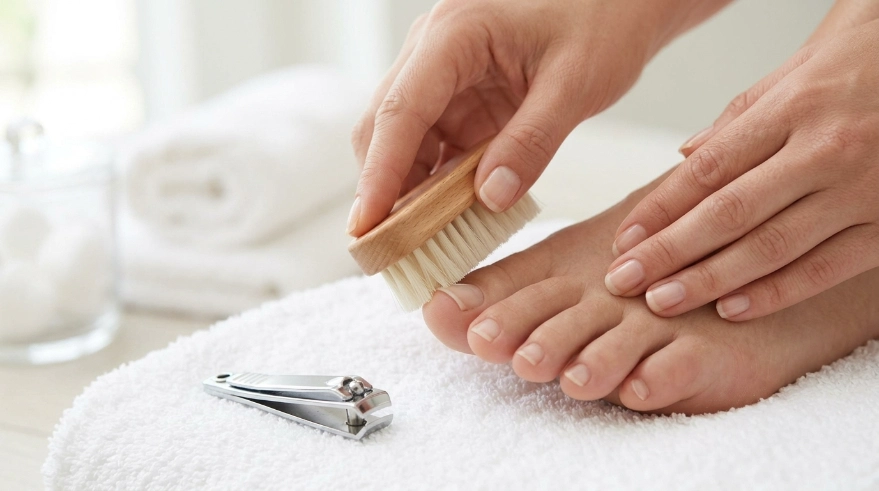
- Use a soft nail brush to loosen visible surface debris.
- Rinse thoroughly.
- Dry carefully, especially between your toes.
- Trim long toenails straight across with clean toenail clippers.
- Wash and dry the tools after use.
If debris is trapped deeply underneath a thickened or lifted nail, do not force a tool underneath it. That is a good reason to ask a podiatrist, dermatologist, or qualified foot-care professional for help.
Choosing Basic Toenail-Care Tools
For ordinary maintenance, you usually need very little.
A sturdy stainless-steel toenail clipper is easier to clean than a worn or rusty tool. A soft nail brush is useful for gentle cleaning, while a fine nail file can smooth sharp edges.
Basic home tools are generally inexpensive—often under about $20 for a simple clipper, file, and brush set. A salon pedicure costs more and can be convenient for cosmetic maintenance, while medical evaluation costs vary considerably depending on your location, insurance, and whether testing is required.
Never share toenail clippers or files when an infection is suspected.
Can You Cover White Lines With Nail Polish?
Usually, yes, if the nail and surrounding skin are healthy.
Regular polish can temporarily hide a harmless white line while it grows out.
However, consider leaving the nail bare if you notice:
- Thickening
- Crumbling
- Powdery white areas
- Nail lifting
- Pain
- Redness
- Swelling
- Drainage
Constantly covering a changing nail can make it harder to monitor what is happening.
If you use gel polish, press-ons, or artificial toenails, avoid applying them over a nail you think may be infected or damaged.
Expert Tip
Expert Tip: If you are unsure whether a white line is changing, take a clear photo once every four weeks in the same lighting. A trauma-related mark should gradually move toward the tip as the toenail grows. A mark that expands, spreads, or changes differently deserves a closer look.
Common Mistakes to Avoid
- Scraping the white line away. You can thin or damage the nail without fixing the cause.
- Assuming every white mark is fungus. Trauma and pressure are very common.
- Assuming it is automatically a calcium deficiency. White nail marks alone cannot diagnose a nutritional problem.
- Cutting toenails extremely short. This may irritate the skin and increase your risk of ingrown toenails.
- Digging underneath the nail with metal tools. This can injure the nail bed.
- Ignoring tight footwear. Repeated toe pressure may keep creating new nail damage.
- Sharing pedicure tools. Clippers and files should be cleaned properly and not shared when infection is possible.
- Covering a worsening nail continuously with polish. Give yourself opportunities to check its color, thickness, and attachment.
When to See a Nail Technician or Dermatologist
A nail technician can help with cosmetic maintenance when your toenails are healthy. They can trim, shape, polish, and help you maintain a neat pedicure.
However, nail technicians do not replace medical evaluation.
A dermatologist, podiatrist, or healthcare professional is the better choice when you notice:
- White discoloration spreading across the nail
- Several toenails changing at the same time
- Thickening or significant distortion
- Crumbling or powdery areas
- Nail separation
- Pain, swelling, redness, or warmth
- Drainage or bleeding
- A new dark brown or black streak
- Repeated white bands without an obvious source of pressure
- Changes that continue rather than growing out
- Diabetes, poor circulation, or reduced sensation in your feet
If there is suspected nail fungus, professional testing can be useful because other nail conditions may mimic fungus.
Do not try to aggressively thin, drill, or scrape a suspicious toenail at home.
How to Help Prevent White Lines From Coming Back
You cannot prevent every nail injury, but simple habits can reduce unnecessary stress.
Keep your toenails comfortably short and cut them mostly straight across. Choose shoes with enough space around your toes, particularly for exercise.
Dry your feet after bathing and change damp socks promptly. If you get salon pedicures, choose a clean salon and speak up if filing, buffing, or cuticle work feels painful.
Give damaged toenails time to recover before repeatedly applying artificial enhancements.
Most importantly, pay attention to patterns. One harmless mark that grows out is very different from repeated changes affecting several nails.
FAQs
Why do I suddenly have a white horizontal line on my big toenail?
A single white horizontal line may develop after pressure or minor trauma, including tight shoes, running, stubbing your toe, or a pedicure. If the nail remains smooth and healthy, watch whether the line gradually moves toward the tip as the nail grows.
Can toenail fungus cause white lines?
Yes. Certain fungal nail infections can create white or whitish-yellow areas. Fungus is more likely if the nail also becomes rough, powdery, thick, brittle, crumbly, or begins lifting.
Do white lines mean I need more calcium?
Not necessarily. There is not strong enough evidence to diagnose calcium deficiency based on white nail lines alone. Do not start supplements solely because of a toenail mark.
How long does a white line on a toenail take to disappear?
Toenails grow slowly. If the white line came from an injury within the nail plate, it may take many months to reach the end and be clipped off. Complete toenail growth can take roughly a year or longer.
Should I buff white lines off my toenails?
Usually not. Heavy buffing can thin the nail and cause more damage. If the white area is powdery, rough, spreading, or suspicious for fungus, have it evaluated instead of aggressively buffing it away.
Can nail polish cause white marks on toenails?
Nail products or the way they are applied and removed may contribute to irritation or superficial nail damage. Aggressive buffing and removal are particularly worth avoiding. Take a polish break if your nails appear dry or damaged.
When should I worry about white lines on several toenails?
White lines affecting several nails, especially similar horizontal bands without an obvious injury, should be discussed with a healthcare professional. This is particularly important if the nail changes are accompanied by other symptoms or appeared after a major illness or new medication.
Conclusion
So, why do toenails have white lines? Most of the time, everyday pressure or minor trauma is a much more likely explanation than a serious medical problem. Tight shoes, exercise, pedicure damage, and small injuries can all temporarily affect the way a toenail grows.
The safest approach is to look at the whole nail rather than focusing on the white line alone. A smooth, painless mark that slowly grows toward the tip is generally reassuring. Thickening, crumbling, spreading discoloration, nail lifting, redness, pain, or changes affecting several nails deserve more attention.
Keep your toenails clean, trim them carefully, wear comfortable shoes, and avoid scraping or drilling suspicious areas.
When the cause is unclear, choose professional evaluation instead of trying to diagnose or treat a potentially infected or damaged nail yourself.

