
Why Does My Cat Like to Chew on Nail Files? 7 Likely Reasons

You set your nail file down for a minute, and suddenly your cat is licking it, biting the edge, or trying to carry it away. It is strange enough to make any nail lover wonder whether something on the file is attracting them—or whether the habit could actually be dangerous.
So, why does my cat like to chew on nail files? In many cases, the answer is surprisingly simple. Nail files have an unusual texture, carry interesting scents, and are easy for curious cats to grab and investigate.
Occasional interest is usually different from repeatedly eating pieces of a nail file, though. That distinction matters.
Below, we will look at the most likely reasons cats chew nail files, which file materials deserve extra caution, when the behavior may point to pica, and how to keep both your cat and your manicure tools safe.
Quick Answer
Your cat may like to chew on nail files because of their rough texture, interesting smell, small movable shape, or simple curiosity. Some cats also chew objects when bored or seeking stimulation. However, regularly swallowing pieces of nail files is not normal play and may require a veterinarian’s attention.
Why Does My Cat Like to Chew on Nail Files?
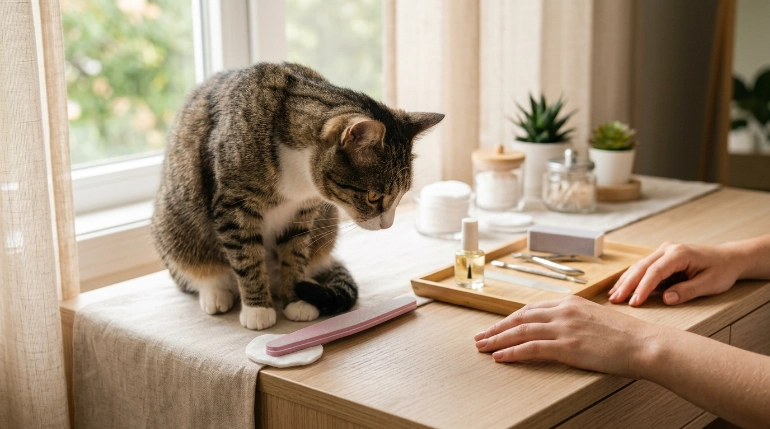
There is not one universal reason. Your cat may be responding to several things at once.
A nail file combines texture, scent, movement, and easy access into one small object. From your cat’s point of view, that can make it much more exciting than the file looks to you.
1. The Rough Texture Feels Interesting
The abrasive surface is probably one of the biggest attractions.
Cats explore their environment with their mouths as well as their noses and paws. An emery board has a rough, gritty surface unlike most household objects.
Your cat may:
- rub their teeth against it;
- lick the abrasive side;
- bite the softer cardboard edge;
- grab it between their front paws;
- chew it for a few seconds and walk away.
Think about how cats investigate cardboard boxes, paper bags, textured toys, and scratching materials. A nail file provides another unusual tactile experience.
That does not mean it is a suitable cat toy.
2. Your Nail File Smells Like You
A used nail file can hold much more scent than you realize.
When you file your nails, tiny amounts of nail dust, skin oil, lotion, hand cream, cuticle oil, or other products may collect on the surface.
Your cat’s sense of smell is much more sensitive than yours, so a file that seems odorless to you may carry plenty of interesting information.
Your scent may make the object especially attractive because it is familiar.
3. Nail Dust May Get Their Attention
Filing natural nails produces tiny particles of keratin, the tough protein that makes up much of your nail plate.
A cat may smell or taste these particles while investigating the file. That does not mean the cat needs nail material in its diet or that chewing your file provides nutritional benefits.
The bigger concern is what else may be on a used file, especially if you use polish, gel products, acrylic products, nail glue, removers, or other manicure chemicals.
4. The Shape Makes It Fun to Play With
A standard emery board is almost perfectly shaped for a curious paw.
It is:
- lightweight;
- narrow;
- easy to bat;
- easy to pick up;
- easy to slide across a floor;
- flexible enough to move when bitten.
If your cat knocks the file off your vanity and it skitters across the floor, the movement itself may trigger play behavior.
The ASPCA notes that enrichment opportunities such as appropriate exploratory objects, puzzle feeders, and interactive activities can help keep cats mentally engaged. Their cat enrichment ideas include safe objects and activities designed specifically for feline exploration.
5. Your Reaction Can Reinforce the Habit
Cats learn patterns quickly.
Imagine that your cat grabs your nail file. You immediately say their name, chase them across the room, and try to take it away.
From your perspective, you are stopping dangerous behavior.
From your cat’s perspective, grabbing the nail file may have just started a very entertaining game.
If chewing the file consistently earns attention, your cat may return to it whenever they want interaction.
6. Boredom May Increase Object Chewing
A cat with plenty of physical and mental stimulation can still investigate strange objects. However, boredom may increase repetitive behaviors in some cats.
Consider whether your cat has regular opportunities to:
- chase toys;
- climb;
- scratch;
- hide;
- explore boxes;
- watch outdoor activity safely;
- solve food puzzles;
- interact with you.
Adding appropriate stimulation is often more effective than simply taking forbidden items away.
7. Persistent Chewing Could Be Pica
This is the reason to pay closer attention.
Pica refers to persistent ingestion of things that are not food. According to the veterinary guidance on pica in cats from VCA Animal Hospitals, cats with pica may chew or consume objects such as plastic, paper, fabric, string, or thread. Behavioral and medical issues can sometimes contribute to the condition.
Chewing a nail file once does not automatically mean your cat has pica.
However, contact your veterinarian if your cat repeatedly tries to eat nail files or regularly consumes other non-food materials.
Is It Safe for Cats to Chew Nail Files?
It is better not to allow it.
A quick lick of an intact file is different from biting off pieces and swallowing them. Nail files are made for shaping human nails, not for chewing.
Different materials also present different concerns.
| Nail File Type | Main Concern Around Cats | Practical Choice |
|---|---|---|
| Emery board | Cardboard or abrasive material may break off | Store in a closed drawer |
| Glass/crystal file | Hard surface may damage teeth; broken glass can be dangerous | Keep completely out of reach |
| Metal file | Very hard edges may hurt teeth or mouth tissue | Never use as a cat toy |
| Foam buffer | Soft material may be tempting to bite and tear | Replace if your cat damages it |
| Used salon-style file | May contain nail dust or product residue | Do not share after cat mouths it |
Glass and metal files deserve particular care because biting hard materials may damage teeth.
Even disposable emery boards should not become chew toys simply because they feel softer.
What If My Cat Swallows Part of a Nail File?
Watch carefully and contact your veterinarian if you believe material was actually swallowed.
The risk depends on what the cat swallowed, how much, its size and shape, and whether any chemical residue was present.
Possible warning signs include:
- repeated vomiting;
- gagging;
- unusual drooling;
- difficulty swallowing;
- refusing food;
- obvious abdominal discomfort;
- lethargy;
- repeated attempts to swallow.
Veterinary guidance from the Merck Veterinary Manual on foreign objects in cats notes that objects lodged in the esophagus can cause signs such as drooling, gagging, regurgitation, and repeated swallowing attempts.
Do not try to make your cat vomit unless a veterinarian specifically instructs you to do so.
If the file had wet nail products, glue, remover, or another cosmetic chemical on it, tell the veterinarian exactly what product was involved. For suspected toxic exposures, the ASPCA Animal Poison Control Center provides 24-hour guidance, although a consultation fee may apply.
Used Nail Files Need Extra Hygiene Care
Even when your cat does not swallow anything, there is another issue for nail lovers: hygiene.
Once your cat has had a nail file in its mouth, the safest choice for a disposable emery board is simply to throw it away.
Do not continue filing around your cuticles with a saliva-covered tool.
If you use a reusable glass or metal file, follow the manufacturer’s cleaning instructions before putting it back into your manicure kit.
This is especially important if you have:
- cracked cuticles;
- hangnails;
- broken skin;
- irritated nail folds;
- recently removed enhancements;
- very sensitive skin.
Keeping pet toys and manicure tools separate is a simple habit that protects both sides.
Is My Cat Just Curious, or Should I Be Concerned?
Look at the pattern, not one isolated moment.
Probably Simple Curiosity
The behavior is more likely to be exploratory if your cat:
- occasionally sniffs or licks a file;
- bites it briefly without removing pieces;
- loses interest after you put it away;
- does not regularly chew other non-food objects;
- eats and behaves normally.
Worth Discussing With a Veterinarian
Pay closer attention if your cat:
- actively removes and swallows pieces;
- searches for nail files repeatedly;
- eats plastic, fabric, paper, string, or other objects;
- has suddenly developed the behavior;
- vomits or loses appetite;
- seems weak or unusually tired;
- develops bad breath or trouble chewing.
VCA notes that pica can have both behavioral and medical associations and that persistent ingestion of non-food objects can create problems including intestinal obstruction and dental damage.
A veterinarian can look at the whole picture instead of assuming the behavior is merely a quirky habit.
How to Stop Your Cat From Chewing Nail Files
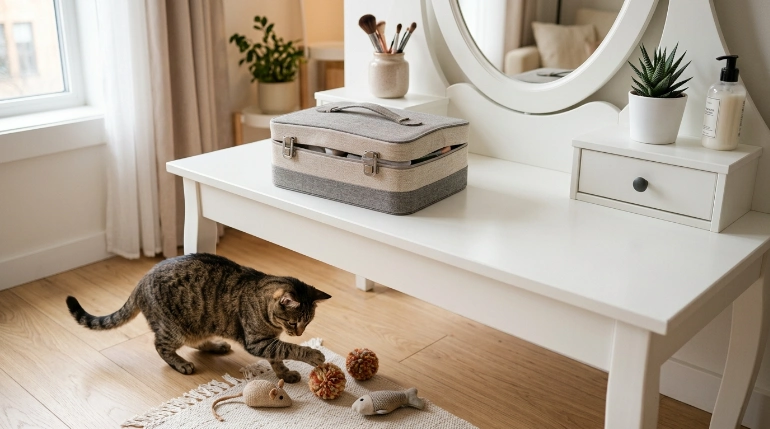
You usually do not need an elaborate training program. Start by removing access and giving your cat something safer to do.
1. Store Nail Files Immediately After Use
Keep files in:
- a manicure case;
- closed vanity drawer;
- lidded container;
- cabinet your cat cannot open.
Do not leave them on nightstands, bathroom counters, or the floor.
2. Clean Up Nail Dust
After filing, wipe down your manicure area.
This prevents loose nail dust and product residue from remaining where your cat can investigate it.
3. Do Not Turn It Into a Chase Game
If your cat grabs a file, stay calm.
Offer a toy or treat at a safe distance and retrieve the file once the cat lets go. Avoid repeatedly chasing your cat around the room.
4. Redirect to Safe Toys
Try toys that provide some of the same sensory appeal without using manicure equipment.
Options may include:
- textured cat toys;
- kicker toys;
- cardboard scratching surfaces;
- food puzzles;
- wand toys;
- lightweight balls.
Always choose toys designed for cats and supervise toys that can be torn apart.
5. Increase Daily Enrichment
A few short play sessions can be more realistic than expecting one long session every day.
Rotate toys periodically so old toys feel interesting again.
Food puzzles and opportunities to climb, hide, scratch, and observe can also give an indoor cat safer ways to explore.
6. Watch for Repeated Non-Food Eating
If removing the nail file only causes your cat to start chewing fabric, plastic, cardboard, or other non-food items, bring that pattern to your veterinarian’s attention.
Keeping a short note of what, how often, and whether anything is swallowed can make that conversation easier.
Expert Tip: Keep a small lidded container beside your manicure station. Put used files, cotton pads, nail clippings, and other tempting manicure items inside immediately instead of leaving them on the table until you finish.
Can Nail Products on the File Make the Situation Riskier?
Potentially, yes.
A natural-nail file with nothing but nail dust on it is a different situation from a file contaminated with wet cosmetic products.
Be particularly careful around files or buffers used during:
- gel manicures;
- acrylic removal;
- dip powder removal;
- nail glue application;
- polish removal;
- artificial nail maintenance.
Do not assume that a tiny exposure will cause poisoning, but do not guess about chemical safety either.
If your cat gets a cosmetic product in its mouth or consumes a meaningful amount, check the product label and contact a veterinarian or animal poison-control service for case-specific advice.
Common Mistakes to Avoid
A few reactions can accidentally make this habit harder—or introduce a different risk.
- Letting your cat keep an old file as a toy. It was not designed for chewing or swallowing.
- Assuming cardboard files are harmless. Pieces can still be torn off and ingested.
- Continuing to use a disposable file after your cat chews it. Replace it for hygiene reasons.
- Punishing or frightening your cat. Removing access and redirecting the behavior is usually more useful.
- Ignoring repeated swallowing. Persistent non-food eating deserves veterinary attention.
- Leaving nail products beside the file. Your polish, glue, remover, and manicure tools should all be stored securely.
- Trying DIY medical treatment for suspected pica. There are multiple potential causes, so diagnosis belongs with a veterinarian.
When to Call a Veterinarian
Call your veterinarian promptly if your cat has swallowed pieces of a file or develops concerning symptoms afterward.
Seek veterinary advice for:
- vomiting;
- repeated gagging;
- excessive drooling;
- difficulty swallowing;
- loss of appetite;
- significant lethargy;
- abdominal discomfort;
- blood in vomit or stool;
- repeated consumption of non-food objects.
Do not wait for severe symptoms if you know your cat swallowed a sharp piece of glass, metal, or another potentially dangerous object.
When to See a Nail Technician or Dermatologist
Your cat’s chewing behavior itself belongs with a veterinarian, not a nail technician or dermatologist. However, your own nails may need attention if a contaminated tool causes a problem.
A nail technician can help with cosmetic care of otherwise healthy nails, but they should not diagnose infections or skin disease.
Consider seeing a dermatologist or other appropriate medical professional if the skin around your nails becomes persistently swollen, painful, warm, discolored, or develops drainage.
If a cat has mouthed a disposable nail file, replacing the file is much easier than trying to sanitize a porous emery board and hoping it is safe.
FAQs
Why does my cat lick my nail file?
Your cat may be interested in the file’s rough texture or the scents left behind by your hands, nail dust, lotion, or manicure products. Occasional licking is usually different from repeatedly biting off and swallowing pieces.
Why is my cat obsessed with emery boards?
Emery boards combine a gritty surface with lightweight cardboard that moves easily when touched. That can make them interesting for play and sensory exploration. Keep them stored away rather than allowing your cat to use them as toys.
Is nail filing dust toxic to cats?
Small amounts of natural nail dust are not the same as exposure to cosmetic chemicals. The bigger concern is usually chewing or swallowing the file itself or contacting residues from nail products. If a specific chemical was ingested, contact a veterinarian or poison-control service.
Can my cat chew a cardboard nail file safely?
It is best not to allow it. Cardboard and abrasive material can break into pieces, and swallowing non-food material may create digestive problems.
Does chewing nail files mean my cat has pica?
Not necessarily. A cat that investigates a nail file once or twice may simply be curious. Persistent chewing and swallowing of nail files or other non-food objects is more concerning and should be discussed with a veterinarian.
What can I give my cat instead of a nail file?
Choose cat-safe enrichment such as scratching surfaces, food puzzles, kicker toys, wand toys, or textured toys intended for feline use. Match the replacement to what seems to interest your cat about the file.
Should I throw away a nail file after my cat chews it?
For a disposable emery board, yes. Replacing it is the simplest hygienic option. Reusable glass or metal files should be cleaned according to the manufacturer’s instructions and inspected for cracks, chips, or other damage before reuse.
Conclusion
If you have been wondering, “Why does my cat like to chew on nail files?”, the answer is usually a combination of texture, scent, curiosity, movement, and the simple fun of investigating something you use often.
A brief sniff or nibble is very different from repeatedly tearing pieces off and swallowing them.
Keep nail files and manicure products stored away, replace disposable files after your cat mouths them, and redirect your cat toward safe toys and enrichment instead.
Most importantly, watch the behavior rather than dismissing it as a funny habit. If your cat repeatedly eats nail files or other non-food objects—or shows vomiting, appetite changes, gagging, or other warning signs—contact your veterinarian.
Your manicure tools can stay part of your beauty routine. Give your cat something safer to chew, chase, and explore.

