
Why Does My Dog Like Nail Files? Reasons, Risks, and What to Do

If your dog comes running whenever you pull out an emery board or keeps trying to steal your favorite glass file, you are probably wondering, why does my dog like nail files?
It can seem strangely specific. But your dog probably does not understand that the object is a beauty tool. To them, a nail file can combine several interesting things at once: your scent, tiny traces of nail debris, an unusual rough texture, and the chance to get your attention.
Most of the time, this interest comes from normal canine curiosity or chewing behavior. However, actually biting, breaking, or swallowing a nail file can be unsafe.
Here is why dogs may become fascinated with nail files, which types can be risky, how to discourage the behavior, and when unusual chewing deserves professional attention.
Quick Answer
Dogs may like nail files because they smell like their owner, contain tiny traces of nail material, have an interesting abrasive texture, or simply make a satisfying object to investigate or chew. Boredom, teething, attention-seeking, and anxiety can also contribute. Do not let your dog chew or swallow nail files.
Why Does My Dog Like Nail Files in the First Place?
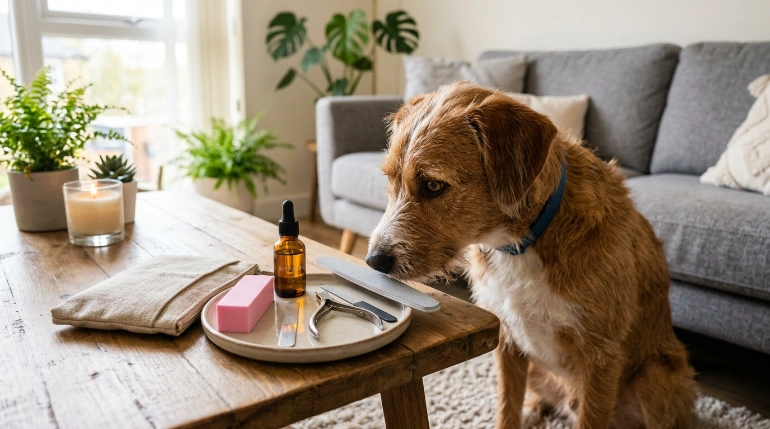
There is no recognized canine behavior specifically called a “nail file obsession.” Instead, several ordinary dog behaviors can make the tool unusually appealing.
Dogs naturally investigate the world through their noses and mouths. According to the American Kennel Club’s explanation of destructive chewing, objects that carry a person’s scent can be especially attractive to dogs. Texture can also influence what they choose to chew.
A used nail file happens to offer both.
1. The Nail File Smells Like You
Your dog’s sense of smell is far more important to them than an object’s appearance.
You repeatedly hold a nail file between your fingers. Oils from your skin, lotions, soaps, nail products, and other scents can transfer onto it.
If you recently filed your nails, the surface may also hold microscopic nail particles.
To you, the file may smell like nothing. To your dog, it may contain a surprisingly detailed scent profile.
This is similar to why dogs sometimes steal:
- Socks
- Shoes
- Hairbrushes
- Remote controls
- Towels
- Clothing
- Other frequently handled objects
The file may simply smell familiar and interesting.
2. Dogs Often Like Interesting Textures
Nail files have a texture that most household objects do not.
An emery board feels rough and slightly flexible. A foam file may compress between the teeth. A thick buffer block can resemble a small chew toy.
That unusual texture may encourage your dog to investigate it.
Dogs naturally chew for stimulation and enjoyment. The ASPCA’s guide to destructive chewing explains that puppies and adult dogs can chew for exploration, entertainment, anxiety relief, and other reasons.
Unfortunately, something that feels satisfying to your dog is not necessarily safe for chewing.
3. Your Dog May Be Curious About Nail Dust
When you file your nails, small amounts of keratin are removed from the nail plate.
Dogs may investigate those particles simply because they smell different.
This does not necessarily mean your dog has a nutritional deficiency or needs something contained in your nails. Curiosity is a much simpler explanation for an occasional sniff, lick, or attempt to grab the file.
If your dog regularly eats nail clippings or many different non-food items, however, that pattern deserves more attention.
4. Your Reaction Can Make the Nail File More Exciting
Imagine this routine:
You start filing your nails.
Your dog steals the file.
You immediately say their name, get up, follow them around the room, and try to take it away.
From your dog’s perspective, stealing the nail file just created an exciting game.
Dogs can learn that taking household objects earns attention. Veterinary behavior guidance notes that some dogs repeatedly steal objects because the resulting chase or interaction becomes rewarding.
Even negative attention can unintentionally keep the game going.
5. Puppies May Be Teething
If your dog is still a puppy, chewing is even less surprising.
Puppies investigate objects with their mouths, and chewing can help them cope with the discomfort associated with teething. The ASPCA notes that chewing is especially common during this developmental stage.
A flexible emery board might therefore feel very tempting.
The problem is that a human nail file is not designed to survive a puppy’s teeth.
Provide a puppy-safe chew instead.
6. Your Dog Could Be Bored
Sometimes the simplest explanation is boredom.
A nail file sitting on a coffee table may become entertainment when nothing more interesting is available.
Dogs benefit from opportunities to sniff, play, forage, chew appropriate items, exercise, and interact with people.
If your dog frequently steals beauty tools, paper, shoes, or household objects, look at the bigger picture.
They may need more appropriate outlets for chewing and mental stimulation.
7. Stress or Anxiety Can Increase Chewing
Chewing may also help some dogs cope with frustration, excitement, or anxiety.
That does not mean a dog that grabs a nail file once has an anxiety problem.
Look for a pattern.
For example, concern is more reasonable if destructive chewing happens mainly when your dog is alone and appears alongside behaviors such as:
- Pacing
- Whining
- Excessive barking
- Attempts to escape
- Destruction around doors
- Restlessness
- House-soiling despite being trained
Persistent or severe anxiety-related behavior is better discussed with a veterinarian or qualified canine behavior professional than treated as simple mischief.
Is It Safe for My Dog to Chew a Nail File?
No. A human nail file should not be treated as a dog chew toy.
The exact danger depends on the material.
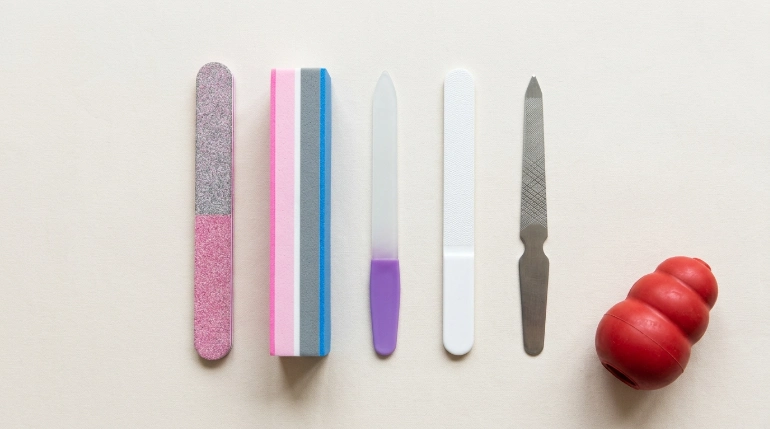
| Nail file type | Why dogs may like it | Main concern |
|---|---|---|
| Emery board | Rough, flexible texture | Can tear into pieces that may be swallowed |
| Foam file | Soft and chewable | Foam and abrasive layers may break apart |
| Buffer block | Toy-like shape | Pieces may be bitten off and swallowed |
| Metal file | Firm texture | Hard or pointed surfaces can injure the mouth |
| Glass/crystal file | Smooth, rigid object | Can break and create sharp fragments |
| Electric nail file | Movement and sound may attract attention | Small parts, sanding heads, batteries, and electrical components |
The biggest issue is not that your dog touches the file. It is what can happen after persistent chewing.
Non-food objects can cause choking, gastrointestinal obstruction, dental injuries, or damage to the digestive tract if swallowed. Veterinary guidance on pica in dogs specifically warns that swallowed non-digestible objects can become lodged in the gastrointestinal tract and that sharp objects can cause serious injury.
A damaged nail file should immediately be taken away from your dog.
Do not continue using it on your nails either.
What If My Dog Licked My Nail File?
A quick lick of an ordinary dry nail file is very different from chewing and swallowing one.
If your dog briefly licked the surface and remains completely normal, the first step is usually to remove the file and prevent another attempt.
Pay closer attention when the file contains substances such as:
- Fresh nail polish
- Gel residue
- Acrylic product
- Nail glue
- Acetone
- Polish remover
- Cuticle remover
- Medicated nail products
- Unknown salon chemicals
If your dog has swallowed the file, broken off part of it, or ingested a chemical product, contact your veterinarian for advice rather than trying to guess whether the amount is safe.
Keep the product packaging available because the ingredient list may help the veterinarian determine what happened.
What If My Dog Actually Eats Nail Files?
Occasionally sniffing or stealing an object is one thing.
Repeatedly eating non-food items is different.
Veterinarians use the term pica for persistent ingestion of objects that are not food.
Pica can have behavioral causes, but medical problems may also contribute. VCA notes potential associations including gastrointestinal disorders, anemia, dietary issues, endocrine disease, anxiety, and other conditions.
Do not diagnose pica from a single stolen emery board.
Instead, look for repeated behavior involving things such as:
- Paper
- Fabric
- Plastic
- Rocks
- Wood
- Foam
- Dirt
- Nail tools
- Other household materials
If your dog consistently tries to consume non-food objects, schedule a veterinary examination.
How to Stop Your Dog From Stealing Nail Files
You do not need to make nail filing stressful for either of you.
A few environmental and training changes usually make more sense than repeatedly chasing your dog.
1. Keep Nail Files Completely Out of Reach
Prevention is the easiest solution.
Store files in:
- A closed manicure case
- A drawer
- A cosmetic organizer with a lid
- A high cabinet
- A closed toiletry bag
Do not leave used files on the sofa, floor, nightstand, or coffee table.
This also improves your own nail-tool hygiene.
2. Give Your Dog an Appropriate Alternative
Before starting your manicure, give your dog something safe and appropriate to do.
Depending on your dog’s size, chewing habits, and veterinarian’s recommendations, that could include an appropriate dog chew, durable toy, food puzzle, or enrichment activity.
Choose products specifically designed for dogs and supervise chewing appropriately.
3. Teach “Leave It”
“Leave it” helps your dog learn that certain objects should remain untouched.
Start with something boring rather than your dog’s favorite stolen treasure.
Reward the dog for disengaging from the item and focusing on you.
Gradually practice around more tempting objects.
4. Teach “Drop It”
A reliable “drop it” cue is particularly valuable if your dog already has something unsafe.
VCA’s guidance on teaching a dog to drop an object recommends teaching the release behavior because it can help when a dog picks up dangerous objects or personal belongings.
Use rewards and calm exchanges rather than turning retrieval into a chase.
5. Avoid Punishing the Dog
Yelling, frightening, or physically punishing your dog does not teach them what they should chew.
It can also make some dogs more anxious about giving objects back.
Instead:
- Stay calm.
- Offer an appropriate trade if necessary.
- Remove the file.
- Redirect your dog to an acceptable activity.
- Store the nail file properly afterward.
Management plus consistent training is usually more useful than punishment.
Expert Tip: Keep a dog-safe toy or enrichment item near your manicure area. Give it to your dog before opening your nail kit so appropriate chewing becomes the predictable routine instead of stealing your file.
Nail File Hygiene Matters Too
If your dog has carried a nail file around in their mouth, think about your own hygiene before putting that tool back against your nails.
Saliva, dirt, food debris, and microorganisms can contaminate the surface.
Disposable emery boards are difficult to thoroughly clean once chewed, so replacing them is usually the simplest choice.
Washable tools should only be cleaned according to their manufacturer’s instructions.
Never keep using:
- A cracked glass file
- A bent metal file
- A torn emery board
- A file with loose abrasive material
- A damaged electric sanding attachment
Damaged files can scratch the surrounding skin or create uneven nail edges.
Does the Type or Price of Nail File Matter?
Dogs do not care whether your file cost $1 or $30.
From a pet-safety perspective, access matters more than price.
A premium crystal file can still break. A cheap emery board can still be shredded and swallowed. A professional metal file can still cause an oral injury.
Material does change the type of risk, though.
If you own expensive or reusable files, a rigid manicure case is a small investment that protects both your tools and your dog.
Replacing an inexpensive emery board may cost only a few dollars. Treating a swallowed foreign object can be far more serious and may require veterinary examination, imaging, medication, endoscopy, or surgery depending on what occurred.
That makes prevention the better bargain.
Common Mistakes to Avoid
Dog owners and nail-care lovers can make a few understandable mistakes when this behavior starts.
- Letting the dog keep an old file as a toy. Human manicure tools are not designed for canine chewing.
- Assuming the dog “needs” nail dust. Occasional curiosity does not prove a nutritional deficiency.
- Chasing the dog every time. This can accidentally turn stealing into a game.
- Leaving files beside the couch or bed. Easy access makes repetition more likely.
- Reusing a heavily chewed file. Replace damaged or contaminated disposable tools.
- Ignoring swallowed pieces. Contact a veterinarian if material is missing or you know the dog swallowed it.
- Punishing repetitive chewing without finding the cause. Boredom, teething, anxiety, and medical issues can all influence chewing behavior.
- Ignoring repeated ingestion of non-food objects. Persistent consumption deserves veterinary attention.
When to Call Your Veterinarian
Contact your veterinarian promptly if your dog swallowed part or all of a nail file.
Veterinary evaluation becomes especially important if you notice:
- Repeated vomiting
- Loss of appetite
- Abdominal discomfort
- Excessive drooling
- Difficulty swallowing
- Lethargy
- Trouble passing stool
- Blood in vomit or stool
- Mouth bleeding
- Broken teeth
- Persistent gagging
- Sudden behavioral changes
Foreign objects can cause gastrointestinal obstruction, and sharp fragments can damage tissue.
If you can, tell the veterinarian what type of file was involved, approximately how much may be missing, and when the incident occurred.
When to See a Nail Technician or Dermatologist
This problem usually concerns your dog, so a veterinarian is the correct professional for canine symptoms.
However, your own nails and skin deserve attention too.
Consider replacing contaminated manicure tools rather than repeatedly sharing anything that has been in your dog’s mouth.
A professional nail technician may help if a damaged file has left your nails rough, split, or uneven and you simply need cosmetic shaping advice.
See a dermatologist or other appropriate medical professional when you develop persistent:
- Redness around the nail
- Swelling
- Increasing pain
- Drainage
- Nail separation
- Significant discoloration
- Signs that could suggest infection
DIY filing should not be used to cover up an unexplained nail or skin problem.
FAQs
Why does my dog lick my nail file?
Your dog may be attracted to your scent, tiny particles left from filing, or the unusual texture. A brief lick is different from persistent chewing, but the file should still be stored out of reach afterward.
Why does my dog want my nail file but ignore its toys?
Your nail file may smell strongly like you, and stealing it may reliably earn your attention. Rotating dog toys, adding enrichment, and preventing access to the file can make appropriate objects more interesting.
Can dogs chew emery boards?
They physically can, but they should not. Emery boards can break apart, allowing cardboard, abrasive material, or other pieces to be swallowed.
Can my dog chew a glass nail file?
No. Glass or crystal files are not dog toys. A damaged file may create sharp fragments, so keep it in a protective case and replace it if it cracks or chips.
Why does my puppy keep stealing my nail file?
Puppies commonly explore with their mouths and chew during teething. Your file’s scent, texture, and easy availability may make it especially tempting. Redirect your puppy to suitable chew toys instead.
Does eating nail files mean my dog has pica?
Not necessarily after one incident. Pica refers to repeated ingestion of non-food materials. If your dog regularly eats nail files or other objects, discuss the behavior with your veterinarian.
What should I do if my dog swallowed part of a nail file?
Remove any remaining pieces and contact your veterinarian for guidance. Tell them what the file was made from, how much may have been swallowed, and when it happened. Seek prompt help if your dog develops vomiting, pain, appetite loss, lethargy, gagging, or other unusual symptoms.
Conclusion
So, why does my dog like nail files? In most cases, the explanation is fairly ordinary. Your nail file smells like you, has an interesting texture, and may give your dog an easy opportunity to explore, chew, or get your attention.
That curiosity does not make the file a safe toy.
Store nail tools securely, replace files that have been chewed, redirect your dog toward appropriate chewing activities, and work on reliable “leave it” and “drop it” cues.
Most importantly, pay attention to the difference between occasional curiosity and repeated consumption. If your dog regularly eats nail files or other non-food objects—or actually swallows part of a file—contact your veterinarian rather than trying to solve the problem through DIY training alone.
A small change to how you store your manicure kit can protect your favorite nail tools and keep your dog safer at the same time.

