
Why Does My Toenail Keep Splitting in the Same Place?

You trim the rough edge, smooth it with a nail file, and wait for your toenail to grow out. Then a few weeks later, it splits in exactly the same spot again.
If you are wondering, “Why does my toenail keep splitting in the same place?”, repeated stress or damage is often the reason. Tight shoes, an old injury, dryness, aggressive filing, or the way the nail grows can keep weakening one specific area. Sometimes, persistent splitting can also happen alongside a fungal infection or another nail condition.
The key is figuring out whether you are dealing with simple mechanical damage or a nail change that deserves professional attention. Here is what to look for and what you can safely do at home.
Quick Answer
A toenail that keeps splitting in the same place is often being weakened by repeated shoe pressure, an old injury, dryness, improper trimming, or aggressive filing. The split may keep returning until the damaged portion fully grows out. If the nail is also thick, discolored, painful, crumbly, or lifting, get it professionally evaluated.
Why Does a Toenail Keep Splitting in One Spot?
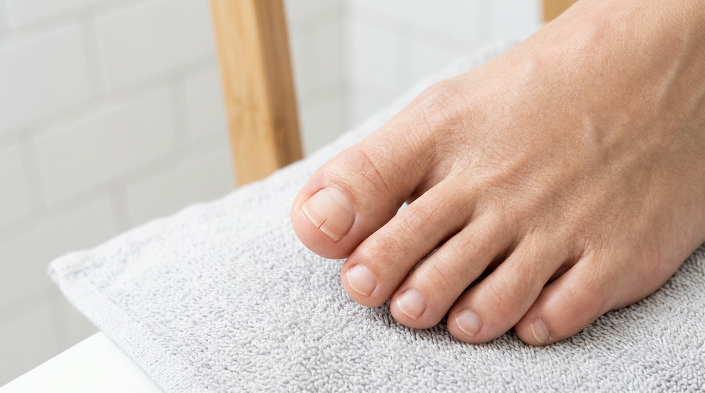
Your toenail is not one solid piece of plastic-like material. The visible nail plate is made of layers of keratin. When one section becomes weaker than the surrounding nail, that area can repeatedly crack as the nail grows.
Think of it a little like a crease in a piece of cardboard. Once a weak point develops, everyday pressure tends to stress that same spot again.
The important question is why that particular area stays weak.
1. Repeated Pressure From Your Shoes
One of the simplest explanations is repeated pressure.
If the toe regularly touches the front, top, or side of your shoe, the same section of nail can experience tiny amounts of trauma over and over.
You may not even feel pain.
This is especially common with:
- Shoes with narrow toe boxes
- High heels that push the toes forward
- Running or hiking shoes that are too short
- Work boots pressing on a particular toe
- Shoes that fit differently once your feet swell
- Activities that repeatedly push your toes against footwear
Over time, the nail may develop a weak point. You trim the split away, but if the same pressure continues, the new nail can become damaged again.
Look at your shoes as carefully as you look at your nail. If one toe constantly rubs against the inside of your footwear, changing the fit may be more useful than repeatedly repairing the crack.
2. An Old Injury Can Affect New Nail Growth
Remember that time you dropped something on your toe, stubbed it badly, or wore painfully tight shoes for an entire evening?
Even if the skin healed, an injury can sometimes affect how a toenail grows.
The nail forms beneath the skin at its base. Damage around this growth area can potentially result in a ridge, groove, thinner section, or irregular nail that remains vulnerable as it moves forward.
That can explain why a crack seems to appear along the same line repeatedly.
If you remember an old injury and the nail has looked different ever since, mention it if you eventually see a dermatologist or podiatrist. That history can be useful.
3. The Nail Is Dry and Brittle
Dry nails are less flexible.
Instead of bending slightly under pressure, a brittle toenail may crack or split.
Dryness can become more noticeable after repeated exposure to nail polish remover, aggressive pedicures, environmental dryness, or routines that repeatedly wet and dry the nail.
The American Academy of Dermatology recommends moisturizing nails after trimming and notes that dry nails split more easily.
Moisturizing will not repair a deep structural crack, but keeping an otherwise healthy nail and surrounding skin conditioned may make the growing nail less prone to minor brittleness.
If you want to improve your overall routine while the damaged area grows out, NailPrime’s guide to healthy toenail growth covers everyday trimming, moisture, footwear, and protection.
4. Your Filing Technique May Keep Reopening the Weak Spot
A nail file is supposed to remove rough edges, not aggressively grind away healthy nail.
The American Academy of Dermatology recommends smoothing rough edges with a nail file or emery board and filing in the same direction. Filing back and forth can weaken the nail.
That matters even more when a toenail already has a split.
Imagine repeatedly sawing a file across the weakest section. You may temporarily make the edge look smooth while also putting more stress on the layers around the crack.
Use light pressure and stop once the snag is smooth.
If you are choosing a gentler tool, NailPrime’s guide to the best nail files for natural nails explains how glass, ceramic, and emery files differ.
Expert Tip: When one toenail repeatedly splits, do not keep filing deeper to “erase” the crack. Smooth only the rough free edge. A crack that extends into attached nail needs time to grow forward—not more thinning.
5. You May Be Cutting the Nail Too Short
Toenails generally do better when trimmed straight across rather than deeply rounded at the corners.
Cutting extremely short can remove the protective free edge and leave the nail vulnerable to pressure from shoes.
It can also tempt you to dig into the sides whenever a small crack develops.
Instead, make small, controlled cuts.
If your trimming technique may be contributing to the problem, follow NailPrime’s step-by-step guide on how to cut your toenails correctly.
Could a Fungal Infection Cause Repeated Splitting?
Yes, but a split toenail does not automatically mean fungus.
Nail fungus can make a toenail brittle enough to crack, split, or crumble. It often causes other changes at the same time.
Watch for:
- Yellow, white, or brown discoloration
- Increasing thickness
- A crumbly or ragged texture
- Debris beneath the nail
- Nail lifting or separation
- Changes in shape
- More than one affected nail
The Mayo Clinic’s overview of nail fungus describes thickening, discoloration, brittleness, crumbling, misshapen nails, and separation from the nail bed among common symptoms.
Similarly, the American Academy of Dermatology’s guide to nail fungus symptoms notes that fungal nails can crack, split, or crumble.
This is why repeatedly covering a suspicious split with polish or glue is not the best approach.
If the nail is changing beyond the crack itself, find out what is causing the change first.
What Your Splitting Pattern May Tell You
| What you notice | Possible explanation | Sensible next step |
|---|---|---|
| Split at the free edge after wearing certain shoes | Repeated pressure or minor trauma | Check footwear and gently smooth the edge |
| Thin, dry nail that flakes and splits | Brittleness or grooming damage | Reduce aggressive filing and moisturize |
| Same vertical line repeatedly cracking | Repeated trauma or altered nail growth | Protect it and consider professional evaluation if persistent |
| Thick, yellow, crumbly nail | Possible fungal infection | See a healthcare professional for evaluation |
| Split after an obvious toe injury | Trauma | Protect the nail while it grows out |
| Deep, painful crack with bleeding | More significant injury | Stop DIY treatment and seek professional care |
| Split plus nail lifting | Trauma, infection, or another nail condition | Avoid pulling or filing underneath it; get it checked |
This table can help you narrow down possibilities, but appearance alone cannot reliably diagnose every nail condition.
How to Care for a Toenail That Keeps Splitting
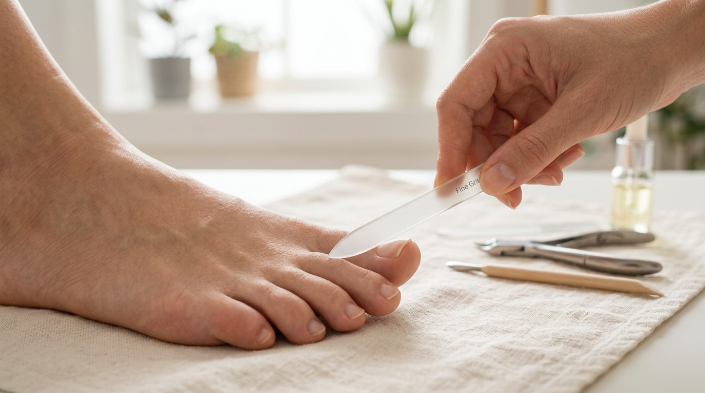
If the split is small, painless, and limited to the free edge, gentle home care is reasonable.
1. Examine the Nail Before Touching It
Remove polish if needed so you can actually see the nail.
Look for:
- Color changes
- Thickening
- Swelling
- Redness
- Drainage
- Bleeding
- Nail lifting
- A deep crack
- Changes in nearby toenails
If any of those changes are significant, treat the problem as more than a cosmetic snag.
2. Trim Only What Is Safely Free
Use clean, sharp toenail clippers.
Do not cut into attached nail simply because you can see the crack continuing farther back.
Trim the free edge in small cuts and keep the overall shape reasonably straight across.
The American Academy of Dermatology’s nail-trimming guidance recommends using appropriate nail tools, cutting toenails straight across, and smoothing rough edges with a file.
3. Smooth the Snag Gently
Use a fine, gentle file to remove only the sharp edge that is catching on socks or bedding.
Avoid:
- Heavy pressure
- Very coarse files on a thin natural nail
- Aggressive back-and-forth sawing
- Filing deeply into the split
- Thinning the top of the nail unnecessarily
The goal is smooth, not thin.
4. Reduce the Pressure That Caused It
This step is easy to overlook.
Check the shoes you wear most often. Stand in them rather than judging the fit while sitting.
Your toes should not be repeatedly jammed against the front.
For athletic shoes, also consider what happens while running downhill, stopping suddenly, or doing exercises that move your foot forward inside the shoe.
A better-fitting toe box may do more for a pressure-related split than another nail product.
5. Moisturize Dry Nails and Surrounding Skin
After washing and thoroughly drying your feet, apply a simple moisturizer to the nail and surrounding skin if they tend to be dry.
Do not intentionally keep the spaces between your toes wet or greasy. Feet that stay damp can create a more favorable environment for fungal problems.
You are aiming for conditioned skin and nails—not constantly moist feet.
6. Give It Time
Toenails grow slowly.
Even after you correct the original cause, the damaged section must move forward as new nail grows from the base.
That means your nail may not look perfect after a week or two.
Do not interpret slow improvement as a reason to file more aggressively.
Which Nail File Is Best for a Splitting Toenail?
For a natural toenail that is already fragile, gentleness and control matter more than speed.
| File type | Best use | Main consideration |
|---|---|---|
| Fine-grit glass file | Smoothing fragile natural nail edges | Gentle and reusable but can break if dropped |
| Fine emery board | Simple occasional touch-ups | Affordable but wears out and is harder to thoroughly clean |
| Ceramic file | Controlled shaping | Durable but quality and texture vary |
| Coarse file | Heavy artificial-product removal | Usually unnecessarily aggressive for a fragile natural toenail |
| Metal file | Fast shaping | Can feel harsh on thin or splitting nails |
You do not need an expensive professional kit to maintain one split toenail.
A basic fine file and a good pair of sharp toenail clippers are usually enough for straightforward grooming. Glass files tend to cost more initially than disposable emery boards but can last considerably longer when cared for properly.
Never share a personal nail file with someone who has a suspected nail or skin infection.
Reusable tools should also be cleaned according to their material and manufacturer instructions. The AAD recommends regularly disinfecting nail clippers and nail scissors.
Can You Glue a Split Toenail Back Together?
A cosmetic patch can sometimes stabilize a tiny split in otherwise healthy nail, but it has limitations.
Do not use nail glue as a substitute for investigating a recurring crack.
Avoid covering the area if:
- The crack reaches sensitive skin
- The nail is bleeding
- There is redness or swelling
- You see drainage
- The nail looks infected
- The nail is significantly lifting
- You have unexplained discoloration
- Applying the product causes burning or irritation
Glue and polish can also make it harder to monitor what is happening underneath.
If the crack is repeatedly returning in exactly the same position, your priority should be finding and reducing the cause.
Common Mistakes to Avoid
A recurring split often gets worse because we understandably want to “fix” it immediately.
Avoid these common mistakes:
- Filing aggressively until the crack disappears. You may simply make the nail thinner.
- Cutting deep into the split. Do not remove attached nail just to make the edge look even.
- Picking off loose layers. Peeling can pull healthy nail away with the damaged section.
- Ignoring tight footwear. A perfect pedicure cannot overcome repeated mechanical pressure.
- Using very coarse files on fragile natural nails.
- Sharing nail tools. Personal grooming tools can potentially transfer microorganisms.
- Covering a suspicious nail with polish for months. You need to be able to monitor changes.
- Assuming every split is fungal. Trauma, dryness, and grooming damage are also possibilities.
- Assuming fungus is “just damage.” Thickening, crumbling, discoloration, and lifting deserve attention.
DIY Care vs. Professional Help
Minor edge damage is often manageable at home.
DIY care makes the most sense when the nail:
- Has a shallow split near the free edge
- Is not painful
- Has normal color and thickness
- Is firmly attached
- Has no redness, swelling, or drainage
- Has an obvious mechanical cause you can correct
A nail technician may help with safe cosmetic grooming of an otherwise healthy nail, but a nail technician cannot diagnose a medical nail condition.
If the problem looks like an infection, significant injury, or unexplained nail disorder, a dermatologist, podiatrist, or other qualified healthcare professional is the better choice.
When to See a Nail Technician or Dermatologist
Consider a reputable nail technician when your toenail is basically healthy but you need help with routine trimming, shaping, or choosing a gentler file.
Choose a dermatologist, podiatrist, or healthcare professional instead if the split:
- Keeps returning despite correcting obvious pressure and grooming habits
- Extends deeply into attached nail
- Causes significant pain
- Bleeds repeatedly
- Is accompanied by swelling or redness
- Produces drainage or pus
- Appears alongside major discoloration
- Occurs in a nail becoming increasingly thick or crumbly
- Appears with significant nail lifting
- Developed without an obvious explanation
The Mayo Clinic recommends seeking medical care when suspected fungal changes continue despite self-care or the nail becomes increasingly discolored, thickened, or misshapen. Pain, swelling, bleeding, or difficulty walking also deserve professional attention.
People with diabetes, poor circulation, or a weakened immune system should be especially cautious about DIY foot and toenail treatment. Small injuries and infections can carry greater risks in these situations.
FAQs
Why does my big toenail keep splitting in the same spot?
Repeated pressure from footwear, an old injury, dryness, or a persistent weak area in the nail can cause the same spot to split repeatedly. If the nail is also thick, discolored, painful, or crumbly, have it evaluated rather than treating it only as cosmetic damage.
Can a nail file cause my toenail to split?
Yes. Aggressive filing, heavy pressure, or repeated back-and-forth filing can weaken a natural nail. Use a gentle file and smooth only the rough edge instead of thinning the entire nail.
Will a split toenail eventually grow out?
A minor split caused by temporary damage often can grow forward and eventually be trimmed away, provided the source of repeated damage has stopped. Toenails grow slowly, however, so visible improvement requires patience.
Why does my toenail split vertically?
A vertical split may follow an area that has been weakened by repeated trauma or altered nail growth. A persistent vertical crack—especially one extending far toward the base—deserves professional evaluation rather than repeated filing.
Does a splitting toenail mean I have fungus?
Not necessarily. Dryness, pressure, injuries, and grooming habits can also cause splitting. Fungus becomes more suspicious when splitting occurs with discoloration, thickening, crumbling, debris, or nail separation.
Should I cut off the split part of my toenail?
You can carefully trim loose nail at the free edge if doing so is painless. Do not cut deeply into attached nail or tear the split away. Smooth remaining roughness gently with a fine file.
What is the best file for a toenail that keeps splitting?
A fine-grit glass, ceramic, or gentle emery file can work well for a natural toenail. The technique matters just as much as the material: use light pressure and avoid repeatedly grinding the weakened area.
Conclusion
If you keep asking, “Why does my toenail keep splitting in the same place?”, pay attention to what repeatedly happens to that exact section of nail.
Tight shoes, an old injury, dryness, trimming habits, and aggressive filing can all create or maintain a weak spot. Your best first move is usually to protect the nail, correct repeated pressure, trim it carefully, and smooth rather than grind the damaged edge.
Then give the nail time to grow.
If the split keeps returning—or you notice pain, swelling, discoloration, thickening, crumbling, bleeding, or nail lifting—stop treating it as an ordinary pedicure problem and have it professionally evaluated.
Start by checking your everyday shoes and nail-file technique today. Those two simple changes may remove the repeated stress that keeps reopening the same weak spot.

