
Why Is My Toenail Lifting From the Nail Bed?

You look down at your foot and notice something strange: part of your toenail is no longer sitting flat against the skin underneath it. Maybe the edge looks white, there is a small gap under the nail, or the nail seems to be slowly pulling away.
So, why is my toenail lifting from the nail bed?
This type of nail separation is called onycholysis. It can happen after an injury, repeated pressure from shoes, a fungal infection, psoriasis, irritation, or other nail problems. Sometimes the cause is obvious. Other times, a lifting toenail needs professional evaluation to figure out what is happening.
The most important thing is not to pull, glue, scrape, or aggressively file the nail back into place. A lifted section cannot simply reattach. Instead, the goal is to protect the area, prevent further damage, and allow healthier nail growth to replace the separated portion.
Quick Answer
A toenail may lift from the nail bed because of injury, tight shoes, repeated pressure, fungal infection, psoriasis, or irritation. This separation is called onycholysis. Keep the nail clean and dry, avoid pulling or digging underneath it, and seek professional care if you notice pain, swelling, drainage, major discoloration, or unexplained worsening.
What Does It Mean When a Toenail Lifts From the Nail Bed?
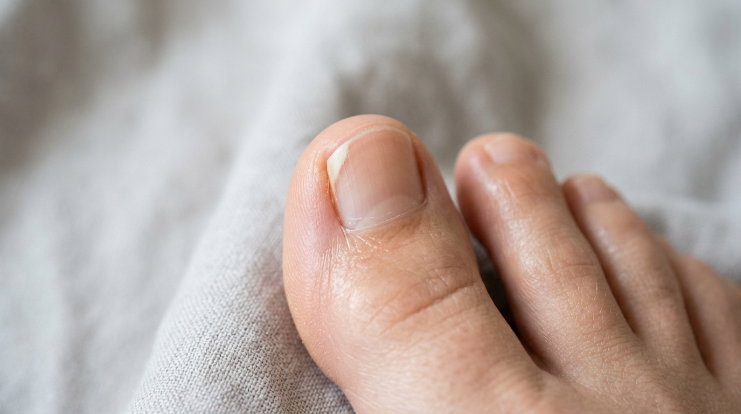
Your toenail has two important parts to understand.
The nail plate is the hard nail you can see and trim. The nail bed is the skin directly underneath it.
When the nail plate separates from the nail bed, a small pocket of air forms underneath. This often makes the separated area look white, pale, or opaque instead of pink.
The medical term for this separation is onycholysis.
According to the Cleveland Clinic’s guide to onycholysis, nail separation can occur after trauma and may also be associated with conditions such as fungal infections or psoriasis. The detached section itself does not reattach to the nail bed. Healthy nail must gradually grow forward instead.
A small amount of lifting after a clear toe injury may simply grow out. However, unexplained or worsening lifting deserves more attention.
Why Is My Toenail Lifting From the Nail Bed? 7 Common Causes
Several different problems can produce a similar-looking lifted toenail.
1. An Injury to the Toenail
Trauma is one of the simplest explanations.
You might remember:
- Dropping something on your toe
- Stubbing the toe
- Catching the nail on furniture
- Having the nail crushed
- Cutting or filing the nail too aggressively
Sometimes the injury is minor enough that you forget about it.
The nail may still separate weeks later as the damaged section grows forward.
2. Tight Shoes or Repeated Pressure
Your toenails can also experience small amounts of trauma over and over again.
Running shoes, heels, narrow toe boxes, work boots, or shoes that are slightly too short may push the nail against the front or top of the shoe.
This is especially common with big toenails.
Look for clues such as:
- Soreness after wearing certain shoes
- A bruised-looking nail
- Repeated lifting on the same toe
- Pressure marks on the toe
- Nails touching the front of the shoe when walking
Changing footwear may prevent more damage, but an already detached nail still needs time to grow out.
3. Toenail Fungus
Fungal nail infection, also called onychomycosis, can sometimes cause a toenail to separate from its bed.
Fungal nails may also become:
- Yellow, white, or brown
- Thicker than normal
- Brittle
- Crumbly
- Rough
- Distorted
The NHS guide to fungal nail infections notes that fungal toenails can become thicker, discolored, brittle, and crumbly, and a severely affected nail may eventually lift.
However, do not assume every lifting toenail has fungus. Trauma and other nail conditions can look very similar.
A healthcare professional may need to examine or test the nail before recommending antifungal treatment.
4. Psoriasis or Another Skin Condition
Psoriasis can affect nails as well as skin.
Nail psoriasis may cause:
- Pitting
- Thickening
- Yellow-brown discoloration
- Crumbling
- Nail separation
- Changes in nail shape
If you already have psoriasis and a toenail begins lifting, mention the change to your dermatologist.
Fungus and nail psoriasis can sometimes resemble each other, making self-diagnosis difficult.
5. Aggressive Pedicures or Nail Filing
A pedicure should make your nails look neater, not leave the nail bed exposed.
Problems may occur when someone:
- Files too deeply underneath the nail
- Uses a sharp tool to clean beneath the nail
- Buffs the nail excessively
- Cuts the nail extremely short
- Forces a tool between the nail plate and nail bed
Even if the goal is to remove debris or create a cleaner-looking edge, aggressive pressure underneath the toenail can increase separation.
6. Nail Product Irritation or Damage
Artificial nail products are more commonly used on fingernails, but polish, adhesives, gel products, removers, and other chemicals may occasionally contribute to irritation around toenails.
If the lifting started after a pedicure or product application, watch for:
- Burning
- Itching
- Rash
- Redness
- Swelling
- Blisters
Stop using a product that appears to be irritating your skin or nail and seek medical advice if the reaction is significant.
7. Another Health or Nail Condition
Occasionally, nail lifting occurs without an obvious injury or infection.
Because nail changes can sometimes reflect an underlying health or dermatologic condition, unexplained separation should not simply be covered with polish indefinitely.
The American Academy of Dermatology’s guide to nail changes recommends having certain nail changes evaluated, including nails that begin lifting and suspicious new or changing dark streaks.
What a Lifting Toenail Can Look Like
Onycholysis is not always dramatic.
You may notice only a narrow white area near the tip at first.
| What You Notice | Possible Meaning | Best Next Step |
|---|---|---|
| Small white lifted edge after an injury | Minor trauma | Protect and monitor |
| Repeated lifting after wearing tight shoes | Pressure or friction | Improve shoe fit |
| Yellow, thick, crumbly lifting nail | Possible fungus | Consider medical evaluation |
| Pitting plus nail separation | Possible psoriasis | Dermatology evaluation |
| Redness, swelling, warmth, or drainage | Possible infection | Seek medical care |
| Green or unusual discoloration | Possible microbial involvement | Professional evaluation |
| New or changing dark streak | Needs medical assessment | See a dermatologist |
| Nail lifting with no obvious cause | Several possibilities | Consider healthcare evaluation |
This table is only a general guide. Appearance alone cannot reliably diagnose the cause.
Should I Cut Off a Lifted Toenail?
Do not rip the nail off.
A loose tip that extends beyond the toe may sometimes be carefully shortened, but only if you can clearly tell which part is no longer attached.
If cutting causes pain, pressure, bleeding, or resistance, stop.
The goal is to keep the nail from catching on socks or bedding without cutting into still-attached nail.
For normal nail maintenance, the American Academy of Dermatology’s nail-trimming guidance recommends trimming toenails straight across and smoothing rough edges with a nail file.
Can I File a Toenail That Is Lifting?
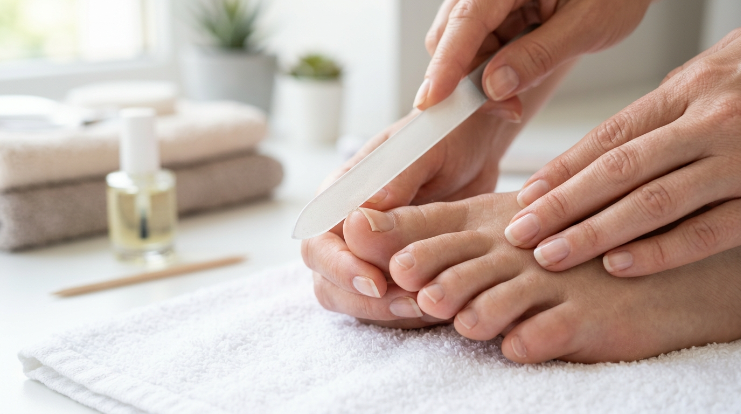
Yes, but only gentle filing of a rough free edge may be appropriate.
A nail file should not be used to scrape underneath a lifted nail or grind deeply into damaged nail tissue.
If you want to smooth a snag:
- Wash your hands and feet.
- Make sure the toe is completely dry.
- Use a clean nail file.
- Support the nail gently with your other hand.
- File only the rough free edge.
- Stop immediately if you feel pain or movement near the attached portion.
A fine or medium natural-nail file is usually easier to control than a very coarse file.
Avoid aggressively thinning a suspicious, crumbly, painful, or discolored toenail just to improve its appearance.
Never insert the pointed end of a metal file, cuticle tool, or other object underneath the lifted nail.
You can injure the exposed nail bed and potentially create more space for moisture and microorganisms.
Nail File Material and Hygiene Matter
The best nail file depends partly on whether the nail looks healthy.
Disposable Emery Boards
These are inexpensive and easy to control.
However, their porous surface makes thorough disinfection difficult. If you are filing a nail that may have fungus or another infection, do not use the same disposable file on healthy nails.
Glass Nail Files
Glass files provide a smoother filing surface and can often be cleaned more easily than disposable boards.
They are useful for gently finishing rough edges, although they should still be kept clean and used carefully.
Metal Nail Files
Metal files are durable, but aggressive pressure can remove nail material quickly.
If the nail is already damaged or separated, use very light pressure.
Electric Nail Files
A powered e-file or nail drill can remove nail material very quickly.
That is also why it can be risky for inexperienced DIY use on a lifting toenail.
Do not drill aggressively into a separated toenail at home. If significant thickness needs reducing, a podiatrist or dermatologist can determine whether professional debridement is appropriate.
How to Care for a Lifted Toenail at Home
For a small, painless area of lifting after an obvious minor injury, gentle home care may be reasonable.
1. Keep the Nail Clean
Wash your feet normally with soap and water.
Avoid digging underneath the nail while cleaning.
2. Dry Your Feet Thoroughly
Moisture trapped beneath a lifted nail can create an environment where microorganisms thrive.
Dry between your toes as well.
3. Protect the Nail From More Trauma
Choose shoes with enough room around the toes.
Avoid footwear that repeatedly pushes the toenail backward or downward.
4. Smooth Snags Carefully
If the loose edge catches on socks, gently shorten or file only the clearly detached portion.
Do not force the nail shorter.
5. Avoid Cosmetic Cover-Ups for a While
Polish may hide changes that would otherwise help you notice whether the nail is improving or worsening.
If the nail looks suspicious, leave it visible until you understand what is happening.
6. Watch the New Nail Growth
Healthy growth should gradually move outward from the base.
Toenails grow slowly, so cosmetic improvement takes patience.
Expert Tip: Take a clear photo of the toenail every two to four weeks in similar lighting. Comparing photos makes it easier to see whether the lifting is growing out, staying the same, or spreading toward the base.
What Not to Put Under a Lifted Toenail
The gap underneath the nail can make you want to clean, glue, or treat it aggressively.
Resist that temptation.
Avoid:
- Nail glue
- Household glue
- Sharp manicure tools
- Excessive scraping
- Aggressive buffing
- Random antifungal products without a reasonable diagnosis
- Strong chemicals intended to “dry out” the nail
- Picking out every piece of debris
The lifted space is not a pocket that needs to be manually cleaned until it looks perfect.
Repeated manipulation may keep irritating the nail bed.
Hygiene Tips If Fungus Might Be Involved
If your nail is yellow, thick, crumbly, or suspicious for fungus, be especially careful with shared tools.
Do not share:
- Nail clippers
- Toenail nippers
- Nail files
- Pedicure scissors
- Towels
- Foot-care tools
The American Academy of Dermatology notes that contaminated grooming tools can help spread nail fungus and recommends keeping feet clean and dry and sanitizing reusable tools.
Disposable files are best discarded after use on a potentially infected nail rather than reused on your other toes.
DIY Care vs. Professional Care
A mild traumatic lifting nail is different from a painful or infected-looking one.
| Situation | DIY Care | Nail Technician | Dermatologist/Podiatrist |
|---|---|---|---|
| Small painless snag | Usually reasonable | Optional | Usually unnecessary |
| Routine shortening or shaping | Yes | Yes | Usually unnecessary |
| Cosmetic nail care | Yes | Yes | No |
| Yellow, thick, crumbly nail | Limited grooming | Do not rely on salon diagnosis | Recommended if persistent |
| Major lifting | Avoid aggressive DIY | Cosmetic care may be inappropriate | Recommended |
| Pain, swelling, or drainage | No | No | Yes |
| Unexplained dark streak | No | No | Dermatologist |
| Recurrent lifting | Limited | Can help with grooming only | Consider evaluation |
Cost is another factor.
A basic file and toenail clipper are inexpensive for routine home grooming. A salon service costs more but can help when you simply need cosmetic shaping.
Medical evaluation may cost considerably more depending on your location and insurance, but it is the appropriate investment when you need a diagnosis, laboratory testing, prescription treatment, or medical nail care.
Common Mistakes to Avoid
When a toenail starts lifting, avoid these common mistakes:
- Pulling off the loose nail. You may tear attached nail and injure the nail bed.
- Digging underneath it. This can create more separation or cause bleeding.
- Filing until the nail becomes thin. Excessive filing can make damaged nail more fragile.
- Assuming it is automatically fungus. Trauma, psoriasis, and other conditions can cause similar changes.
- Treating fungus blindly. A healthcare professional may need to confirm the cause.
- Covering the nail continuously with polish. You may miss worsening discoloration or separation.
- Ignoring your shoes. Repeated pressure can keep damaging the nail.
- Sharing pedicure tools. This is especially risky when infection is possible.
- Continuing a painful pedicure. Nail care should not require you to tolerate sharp pain or bleeding.
- Trying to glue the nail down. A detached nail cannot be permanently reattached this way.
When to See a Nail Technician or Dermatologist
A nail technician is helpful when the nail otherwise looks healthy and you simply need routine trimming, shaping, or cosmetic care.
A nail technician cannot diagnose fungal infection, psoriasis, melanoma, or another medical cause of nail separation.
Consider a dermatologist, podiatrist, or other qualified healthcare professional when you notice:
- Increasing pain
- Redness
- Swelling
- Warmth
- Pus or drainage
- Bleeding without an obvious recent grooming injury
- A bad odor
- Green discoloration
- Significant yellow or brown discoloration
- Severe thickening or crumbling
- Separation moving toward the nail base
- Multiple nails changing
- Repeated unexplained lifting
- A new or changing dark streak
You should also be more cautious about DIY foot care if you have diabetes, reduced foot sensation, poor circulation, or another condition that may affect healing.
FAQs
Can a lifted toenail reattach to the nail bed?
The already detached portion generally does not simply stick itself back down. Instead, the goal is for new nail to grow forward while remaining properly attached. Avoid trying to glue or press the separated section back into place.
Is toenail lifting always caused by fungus?
No. Trauma, repeated pressure from shoes, psoriasis, irritation, aggressive pedicures, and other nail conditions can also cause lifting.
Should I remove the white part of a lifted toenail?
Only shorten a clearly loose free edge if you can do so comfortably and safely. Do not cut into attached nail or anything that causes pain, bleeding, or resistance.
Can tight shoes cause my toenail to lift?
Yes. Repeated pressure or friction can injure the nail and lead to separation. Make sure your shoes provide enough length, width, and space above the toes.
Can I put nail polish on a lifting toenail?
It is usually better to keep an unexplained nail change visible while you monitor it. Polish may hide worsening discoloration, cracking, or separation.
How do I know if my lifting toenail is infected?
Pain, redness, swelling, warmth, drainage, bad odor, or worsening discoloration can be warning signs. A fungal infection may also cause thickening, yellowing, brittleness, and crumbling. Professional evaluation is the safest way to determine the cause.
How long does it take a lifting toenail to look normal again?
Toenails grow slowly, so improvement can take months. The damaged section has to gradually move toward the end of the toe as healthier nail grows from the base.
Conclusion
If you are wondering why is my toenail lifting from the nail bed, the answer may be as simple as an old injury or tight shoes, but fungal infection, psoriasis, irritation, and other nail conditions are also possible.
For a small, painless lifted area after obvious trauma, keep the toe clean and dry, avoid more shoe pressure, and gently manage only rough or loose edges.
Do not pull the nail off, dig underneath it, glue it down, or aggressively file it.
Most importantly, pay attention to what happens next. Pain, redness, swelling, drainage, major discoloration, significant crumbling, a new dark streak, or worsening separation are reasons to stop treating the problem as a cosmetic issue and get professional advice.
Protect the nail now, give healthy growth time to replace the damaged section, and choose professional care whenever the cause is unclear or the nail is getting worse.

