
What Factors Affect Toenail Growth? A Practical Guide to Healthy Growth

If your toenails seem to take forever to grow, grow at different speeds, or look different after an injury, you may wonder whether something is slowing them down.
So, what factors affect toenail growth? Normal growth can vary with age, circulation, nail injuries, repeated shoe pressure, infections, health conditions, medications, nutrition, and the health of the nail matrix where new nail is produced.
Toenails also naturally grow much more slowly than fingernails. That means even a healthy toenail may need many months to replace damaged or discolored nail.
Below, you will learn what influences toenail growth, which everyday habits can protect growing nails, how nail files and other tools fit into your routine, and which changes deserve professional attention.
Quick Answer
Several factors affect toenail growth, including age, circulation, nail-matrix health, injuries, tight footwear, fungal infections, certain illnesses, medications, and nutrition. Toenails naturally grow slowly—typically around 1 to 1.6 millimeters per month. Protecting your toes from repeated damage is usually more realistic than trying to dramatically speed up growth.
How Toenails Actually Grow
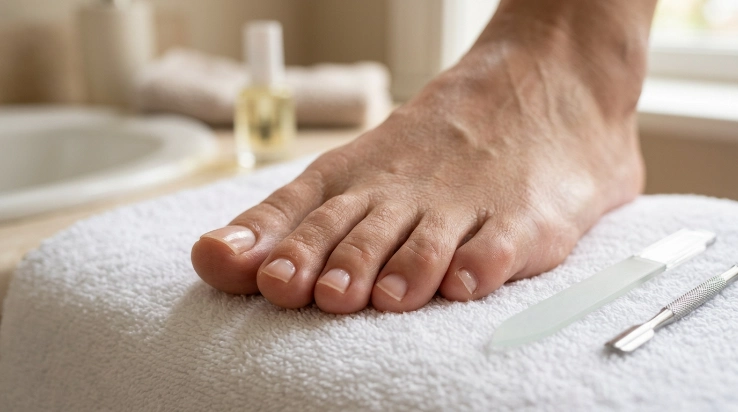
The part of your toenail that you paint, trim, or file is the nail plate. It is mainly made of hardened keratin.
New nail begins farther back, underneath the skin at the base of your nail. This growth area is called the nail matrix.
Think of the matrix as your nail’s production center. It continually creates new cells, which harden and push the existing nail plate forward.
Cleveland Clinic explains that injuries and certain health conditions can damage the nail matrix and interfere with normal nail production. Cleveland Clinic’s guide to the nail matrix
Because the growing portion is mostly hidden beneath your skin, a product applied to the visible tip of your nail usually cannot simply “make” the matrix produce nail much faster.
How Fast Do Toenails Normally Grow?
Toenails are slow growers.
A published study involving healthy young adults measured an average toenail growth rate of about 1.62 millimeters per month, while fingernails averaged about 3.47 millimeters per month. The study also found that the big toenail tended to grow faster than the other toenails. PubMed study on fingernail and toenail growth rates
Clinical references often use an estimate closer to approximately 1 millimeter per month.
Either way, these numbers are averages rather than deadlines.
A toenail may take roughly 12 to 18 months to replace completely, particularly after significant damage or nail loss.
That slow timeline is why a damaged area can remain visible through several pedicures.
What Factors Affect Toenail Growth?
1. Age
Age is one of the most important influences on nail growth.
Toenail growth generally becomes slower as people get older. Nails may also become thicker, harder, more brittle, or more difficult to trim.
This does not automatically mean the nail is unhealthy.
However, a dramatic change in one particular toenail should not automatically be blamed on age—especially if the nail becomes painful, discolored, crumbly, or detached.
2. Natural Differences Between People and Toes
Not everyone’s toenails grow at exactly the same speed.
Even your own ten toenails may behave differently.
The big toenail may grow faster than some of your smaller toenails. Differences in nail-matrix size, nail thickness, previous injuries, pressure, and individual biology can all influence what you see.
Small, consistent differences are generally less concerning than a sudden change.
For example, if your big toenail has always needed trimming sooner than your little toenail, that may simply be your normal pattern.
3. Blood Circulation
Your growing nail depends on living tissue beneath and around it.
Reduced circulation can contribute to slower nail growth. An NCBI clinical overview specifically notes that age and poor circulation can reduce nail growth rate. NCBI overview of toenail anatomy and growth
This is particularly important if you already have a condition that affects blood flow to your feet.
Do not aggressively cut, drill, or thin problem toenails yourself if you have poor circulation, reduced foot sensation, or diabetes unless a healthcare professional has told you it is safe.
A minor cut that seems insignificant during a home pedicure can become a bigger problem when healing or sensation is impaired.
4. Injuries to the Nail Matrix
Dropped a heavy object on your toe?
Stubbed it badly?
Repeatedly hit the front of your shoe while running?
Trauma can temporarily disturb the nail matrix and change how the nail grows.
You might notice:
- Slower growth
- A ridge across the nail
- Temporary discoloration
- Thickening
- An uneven surface
- Partial or complete nail loss
Minor matrix injuries can recover. More significant injuries may cause longer-lasting changes.
Because toenails grow so slowly, damage that happened months ago can still be visible today.
5. Tight Shoes and Repeated Pressure
Your favorite shoes can affect your toenails more than you might expect.
Shoes that squeeze the toes or repeatedly push them against the front of the shoe can create ongoing nail trauma.
This is common with:
- Shoes that are too short
- Narrow toe boxes
- High heels
- Running shoes that do not fit correctly
- Long-distance walking or hiking footwear
- Sports involving repeated stopping or directional changes
Pressure does not necessarily stop nail growth completely. Instead, it may injure the nail or matrix enough to make the growing nail appear uneven, bruised, ridged, thick, or damaged.
Give your toes enough room to move comfortably.
Factors That Can Affect Toenail Growth
| Factor | Possible Effect | Smart Next Step |
|---|---|---|
| Normal biology | Slightly faster or slower growth | Watch your normal pattern |
| Aging | Gradually slower growth | Use gentle, regular nail care |
| Poor circulation | May reduce growth | Discuss concerns with a healthcare provider |
| Toe injury | Temporary or lasting growth changes | Protect the toe and monitor regrowth |
| Tight footwear | Repeated pressure and trauma | Choose a roomier toe box |
| Nail fungus | Thickening, crumbling and abnormal appearance | Seek diagnosis if persistent |
| Significant illness | Temporary interruption of nail growth | Monitor and discuss unexplained changes |
| Certain medications | May alter nail growth or appearance | Ask the prescribing clinician |
| Aggressive filing | Can thin or damage existing nail | File gently instead |
6. Fungal Nail Infections
Toenail fungus can make it difficult to judge whether a nail is growing normally.
An infected toenail may become:
- Yellow, white, or brown
- Thick
- Crumbly
- Ragged
- Distorted
- Partially separated from the nail bed
According to Mayo Clinic, toenail fungus can cause discoloration, thickening, crumbling, and separation from the nail bed. Mayo Clinic’s nail fungus symptoms guide
Do not assume every yellow or thick toenail is fungal, though. Injury, psoriasis, aging, and other conditions can sometimes look similar.
That is one reason professional diagnosis matters.
Filing away a thick or discolored surface does not cure a fungal infection. The American Academy of Dermatology notes that fungi can live within the nail and underlying tissue, so filing alone cannot remove the infection.
7. Illness and Certain Medications
Your nails sometimes record what happened to your body months earlier.
A major illness, fever, injury, or certain medications can temporarily interrupt nail production. Horizontal grooves called Beau’s lines can appear when nail growth slows significantly or stops for a period.
The American Academy of Dermatology advises having unexplained nail changes evaluated, particularly when nails develop significant changes in color, shape, texture, attachment, or growth. AAD guide to nail changes worth examining
Some medications, including chemotherapy drugs, can also temporarily affect the nail matrix.
Never stop a prescribed medication because you notice a nail change. Discuss it with your healthcare provider instead.
8. Nutrition
Toenails need nutrients because the living cells that produce the nail are part of your body.
A balanced diet that provides adequate protein, vitamins, minerals, and energy supports normal body functions—including nail production.
However, that does not mean taking large doses of supplements will make normal toenails suddenly grow twice as fast.
Be especially cautious with “nail growth” supplements making dramatic promises.
If you suspect a nutritional deficiency because of other symptoms or major nail changes, a healthcare professional can determine whether testing is appropriate.
Treating an actual deficiency is different from taking supplements when you do not need them.
9. Nail Breakage Can Look Like Slow Growth
Sometimes your toenail is growing normally—you just cannot see the progress.
Imagine that your nail produces new growth from the base, but the outer edge repeatedly cracks, peels, or breaks.
The nail may stay approximately the same visible length.
That can make you think growth has stopped even though new nail is continuously being produced.
Reducing breakage therefore matters almost as much as the growth rate itself.
Do Nail Files Affect Toenail Growth?
A nail file does not normally change the biological speed at which your nail matrix creates new nail.
What it can change is how well you preserve the nail that has already grown.
Gentle filing can smooth rough edges so they are less likely to snag on socks or split.
Aggressive filing does the opposite.
Repeatedly grinding the nail surface or aggressively sawing at the edge can thin and weaken the nail plate.
The American Academy of Dermatology recommends smoothing rough edges with a nail file and filing in the same direction rather than aggressively moving back and forth. AAD’s nail trimming and filing guidance
Choosing a Nail File for Toenails
For everyday healthy toenails, you usually do not need an extremely coarse file.
A basic emery board or suitable nail file can help smooth the free edge after clipping.
Avoid using excessive pressure.
Very thick toenails may require different tools or professional thinning, especially when you cannot comfortably trim them yourself.
Do not aggressively grind a thick, painful, discolored, or infected-looking nail simply to make it thinner.
Those changes may need diagnosis rather than cosmetic correction.
A Simple Routine That Supports Healthy Toenail Growth

You cannot control every factor affecting toenail growth, but you can reduce unnecessary damage.
- Keep your feet clean and dry. Change damp socks and allow shoes to dry properly.
- Trim toenails straight across. Avoid digging deeply into the corners.
- Leave a small amount of nail. Cutting extremely close to the skin can cause tenderness and irritation.
- Smooth sharp edges gently. Use a clean nail file rather than tearing or picking at rough areas.
- Wear properly fitting shoes. Your toes should not repeatedly hit the front.
- Moisturize dry nails and surrounding skin. This can help reduce dryness and splitting.
- Clean your nail tools. Do not casually share clippers or files between people.
- Watch changes over time. Toenail improvement should be judged over months, not days.
Expert Tip: If you are tracking a damaged toenail, take a clear photo once every four weeks under similar lighting. Comparing monthly photos is much more useful than checking the nail every day because toenail growth is naturally very slow.
Hygiene Matters More Than Expensive Tools
You do not need the fanciest pedicure kit to maintain healthy nails.
A clean, sharp toenail clipper and an appropriate nail file are often enough for routine maintenance.
What matters is how you use them.
Wash or disinfect reusable tools appropriately, allow them to dry completely, and avoid sharing personal nail equipment when possible.
If you visit a salon, choose one that follows appropriate sanitation procedures.
A professional pedicure can make healthy toenails look polished and well maintained, but a nail technician should not be expected to diagnose a fungal infection, unexplained discoloration, or another medical condition.
Common Mistakes to Avoid
- Cutting toenails extremely short. This may irritate the surrounding skin and contribute to ingrown edges.
- Digging into the corners. Toenails are generally safer when trimmed straight across.
- Aggressively filing back and forth. Excessive friction can weaken the free edge.
- Over-buffing the nail surface. Thinner does not mean healthier.
- Trying to file away suspected fungus. Filing cannot eliminate infection living deeper in the nail.
- Ignoring tight shoes. Repeated pressure can keep damaging new growth.
- Sharing nail tools. Poor hygiene can increase infection risk.
- Picking underneath the nail with sharp objects. This may damage the nail bed or cause separation.
- Expecting rapid results. Toenail changes often need months to grow out.
- Covering unexplained discoloration continuously with polish. Give yourself opportunities to examine the natural nail.
DIY Toenail Care vs. Professional Help
Basic cosmetic maintenance is perfectly reasonable for healthy, painless toenails.
You can usually handle routine trimming, gentle filing, moisturizing, and polish care at home.
A nail technician can also help with cosmetic grooming when the nail and surrounding skin are healthy.
The situation changes when there is pain, infection, significant thickening, unexplained pigment, bleeding, or major nail separation.
These are not simply pedicure problems.
When to See a Nail Technician or Dermatologist
A nail technician may be appropriate when you have healthy nails and want help with trimming, shaping, polishing, or general cosmetic maintenance.
A dermatologist, podiatrist, or other qualified healthcare professional is more appropriate when something may be medically wrong.
Consider professional medical evaluation if you notice:
- Increasing pain
- Redness, warmth, or swelling
- Pus or drainage
- Significant nail thickening
- Persistent crumbling
- A nail lifting away from the nail bed
- Repeated ingrown toenails
- A new or changing dark streak
- Bleeding without an obvious minor cause
- Sudden growth changes in several nails
- A nail that appears to stop growing
- Changes that persist despite gentle care
You should also be especially cautious about DIY foot care if you have diabetes, impaired circulation, reduced sensation, or another condition that makes foot injuries harder to detect or heal.
When infection, injury, or disease may be involved, getting the cause identified is more important than making the toenail look better temporarily.
FAQs
Can you make toenails grow faster?
There is no reliable beauty treatment that dramatically speeds up normal toenail growth. Protecting the nail matrix, avoiding repeated trauma, wearing comfortable shoes, eating a balanced diet, and preventing breakage are more realistic strategies.
How fast should a healthy toenail grow?
Toenails commonly grow around 1 to 1.6 millimeters per month, although individual rates vary. Complete replacement can take approximately 12 to 18 months.
Does filing toenails make them grow faster?
No. Filing the free edge does not normally stimulate the nail matrix to produce nail faster. Gentle filing can prevent rough edges from snagging and breaking, which may help you preserve visible length.
Why is one toenail growing more slowly than the others?
Natural differences are possible, but previous injuries, repeated shoe pressure, infection, or matrix damage can also affect one nail. A sudden change accompanied by pain, discoloration, thickening, or crumbling deserves attention.
Can tight shoes slow toenail growth?
Repeated pressure from poorly fitting shoes can injure the toenail and nail matrix. Even when growth continues, the nail may become bruised, ridged, thickened, or distorted.
Does toenail fungus stop nail growth?
Fungal infection can significantly change how a toenail looks and grows. The nail may thicken, discolor, crumble, or separate. Because several nail conditions can look similar, persistent changes should be professionally evaluated.
How long should I wait for a damaged toenail to look normal?
Expect months rather than weeks. A completely replaced toenail may require around 12 to 18 months. Damage affecting only the outer portion will disappear sooner as that section gradually moves toward the tip.
Conclusion
So, what factors affect toenail growth? Age, circulation, individual biology, nail-matrix health, injuries, repeated shoe pressure, infection, illness, certain medications, nutrition, and everyday nail-care habits can all influence how quickly or smoothly your toenails grow.
Remember that toenails are naturally slow. A nail does not need to grow quickly to be healthy.
Instead of chasing products that promise dramatic overnight growth, focus on protecting your nail matrix, wearing comfortable shoes, trimming correctly, filing gently, keeping tools clean, and watching for unusual changes.
If a toenail becomes painful, swollen, severely thickened, crumbly, detached, unusually discolored, or suddenly stops growing, move beyond DIY beauty care and have it professionally evaluated.
Healthy toenail growth is mostly about patience, protection, and knowing when a nail needs more than a pedicure.

