
Do Nail Polish Drying Drops Work? A Beginner’s Guide to Faster, Less Smudged Manicures

If you paint your nails at home and hate waiting for them to dry, drying drops can be worth trying. In simple terms, they may help polish feel less tacky sooner and can reduce the chance of dents and smudges. They are not magic, though, and they do not make a manicure fully cured instantly.
For beginners, the most useful expectation is this: drying drops usually help the manicure feel more comfortable within a few minutes, not seconds, and the improvement is often modest rather than dramatic. If they work well for you, you may notice less surface stickiness and a smaller window for accidental smudges.
If you want the short answer, here it is:
– Yes, they may help.
– No, they do not instantly harden polish all the way through.
– Results vary by formula, application, and polish thickness.
If your polish often stays sticky or gets marked while you are getting dressed, drying drops may be a practical upgrade. If you want to understand why, it helps to know how polish dries in the first place. You may also want to read why nail polish feels sticky after drying and why nail polish stays tacky after drying for more background.
Why Nail Polish Takes Time to Dry
Nail polish dries mainly as the liquid solvents in it evaporate. As those solvents leave the polish, the coating becomes harder and less movable.
That process happens in stages:
– Surface dry: the top feels less wet or sticky
– Tacky: the polish is not wet, but it can still dent
– Fully dry: the layers are much more stable
– Fully cured: the polish has finished hardening as much as it will on its own
This is why a manicure can seem dry after a few minutes but still get ruined if you press on it too soon. The top may feel okay while the layers underneath are still soft.
Thick coats make this worse. So does layering on polish too quickly without letting each coat settle. If you have ever wondered why is my nail polish not drying, the answer is often a mix of coat thickness, formula, and timing.
How Nail Polish Drying Drops Work
Drying drops are usually designed to help the top of the manicure dry more comfortably and reduce that sticky, freshly-painted feeling. The most effective formulas are usually the ones that are matched to regular polish and used exactly as directed, because timing and compatibility matter as much as the ingredient list.
In practical terms, the formula usually matters in one of two ways:
- Solvent-based drops may help the polish’s own solvents leave faster, which can speed up the point where the surface stops feeling tacky.
- Oil-based drops usually do not speed solvent evaporation in the same way. Instead, they often work more like a slick finishing layer that can make the surface feel smoother and less grabby while the polish continues drying underneath.
That distinction matters. Some products are better at reducing surface tackiness, while others are designed to support actual drying more directly. A drop can make the manicure feel safer to live with sooner without making the polish fully hard at once.
This is an important distinction. Drying drops are often better at improving the feel of the manicure than at making every layer fully dry at once. So if you tap a nail too soon, you can still leave a mark.
A good mental model is this: drying drops may help the polish get past the “annoying sticky stage” faster, but they are not a free pass to treat the manicure like it is fully cured.
How Effective Are They in Real Use?
For beginners, the real question is not whether drying drops sound clever. It is whether they make enough difference to matter.
They can be useful when:
– you want to reduce smudges after painting
– you need your nails to feel less sticky before bed
– you are trying to avoid dents from clothing, sheets, or hair
– you want a small convenience boost without changing your whole routine
They may be less impressive when:
– the polish was applied too thickly
– you used a slow-drying formula
– you touched the nails too soon
– you expected instant hardness instead of faster surface drying
So what should you expect? Not perfection. A modest improvement is the safest expectation. If your manicure usually gets ruined because it stays tacky for too long, drying drops might help enough to feel worthwhile. If you are already using very thin coats and a quick-dry top coat, the difference may be smaller.
Here is a simple rule: if your main problem is surface tackiness, drying drops may help. If your main problem is very thick polish layers, they probably will not fix that on their own.
They can also help with everyday smudge prevention, but only to a point. They are more likely to reduce accidental marks from light contact than protect a manicure that is still very soft or heavily layered.
How to Use Nail Polish Drying Drops Correctly
Using the drops properly matters more than people think. A good product can seem disappointing if it is applied at the wrong time.
Step-by-step
-
Paint your nails in thin coats.
Thick polish slows everything down, no matter what product you use. -
Let the final coat settle briefly.
Follow the product directions, but do not rush to apply the drops the second the polish goes on. The surface should be fresh, not flooded. -
Apply the recommended amount.
Most products are meant to be used sparingly. Too much can leave the nail oily or messy. -
Let the drops sit.
Do not rub the nail unless the instructions specifically say to. Rubbing can disturb the polish. -
Give the manicure a little more time.
Even after the surface feels better, avoid treating the polish like it is fully cured.
Common timing mistake
One of the biggest beginner mistakes is applying drying drops before the polish has had any chance to level out. Another is using them after a very thick coat and expecting a rescue. They are a finishing aid, not a repair tool.
If you are using a top coat too, make sure the drying drops are compatible with it and follow the brand’s directions. When in doubt, the product label should guide the timing.
What Types of Polish Do They Work Best On?
Drying drops are most relevant for regular nail polish and a standard top coat. That is where surface drying and tackiness are the biggest day-to-day issues for home manicures.
They often make the most sense with:
- regular polish
- thinly applied color coats
- a final top coat
- quick, practical at-home manicures
They may be less helpful with:
- very thick polish layers
- glitter-heavy formulas that already dry slowly
- polish applied in multiple heavy coats
- products that are not meant to be combined
What about gel polish?
Gel polish is a different system and is usually cured under a lamp. Drying drops are not a substitute for that process. If you use gel, follow the brand’s curing instructions instead of assuming drying drops will do the same job.
That is why product compatibility matters. A bottle may say it is for regular polish only, or it may give specific instructions for top coats and other formulas. Always check the label.
Drying Drops vs Other Quick-Dry Methods
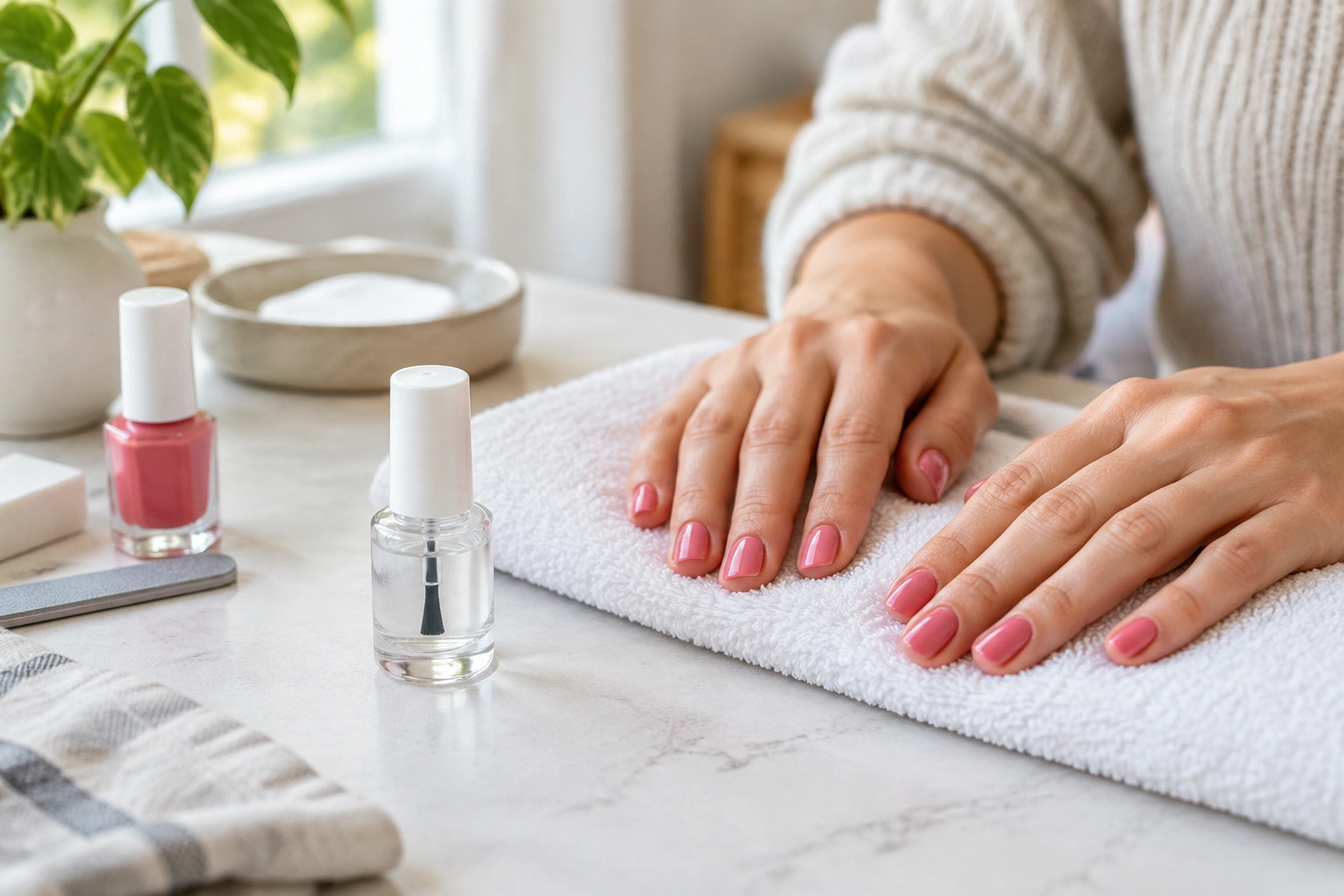
Here is the practical comparison most beginners want.
| Method | Speed | Ease of Use | Smudge Protection | Best For |
|---|---|---|---|---|
| Drying drops | Moderate help with tackiness | Easy once you know the timing | Good for light everyday protection | Beginners who want a simple finishing step |
| Quick-dry top coat | Often stronger overall effect | Very easy | Usually better than drops alone | People who want a more noticeable speed boost |
| Drying spray | Can be convenient | Easy, but can be messier | Varies by formula | Fast application with less precision |
| Air-drying | Slowest | Simplest | Lowest protection early on | People with time to spare |
| Fan drying | Can help the surface feel better | Easy if you already have a fan | Limited for deeper layers | A small boost without product |
| Cold-water method | Mixed results | Awkward for many beginners | Not always reliable | People who are willing to experiment |
Drying drops vs quick-dry top coat

A quick-dry top coat often gives a more noticeable effect because it is designed to seal the manicure and help the top layers set. Drying drops can still be useful, especially if you already own a favorite top coat and want a little extra help.
Drying drops vs drying spray
Sprays can be convenient, but they may feel messier and can be harder to control. Drops are usually more targeted, which some beginners find easier.
Drying drops vs air-drying
Air-drying costs nothing, but it also asks you to wait and be careful longer. Drops can be worth it if you want to shorten that awkward window when the nails feel almost dry but not quite safe.
Drying drops vs fan or cold-water methods
A fan may help polish feel less sticky on the surface. Cold water is popular online, but it is not a guaranteed fix and can be awkward to use well. Drying drops are usually the more controlled option.
Common Mistakes That Make Them Seem Ineffective
Sometimes drying drops are blamed when the real problem is technique.
The usual culprits
-
Polish was applied too thickly
This is the biggest one. No drying aid can fully offset a heavy coat. -
The drops were used too early
If the polish was still pooling or moving, the finish may have been disturbed. -
Too much product was used
More is not always better. Overuse can leave the nail coated or slippery. -
The manicure was touched too soon anyway
Drying drops reduce tackiness, but they do not make polish dent-proof instantly. -
The formula and the product did not match well
Some combinations simply work better than others.
If your manicure still feels soft, check the basics first: thin coats, enough drying time between layers, and correct top coat use. A lot of “the product didn’t work” problems are really application problems.
Safety, Ingredients, and Possible Downsides
Drying drops are cosmetic products, so the safest approach is to treat them like any other nail product: follow the label and avoid using them on irritated or broken skin.
Possible downsides can include:
– a slippery or oily feeling around the nails
– a residue that can make the surface look slightly shiny, greasy, or uneven
– irritation for sensitive skin
– a strong smell if the formula contains solvents
– compatibility issues with some top coats or polish systems
Oil-based drops can be especially likely to leave a residue or alter the finish if too much is used. In some cases, that can make the manicure feel slick for longer or interfere with how well another layer bonds. Solvent-based drops may dry down more cleanly, but they can be more noticeable in smell and need better ventilation.
If you have sensitive skin, read the ingredient list and patch-test carefully when appropriate.
For general cosmetic safety guidance, the FDA’s cosmetics information is a useful place to start, and CDC hand hygiene guidance can help if you are trying to keep your nail routine clean and practical at home.
One more thing: drying drops should not be used as a substitute for proper product compatibility. If the bottle says it is not for certain formulas, respect that.
What to Do If Your Polish Is Still Tacky After Using Drying Drops
If the polish still feels sticky, do not keep adding more drops right away. Start with the basics:
- Wait a little longer if the polish was applied recently.
- Check whether the coat was too thick.
- Avoid pressing, rubbing, or stacking items on the nails.
- Use a compatible quick-dry top coat next time if the formula allows it.
- Review the product directions in case the drops need to be applied at a specific stage.
If the manicure is still soft after a reasonable wait, the issue is usually the polish layer itself rather than the drops. In that case, it is better to troubleshoot the application than to keep layering on more product.
Should You Buy Nail Polish Drying Drops?
If you paint your nails at home and mostly want to reduce tackiness, drying drops can be a smart, low-effort add-on. They are especially appealing if you like simple routines and do not want to change your whole manicure process.
They are probably worth considering if:
– you often smudge polish after painting
– you usually use regular polish
– you want a small convenience boost
– you already apply thin coats and just want a little help
They may not be the best first purchase if:
– you want the strongest possible speed-up
– your polish routine is already messy or too thick
– you mainly use gel polish
– you expect them to replace good application habits
If you want the most noticeable improvement, a quick-dry top coat may be the better main product, with drying drops as an extra step. If you want something simple and beginner-friendly, drying drops can still be a useful choice.
A practical way to decide is this: if your biggest frustration is “my nails feel sticky forever,” drying drops may be enough. If your biggest frustration is “my manicure keeps getting dented for ages,” you may need a stronger quick-dry system, thinner coats, or both.
When to See a Nail Technician or Dermatologist
If your polish seems to never dry properly even when you use thin coats and follow the directions, a nail technician can help you troubleshoot your application technique and product choices.
See a dermatologist if you notice:
– redness or itching after using a product
– repeated skin irritation around the nails
– peeling, burning, or swelling
– a reaction that seems to get worse with repeated use
That is less about drying performance and more about making sure the product is suitable for your skin.
Bottom Line
So, do nail polish drying drops work? Often, yes — but in a practical, limited way. They are best thought of as a helper for reducing tackiness and lowering the risk of small smudges, not as a shortcut to instant cure.
If you use regular polish, paint in thin coats, and want a simpler way to get through the first few minutes after a manicure, they may be worth trying. If you want the biggest speed boost possible, a quick-dry top coat may do more of the heavy lifting.

