
How Much to Tip at a Nail Salon: A Practical Guide for Manicures, Pedicures, and More

If you want the shortest answer, use this: tip 15% to 20% of the service total before tax at a nail salon, then round the final amount to a clean number if needed. If the service was solid and you’re happy, 20% is the easiest standard; if it was decent but not exceptional, 15% to 18% is a reasonable range.
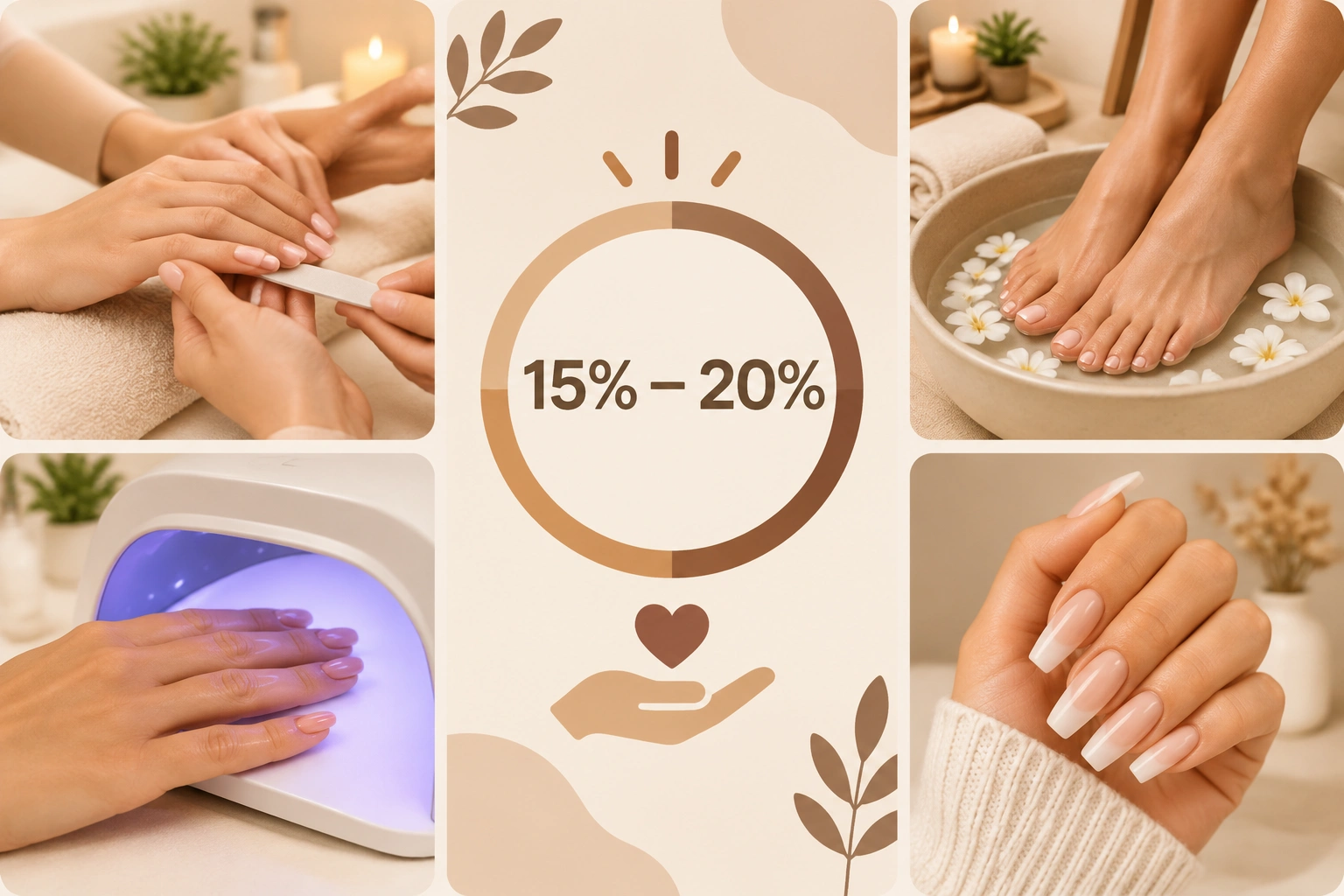
That rule works for most manicures, pedicures, gel services, acrylics, dip powder, and nail art appointments. It also keeps things simple when you’re standing at checkout and don’t want to do complicated math.
A helpful way to think about it: 15% is the lower end of customary tipping, 18% is a comfortable middle ground, and 20% is the “thank you, that was great” amount. Local salon norms can vary, though, so if a salon has its own tipping policy or the service setup is unusual, follow the salon’s guidance first. NerdWallet and StyleSeat both reflect that common practice.
The standard nail salon tipping rule
In most salons, tipping is customary rather than legally required. That matters because it gives you room to adjust based on the actual experience, but it also means you should plan to tip unless the salon’s policy is different.
Here’s the practical rule I teach clients:
- 15%: acceptable for a straightforward service when you’re content but not wowed
- 18%: a strong middle choice if the service was good and you want to be fair
- 20%: the best default for excellent service or especially careful work
If you’re unsure, 18% is the safest “in-between” number. It feels generous without pushing you into an awkward over-tip if the appointment was routine.
For a simple benchmark, DaySmart Salon says 20% is standard if you are 100% happy. That lines up with the broader idea that many clients use 15% to 20% as their tipping range. DaySmart Salon / Erica’s ATA
When 15%, 18%, or 20% makes the most sense
Use this quick decision framework:
- Choose 15% when the service was fine, but basic
- Choose 18% when the technician was careful, timely, and pleasant
- Choose 20% when the work was detailed, efficient, or exceeded expectations
A salon visit can be technically correct and still feel average. In those cases, 15% to 18% is perfectly reasonable. If your technician fixed a shape issue, took extra time on cleanup, or handled a detailed finish well, 20% better reflects the effort.
How much to tip for specific nail services
Different services take different amounts of skill, time, and attention, so the tip should scale with the appointment.
Manicures
For a basic manicure, the usual 15% to 20% range still applies. If the service was quick and straightforward, 15% is fine. If the tech was especially careful with shaping, cuticle work, or polish application, 18% to 20% is more appropriate.
Example: If your basic manicure costs $30, a 15% tip is $4.50, 18% is $5.40, and 20% is $6.
Pedicures
Pedicures often take more time than a basic manicure, so many clients lean toward the higher end of the range. A standard pedicure that feels thorough and comfortable is often tipped at 18% to 20%.
Example: If your pedicure costs $45, a 15% tip is $6.75, 18% is $8.10, and 20% is $9.
Gel nails
Gel services usually involve more prep and precision than a basic polish service, so they often deserve a tip at the upper end of the customary range. If the appointment was detailed, time-consuming, or involved careful shaping and finishing, 20% is a solid default.
Example: If a gel manicure costs $70, a 20% tip is $14. At 18%, it would be $12.60.
Acrylics and dip powder
Acrylic and dip services can take more skill and more time than a standard manicure, especially if you’re getting a full set, fill-in, or detailed shaping. For these appointments, 18% to 20% is usually the most natural range.
Example: If an acrylic or dip service costs $90, a 20% tip is $18. At 18%, it would be $16.20.
Nail art, removals, and repairs
For nail art, removals, or repair work, tip based on the time and precision involved, not just the final polish result. A small fix may not need a huge tip, but detailed art or a complex correction usually calls for more than a bare-minimum amount.
If multiple services happen in one visit, treat each one as part of the total appointment and tip accordingly. If one person did the base service and another handled art or finishing, it’s reasonable to reflect that in the tip split.
Quick tip chart for common nail service prices
Use this table when you want an instant estimate.
| Service total | 15% tip | 18% tip | 20% tip |
|---|---|---|---|
| $30 | $4.50 | $5.40 | $6.00 |
| $45 | $6.75 | $8.10 | $9.00 |
| $60 | $9.00 | $10.80 | $12.00 |
| $70 | $10.50 | $12.60 | $14.00 |
| $90 | $13.50 | $16.20 | $18.00 |
A few realistic examples:
- A $30 basic manicure: $4.50 at 15%, $5.40 at 18%, or $6 at 20%
- A $45 pedicure: $6.75 to $9 depending on service quality
- A $70 gel manicure: $10.50 to $14
- A $90 acrylic full set with nail art: $13.50 to $18, or more if the design was especially detailed
If the math feels annoying at the counter, round to a clean number. For example, on a $45 service, $8 is a neat middle-ground tip and lands close to 18%.
Should you tip on the pre-tax, post-tax, or discounted total?
The clearest rule is to tip on the pre-tax service total. That is the standard default because you’re tipping for the service, not the tax.
Then, if the amount comes out to an awkward number, round the final tip to the nearest clean dollar amount. For example, if 18% comes to $8.10, leaving $8 is a normal rounded tip.
What to do with coupons, discounts, and package deals
If you used a coupon or got a package price, the most practical approach is to tip on the amount you actually paid for the service, unless the salon specifically tells you to tip on the original menu price. For larger discounts, some clients choose to tip closer to the original value if the appointment took extra time or effort, but the discounted total is the simpler default.
Here’s the simplest way to decide:
- Small promotional discount: tip on the discounted amount, then round up if you want to be generous
- Large discount or package deal: tip on the amount you paid unless salon policy says otherwise
- Gift certificate: tip on the service value you received, not on the certificate itself
The key is not to let a discount make the technician’s effort feel “free.” The service still took time.
How to adjust the tip for service quality
Tipping at a nail salon is one of the few places where the quality of the work should visibly affect the amount.
If the service was exceptional
Go to 20% or slightly above if the appointment felt especially careful, efficient, or polished. Good signs include:
- clean shaping
- careful cuticle work
- even polish application
- thoughtful attention to detail
- a calm, professional experience
If the service was average
Stay in the 15% to 18% range. That’s the right zone when the service was fine, but nothing stood out.
If the service was poor
Use this simple decision tree:
- Acceptable but not great: tip 15% or a little less if the work was just average
- Fixable issue: ask for a correction first, then tip based on the final result
- Seriously bad service: if the service was rushed, incomplete, unsafe, or left you with a result that should not have been delivered that way, speak to the salon manager or owner before deciding whether to lower or skip the tip
A few concrete examples:
- If the polish is a little uneven but the technician fixes it quickly, a normal tip still makes sense.
- If a nail is filed crooked and they correct it before you leave, tip based on the corrected result.
- If the service was rushed, painful, or clearly unfinished, it’s reasonable to raise the issue first instead of deciding the tip amount in silence.
Who to tip: technician, salon owner, or multiple workers?
This is where etiquette gets tricky.
Independent salon owner vs chain salon employee
If you’re in an independent studio and the owner is also the technician, tipping is still common when the owner provides the service, though local norms can vary. If the owner is both running the business and doing your nails, a tip is usually appreciated when the work is good.
If you’re at a chain salon or standard salon and the technician is an employee, tipping is the normal expectation.
When more than one person helps
If one person does the manicure and another does the polish, design, prep, or finishing work, split the tip in a way that reflects who did what. You can:
- give a separate tip to each person
- ask the front desk how they prefer tips to be handled
- leave one combined tip and mention who should receive it
A simple rule is to tip each person who directly worked on your nails, especially if an assistant did prep or a second artist handled the design. If the salon pools tips, follow their system. If it does not, separate tips are the clearest approach.
Cash tip vs card tip
Cash is often preferred because it is immediate and simple. StyleSeat notes that tipping 20% is highly encouraged, and many clients find cash the most straightforward way to make sure the technician receives the full amount quickly. StyleSeat
Card tipping is still perfectly acceptable when cash isn’t practical. If you’re paying by card, adding the tip at checkout is better than skipping it because you don’t have bills.
Practical trade-off
- Cash tip: faster for the technician, easy to hand directly, but requires planning
- Card tip: convenient and tidy, but less flexible if you want to split tips between workers
NerdWallet’s practical advice is worth following here: have cash ready in advance so you’re not hunting for an ATM at the last second. NerdWallet
Common nail salon tipping mistakes to avoid
A few errors come up again and again:
- Tipping only a flat $2 or $3 on a detailed service: that can be too low for longer appointments
- Forgetting add-ons: nail art, repairs, removals, and extra detail work still count
- Skipping the tip because of a coupon: discounts lower the bill, not the effort
- Ignoring multiple technicians: if more than one person helped, one tip may not be enough
- Assuming the owner never gets tipped: check the salon’s norms instead of guessing
- Using the after-tax total without thinking: not wrong, but the cleaner default is pre-tax
One more practical point: if you’re booking a service through a chain, a private studio, or an independent technician, the checkout setup may differ. If you want a smoother visit, it helps to understand the service structure before you arrive. If you’re still comparing appointment types, our guide to what is a full set at a nail salon can help you judge how much time and work a service really involves. For salon safety and cleanliness questions, see how to find a safe nail salon.
Simple rule you can use every time
If you want one dependable formula, use this:
Tip 20% for great service, 18% for good service, and 15% for acceptable service.
Then adjust for complexity:
– more detailed work: lean higher
– clear problems: lean lower
– multiple helpers: split the tip
– coupon or discount: tip on the amount you paid unless salon policy says otherwise
That approach is simple, fair, and close to what most clients already do.
When to See a Nail Technician or Dermatologist
If your concern is about the service itself, the shape of the nail, lifting, product removal, or how to maintain your manicure or pedicure, a licensed nail technician is the right first stop. If you notice ongoing nail changes, pain, or a skin issue around the nail, a dermatologist is the better professional to ask.
For product prep and maintenance questions, you may also find it useful to read our guides on nail prep cleanser and nail dehydrator use, especially if you want to understand why some services last longer than others.

