
How to Ask for a Nail Design at the Salon Without the Guesswork

If you want a nail design and do not want to leave the salon saying, “That’s not quite what I meant,” the fix is simple: describe the overall look first, then add the details that matter most.
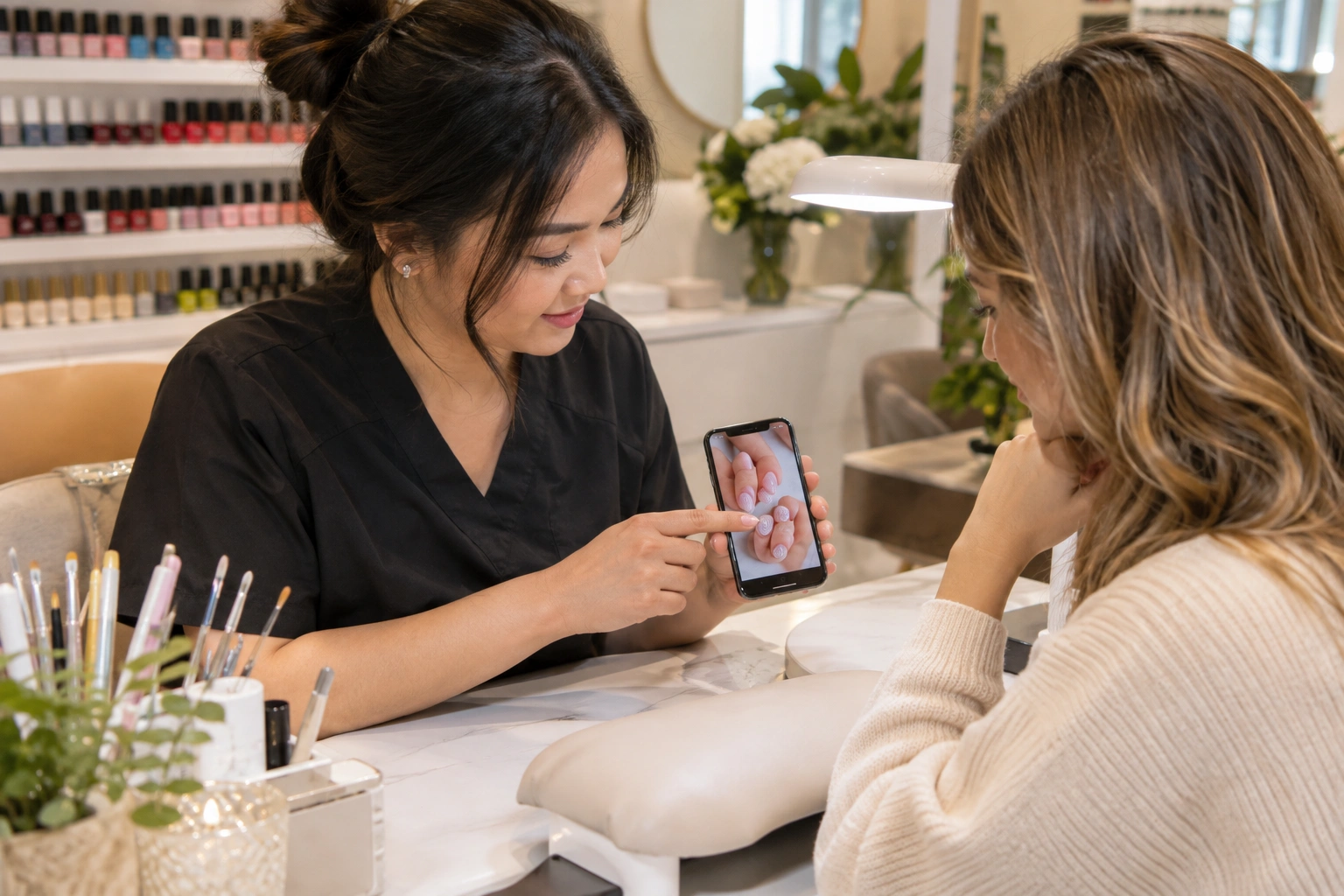
A clear request sounds like this:
“I’d like a soft, elegant look with a nude base, short almond shape, and white swirl accents. I have a photo, but I’m flexible on the exact swirl placement. Can you tell me if this fits my appointment time and price?”
That request gives the technician the style direction, the design details, and a chance to flag any time or service limits before the work starts. That is usually much better than saying, “Can you do something cute?”
If you want a custom manicure to land the way you pictured it, think of the conversation as a short consultation. The more clearly you separate style, shape, length, finish, and nail art, the easier it is for the technician to create something close to your vision.
Quick Answer: What to Say at the Nail Salon
Use this simple formula:
“I want [overall style], with [shape], [length], [base color], and [nail art/finish]. I brought a photo. Can you do this on my nails, and if not, what would you suggest instead?”
For example:
- “I want a clean, minimal look with short square nails, milky pink polish, and a glossy finish.”
- “I want a bold set with medium almond nails, black French tips, and one chrome accent nail on each hand.”
- “I want this photo, but shorter and simpler if that helps with time.”
That last part matters. A technician may be able to adapt a design depending on the time, tools, and service type. If you give them room to suggest a practical version, you are more likely to get a result you like.
Start With the Big Picture: Show the Overall Look
Before you talk about details, name the mood of the design. This gives the technician a fast read on your taste.
Helpful style words include:
- Minimal
- Elegant
- Bold
- Playful
- Seasonal
- Romantic
- Modern
- Soft and neutral
So instead of saying, “I want flowers and glitter,” try:
- “I want a soft romantic look with delicate floral accents.”
- “I want something bold and high-contrast.”
- “I want a minimal neutral set with one small accent detail.”
Why this helps: two designs can use the same colors or art but create very different effects. A technician needs the direction before the decoration. If you skip the big picture, they may build the design around the wrong style.
If You Only Have a Vague Idea, Use This Simple Framework
If you do not have a full design in mind, narrow it down in this order:
- Style — minimal, clean, glam, romantic, bold
- Color — nude, pink, white, red, black, pastel, metallic
- Shape — square, almond, round, coffin, short, long
- Length — short, medium, long, natural-looking, extension length
- Finish — glossy, matte, chrome, shimmer, sheer
- Art — plain, French tips, swirls, flowers, gems, accent nails
Example: “I want a clean style, nude color, short almond shape, glossy finish, and just one or two accent nails.”
Bring a Reference Photo and Point Out Exactly What You Want
A reference photo is one of the best tools you can bring. In fact, some salon guides specifically encourage showing a photo and asking whether the technician can do that design, and if you do not have one, asking for sample designs instead. The key is not just bringing the image — it is using it well. One salon guide also advises being transparent when asking about a design, which is good advice for both sides of the chair: you get better results when the request is clear and honest. See the salon guidance from Gloss n Blink Nails.
Here is how to use a photo effectively:
- Show the image first.
- Point to the exact parts you want copied.
- Circle or name the parts you want changed.
- Say what is optional.
For example:
- “I want the color and shape from this photo, but not the extra gems.”
- “I like the swirl placement here, but I want a softer nude base.”
- “This is the vibe I want, but I’m happy to simplify it.”
If the photo is only partly useful, say that directly:
- “I like the color, but not the shape.”
- “I want the art, but not that much detail.”
- “This photo is just for the general feel.”
That distinction matters. A photo shows the final look, but not always the work behind it. A design that looks simple in a picture may require more time, more skill, or a different service type than you expected.
If you have only one image, try to explain what specifically drew you to it: the color, the shape, the finish, or the art. If you bring two or three images, make sure they do not conflict. One photo for shape and another for art is helpful; three photos with different lengths, colors, and finishes can create confusion.
When a Verbal Description Is Enough, and When a Photo Is Better
A verbal description can be enough if the design is simple:
- one solid color
- a basic French tip
- a short neutral manicure
- a small accent detail
A photo is strongly recommended if the design includes:
- detailed nail art
- multiple colors
- a specific shape or length
- gems, chrome, or ombré
- a look you want copied closely
Break the Design Into Salon Language
When you know how to name the parts of the design, the conversation gets much easier.
Color
Use plain color words first:
- nude
- milky pink
- soft white
- deep red
- black
- pastel blue
- sheer pink
If needed, add a finish:
- glossy nude
- matte black
- chrome silver
- pearl shimmer
Shape
Common shape words include:
- round
- square
- squoval
- almond
- coffin
- stiletto
If you are unsure, say what you want the nails to look like in everyday language:
- “I want them soft and slightly tapered.”
- “I want a neat square edge.”
- “I want a feminine almond look, not too pointy.”
Length
Length matters because it affects both the look and how much room there is for nail art.
You can say:
- short
- medium
- long
- just past the fingertip
- longer than my natural nails
If you do not know the exact term, point to a photo or compare the length to your own nails. A technician can usually work from that.
Finish
Finish changes the whole mood of the set:
- Glossy feels polished and classic.
- Matte feels softer and more modern.
- Chrome adds a reflective, metallic look.
- Glitter adds sparkle and texture.
A French tip, matte finish, and chrome accent can all look very different even on the same nail shape. Be specific so the technician knows whether the finish is the main feature or just a small detail.
Nail Art
If you want art, name the type:
- French tips
- swirls
- flowers
- stars
- hearts
- glitter accents
- line art
- ombré
- gems
- accent nails
If you are not sure how to describe it, say what it looks like in simple words:
- “A thin white line design.”
- “Tiny floral details.”
- “One sparkly nail on each hand.”
- “A soft gradient from pink to white.”
Decide Whether You Want the Design on Every Nail or Just Accent Nails
This is one of the easiest ways to control cost, time, and visual impact.
Full-set art
A full-set design means the art appears on most or all nails. This creates a stronger, more dramatic look, but it usually takes more time and can be harder to maintain if the design is detailed.
Accent nails
Accent nails keep the design to one, two, or a few nails per hand. This is a smart choice if you want the manicure to feel special without becoming too busy.
A practical example:
- Full-set: all nails have a swirl or floral pattern
- Accent version: eight plain nails, two decorated nails
If you are unsure, ask for the design on just one or two accent nails first. That gives you a cleaner look and leaves more room for the technician to keep the service efficient.
Ask Whether the Design Works on Natural Nails, Gel, Acrylic, or Dip
Some designs work better on certain nail systems because of length, structure, and how much surface area the technician has to work with. If you want a longer shape or detailed art, a stronger service may give more support. If you want a simple look, natural nails or gel polish may be enough.
Here is a more specific way to think about it:
| Choice | Best when you want | What it can affect |
|---|---|---|
| Natural nails | A simple, low-maintenance look | Less room for long shapes, heavy embellishment, or detailed art |
| Gel polish | A polished color finish and light nail art | Good for clean designs, but not always ideal for major length or structure changes |
| Acrylic | More structure for longer shapes or more dramatic designs | Often better if you want added length, stronger support, or more room for detailed art |
| Dip powder | A sturdier color service with a clean finish | Can work well for solid color and some simple designs, but options for complex art vary by salon |
If you are not sure what service fits your idea, ask directly:
- “Can this design be done on my natural nails?”
- “Would this look work better with gel, acrylic, or dip?”
- “Do I need extensions for this shape?”
- “Will this service support the length I want?”
That question saves time. It also helps you avoid asking for a design that does not suit the nail system you chose. For a closer look at service types and what they are commonly used for, you may also want to read NailPrime’s guides on what to ask for at the nail salon and what to ask for at the nail salon for acrylics.
If you are considering stronger systems for a design that needs more support, some salons may suggest BIAB or acrylic. One salon guide notes that with more durable nail designs like BIAB and acrylics, you can return for infills after a few weeks of wear, and that infills fill the gap between the natural nail and the artificial nail rather than removing the full set. It also notes that the original design can be filed off and repainted if you want a change. See the salon guidance from Restless.
Confirm Price, Time, and Any Extra Charges Before the Technician Starts
This is the part many people skip, then regret later.
Ask before the service begins:
- “Does this design cost extra?”
- “Will this take longer than a regular full set?”
- “Is there an added charge for gems, chrome, or hand-painted art?”
- “If we simplify it, will that change the price?”
You do not need to sound formal. You just need clarity.
A good rule: if your design includes multiple colors, detailed hand-painted art, embellishments, or shape changes, ask about the time and price before the first coat goes on. That is much easier than negotiating after the work is halfway done.
If the salon cannot do the exact look within your appointment window, ask what the closest version would be. A technician may be able to suggest a simpler version that still fits the appointment.
For general consumer guidance on salons and product safety, it can also help to review sources like the FDA’s cosmetics information and the CDC’s general health guidance, especially if you have sensitivities or want to understand basic salon hygiene considerations.
How to Communicate Changes Politely If the Design Needs to Be Adjusted
Sometimes the technician will suggest a change because of your nail length, the current service type, or the time available. That is normal. The goal is to keep the overall style while adjusting the details.
Helpful phrases:
- “Could we simplify the art a little and keep the same color palette?”
- “I’m flexible on the tiny details, but I want the overall look to stay the same.”
- “Can we make the shape slightly shorter?”
- “If the gems take too long, I’d rather skip them and keep the clean design.”
- “Could you show me the closest version you’d recommend?”
This keeps the conversation collaborative instead of corrective. You are not asking the technician to guess; you are giving them permission to solve the problem with you.
If you want to change your mind during the appointment, say it early. The earlier you speak up, the easier it is to adjust the design without redoing work.
What to Do If the Technician Does Not Understand Your Reference Photo
This happens more often than people think, especially with language barriers or very detailed inspiration images.
Try this sequence:
- Point to the exact section of the photo.
- Say what you want in short phrases.
- Use simple yes/no questions.
- Ask the technician to repeat the plan back before they begin.
- Ask them to show you a rough version if needed.
For example:
- “This color here.”
- “This shape, but shorter.”
- “These nails plain, only this one with art.”
- “So we’re doing nude base, short almond, and white swirls, right?”
- “Yes or no: can you do this exact shape?”
- “Can you repeat the plan back to me before you start?”
If words are getting in the way, use the image itself. Circle the detail you want. Cross out the part you do not want. Show one detail at a time instead of trying to explain the whole photo at once. A simple visual cue can be more effective than a long explanation.
If the technician still seems unsure, ask for the closest alternative they can do well. A clean, well-executed simplified design usually looks better than an overcomplicated one that nobody fully understood.
Common Mistakes to Avoid When Asking for a Nail Design
These are the communication errors that cause the most disappointment:
- Being too vague. “Something cute” leaves too much room for interpretation.
- Assuming one photo is enough. If the image is complicated, explain what matters most.
- Forgetting to mention shape or length. The design may be right, but the overall look may feel wrong.
- Not asking about extra charges. Gems, art, and special finishes may change the service.
- Choosing a design that does not fit the appointment time. A detailed look may need more time than you booked.
- Expecting a perfect copy. A reference image is a guide, not always a guarantee.
- Waiting until the end to request changes. Early feedback is easier to fix.
If you avoid those mistakes, you are already ahead of most first-time clients.
Simple Example Phrases You Can Use at the Salon
Use these as scripts and adjust them to your style.
If you have a clear photo
“Can you do this design for me? I like the shape and color, but I’m okay if the art is slightly simplified.”
If you only have a general idea
“I want a soft, elegant look with nude polish, short almond nails, and a glossy finish. Could you suggest a design that fits that?”
If you want a custom set
“I’d like a custom design with a few accent nails. I’m thinking white and gold details on a neutral base. What would work best with my nail length?”
If you want something budget-friendly
“I like this style, but I’d like a simpler version with fewer details. What would you recommend?”
If you are unsure about service type
“Can this design be done on my natural nails, or would gel, acrylic, or dip work better?”
If you want to confirm before they begin
“Just to confirm, we’re doing short almond nails, a nude base, and chrome accents on two nails, right?”
How to Turn Vague Inspiration Into Salon Language
Here are a few common examples:
- “Clean girl” nails: “I want a clean, minimal look with a sheer pink or nude base, short shape, and glossy finish.”
- Birthday nails: “I want something fun and a little glam, maybe with sparkle, gems, or chrome accents, but not too busy.”
- Wedding nails: “I want a soft, elegant look with a neutral base, subtle shine, and delicate detail.”
- Vacation nails: “I want a bright or playful set with simple art that still works for everyday wear.”
When to See a Nail Technician or Dermatologist
If your nails are very weak, painful, or visibly changing in a way that concerns you, pause the design conversation and get professional advice first. A technician can help with service options, but a dermatologist is the right person for medical concerns. If you have sensitivities or known product reactions, mention them before the appointment so the salon can tell you whether they can accommodate your needs.
Final Takeaway
The easiest way to ask for a nail design is to lead with the style, show a photo, name the details, and confirm the practical limits before the service starts. That gives the technician a clear target and gives you a much better chance of leaving with nails that match your idea.
If you remember only one thing, make it this: describe the look, not just the picture. That is where the clarity comes from.

